Intuition: Unconscious Inference, Bodily Signals or Something More?
Intuition can be compressed expertise, a bodily signal, or a rapid bias. When can it be trusted, and what do we know about claims that it detects information beyond ordinary senses?

Sometimes we know an answer before we can explain why. An experienced physician looks at an image and senses that something is wrong. A firefighter leaves a room seconds before a dangerous event without immediately being able to list all the cues that triggered the alarm. In a conversation with a stranger, trust or unease can arise almost instantly. We usually call such moments intuition. [1][2]
Yet the same word covers very different processes. Sometimes it is rapid pattern recognition learned over years of experience. Sometimes it is a bodily signal influencing a decision before we consciously understand it. Sometimes it is a heuristic that is fast and confident but wrong. In its most controversial form, intuition is taken to mean knowledge of something that a person supposedly could not have acquired through ordinary sensation, memory or inference.
The real question is therefore not whether intuition “exists.” Fast, partly nonconscious judgment unquestionably exists. The question is when it carries useful information, where its signal comes from, and when we mistake a feeling of certainty for evidence of truth.
What Do We Actually Mean by Intuition?
An intuitive judgment is typically fast, appears without conscious step-by-step reasoning and often arrives as a feeling that something is simply “right” or “off.” A person may be able to give an answer without being able to reconstruct all of the information that produced it. [1][3]
That does not mean the answer has no cause. Much brain processing occurs outside direct conscious access. A system can detect regularities, similarities, deviations and likely consequences before they are translated into words.
Matthew Lieberman linked social intuition to implicit learning: through repeated experience, we acquire statistical regularities in an environment without necessarily knowing the explicit rules by which we are judging. [3]
Intuition can therefore be understood as the output of a complex process whose intermediate steps are not consciously available.
Implicit Learning: Knowing More Than We Can Say
Artificial grammar learning is a classic method for studying implicit learning. Participants see symbol strings generated according to hidden rules without being told those rules. Later, they can often classify new strings as “grammatical” or “ungrammatical” above chance even though they cannot clearly articulate the rules. [4]
After decades of research, there is still debate over how much such knowledge is fully unconscious and how much consists of consciously available fragments, similarities and associations. But the central finding is robust: learning can alter judgment before a person can explicitly formulate everything that has been learned. [4]
This provides an important basis for intuition. Someone who has encountered a certain kind of problem thousands of times may recognize the configuration as familiar before consciously listing its components.
The feeling “I have seen this before” can be compressed learning history.
The Firefighter Who Cannot Immediately Explain Why
Gary Klein’s research on real-world decision making under time pressure led to the recognition-primed decision model. Experienced decision makers often do not generate a list of alternatives and compare them. They recognize a situation as belonging to a familiar pattern, quickly mentally simulate the first plausible action, and act if it appears workable. [2]
Famous cases from his studies of fireground commanders suggest that an alarm can arise as a sense that the situation is abnormal before the person consciously identifies the individual cues. Later analysis may reveal unusual heat, sound, fire spread or a mismatch between the visible scene and the expected behaviour of the fire. [2]
This kind of intuition is not paranormal. It is highly compressed expert pattern recognition.
When Does Expert Intuition Actually Work — and Why Experience Alone Is Not Enough?
Daniel Kahneman and Gary Klein came from research traditions often presented as opposites. Kahneman emphasized systematic errors in rapid judgment; Klein studied successful expert decisions in natural settings. When they jointly examined intuition, however, they reached a surprisingly compatible conclusion. [1]
Reliable expert intuition is most likely to develop when at least two conditions are present:
the environment contains sufficiently stable, recurring regularities that there is something learnable;
the person has many opportunities to learn those regularities through sufficiently rapid and accurate feedback. [1]
Chess is such an environment: positions contain recurring structures and moves produce clear consequences. Experienced radiologists can similarly develop very rapid recognition of some abnormalities when they encounter enough cases and receive adequate diagnostic feedback. [5]
By contrast, years of experience in a poorly predictable environment may produce mainly confidence rather than expertise.
This is one of the most important lessons from intuition research. Someone can perform a task for twenty years and remain poorly calibrated if feedback is weak.
When outcomes are delayed, ambiguous or dependent on many hidden factors, false patterns are easy to learn. Each prediction that happens to come true may be remembered as confirmation, while failed predictions are easier to rationalize or forget.
Kahneman and Klein therefore explicitly warn that the subjective experience of confidence is not a reliable indicator of intuitive accuracy. [1]
That boundary matters. Genuine expertise can feel just as certain as a bias.
Heuristics: Speed Is Useful, but It Has a Cost
Tversky and Kahneman showed that people often rely on fast cognitive shortcuts, or heuristics, when judging uncertainty. These can be efficient but can also produce systematic errors. [6]
With the availability heuristic, we overestimate events that are easy to recall. After a dramatic plane crash, flying may feel more dangerous even though the objective risk has not changed.
With representativeness, we judge probability by resemblance to a stereotype and neglect base rates.
With anchoring, an initial number or frame influences later estimates more than we recognize.
All of these processes may appear as immediate, compelling feelings. “It came to me intuitively” therefore does not tell us whether we are seeing expert pattern recognition or cognitive bias. [6]
First Impressions Can Sometimes Be Better Than Expected
Rapid social judgment is not always mere stereotyping. Research on thin slices of behaviour shows that brief samples of facial expression, tone of voice, movement or interaction can sometimes contain genuine predictive information. [7]
Accuracy depends heavily on what is being judged, which cues are available, the length and location of the sample, and how the criterion is defined. Some characteristics become visible quickly; others benefit from longer observation; others are judged poorly. [7]
The conclusion is therefore not “trust your first impression.” A better conclusion is that human brains can sometimes extract useful statistical signals from very small samples of behaviour, but not universally and not without bias.
A “Gut Feeling” Can Carry Real Information
Intuition is often described bodily: a tightening in the stomach, pressure in the chest, altered breathing, unease or sudden relief. Such sensations are not merely poetic language.
The brain continuously receives interoceptive information from the heart, respiratory system, gut and other internal organs. These signals participate in regulation of arousal, emotion, motivation and decision making. [8][9]
In a study by Barnaby Dunn and colleagues, greater heartbeat-perception accuracy was associated with a stronger relationship between bodily responses and subjective arousal. During intuitive decision making, however, better interoceptive ability could help or hinder performance depending on whether the bodily signals themselves pointed toward advantageous or disadvantageous choices. [8]
This is an important correction to the slogan “the body always knows.” The body carries information. Not every bodily signal is an accurate prediction of the world.
Somatic Markers: The Body as a Shortcut in Decision Making
Antonio Damasio developed the somatic marker hypothesis in the 1990s. The idea is that past experience associates certain situations with bodily and emotional responses. When similar situations recur, those signals may rapidly narrow the field of options before every consequence is consciously analysed. [10]
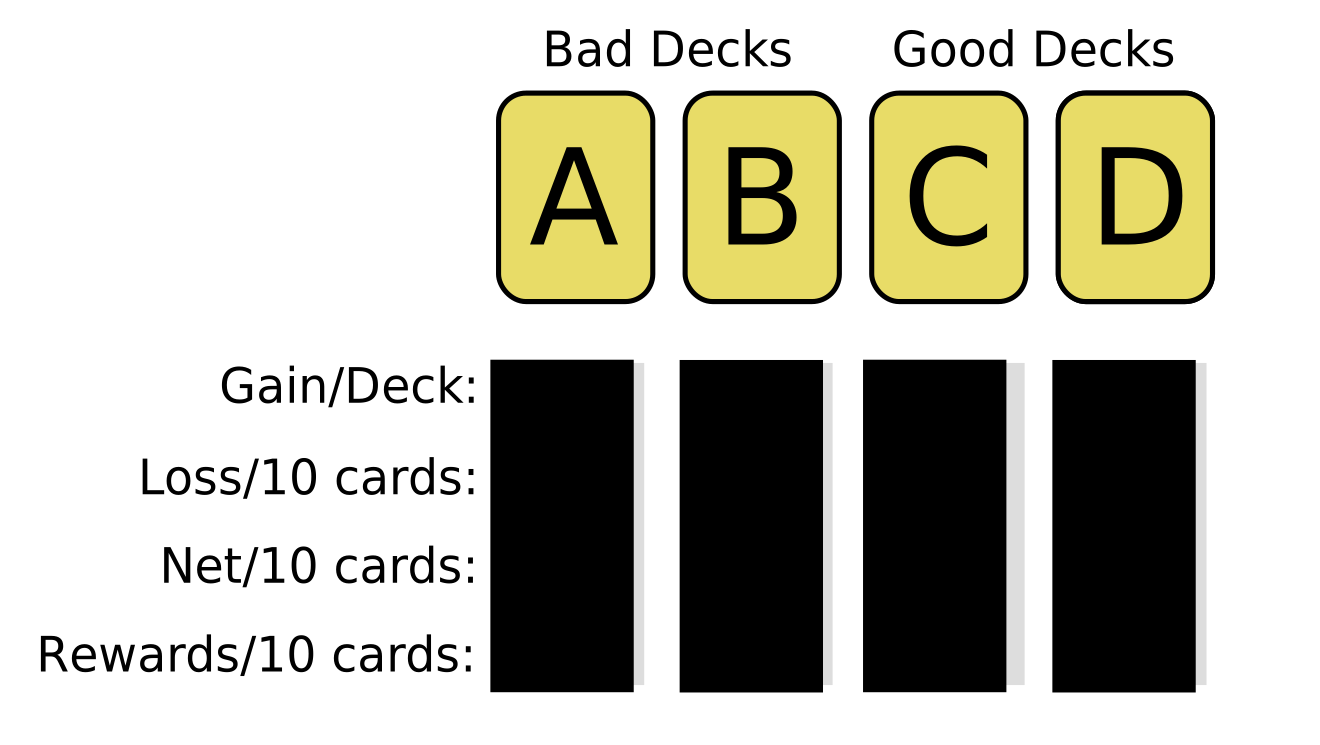
The classic Iowa Gambling Task produced an influential finding. Healthy participants began generating anticipatory skin-conductance responses before risky choices and gradually shifted toward advantageous decks before they could fully verbalize the strategy. Patients with ventromedial prefrontal damage did not develop the same anticipatory responses and continued to make poorer choices. [11]
This result strongly shaped the idea that “the body knows before consciousness.”
But there is an important second half to the story.

The Iowa Gambling Task Does Not Show That the Body Mysteriously Knows the Future
Later work suggested that participants’ conscious knowledge had probably been underestimated in the original interpretation. Using more sensitive questioning, Maia and McClelland found that people often possessed substantially more explicit knowledge of the task structure than earlier methods had detected. [12]
Critical reviews raised additional issues: bodily responses may not be the necessary cause of better choices, alternative learning mechanisms can explain parts of the data, and the task is not a pure test of one theory. [13]
This does not mean the body is irrelevant to decision making. It means that one famous experiment does not establish the simple formula “the body knows the correct answer before the brain does.”
Bodily signals are part of a brain–body decision process, not an independent oracle.
Interoception Is Also Harder to Measure Than It Once Appeared
For many years interoceptive accuracy was often measured by asking people to count their own heartbeats. We now know that performance can be influenced by prior knowledge of heart rate, expectations, counting strategies and other factors.
A 2023 systematic review of newer measures concluded that the field is still working toward reliable and valid ways of assessing the perception of internal signals. [9] A 2025 review again emphasized that interoceptive experience emerges from an interaction between bodily signals, external context, expectation and cognitive bias. [14]
Thus, saying “I am good at feeling my body” does not by itself demonstrate that a person objectively perceives internal physiology more accurately or predicts external events better.
Intuition Can Be an Excellent Alarm and a Poor Judge
A safe way to use intuition is often to treat it as an attention signal rather than a final verdict.
An experienced surgeon, pilot, firefighter or programmer may sense that “something is wrong.” In a familiar environment that feeling can be valuable because a recognition system has detected a mismatch before language catches up. But after the alarm, it is still useful to ask: what is different, which data support the feeling, what alternative explanation could account for it?
This matters especially when decisions have serious consequences, when situations are novel, and when judging people, where stereotypes can produce a feeling of familiarity without genuine expertise.
Intuition is often most useful as a hypothesis to be checked.
When Is It More Reasonable to Trust It?
Research on expertise suggests a practical test.
Intuition is more likely to be useful when: - we have encountered many genuinely comparable cases in the same domain; - the environment contains stable regularities; - decisions produce clear consequences; - feedback is frequent and accurate; - errors are recorded rather than rationalized; - the present situation resembles those on which the intuition was trained. [1][5]
We should be more cautious when: - events are rare or largely random; - previous predictions are not systematically tracked; - outcomes become clear only years later; - many different stories can explain the same result; - we are emotionally invested; - the feeling confirms what we already wanted to believe.
In such environments confidence may increase much faster than predictive skill.
What About the Feeling That “I Knew Something I Couldn’t Have Known”?
This brings us to the most controversial part of the subject.
A literature exists on presentiment, in which researchers measure heart rate, electrodermal activity, EEG or other physiological signals in the seconds before a randomly selected emotional or neutral stimulus. A 2012 meta-analysis reported a small but statistically significant anticipatory effect, and a 2018 update reported a similar positive result. [15][16]
It would be inaccurate simply to erase these findings from the literature. At the same time, this is an unusually difficult field because of potential effects of sequence expectation, autocorrelation in physiological signals, analytic flexibility, artifacts, randomization procedures and publication selection. A larger 2015 study using several physiological measures found no evidence for presentiment and demonstrated measurable anticipatory effects of expectation itself. [17]
The existence of a statistical effect in some meta-analyses is therefore not equivalent to confirmation that the body perceives the future.
Precognition Is Not the Same as Expert Intuition
More direct claims of precognition — consciously responding correctly to a random event that will only be selected later — have also been experimentally tested.
Following Daryl Bem’s early positive reports, the literature became highly controversial. A 2015 meta-analysis of 90 experiments reported a small overall positive effect and argued for anomalous anticipation. [18]
Especially important, however, is the large Transparent Psi project published in 2025. Three preregistered studies included 26,483 people and more than 420,000 critical trials. The first study failed to replicate Bem’s predicted effect. Researchers then found an exploratory effect in the opposite direction and successfully confirmed it in a second study, but a third and still larger study failed to replicate that effect. The authors concluded that, given the lack of stable replication and the absence of an accepted theory, a methodological or statistical anomaly was more plausible than a psi effect. [19]
This illustrates why an extraordinary claim requires more than a one-time significant result. What matters is a prespecified effect, independent replication and stability across new data.
Could There Be “Something More”?
The scientifically careful answer is not that it is logically impossible. The important question is what evidence would be required.
If intuition sometimes provides information without ordinary senses, implicit learning, bodily cues, memory or inference, this would need to be demonstrated under conditions in which those ordinary channels are rigorously excluded.
Strong evidence would require: - a preregistered hypothesis and analysis; - a genuinely random or inaccessible target; - prevention of sensory and informational leakage; - adequate sample size; - independent replication in other laboratories; - an effect that remains stable across new data and reasonable analysis choices; - ideally, a predictive model that succeeds prospectively.
At present, there is no effect stable enough to justify saying that extrasensory intuition is an established human ability. There are disputed positive findings, null findings and methodological debates. The most appropriate status is therefore an open research claim rather than an established fact. [15][16][17][19]
What Does Intuition Really Tell Us?
Intuition is remarkable without requiring a paranormal explanation.
The brain can extract statistical patterns from thousands of experiences that consciousness never puts into words. The body can contribute information about current state, risk and emotional significance. A brief glimpse can sometimes contain enough information for above-chance judgment. An expert can detect a deviation before being able to say which tiny cue triggered concern. [2][3][7][8]
The same fast systems also produce stereotypes, anchoring, illusory correlations, overconfidence and memory errors. [6]
The best boundary is therefore not “reason versus intuition.” Reason and intuition are parts of the same learning and decision system. Good intuition is often compressed experience; bad intuition can be compressed bias.
And when an unexplained feeling appears, we need not automatically dismiss it or immediately declare it access to a hidden source of information. A more scientific response is simpler: record the prediction before the outcome, define what counts as a hit, and test whether the feeling actually predicts better than chance over time.
Then intuition ceases to be only a feeling. It becomes something we can test.
Sources and further reading
- Key review of the conditions under which reliable intuitive expertise can develop and the limits of subjective confidence. Source
- Primary naturalistic decision-making framework for recognition-primed expert judgment in real settings. Source
- Review of intuition as a product of implicit learning and social-cognitive processing. Source
- Review of theories of artificial grammar learning and the status of implicit knowledge. Source
- Review of intuitive cognition in radiological decision making as an applied example of expert intuition. Source
- Classic primary source on heuristics, biases and systematic errors in rapid judgment. Source
- Review of thin-slice behavioural judgments and the limits of rapid social inference. Source
- Primary study linking interoception, bodily arousal and intuitive decision making. Source
- Systematic review of newer measures of interoceptive accuracy and their methodological limitations. Source
- Historical framework for the somatic marker hypothesis.
- Classic primary Iowa Gambling Task study of anticipatory bodily responses. Source
- Reanalysis of the Iowa Gambling Task showing more explicit participant knowledge than previously assumed. Source
- Critical review of the evidence and alternative interpretations of the somatic marker hypothesis. Source
- 2025 review revisiting methodological assumptions in interoception research. Source
- Meta-analysis of physiological anticipation before apparently unpredictable stimuli; represented as contested positive evidence. Source
- Updated presentiment meta-analysis, included with an explicit methodological boundary. Source
- Multi-measure study of expectation effects providing important null and alternative evidence. Source
- Meta-analysis of 90 anomalous anticipation experiments, represented as contested positive psi literature. Source
- Large 2025 preregistered Transparent Psi project that failed to produce a stable replicable precognition effect. Source