Heart Intelligence: The Heart, the Brain and the Boundary of Metaphor
The heart has an intrinsic nervous system, communicates bidirectionally with the brain, and its rhythm participates in bodily regulation. But cardiac neurons, HRV and the biomagnetic field are not evidence of an independent heart-mind.
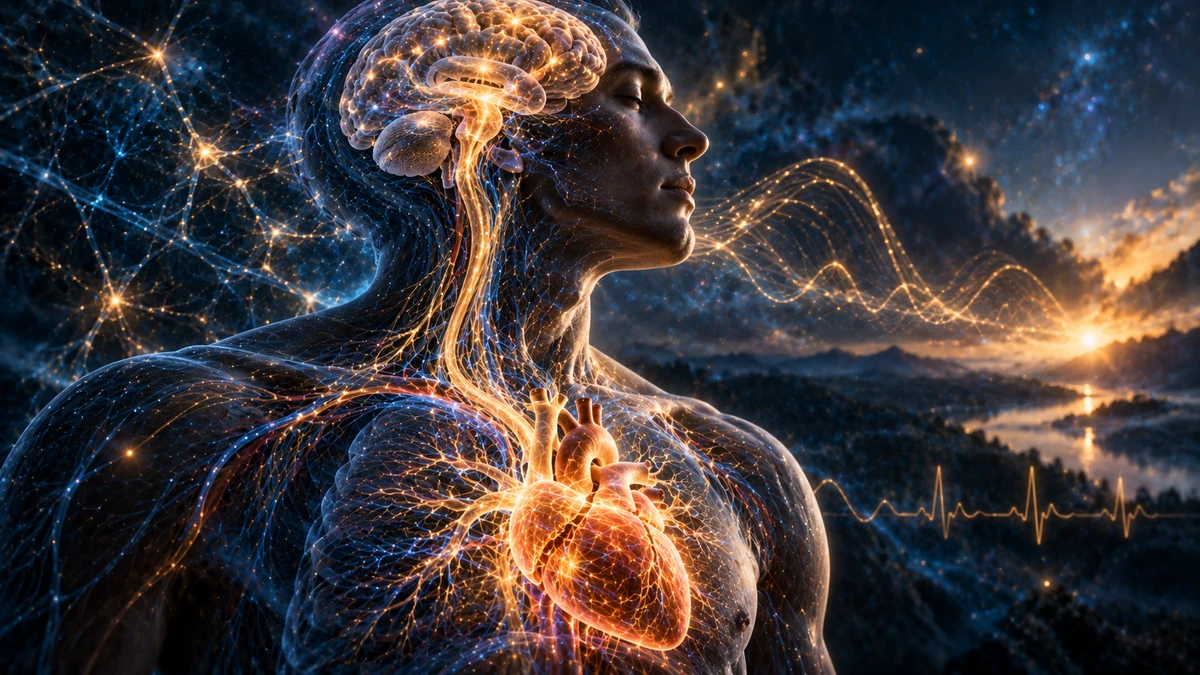
For thousands of years, the heart has meant more than a pump. Language associates it with courage, love, intuition, sincerity and inner knowing. Modern neurocardiology has added several surprising physiological facts to that old metaphor: the heart possesses an intrinsic nervous system, continuously sends information toward the brain, changes its rhythm with breathing and emotional state, and can influence perception, attention and emotional processing through bodily signals. [1][2][3][6]
Those facts have also inspired stronger claims. The heart is sometimes said to possess its own “brain,” independent intelligence, memory, intuition or knowing separate from the central nervous system. In some versions, an ordered heart rhythm creates a special state of “coherence” synchronising body and consciousness, while the heart’s electromagnetic field is said to transmit information between people. This is where a precise boundary becomes essential: the heart is genuinely a sensory, neural and regulatory organ, but that is not the same as an independent cognitive mind.
The Heart Is More Than a Muscular Pump
The heart is an electrically, mechanically, neurally and hormonally regulated organ. Its basic rhythm can arise locally in the cardiac conduction system, while rate, contraction strength, conduction and moment-to-moment adaptation are continuously modified by sympathetic and parasympathetic nerves, hormones, blood pressure, breathing, physical activity and numerous local signals. [1][2]
The classical picture in which the brain simply sends commands to the heart is therefore incomplete. Contemporary models are hierarchical and bidirectional. The central nervous system influences the heart, while receptors and neurons in the heart and blood vessels continually report pressure, stretch, chemistry, rhythm and other internal states. These signals are integrated locally, in intrathoracic ganglia, spinal cord, brainstem and higher brain regions. [1][2][3]
This is the real heart–brain axis.
The “Little Brain on the Heart”: What Is the Intrinsic Cardiac Nervous System?
Groups of neurons lie in ganglionated plexuses within and around the heart. Together they form the intrinsic cardiac nervous system, or ICNS. It contains sensory or afferent neurons, motor or efferent neurons and local circuit neurons, allowing short reflex loops and beat-to-beat regulation of specific regions of the heart. [1][2]
Because of this local organisation, the phrase “little brain on the heart” has entered the scientific literature. [1] It is a useful image but a dangerous literal description. The ICNS is complex enough to integrate local information and modify cardiac function; it is not an anatomical or functional equivalent of the brain inside the skull.
A 2026 Cell study makes this distinction especially clear. In mice, researchers identified at least two molecularly distinct intrinsic cardiac neuron populations with different inputs and functions. One population was essential for parasympathetic regulation of heart rate and coronary perfusion; another helped preserve electrical stability under extreme physiological or psychological stress. [4] This is powerful evidence that the ICNS is a functionally specialised neural system. It is not evidence that the heart thinks.

Does the Heart Really Have About 40,000 Neurons?
The claim that the heart contains “40,000 neurons” is repeated so often that it can sound like an exact biological constant. There is a basis for the number, but the precision is misleading.
Anatomical studies of the human intrinsic cardiac nervous system have produced different estimates. One estimated more than 14,000 neurons, while another used counts of epicardial ganglia to estimate roughly 43,000 intrinsic neurons in adult hearts, with higher estimates in younger hearts. [5][6] Differences reflect methodology, sampling, age and which parts of the network are counted.
It is therefore reasonable to say that the human heart contains tens of thousands of intrinsic neurons, rather than that every heart contains exactly 40,000 “brain cells.”
More importantly, neuron count by itself does not determine cognitive capacity. The enteric nervous system also contains extensive neural networks, yet their existence does not establish autobiographical memory or abstract thought in the gut.
What Does It Mean to Say the ICNS Has “Memory”?
Scientific descriptions of the intrinsic cardiac nervous system sometimes use the words plasticity and memory. [1] This can be highly misleading outside their physiological context.
In neurophysiology, “memory” can mean that a neural network changes after prior activity: synapses adapt, responses become stronger or weaker, and reflex behaviour depends on the system’s previous state. Such short- or long-term adaptation is a basic property of many neural circuits.
That is not the same thing as episodic or autobiographical memory — remembering a person, song, taste, event or life experience. Those forms of memory depend on complex brain systems involving the hippocampus, cortex and other central networks. Evidence that cardiac ganglia adapt to previous activity therefore does not show that the heart stores personal memories in the way the brain does.
The Heart Talks to the Brain — and Much of the Vagus Is Sensory
Popular accounts often point out that a large proportion of signals in the vagus nerve travel from the body toward the brain. The core of that statement is correct: roughly 80% of vagal fibres are afferent or sensory, with approximately 20% efferent. [3][7]
But the vagus does not carry only cardiac information. It receives sensory input from several internal organs, including the heart, lungs and gastrointestinal tract. Cardiac information also travels through sympathetic afferent pathways and receptors in major blood vessels. [3][7]
Cardiovascular receptors detect mechanical and chemical changes. Baroreceptors, for example, detect pressure changes associated with individual heartbeats and contribute to rapid blood-pressure regulation. These inputs enter the brainstem and broader networks extending to the insula, cingulate cortex, amygdala and other areas involved in bodily state, emotion and behaviour. [7][8]
The heart therefore genuinely influences the brain. Transmission of physiological signals, however, is not transmission of thoughts.
Cardioception: How the Brain Senses the Heart
Modern neuroscience uses interoception for the sensing of internal bodily states. When the focus is specifically on cardiac and vascular information, some researchers use the term cardioception. [8]
The brain continuously tracks the timing, force and consequences of heartbeats, usually outside awareness. This contributes to an internal model of bodily state that helps regulate arousal, safety, effort and behavioural readiness.
These effects can be measured. Studies of heartbeat-evoked potentials — brain responses time-locked to heartbeats — link cardiac signal processing with body awareness, emotional feeling, self-consciousness and perceptual awareness. [9]
That is much richer than a picture of the heart as a passive pump. Yet it still describes brain processing of bodily signals, not proof that the heart independently interprets the outside world.
Can an Individual Heartbeat Affect What We Perceive and Feel?
Yes — in at least some tasks.
During systole, when the heart ejects blood, arterial baroreceptors become active. Experiments have shown that the timing of a stimulus within the cardiac cycle can alter its processing. In a well-known study, participants detected fearful faces more easily and rated them as more intense when they were shown at systole rather than diastole; amygdala responses also changed. [10]
This means that cardiovascular signals can modulate brain processing of emotional stimuli. Similar frameworks are being studied in pain, attention, memory and bodily self-awareness. [9][10]
Again, the direction of inference matters. The result is not that “the heart recognised fear.” The result is that the brain processes an external stimulus differently depending in part on the current internal bodily signal associated with the cardiac cycle.
HRV: Why a Healthy Heart Is Not a Metronome
Heart rate variability, or HRV, describes changes in the time intervals between successive normal heartbeats. A healthy resting heart does not beat at perfectly equal intervals. Beat-to-beat timing varies with breathing, vagal and sympathetic activity, baroreflexes, posture, exercise, sleep, hormones, age and many other influences. [11][12]
HRV is therefore a useful window into autonomic regulation, but it is not a single measure of “health,” “energy” or “emotional intelligence.” Different HRV metrics quantify different features and depend strongly on recording conditions.
An especially important correction concerns the older interpretation that low-frequency HRV directly represents sympathetic activity, high-frequency HRV parasympathetic activity, and the LF/HF ratio therefore measures “sympathovagal balance.” Contemporary methodological guidance warns that this is too simple: LF contains mixed physiological influences and LF/HF is not a reliable universal index of autonomic balance. [12][13]
What Is Heart “Coherence”?
During slow breathing, often near 0.1 Hz or about six breaths per minute, heart rate can develop a large, smooth, almost sinusoidal oscillation. This reflects respiratory sinus arrhythmia, vagal modulation and especially resonance between cardiac rhythm, breathing and the baroreflex. [14]
Some biofeedback systems call this pattern heart coherence. HeartMath describes it as an ordered physiological state that can be encouraged through slow breathing and positively focused emotional attention. [15]
The measurable part is real: slow breathing near an individual’s resonance frequency can increase HRV amplitude and baroreflex sensitivity and produce a highly ordered oscillatory pattern. [14] But “coherence” is not a single universally defined physiological quantity proving optimal coordination of every organ or a special state of consciousness.
A crucial methodological boundary is that a very similar HRV pattern can be produced by slow resonant breathing itself. The graph alone therefore cannot establish that gratitude, love or a special informational signal originating in the heart caused the effect.

Does HRV Biofeedback Actually Help?
Here the evidence is more positive than one might expect from the controversy surrounding broader interpretations.
A 2025 systematic review and meta-analysis including 18 studies and 1,352 participants found a medium effect of remote HRV biofeedback on reducing depressive symptoms and increasing HRV. The pooled effect on stress was not statistically significant, and results across outcomes were heterogeneous. [16] Another systematic review found remote HRV biofeedback feasible and frequently associated with improvement, but judged all included studies globally weak in methodological quality. [17]
The defensible conclusion is therefore that slow breathing and HRV biofeedback are real psychophysiological techniques with measurable effects and promising clinical usefulness, but their effects do not demonstrate independent cognitive intelligence in the heart.
A useful technique and a metaphysical explanation of that technique are different things.
The Heart Really Does Generate an Electromagnetic Field
Electrical activity in the heart produces a magnetic field. This is not an esoteric claim; it is the basis of magnetocardiography. The heart’s magnetic signal is the largest biomagnetic signal generated by the human body and can be recorded outside the chest with highly sensitive magnetometers. [18]
The signal is nevertheless extremely weak — on the order of tens to roughly a hundred picotesla — and measurements commonly require very sensitive instruments and careful rejection of environmental magnetic noise. [18]
The existence of this field does not by itself show that it encodes thoughts, emotional information or personality and transmits them directly to other people. People can show physiological synchrony during social interaction, but ordinary mechanisms are available: shared sensory input, breathing, speech, movement, attention, emotional mimicry and autonomic co-regulation. There is currently no demonstrated need for direct interpersonal transfer of thoughts through the heart’s magnetic field. [18]
Heart Transplantation and “Cellular Memory”
One of the strongest popular claims about heart intelligence comes from stories of heart-transplant recipients. Some report new tastes, emotions, dreams or a changed sense of identity and occasionally link these changes to the donor.
Such reports exist and need not be dismissed. Heart transplantation is an extraordinarily powerful biological and psychological event. Health status, immune and hormonal conditions, medication, diet, body perception, mortality awareness and identity can all change after transplantation. Psychological change is therefore expected and clinically meaningful. [19]
A 2026 scoping review specifically examining reported donor-recipient correspondences concluded that these experiences remain methodologically poorly studied and that current evidence does not support the transfer of donor memory, personality or identity through the transplanted heart. Donor-transfer hypotheses were mainly developed in secondary literature rather than empirically established. [20]
There are also newer small exploratory studies in which many recipients report personality changes. But the fact that a person changes after transplantation does not reveal whether the source was donor memory, an extraordinary life event, medication, physical recovery, expectation or psychological integration of a new organ.
Does the Heart “Know”?
The answer depends on what knowing means.
If “intelligence” means a system’s capacity to sense local change, integrate information, adapt to previous states and regulate its own behaviour, then the intrinsic cardiac nervous system has properties that can be described as intelligent in a very broad cybernetic sense. The heart is not passive.
If intelligence means conscious understanding, abstract reasoning, autobiographical memory, personality or independent intuition, current evidence does not assign those functions to the heart. They remain associated with brain systems operating in continuous interaction with the rest of the body.
The more interesting contemporary picture is therefore not “brain versus heart.” It is embodied cognition: the brain does not work in isolation. It continuously models signals from the heart, lungs, gut, hormones and immune system, and the bodily state genuinely influences feeling, perception and decision making. [8][9][10]
Where Does Physiology End and Metaphor Begin?
Several statements can now be made with high confidence.
The heart has an intrinsic nervous system. It contains sensory, local circuit and motor neurons and contributes to beat-to-beat cardiac regulation. [1][2][4]
Communication between heart and brain is bidirectional. Cardiac and vascular afferent signals influence brain networks involved in homeostasis, interoception, emotion and perception. [3][7][8][9][10]
HRV is a real and useful physiological phenomenon. Slow resonant breathing and HRV biofeedback can alter autonomic regulation and can produce beneficial effects for some outcomes. [14][16][17]
The heart produces a measurable magnetic field. The field is biologically and physically real, but its existence alone does not demonstrate transmission of thoughts, intuition or emotional information between people. [18]
The ICNS has plasticity and local “memory” in a neurophysiological sense. This does not imply that it stores autobiographical memories or personality. [1][20]
The key boundary is therefore familiar: “the heart sends information to the brain” ≠ “the heart thinks independently of the brain”; “the heart contains neurons” ≠ “the heart contains a second mind”; “cardiac rhythm influences emotion” ≠ “the heart possesses independent emotional knowledge.”
Yet the correction does not make the heart less remarkable. Contemporary neurocardiology shows that the old division between “the brain that thinks” and “the body that merely carries it” is too simple. The heart is not a hidden second brain, but it is one of the most important partners in the continuous body–brain system from which human experience emerges.
Sources and further reading
- Review of the intrinsic cardiac nervous system, its anatomy, plasticity and clinical implications. Source
- Review of the intrinsic cardiac nervous system in cardiac pacemaking and conduction. Source
- Review of cardiac vagal afferent pathways and open questions in bidirectional heart–brain communication. Source
- 2026 primary study identifying molecularly distinct intrinsic cardiac neuron populations required for cardiac stability. Source
- Classic anatomical study of the human intrinsic cardiac nervous system and its neuron counts. Source
- Anatomical study of human epicardial cardiac ganglia and estimates of their intrinsic neuron population. Source
- Review of interoceptive signals from the heart and coronary circulation. Source
- Current framework for cardioception and functional heart–brain crosstalk. Source
- Review of heartbeat-evoked cortical responses and their interpretation. Source
- Experimental study showing cardiac-cycle modulation of fear perception and amygdala response. Source
- Classic standards for measurement and interpretation of heart rate variability (HRV). Source
- Current methodological guidelines for human heart-rate and HRV studies. Source
- Critical analysis of low-frequency HRV as an index of sympathetic cardiac tone. Source
- Review of slow-paced breathing, HRV coherence and cardiorespiratory resonance. Source
- HeartMath-authored review of its coherence framework; used as claim provenance rather than independent validation. Source
- Systematic review and meta-analysis of remote HRV biofeedback for mental-health outcomes. Source
- Systematic review of portable/remote HRV biofeedback feasibility and effectiveness. Source
- Review of sixty years of biomagnetism, including magnetocardiography and the magnitude of the cardiac magnetic signal. Source
- Systematic review of the psychological experiences of adult heart-transplant recipients. Source
- 2026 review of post-transplant changes and claimed donor–recipient correspondences; donor memory/personality transfer was not established. Source