Left Brain and Right Brain: How Much Truth Is There in the Logic–Creativity Myth?
Hemispheric specialization is real, but it does not divide people into logical “left-brained” and creative “right-brained” types. Modern neuroscience shows local lateralization and broad cooperation between both hemispheres.
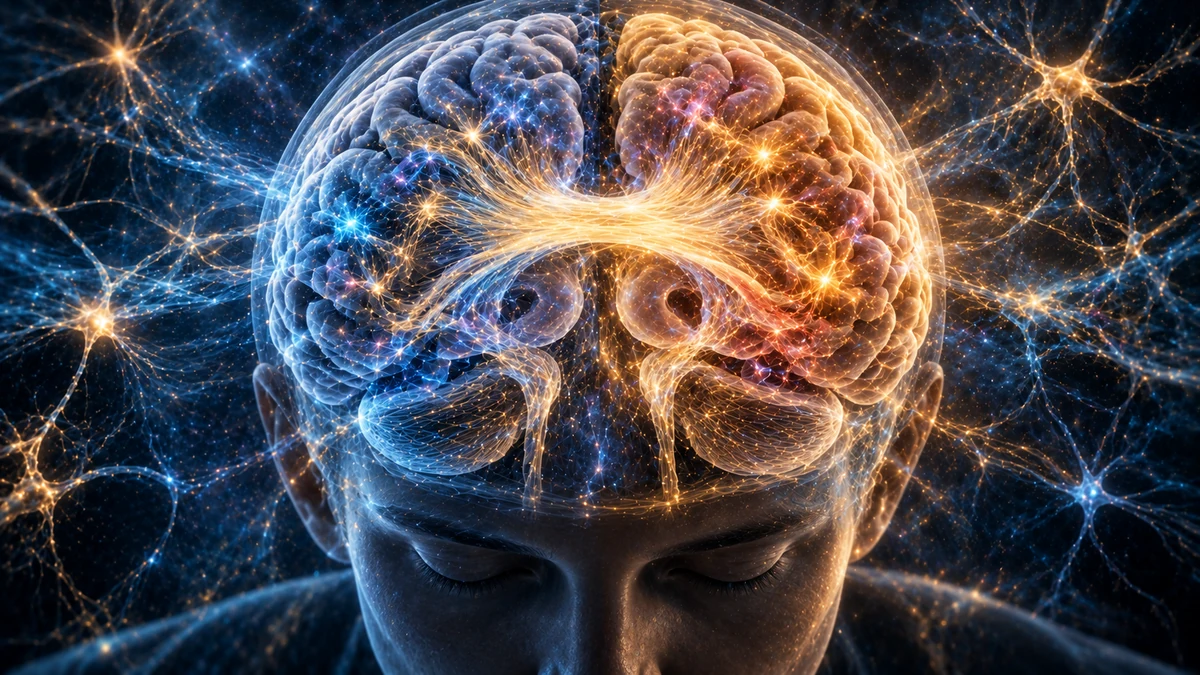
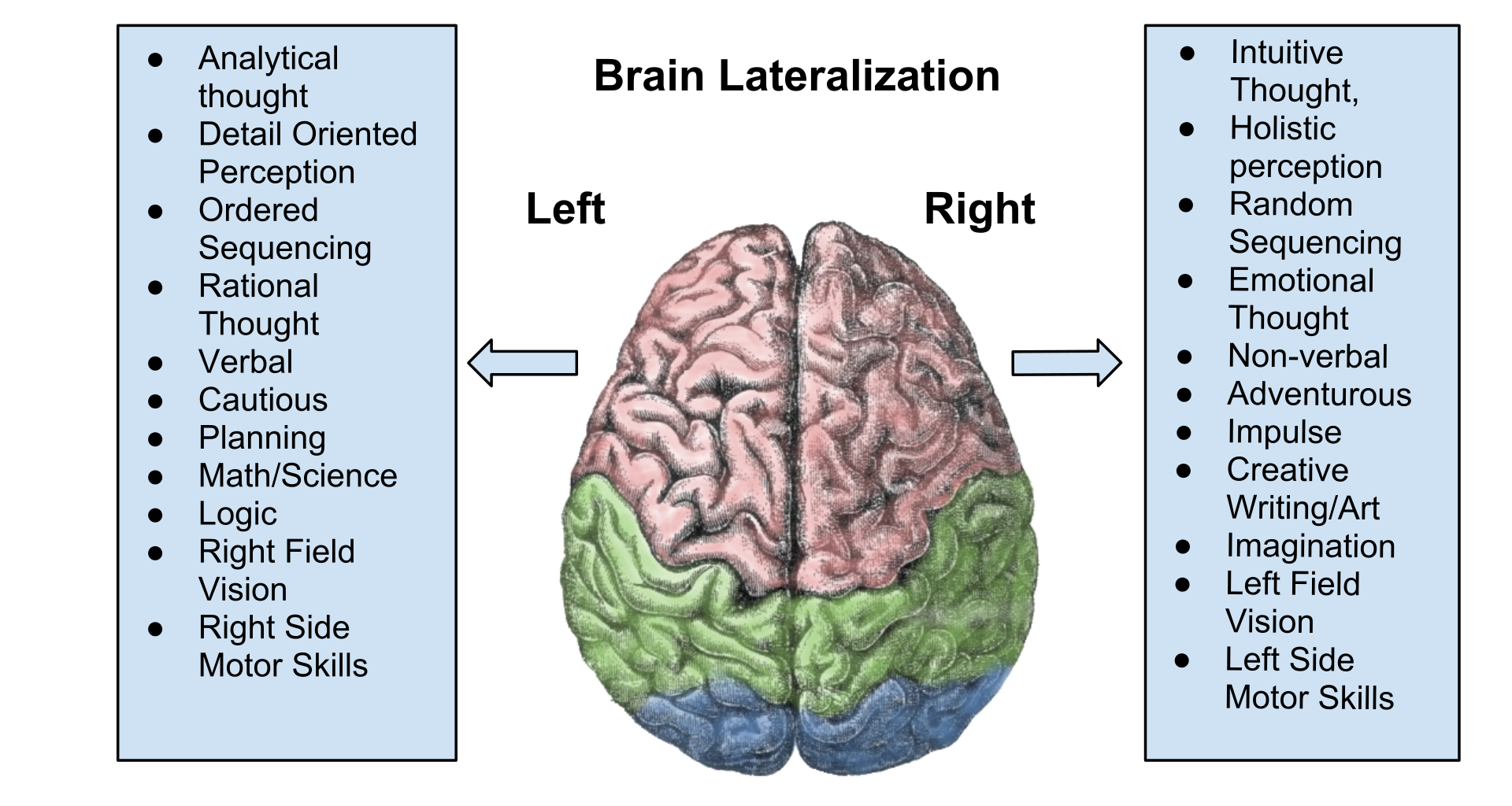
“Are you more left-brained or right-brained?” In popular psychology, the answer is supposed to reveal almost everything: the left brain is said to be logical, analytical, mathematical and verbal, while the right is creative, intuitive, emotional and artistic. This division has inspired personality tests, educational methods, business seminars and advice on how to “activate” the neglected hemisphere. [1][4]
The problem is that the myth grew out of a genuine scientific discovery. The cerebral hemispheres are not functionally identical. Language is more strongly lateralised to the left hemisphere in most people, certain visuospatial processes often show a rightward advantage, and some forms of emotional prosody are more vulnerable to right-hemisphere injury. Split-brain research dramatically demonstrated that, when their major connection is severed, the two hemispheres can process information in different ways. [2][3][5]
But genuine specialisation of particular functions does not mean that whole people are “left-brained” or “right-brained,” nor that creativity resides in the right half of the skull while logic resides in the left. Contemporary neuroscience presents a more interesting picture: lateralisation is local, task-dependent and variable across individuals, while complex thought emerges from cooperation among large-scale networks spanning both hemispheres. [1][4][10][11]
From Broca to the Idea of a Dominant Hemisphere
The story accelerated in the nineteenth century. Paul Broca linked speech-production deficits in patients to damage in the left frontal cortex, and Carl Wernicke later described a left temporal region important for language comprehension. Such findings helped establish the view that the left hemisphere was “dominant” and the right secondary or less important. [1]
That terminology was always potentially misleading. Dominant for one function does not mean dominant as an entire half of the brain. Damage to particular left-hemisphere language regions can devastate speech, while right-hemisphere injury can severely disrupt spatial attention, face processing, emotional prosody and other abilities. [1][6][7]
The brain is therefore not a hierarchy with one “main” half. It is an asymmetric system in which some functions are distributed unequally.
Split Brain: The Experiment That Changed Neuroscience
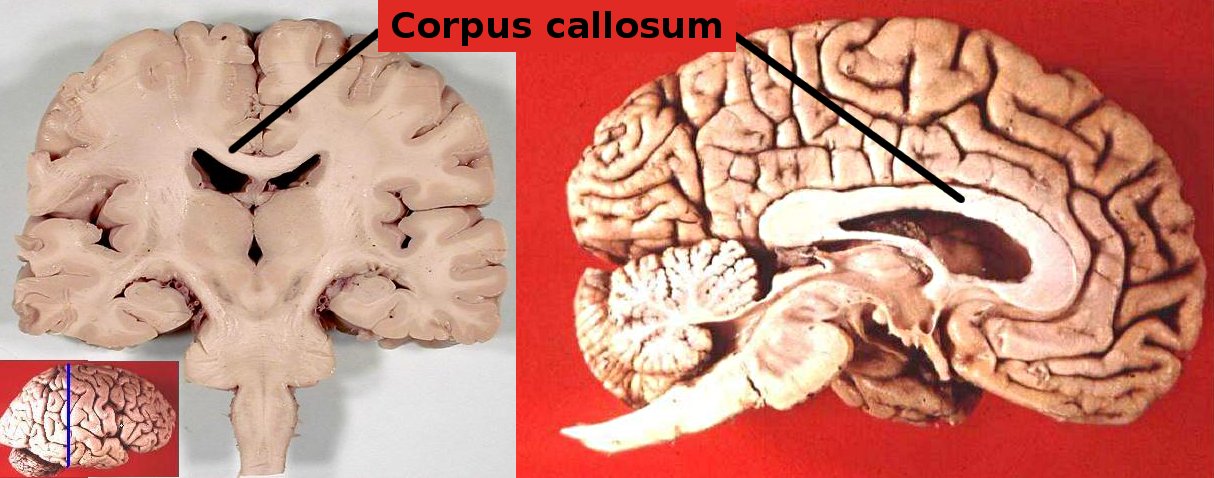
During the 1960s Roger Sperry, Michael Gazzaniga, Joseph Bogen and colleagues studied patients with severe epilepsy whose surgeons had severed the corpus callosum, the largest fibre tract connecting the hemispheres. The operation was intended to prevent epileptic activity from spreading from one hemisphere to the other. [2][3]
These patients were often surprisingly functional in everyday life. Carefully designed experiments, however, revealed something remarkable. If a picture was flashed briefly only to the left visual field, the information initially reached primarily the right hemisphere. In typical split-brain patients, the right hemisphere often could not name the object aloud, yet the left hand could correctly select it from several objects. When the same stimulus was shown in the right visual field, the left hemisphere could often name it verbally. [2][3]
Roger Sperry received half of the 1981 Nobel Prize for “discoveries concerning the functional specialization of the cerebral hemispheres.” [2] This was powerful evidence for hemispheric specialisation — not for the popular personality dichotomy.
What Did Split-Brain Research Really Show?
Sperry’s Nobel lecture described the left hemisphere as especially strong in speech and some sequential, analytical operations, while the right often performed better on certain visuospatial, constructional, facial and nonverbal tasks. [2]
But even the original findings were more complex than “left = logic, right = creativity.” The right hemisphere of split-brain patients was not merely a mute visual processor. It showed understanding of many words, faces, spatial relationships and personally meaningful information. Emotional effects also did not remain neatly restricted to one side. [2][3]
Most importantly, these were brains in which the principal communication routes between the hemispheres had been surgically interrupted. In ordinary brains the corpus callosum continually transfers information between sides. Performance of an isolated hemisphere is therefore not a direct description of how an intact brain solves everyday problems.
Language Really Is Mostly Left-Lateralised — But Not Only Left
Left-hemisphere specialisation for language is one of the most robust examples of cerebral lateralisation. Reviews estimate that language is predominantly left-lateralised in roughly 90% of healthy people. Handedness is related to this pattern but does not determine it. Left-hemisphere language dominance is extremely common among strong right-handers, while bilateral and right-lateralised patterns are more frequent among left-handers. [5][8]
In a classic study of 326 healthy people, right-hemisphere language dominance occurred in about 4% of strong right-handers, 15% of ambidextrous individuals and 27% of strong left-handers. [8] Thus left-handedness does not mean “right-brained language,” and right-handedness does not guarantee completely left-sided language.
Moreover, “language” is not one process. Word production, grammar, semantics, reading, prosody and pragmatics can show different degrees of lateralisation. A systematic review of fMRI tasks emphasises that different language processes may develop lateralisation partly independently. [9]
The Right Hemisphere and the Melody of Speech
If the left hemisphere often has an advantage for some core linguistic operations, the right plays important roles in prosody — rhythm, pitch, intonation and emotional tone. Right-hemisphere damage can therefore contribute to aprosodia: difficulty producing or understanding emotional nuances in speech. [6][7]
Yet the simple division fails here as well. Meta-analyses show that both linguistic and emotional prosody activate bilateral frontotemporal networks. A 2025 systematic ALE meta-analysis found substantial bilateral overlap, with individual components differing in their relative lateralisation. [7]
It is therefore more accurate to say that the right hemisphere shows a relative advantage for some prosodic processes, not that “the right understands tone while the left understands words.”
Visuospatial Attention: A Real Rightward Asymmetry
One of the clearest functional asymmetries concerns spatial attention. Damage to right parietal and related networks can produce left hemispatial neglect: a person can physically see yet fail to attend normally to the left side of space or even the left side of the body. Comparable neglect after left-hemisphere injury is generally less common or less severe.
This demonstrates that the right hemisphere often plays an especially important role in spatial attention. But it does not establish a global “right-brained” cognitive style. A person does not become an artist because their right parietal network works well, just as left-lateralised language does not make someone an accountant.
Hemispheric advantage belongs to a specific process, not a personality type.
Creativity Is Not in the Right Hemisphere
This may be the most widespread consequence of the myth. Artists, musicians and “intuitive” people are said to use the right hemisphere, while analytical scientists use the left.
Modern brain imaging does not support that picture. Research on creative cognition implicates several large-scale networks, particularly the default network and the executive control network. The default network contributes to spontaneous idea generation, associative thought, episodic memory and mental simulation; executive networks help guide, evaluate and constrain ideas toward a goal. [10][11]
These systems contain regions in both hemispheres. Beaty and colleagues have shown that creative thought involves dynamic cooperation between networks that can be more antagonistic during other tasks. [10][11]
Creativity is therefore better understood as coordination among idea generation, memory, attention and control — not as a function of the right half of the brain.
Logic and Mathematics Are Not Owned by the Left Half Either
Because the left hemisphere is often important for language and sequential symbolic processing, popular literature extended that association to mathematics, logic and “rationality.” Complex mathematical thinking, however, combines numerical, spatial, visual, working-memory and executive processes that recruit bilateral parietal and frontal networks.
Logical reasoning is likewise not a single localised module. The exact task strongly influences which networks are engaged: verbal logic may recruit left-lateralised language systems more heavily, while spatial reasoning can recruit different and often more bilateral or right-weighted networks.
The claim “the left brain is logical” therefore transforms the relative lateralisation of some components into a global property of thought.
The Strongest Direct Test of the “Brain Type” Myth
If people were globally “left-brained” or “right-brained,” we would expect an individual to show consistently stronger within-hemisphere connectivity on one side across the whole brain.
In 2013 Nielsen and colleagues analysed resting-state functional connectivity in 1,011 people aged 7 to 29. They found many locally lateralised connections and hubs — genuine left- and right-sided specialisations. But they did not find a pattern in which some individuals were globally more “left” and others globally more “right.” Lateralisation was a local property of networks, not a whole-brain personality phenotype. [4]
This result matters because it does not deny lateralisation. It shows that lateralisation exists, but is organised by specific systems.
The Corpus Callosum: Why the Halves Are Not Two Separate People
The hemispheres are linked by several commissures, the largest of which is the corpus callosum, containing hundreds of millions of axonal connections between cortical regions. Split-brain studies are so informative precisely because they reveal what happens when much of this communication is interrupted. [3]
In an intact brain, information passes continually between hemispheres. A language process may use a left-specialised region while simultaneously receiving visual, emotional and contextual information from bilateral or right-weighted systems. A visuospatial task may require right-sided attention and a left-sided verbal strategy. Music can recruit pitch, rhythm, memory, motor and predictive processes distributed across both hemispheres.
For most everyday activities, then, “which hemisphere are you using?” has no good answer. A better question is which networks are relatively lateralised for this task and how do they cooperate with the rest of the brain?
Is the Left More Analytical and the Right More Holistic?
This claim is subtler than the creativity myth. Early split-brain work did suggest differences in processing style: the left hemisphere was more sequential and language-analytic on some tasks, while the right performed better on certain spatial and configurational relations. [2][3]
These differences are not invented, but they do not scale into universal personality rules. Results depend on stimulus type, task demands, the individual and measurement method. Corballis notes that popular polarities such as “analytical versus creative” and “logical versus intuitive” extend far beyond what hemispheric asymmetry data actually justify. [1]
A relative processing advantage of one hemisphere is not the same as two distinct ways of being or two personalities inside the skull.
Left and Right in Emotion: Another Simple Division That Falls Apart
The myth is sometimes extended into the claim that the right hemisphere is “emotional” and the left rational. This too is too crude.
The right hemisphere is important for some aspects of emotional prosody and social communication, but emotional processing involves bilateral networks including the amygdala, insula, cingulate cortex, prefrontal regions, striatum, sensory systems and multiple subcortical structures. [6][7]
Sperry already noted in his Nobel lecture that emotions could not be cleanly confined to one hemisphere: emotional effects generated by lateralised stimuli could spread rapidly through the broader system. [2]
The broader correction is the same: reason and emotion are not separate machines, and the hemispheres are not their anatomical seats.
What About Left-Handers?
Handedness and brain lateralisation are statistically related but are not the same thing. A large meta-analysis estimated that approximately 10.6% of people are left-handed. [12] Most left-handers nevertheless have predominantly left-hemisphere language, although bilateral and right-sided language representation are more common among them than among right-handers. [8][12]
Handedness therefore cannot reliably predict personality, creativity, intelligence or a whole-brain laterality profile. Left-handedness does not mean “right-brained,” just as right-handedness does not mean “left-brained.”
Lateralisation is not a single trait either. One person can show strongly left-lateralised language, right-lateralised spatial attention and a different pattern for faces or emotional prosody. Different asymmetries can develop partly independently. [9][13]
Why Is the Myth So Persistent?
Because it contains just enough truth to sound scientific. There are two hemispheres. There is a corpus callosum. Language is lateralised. Spatial and prosodic asymmetries exist. Split-brain patients really did reveal dramatic functional differences. [1][2][3]
Then comes the leap:
specialised function → specialised hemisphere → global cognitive style → personality type.
The first two steps can be well supported. The last two generally are not.
The myth is also psychologically attractive. It offers an easy identity label: “I am bad at mathematics because I am right-brained,” or “I am not creative because I use my left brain.” Such explanations are easier to remember than the reality of dozens of dynamically interacting networks.
What Can We Actually Say Today?
Hemispheric lateralisation is real. In most people the left hemisphere is relatively more specialised for many language processes; the right often plays larger roles in spatial attention, some aspects of face processing and emotional prosody. [1][5][6][8]
Lateralisation is not absolute. The same function can recruit both hemispheres, individuals vary, and different subtasks within one domain can have different laterality patterns. [7][9]
Creativity is not a right-brain function. Creative cognition depends on dynamic cooperation among bilateral default, executive and other networks. [10][11]
Logic does not belong to the left half of the brain. Verbal and symbolic components may increase left-sided contribution, but complex reasoning recruits distributed networks spanning both hemispheres.
Most importantly, a person is not a left-brained or right-brained personality type. The strongest direct whole-brain connectivity test did not find such a global division. [4]
The real picture is less suitable for a personality quiz but richer scientifically. Evolution did not build two separate thinkers, one logical and the other artistic. It built two densely interconnected hemispheres with partially different specialisations that solve most complex human tasks together.
Sources and further reading
- Historical and critical review of facts and fantasies surrounding hemispheric lateralization. Source
- Sperry’s Nobel lecture on the effects of disconnecting the cerebral hemispheres. Source
- Review of decades of split-brain research and its interpretive limits. Source
- Large rs-fMRI study of 1,011 people showing lateralization as a local network property rather than a global personality phenotype. Source
- Review of factors modulating language lateralization and plasticity. Source
- Clinical review of aprosodia after focal left- or right-hemisphere damage. Source
- 2025 systematic review and ALE meta-analysis of linguistic and emotional prosody. Source
- Classic large study of handedness and hemispheric language dominance. Source
- Systematic review of lateralization across different language fMRI tasks. Source
- Review of large-scale network dynamics in creative cognition. Source
- Review of network neuroscience of creativity and individual differences. Source
- Large meta-analysis of the prevalence of human left-handedness. Source
- Review of the evolution of lateralized brain circuits and functional asymmetries. Source