The Triune Brain: Scientific Model or Surviving Metaphor?
MacLean’s three-brain model was historically influential, but modern comparative neuroscience does not support a literal reptilian, mammalian, and rational brain stacked one on top of another.
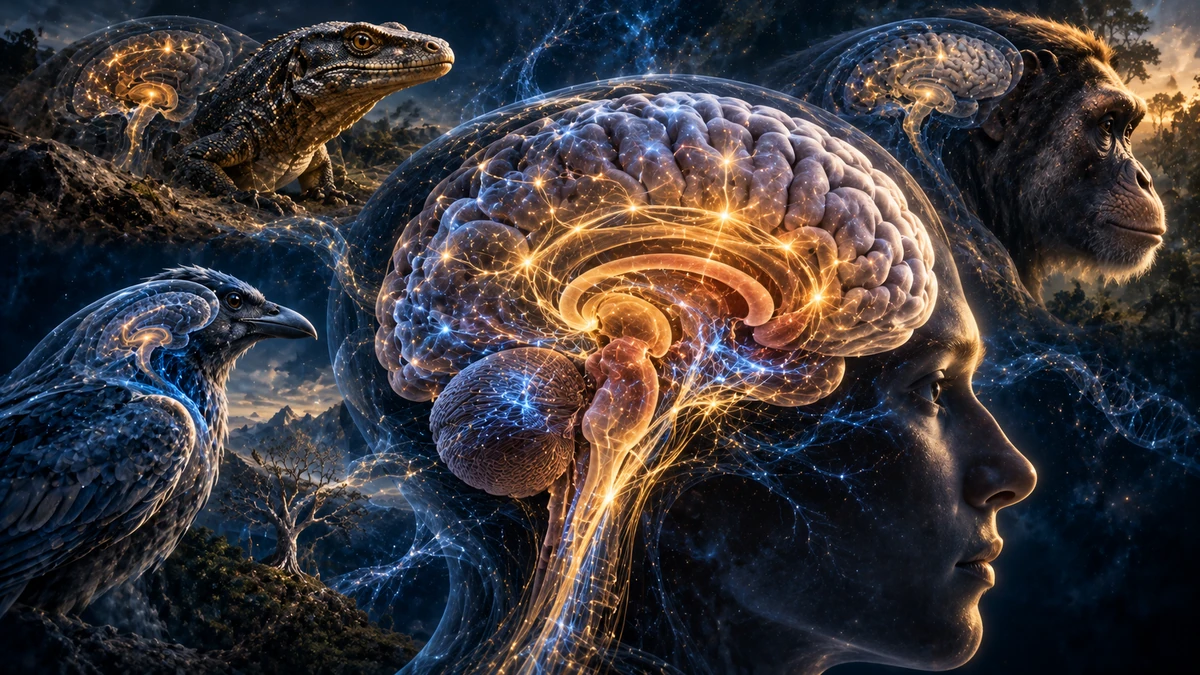
Few neuroscience images are as persistent as the story of three brains inside one skull. Deep below supposedly sits the “reptilian brain,” responsible for survival, instinct and automatic responses. Above it lies the “limbic system,” producing emotion. On top, the neocortex is said to have evolved as the youngest layer — the seat of reason, language and conscious control. When we become frightened or angry, the story goes, ancient parts temporarily seize control from the rational human brain. [1]
The picture is intuitive, simple and highly useful in teaching, self-help psychology, marketing and explanations of stress. It also has a genuine scientific history in the work of Paul D. MacLean. Modern comparative neuroanatomy, developmental biology, genetics, research on avian and reptilian brains, and network neuroscience, however, show that brain evolution did not proceed by stacking three nearly separate brains on top of one another. [2][3][4][5]
That does not mean everything in MacLean’s model was worthless. Some neural circuits really are extremely ancient, some regions expanded greatly in different evolutionary lineages, subcortical systems genuinely contribute to motivation, defence, habits and bodily regulation, and the neocortex became exceptionally large and complex in some mammals. The problem begins when those real differences are reorganised into a story of three successive brains with separate functions.
What Did MacLean Actually Propose?
American neuroscientist Paul D. MacLean developed his idea over several decades and presented it systematically in his 1990 book The Triune Brain in Evolution. He described three major evolutionary formations: the reptilian complex, the paleomammalian formation, and the neomammalian formation. [1]
One popular simplification needs correction immediately. MacLean’s “reptilian complex” was not simply the entire brainstem, as many contemporary infographics suggest. He placed considerable emphasis on the basal ganglia and striatal structures and associated them with ritualised, territorial, routine and species-typical patterns of behaviour. The paleomammalian formation was linked with the limbic system, maternal behaviour, vocalisation, social attachment and emotion. The neomammalian formation centred largely on the neocortex, learning, problem solving and, in humans, language. [1]
The original model was therefore richer than the modern slogan “reptile = instinct, mammal = emotion, human = reason.” Yet its basic evolutionary framework still treated the brain as three successively evolved systems that remained to a large degree relatively distinct functional units.
Why Did the Model Become So Convincing?
The triune brain maps neatly onto the everyday experience of internal conflict. Sometimes we “know better” but still react impulsively. Fear can override a long-term plan, hunger changes decisions, habit defeats intention, and anger reduces reflection. The model offers an easy story: the older brain defeats the newer one.
There is also some truth behind it. Brainstem and hypothalamic circuits perform very ancient life-maintaining functions. The basal ganglia are evolutionarily ancient. The mammalian neocortex expanded enormously in some lineages, especially primates and humans. Stress can rapidly impair some prefrontal functions and strengthen more automatic patterns of behaviour. [7][13]
This is why the model survives so well: it is not wholly invented; rather, it arranges several real observations into an evolutionary story that is too simple.

Evolution Is Not a Ladder from Reptile to Human
The deepest problem begins with the underlying picture of evolution. Living reptiles are not our living ancestors. Mammals and sauropsids — the lineage including modern reptiles and birds — share remote common ancestors and then evolved along different branches. The human brain is therefore not a reptile brain onto which a mammal brain and finally a human layer were added. [2][4][6]
Comparative and developmental studies show that many basic organisational units of vertebrate brains are very old and shared across lineages. Evolution modified, enlarged, rewired and specialised them. It preserved old cell types and circuits while building new configurations from them. [4][5][6][15]
A better image is therefore not a three-storey tower but a branching family tree in which old structures change together with newer ones.
The Problem with the “Reptilian Brain”
The phrase “reptilian brain” suggests a distinct set of structures that was once reptilian and remained almost unchanged inside the human brain. Contemporary comparative neuroscience does not support that picture.
The basal ganglia, a major component of MacLean’s reptilian complex, exist across very different vertebrate groups and show deeply conserved organisation. In mammals, birds and reptiles, striatal and pallidal regions contain similar basic neuronal populations and related functional loops. They are therefore not meaningfully described as a piece of reptile brain merely carried forward into mammals. They are ancient systems that continued to evolve in all of these lineages. [7]
Functionally, the basal ganglia are also not mere generators of rigid instincts. They contribute to action selection, habit learning, reward, motivation, motor learning and behavioural adaptation. Their functions are interwoven with cortex, thalamus, dopaminergic systems and numerous other structures.
The age of a structure does not equal primitiveness of function.
Reptiles Are Not Simply Instinct Machines
The triune model developed when reptile behaviour was far less studied than it is today. Modern research documents spatial learning, visual discrimination, problem solving, social learning and behavioural flexibility in several reptilian groups. [8][9]
A 2021 review covering decades of research on turtles, crocodilians, lizards and snakes described abilities ranging from habituation and spatial memory to responding to change, solving novel problems and social learning. [9]
This does not mean reptiles possess human cognition. It means that “reptilian = automatic, inflexible and cognitively simple” is not a useful biological category. Modern reptile cognition is substantially richer than the cultural stereotype underlying the popular triune-brain story. [8]
Birds Create an Even Larger Problem
If sophisticated cognition depended primarily on a mammalian neocortex, birds should pose a serious difficulty. They do.
Birds do not possess a six-layered neocortex organised in the same way as mammals, yet many species show advanced learning, categorisation, problem solving, complex communication, planning and other abilities once associated mainly with a large mammalian cortex. [3]
Comparative neuroanatomy therefore underwent an important terminological revision in the early twenty-first century. Large regions of the avian telencephalon once mistakenly characterised as expanded basal ganglia were recognised as pallial structures. Avian and mammalian brains are organised differently, yet they share many related neuronal types, circuits and developmental programmes. [3][4][5]
High-level cognition can therefore arise in different anatomical architectures. This directly weakens the idea that a “neomammalian” cortical layer is the only possible substrate for flexible intelligent behaviour.
The Neocortex Is Special — But It Is Not Simply a New Lid
The six-layered neocortex is a mammalian feature and underwent extraordinary expansion in some mammalian lineages. Rejecting the triune model does not require minimising its importance. The problem is the notion that it appeared almost as a separate new device placed on top of an older brain machine.
Modern evolutionary biology gives a more complicated picture. Birds and reptiles lack a clear structural homologue of the six-layered mammalian neocortex, but their pallia contain many conserved neuronal types and information-processing circuits related to those used by the mammalian cortex. [4][5]
Development can therefore preserve similar cellular components and functional pathways while changing their three-dimensional architecture. Evolution did not necessarily install an entirely new processor; it often rearranged older components into new forms.

The “Limbic Emotional Brain” Is Also Too Simple
The second major pillar of the triune model is the limbic system as a unified centre of emotion. That idea has also become problematic.
The term limbic system has a long history and remains in use, but there is no single sharply defined anatomical and functional unit that simply means “the emotional brain.” The hippocampus, for example, is frequently classed as limbic yet is crucial for episodic memory and spatial processing. Orbitofrontal and prefrontal regions play major roles in valuation and emotional decision making even though classical limbic diagrams have not always treated them consistently. [10][11]
Joseph LeDoux argued as early as the 1990s that a unitary limbic system was no longer an adequate account of the neural basis of emotion or memory. Edmund Rolls later similarly argued for distinguishing multiple functional systems for emotional valuation and memory rather than one unitary limbic apparatus. [10][11]
Emotion is therefore not simply produced by one middle “mammalian brain.”
Reason and Emotion Are Not Two Separate Machines
Popular triune-brain stories often place the neocortex on the side of reason and limbic structures on the side of emotion. Modern neuroscience shows that cognitive and emotional processes are deeply interwoven.
Luiz Pessoa has argued that complex cognitive-emotional behaviour arises from dynamic coalitions of networks, not from a simple conflict between an “emotional” and a “rational” region. Structures including the amygdala, prefrontal cortex, insula, anterior cingulate and striatum participate in different contexts in attention, valuation, learning, decision making and action preparation. [12]
Individual neurons and regions may encode several kinds of information at once. The amygdala is not merely a “fear centre,” and the prefrontal cortex is not a pure logical control room. [12][14]
Decision making without emotional valuation would often be just as dysfunctional as emotion without regulation.
Why Does Stress Still Feel Like the “Old Brain Takes Over”?
Here the popular metaphor touches a real phenomenon, but explains it too crudely.
Acute uncontrollable stress can alter noradrenaline and dopamine signalling and rapidly impair certain prefrontal functions, including working memory, flexible planning and attentional control. At the same time it can strengthen the influence of the amygdala, striatum and other systems associated with faster, learned or defensive responses. [13]
A person under intense stress can therefore genuinely shift from reflective toward more automatic behaviour. But this is not a literal switch among three brains. It is a change in the operation and relative influence of interconnected networks that are always interacting under normal conditions.
“Your reptilian brain took over” can be a memorable phrase, but it is scientifically too coarse.
Old Does Not Mean Low, and New Does Not Mean High
The triune story quietly embeds a value ladder: old is automatic and primitive, new is conscious and advanced. Evolution does not work that way.
Very ancient neural circuits can perform complex functions. Conserved hindbrain systems controlling breathing, feeding and orofacial coordination have been modified and repurposed across hundreds of millions of years in very different vertebrate forms. [15] The basal ganglia are old, yet participate in sophisticated learning and action selection. Hippocampal and pallial systems have deep evolutionary roots but support complex processing.
Conversely, newer regions are not independent. The prefrontal cortex depends on thalamus, striatum, amygdala, hippocampus, brainstem, sensory systems and the body. No “highest” layer operates alone.
Is the Model Completely Useless?
As a literal model of brain evolution and organisation, the triune model is obsolete. Used as anatomical truth — three brains, three evolutionary eras, three largely separate functions — it quickly generates false explanations. [2][3][4][5]
As an extremely rough teaching metaphor it may retain limited value if its limitations are made explicit. It can remind us that:
- the brain contains evolutionarily ancient and more recently elaborated structures;
- automatic, homeostatic, motivational and executive processes are not the same thing;
- stress can shift the balance between reflective and more automatic control;
- conscious intention is not always the strongest determinant of behaviour.
But those facts should not be described as “a reptile, a mammal and a human inside the skull” if anatomical and evolutionary accuracy matters.
A Better Model: An Interwoven Evolutionary Network
If the old picture needs a replacement, the new one is less simple but more faithful to biology.
The human brain is a mosaic of deeply conserved and evolutionarily modified cells, circuits and structures. Some systems have roots long before mammals appeared. Others were reorganised or greatly expanded in the mammalian lineage. The neocortex is a distinctly mammalian architecture, yet it uses ancient cell types and communicates continuously with much older systems. Emotion, memory, motivation, perception and decision making are not each stored in a separate evolutionary box; they arise through cooperation among distributed networks. [4][5][12]
That is less dramatic than a battle between the reptile and the rational human. It is also evolutionarily more interesting: nature generally did not discard old brains and install new ones on top. It continually modified old components, interconnected them and reused them in new ways.
The triune brain is therefore best understood today as an historically important stage in thinking about nervous-system evolution — a model that helped direct attention toward evolutionary differences in behaviour but has been replaced by a far more branching, integrated picture in contemporary comparative neuroscience.
Sources and further reading
- Primary historical source for MacLean’s own triune-brain formulation and the actual scope of his reptilian, paleomammalian, and neomammalian systems. Source
- Comparative review of amniote pallium evolution and the origins of mammalian neocortex. Source
- Key consensus review of avian brains that corrected older homology errors and documented a different architecture for advanced cognition. Source
- Comparative-developmental review of homology, neocortex, and evolutionary developmental mechanisms. Source
- Modern review of cortical evolution through conserved cell types and circuits across vertebrates. Source
- Concise modern review of reptilian brain organization in comparative evolutionary context. Source
- Comparative review of structural and functional evolution of the vertebrate basal ganglia. Source
- Review of reptile cognition integrating neurological mechanisms, behavioral constraints, and evolutionary context. Source
- Broad review of four decades of learning research in non-avian reptiles. Source
- Review arguing for multiple emotion and memory systems rather than one unitary limbic system. Source
- Classic review of emotional-memory systems and specific neural circuits, relevant to correcting a unitary limbic-emotion model. Source
- Review of emotion–cognition integration through dynamic brain networks. Source
- Review of neurochemical stress pathways that rapidly impair prefrontal function, explaining the real phenomenon behind the takeover metaphor. Source
- Review of shared emotion, cognition, and mental-state coding in amygdala and prefrontal cortex. Source
- Comparative review of deeply conserved hindbrain circuits across diverse vertebrate feeding and breathing modes. Source