
Knowledge library

Articles for independent inquiry.

Shorter entry points into the questions explored across THY-REALITY. Browse by field or search directly by title and description.

TOPIC PATHEconomics and ownership30 articles on this path
Back to paths
A woman facing a city shop window sees a reflection assembled from images of products, lifestyle, and status symbols.

Consumerism: when identity becomes a product

When does a purchase stop being merely a purchase and become proof of who we are? On the extended self, status signals, brands, social comparison, materialism, and identities that can be monetized.

Read article
“Do Not Steal” as a Concise Principle of Natural Law

“Do Not Steal” as a Concise Principle of Natural Law

“Do not steal” is a powerful moral rule, but theft already assumes an answer to what legitimately belongs to whom. “Do Not Steal” as a Concise Principle of Natural Law examines property, necessity, taxation, conscience, and the limits of the concept itself.

Read article
Are All Rights Property Rights?

Are All Rights Property Rights?

Self-ownership powerfully explains bodily autonomy and consent, but can property really account for expression, conscience, voting, privacy and fair procedure? Are All Rights Property Rights? tests the limits of the thesis.

Read article
A central pool of created value branches into clearly separated flows toward labour, operating surplus, taxes, interest, rents, and ownership returns.

Where Does the Value We Create Go?

This article builds a basic map of economic flows: from revenue and value added to wages, operating surplus, taxes, interest, rents, dividends, fees and reinvestment—without double counting or a pre-written ideological verdict.

Read article
Four connected organisational forms around a shared core: company, partnership, cooperative and commons.

Cooperative, Company, Partnership, or Commons?

This article compares the company, partnership, cooperative and commons through capital, decision-making, risk, surplus, exit and stewardship, showing why no label by itself guarantees justice.

Read article
A local economic hub with workshop, market and circular flows connects to several external supply routes, illustrating local resilience without economic isolation.

Local Economy Without Autarky

This article shows how to build local capabilities, value circulation and fallback supply routes without confusing resilience with economic isolation.

Read article
Solar panels in the foreground and a settlement in a mountain valley illustrate local energy generation connected to a wider shared system.

Energy: From Consumer to Energy Cooperation

This article shows how local generation, energy sharing, storage, flexible demand and community governance can increase resilience without the illusion of complete energy self-sufficiency.

Read article
A group of people work together to repair and reinforce a shared crossing over water, illustrating practical stewardship and long-term infrastructure maintenance.

Who Maintains Shared Infrastructure?

This article separates ownership from operational responsibility and shows how roads, transport, waste, logistics and communications require clear stewardship, life-cycle planning, financing and fallback arrangements.

Read article

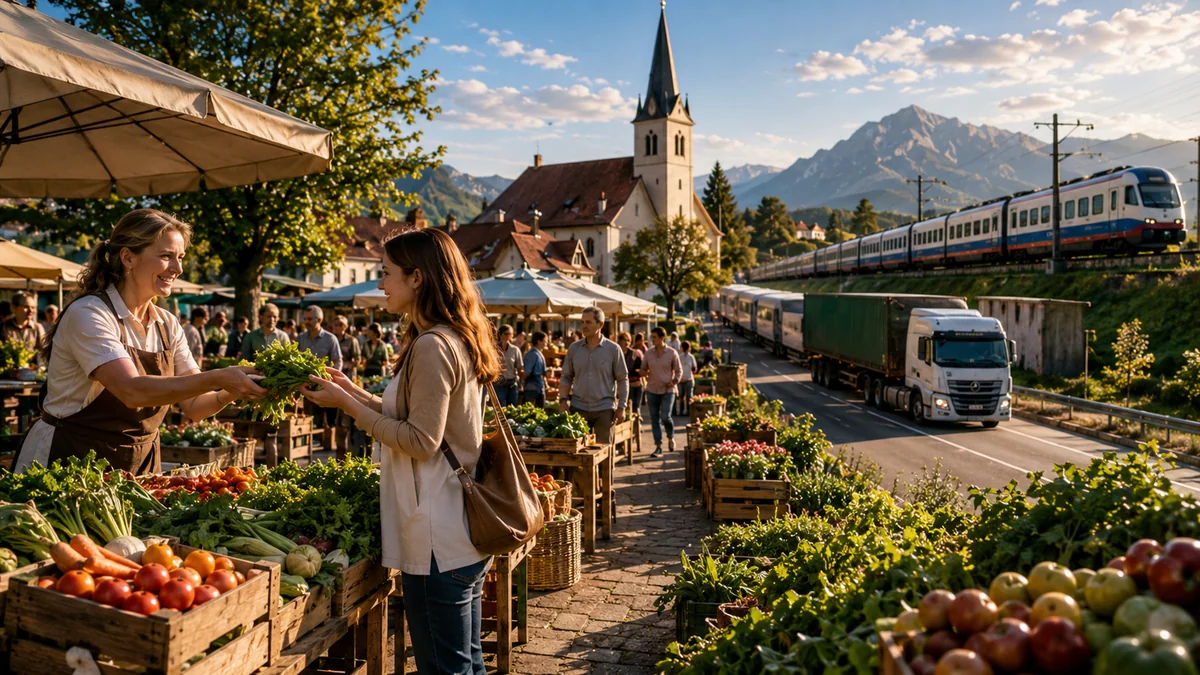
A valley where a local community connects with rail, road and port transport illustrates multiple supply routes between nearby capability and a wider trade network.

Trade and Supply Chains: Mutual Benefit or a New Dependency?

When does trade expand freedom, and when does a supply network become a critical dependency? This article measures specialisation, supplier concentration, upstream bottlenecks, substitutability, redundancy, switching time and the real option to exit.

Read article
A distributed network of communities, routes and resources with several independent nodes and no single control centre — symbolising measurable, functional decentralisation.

How Do We Measure Whether Decentralisation Is Real?

Decentralisation is not the number of municipalities, boards or providers. This article turns it into a measurable profile of decision authority, finance, ownership, data, supply routes, exit costs, redundancy and corrigibility of power.

Read article