Sovereign Wealth Funds: When States Become Global Investors
How sovereign wealth funds invest globally and how public ownership interacts with investment objectives.

An artistic allegory of state capital and its global reach, not a depiction of actual geography or specific investments.
When a state receives revenue from the exploitation of natural resources, state-owned enterprises or other sources, it does not have to spend all of that money immediately. It can invest it in global markets and build wealth intended to benefit future generations as well. In this way, the state becomes an investor, shareholder and creditor in addition to its role as legislator and regulator. How does public wealth translate into economic power, and who decides how it is used?
From public wealth to global capital
Sovereign wealth funds (SWFs) are special-purpose arrangements for investing public wealth to achieve macroeconomic and financial objectives, including through investments abroad. Their purposes vary: long-term saving, cushioning economic fluctuations or supporting development. They may be established using revenues from natural resources, fiscal surpluses or other state assets. Under the definition set out in the Santiago Principles, not all central bank foreign exchange reserves or state-owned enterprises automatically fall into this category. [1]
In the previous part, we examined pension funds, in which individuals have entitlements to pension benefits or to assets in their accounts. State-owned wealth has a different basis. Citizens may be its indirect beneficiaries through public services and the state budget, but this does not mean that each citizen has a personal account or a direct ownership right to any individual investment. Norway’s Government Pension Fund Global (GPFG) and Singapore’s state-owned investment company Temasek illustrate this distinction well. [2][3]
Norway: petroleum revenues, the fund and the state budget
Norway has established a mechanism for converting part of the economic wealth associated with the depletion of non-renewable natural resources into long-term financial assets. The GPFG receives the state’s entire net cash flow from petroleum activities, not all the revenues of every petroleum company. Transfers from the fund to the budget are made on the basis of a parliamentary decision. [4]

Norway’s fiscal guideline provides that, over time, the use of the fund’s resources should track its expected real return. In 2017, the estimate of that return was reduced from four to three per cent. This is not a fixed annual withdrawal limit, as the framework allows adjustments to economic conditions. Its purpose is to cushion the impact of fluctuations in petroleum revenues on public finances and preserve the purchasing power of the wealth for future generations. [4]
Despite the word pension in its name, the GPFG is not a collection of individual pension accounts. Its value represents state-owned financial assets. In the 2020 English version of the Government Pension Fund Act, provided for information, one of the fund’s stated purposes is to support the financing of pension expenditure under the national insurance scheme. The link is through public finances, not personal pension accounts. [2]
Who manages Norway’s sovereign wealth fund?
According to the Norwegian government’s report for 2025–2026, the Ministry of Finance sets the investment strategy and management framework, while Parliament (the Storting) endorses key decisions on risk, returns and the responsible investment framework. Operational management of the GPFG is carried out by the central bank, Norges Bank, through its organisational unit, Norges Bank Investment Management (NBIM). The government report emphasises the separation between political decisions on the mandate and individual investment decisions. [5]
The English version of the management mandate dated 30 June 2024, provided for information, illustrates the legal structure: the Ministry deposits the fund’s assets with the central bank, which invests them in its own name. That version of the mandate also set a limit of ten per cent of the voting shares of any individual company, with exceptions for listed and unlisted real estate companies and unlisted renewable energy infrastructure companies. This describes the arrangements at a specified date rather than the latest consolidated legislation. [6]
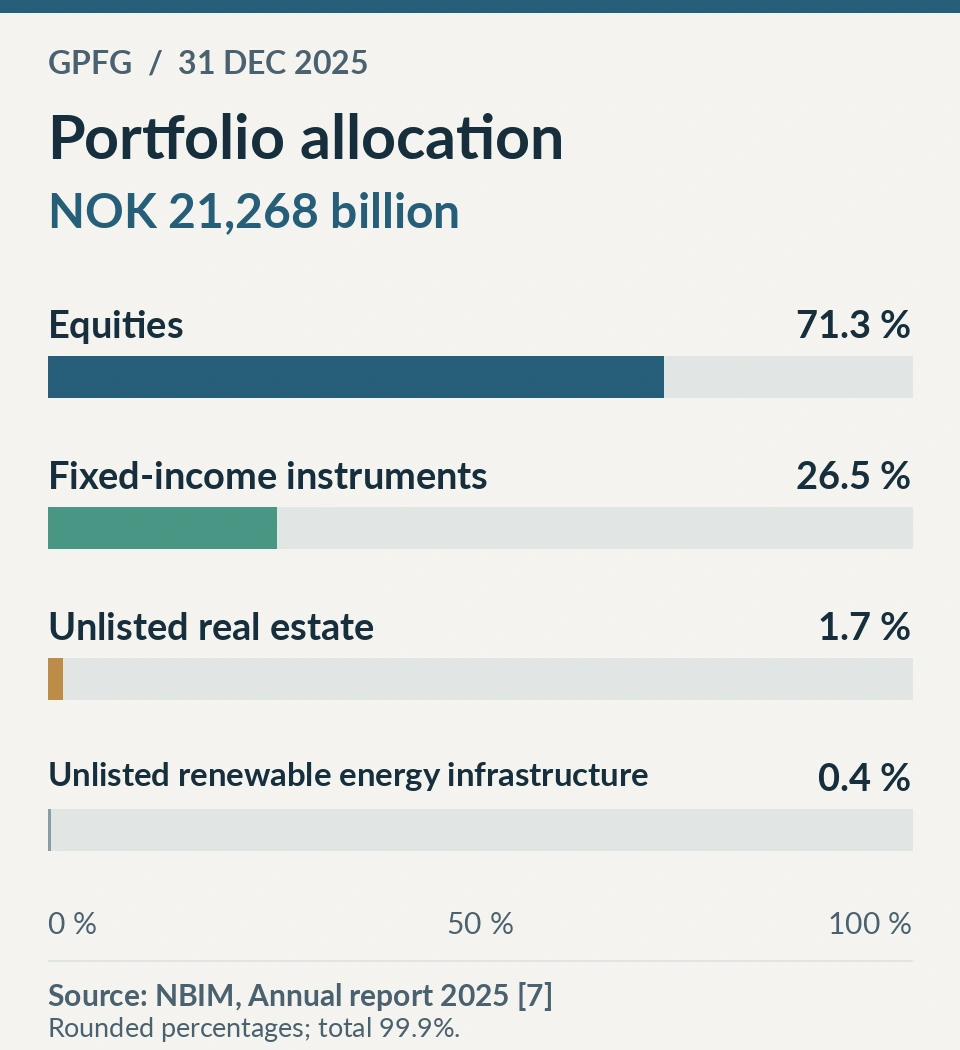
According to NBIM’s annual report, the GPFG was valued at NOK 21,268 billion on 31 December 2025. Equities accounted for 71.3 per cent of the fund’s investments, fixed-income instruments for 26.5 per cent, unlisted real estate investments for 1.7 per cent and unlisted renewable energy infrastructure for 0.4 per cent. The percentages are rounded. The fund had investments in 7,201 companies and, according to its own report, its average ownership stake in listed companies worldwide was 1.5 per cent. This figure concerns stakes in listed companies, not ownership of all the world’s wealth. [7]
Such minority stakes do not automatically confer control over all the companies in the portfolio, but they do carry shareholder rights. NBIM reported that in 2025 it voted on 108,325 proposals at 10,873 shareholder meetings. On 94 per cent of all proposals considered, it voted in line with company boards’ recommendations. [8] The scale of the portfolio and the extent of its voting activities demonstrate the fund’s presence in capital markets, but do not establish that the fund alone determined voting outcomes.
Singapore: Temasek, GIC and MAS
Singapore’s arrangements demonstrate that a single state can use several different institutions to manage its reserves. As the Ministry of Finance explains, GIC manages state assets, while the Monetary Authority of Singapore (MAS), as the central bank, manages the official foreign reserves and holds its own assets on its balance sheet. Temasek has a different status: it is an investment company that owns its own assets. [3]
Temasek was established in 1974. Its sole shareholder is Singapore’s Minister for Finance in an institutional capacity, not as a private owner. The company forms part of the constitutional framework for safeguarding past reserves, within which the President of Singapore also has certain powers. Under the published arrangements, the shareholder appoints or removes members of the board with the President’s concurrence. Temasek states that the government does not direct its individual investment decisions, while highlighting the constitutional protection of past reserves. [3][9] The right to appoint the board and day-to-day investment decision-making are distinct powers; the formal division of responsibilities does not in itself establish how each specific decision was made.
On 8 July 2026, Temasek announced that its net portfolio value as of 31 March 2026 was SGD 518 billion. Its reporting is based on market valuations, with estimates used for unlisted investments. [10][11] This figure cannot be compared directly with the reported value of the GPFG, since the currencies, reporting dates and valuation measures differ.
Temasek and the ownership of Singapore Airlines
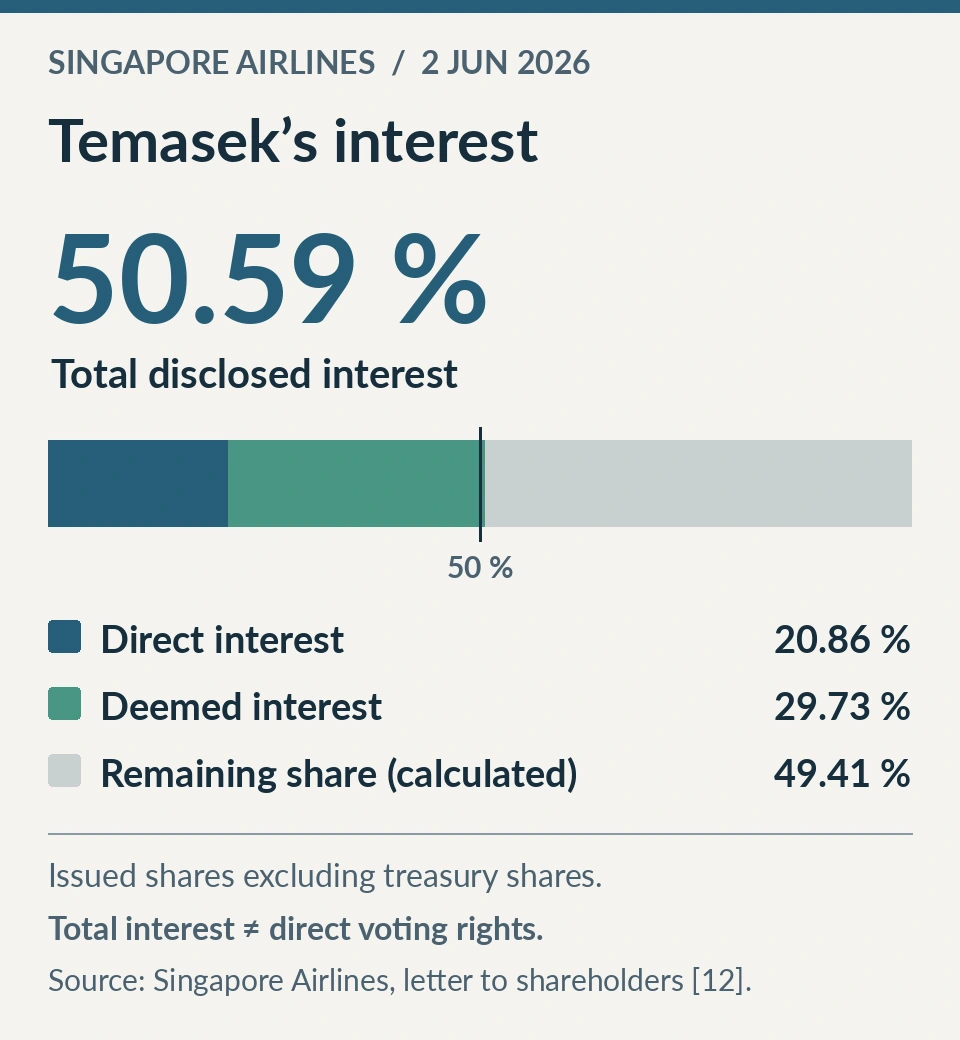
A particularly clear example of the economic influence of a state-owned investment company is its ownership interest in Singapore Airlines. In its official letter to shareholders dated 25 June 2026, the airline reports the position as of 2 June 2026. Temasek had a disclosed direct interest in 20.86 per cent of the shares and a deemed interest in a further 29.73 per cent. Its total disclosed interest therefore amounted to 50.59 per cent of the issued shares, excluding treasury shares. [12]
In this case, the deemed interest covers shares in which Temasek’s subsidiaries and associated companies have direct or deemed interests. Tembusu Capital and Napier Investments also appear in the same table, but their stakes must not be added again to Temasek’s total interest. The report discloses an aggregate majority ownership interest, but not necessarily an equivalent proportion of voting rights held directly by Temasek. A precise assessment of control would require further examination of the rights of the individual companies, the voting rules and the airline’s governance arrangements. [12]
The distinction between this example and the Norwegian model is important. A large, diversified portfolio of minority stakes represents a different form of economic power from a majority ownership interest in an individual company. The ownership link alone, however, is not evidence that the Singapore government issues instructions concerning the airline’s individual business decisions.

Public interest, returns and political accountability
Singapore has also established rules linking returns on state-owned wealth to the budget. The Net Investment Returns Contribution (NIRC) mechanism allows the use of up to half of the expected long-term real returns on the relevant assets invested by GIC, MAS and Temasek, net of government liabilities, as well as up to half of the net investment income from certain other past reserves. [13] This does not mean that the state may spend half the value of Temasek’s portfolio every year or half of its actual annual investment return.
Both models show how state-owned wealth can support the long-term financing of public needs. An important question is how much risk society is willing to accept. Investments are exposed to fluctuations in market prices and exchange rates, economic crises and political change. With very large public investment portfolios, poor decisions may also affect future opportunities to finance public services. Clear mandates, risk oversight, disclosure and accountability on the part of decision-makers are therefore important.
State capital as an instrument of economic power
When a state investor acquires shares, it can exercise the shareholder rights associated with them. When it buys bonds, it becomes a creditor. The scale of its investments can create economic links across national borders, but portfolio size alone does not establish that every investment is an instrument of foreign policy. In its 2026 report, the Norwegian government explicitly rejects using the fund for purposes other than long-term saving. [5] This stated purpose matters, but how it is put into practice is a separate research question.
The International Forum of Sovereign Wealth Funds (IFSWF) highlights the 2008 Santiago Principles, which comprise 24 voluntary principles and practices. They are intended to improve transparency, accountability, governance and prudent investment. [14] They do not replace domestic legislation or automatically guarantee that a particular institution meets all the requirements in practice. Establishing that capital has been used for political purposes would require further evidence about the specific decision, the powers involved, its purpose and its consequences.
State capital thus brings us back to the central question of this series. Who is the legal owner of the assets, who sets the investment mandate, who implements it and who benefits from the returns? Norway and Singapore show that the answer does not always point to a single institution. State-owned wealth can serve public needs while also creating substantial economic power. Its nature can only be understood by examining specific ownership rights and decision-making mechanisms.
In the next part, we will examine private equity and private credit, exploring who buys companies, who finances those acquisitions and how this changes control over companies.
Sources and further reading
- IMF Statistics Department (2008). The Statistical Work on Sovereign Wealth Funds, Appendix II: Defining Sovereign Wealth Funds in the Santiago Principles, pp. 24–25. Source
- Norwegian Ministry of Finance (2020). Act relating to the Government Pension Fund, English version for information, §§ 1–4. Source
- Singapore Ministry of Finance (4 March 2026). Who manages the reserves? Source
- Norwegian Ministry of Finance (7 October 2022). The Norwegian Fiscal Policy Framework. Source
- Norwegian Ministry of Finance (2026). Meld. St. 7 (2025–2026), Executive summary. Source
- Norwegian Ministry of Finance (30 June 2024). Management mandate for the Government Pension Fund Global, English version for information, § 1-1(1–3), § 2-4(12). Source
- Norges Bank Investment Management (2026). Annual report 2025, web edition, sections Results and Individual investments. Source
- Norges Bank Investment Management (26 February 2026). Responsible investment 2025, Our voting. Source
- Temasek. Corporate Governance. Source
- Temasek (8 July 2026). Temasek’s Net Portfolio Value Grows to S$518 billion, up S$49 billion from Last Year. Source
- Temasek. Portfolio Performance. Source
- Singapore Airlines (25 June 2026). Letter to Shareholders, § 3.1 (reporting date), § 5.2 (shareholding interests and notes), published on SGX. Source
- Singapore Ministry of Finance (22 October 2025). Net Investment Returns Contribution. Source
- International Forum of Sovereign Wealth Funds (IFSWF). Santiago Principles (principles adopted in 2008). Source