Pension Funds: Whose Money Is Invested Around the World?
Whose assets pension funds manage, how they invest and their responsibilities to beneficiaries.

Pension contributions are intended to provide an income in old age. In systems that accumulate and invest assets, however, contributions from employees and employers can become part of the capital invested in technology companies, government bonds, commercial property or transport infrastructure on the other side of the world. Retirement saving is therefore not only a matter of social security but also an important factor in the global economy. Yet who actually decides how these accumulated assets are used?
From employee contributions to global capital
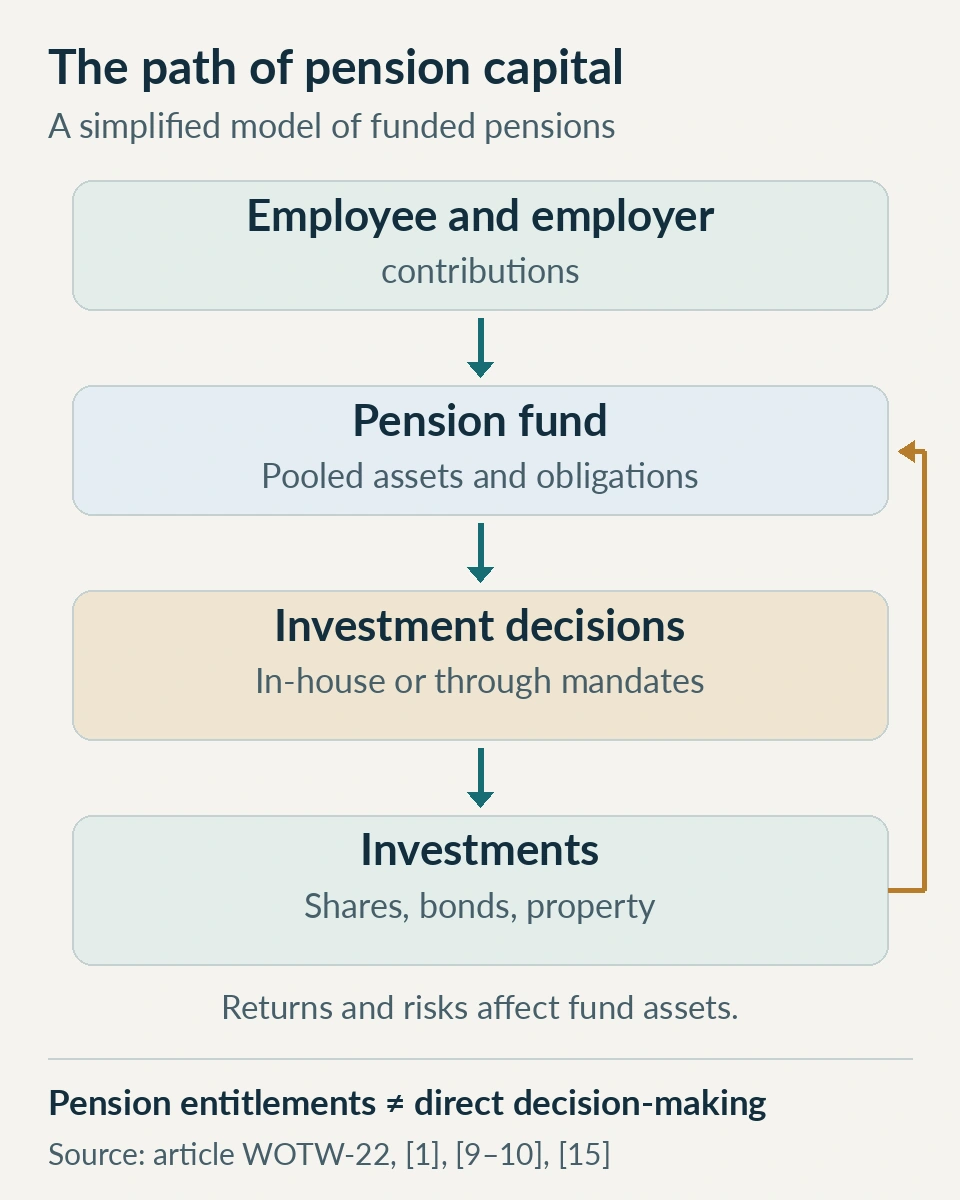
Not all pension systems operate in the same way. In a pay-as-you-go system, current contributions are generally used to pay current pensions. In a funded system, by contrast, assets are accumulated and invested to provide for future payments. There are also public pension reserve funds that supplement pay-as-you-go systems. [1]
Another important distinction is between defined benefit (DB) and defined contribution (DC) pension plans. In the former, the extent of pension entitlements is determined by the rules of the plan; in the latter, the amount available depends primarily on contributions, investment performance and costs. How risks are allocated among employees, employers and other parties responsible for meeting obligations depends on the specific arrangements. [1]
When the contributions of many people are pooled into a large portfolio, an institutional investor emerges with access to investments beyond the reach of most individuals. However, entitlement to a future pension does not in itself mean that each fund member can directly dispose of individual shares in the fund’s portfolio. An individual may be entitled to a specified benefit or to the value of the assets in their pension account without selecting individual securities themselves. The legal form in which assets are held and the investment choices available vary across systems.
The scale of pension assets
According to the OECD Pensions Outlook 2026, published in November 2026, pension assets in the OECD area reached approximately USD 78 trillion at the end of 2025. Pension plan providers managed USD 70.4 trillion, while public pension reserves amounted to USD 7.3 trillion. The report gives the combined figure rounded to a whole trillion. [2]
This is neither an estimate of all pension assets worldwide nor a sum that any single institution can use at its own discretion. It represents the combined value of different systems with different rules, obligations and investment strategies. Even so, this scale helps explain why pension institutions play an important role in capital markets. Part of their influence stems from their capacity to invest over the long term, and part from voting rights and other contractual powers associated with their investments.
CalPERS: the power of a public pension fund
The California Public Employees’ Retirement System (CalPERS) provides pension benefits to public-sector employees in California. According to its financial report summary, the Public Employees’ Retirement Fund had a market value of USD 563 billion as of 30 June 2025. Its estimated funded ratio was approximately 79 per cent, and USD 34.6 billion in pension benefits was paid out during the 2024–2025 fiscal year. [3]

According to CalPERS’ calculation for the twenty-year period ending on 30 June 2024, 55 cents of every pension dollar came from investment returns, 34 cents from employer contributions and 11 cents from member contributions. [4] The fund is overseen by a thirteen-member board: six members are elected by members of the retirement system, three are appointed and four serve by virtue of their office. Among other responsibilities, the board approves the overall investment strategy. [5]
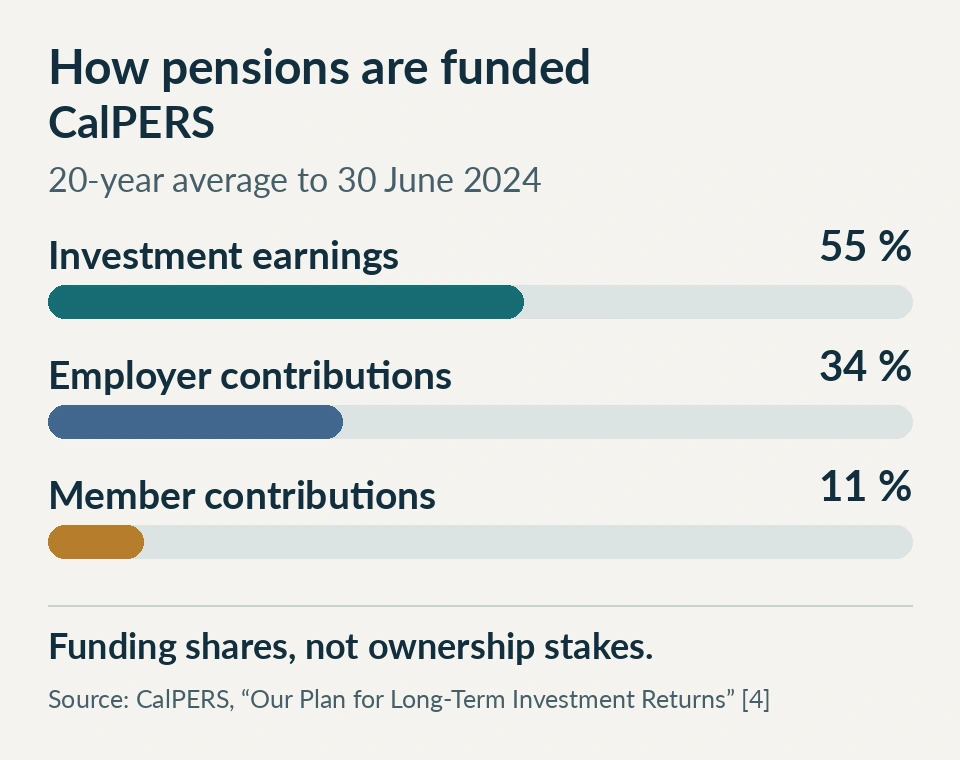
The shares of funding provided by different sources do not represent ownership stakes in the fund. Nor does the value of the portfolio represent assets that are freely available for other purposes, since the fund must meet its obligations to current and future retirees. At the same time, its beneficiaries generally do not decide on every individual investment. The organisational advantage of the fund lies precisely in its ability to pool assets and expertise and act as a large investor. This makes oversight of the decisions taken by those who manage that capital an important question.
ABP and APG: who is the owner and who is the asset manager?
The Dutch pension fund ABP offers a particularly clear example of the distinction between a pension fund and the company that manages assets on its behalf. At the end of 2025, ABP reported EUR 533 billion in available assets and EUR 432 billion in liabilities. Its funding ratio stood at 123.5 per cent, despite a negative annual investment return of −1.6 per cent. According to the fund, the improvement in its funding ratio was mainly attributable to higher interest rates, which reduced the estimated value of its liabilities. [6]
At the end of 2025, ABP became the sole shareholder of the APG Group. According to APG, as of 30 June 2026 it managed approximately EUR 639 billion for pension funds with a combined total of 4.6 million participants. [7][8] These two amounts should not be added together as if they represented independent portfolios: ABP is among APG’s clients, and the figures relate to different dates and measures. Nor is ownership of APG the same as ownership of the assets of all its clients.

ABP publishes its corporate governance policy and describes its arrangements with APG for dealing with conflicts of interest. In 2022, APG explained that it was then using proxy voting for more than 95 per cent of its voting activities. An external service provider voted on behalf of clients in accordance with their voting policies. [9][10] This relationship reveals several levels of decision-making: the fund sets the policy direction, the asset manager carries out the mandate, and specialist service providers may assist in its implementation. The precise powers involved must be established separately for each mandate.
AustralianSuper: representation of members and employers
Australia’s funded pension savings system provides the basis for the emergence of large institutional portfolios. According to its own figures, AustralianSuper managed more than AUD 410 billion as of 31 December 2025. The fund describes itself as an institution that operates in the financial interests of its members. [11]
The board of the company responsible for managing the fund in its fiduciary capacity as trustee has equal numbers of member and employer representatives; independent directors may also be appointed. The shareholders of this company are the Australian Council of Trade Unions (through ACTU Super Shareholding Pty Ltd) and the employers' organisation Australian Industry Group. The shareholders appoint the member and employer representatives. [12] Ownership of shares in this company does not in itself confer a right to the members' pension assets. These are distinct levels of rights and responsibilities.
This form of representation enables organised labour and employers to participate in governance. In itself, however, it does not establish that every member has direct influence over all investment decisions. Assessing effective oversight also requires consideration of how representatives are appointed, access to information, the accountability of managers and opportunities for members to express their interests. Among other disclosures, AustralianSuper publishes separate voting records for domestic and international equities. [12] The funds discussed here are not ranked: the figures are expressed in different currencies, relate to different dates and do not necessarily measure the same type of assets.
Who decides and who votes?
The influence of pension funds is not limited to investment selection. If their portfolios include shares carrying voting rights, they can participate in the election of members of corporate governing bodies and in other shareholder decisions. Who actually casts the vote depends on the legal form in which the assets are held, the investment structure and the powers granted. A securities custodian that records holdings or holds assets in custody is not necessarily the party that independently decides how to vote.
At ExxonMobil’s annual meeting on 29 May 2024, CalPERS, according to its own announcement, voted against all incumbent directors, including CEO Darren Woods. The fund explained its opposition by pointing to ExxonMobil’s lawsuit against a group of shareholders, which it regarded as a threat to their rights. [13] ExxonMobil’s official Form 8-K report shows that all twelve nominees were nevertheless elected. Woods received 91.6 per cent of the votes cast for or against him. [14]
This example illustrates both the existence of institutional voting power and its limits. A large investor can publicly oppose a company’s leadership, but without sufficient support from other shareholders it cannot necessarily achieve the desired outcome. Similar voting patterns among different funds would not in themselves establish that they had reached an agreement. Such a conclusion would require additional evidence of coordination.
Dispersed beneficiaries, concentrated decision-making
Pooling pension assets has economic advantages. It enables investment diversification, professional management, cost-sharing and the financing of long-term projects. Individual investors acting separately would find many of these opportunities more difficult to access. The size of a fund is therefore not in itself evidence of abuse or problematic control.
Yet the same organisational arrangement also creates a risk of concentrated decision-making. Individual beneficiaries do not necessarily share the same interests, and their insight into investment mandates may be limited. When powers are delegated to several external service providers, it becomes harder to establish who is accountable for a particular decision and how its consistency with members' interests can be assessed. What matters here is the transparency of mandates, costs and voting, as well as effective oversight mechanisms. The OECD’s 2016 principles for private pension regulation emphasise, among other matters, the duty to act in beneficiaries' interests, the accountability of governing bodies even when tasks are delegated to external service providers, and the separation of fund assets from those of an independent custodian. [15] These are international recommendations; specific legal obligations arise from the applicable legislation and the fund’s rules.
Pension capital thus brings to light a paradox of the modern economy. Its economic beneficiaries may be millions of ordinary people, while decisions about how it is invested are entrusted to a relatively small number of institutions and professional bodies. This does not mean that these institutions own all the assets they manage or that they act as a single centre of power. It does mean, however, that the question ‘Whose money is it?’ still leaves another, equally important question unanswered: who has the authority to decide how it is used?
In the next part, we will examine a different source of institutional capital: sovereign wealth funds, whose starting point is state-owned wealth rather than individual pension entitlements.
Sources and further reading
- OECD (2025). Pension Markets in Focus 2025, chapter 1. Source
- OECD (2026). OECD Pensions Outlook 2026: Are We Saving Enough for Retirement?, executive summary and section 1.1 (pp. 8, 12). Source
- CalPERS. 7 Things to Know About Our Financial Report (2024–2025 fiscal year). Source
- CalPERS. Our Plan for Long-Term Investment Returns (twenty-year period ending 30 June 2024). Source
- CalPERS. Meet the People Making Big Decisions About Your Retirement Dollars. Source
- ABP (29 January 2026). Quarterly report Q4 2025. Source
- APG (31 March 2026). Data and digitalisation driving APG’s success in 2025. Source
- APG. Asset Management (as of 30 June 2026). Source
- ABP. Investments. Source
- APG (2 November 2022). Voting during annual general meetings: this is how it works. Source
- AustralianSuper. Australia’s Largest Pension Fund / Who we are (as of 31 December 2025). Source
- AustralianSuper. Governance and reporting. Source
- CalPERS (29 May 2024). CalPERS Votes Against ExxonMobil Directors for Anti-Shareholder Lawsuit. Source
- Exxon Mobil Corporation (31 May 2024). Form 8-K, Item 5.07. Source
- OECD (2016). Recommendation of the Council on Core Principles of Private Pension Regulation, OECD/LEGAL/0429, principle 3, guidelines 3.2–3.5, 3.7, 3.10 and 3.13. Source