Voting Choice: Are Investors Taking Over Voting Decisions?
Examines Voting Choice arrangements and the extent to which investors can exercise voting authority.

Artistic illustration of voting policy choice for a portion of delegated voting rights alongside the retained default route and institutional infrastructure. The tokens do not represent actual vote counts. AI-generated.
When individuals invest their savings in an index fund, their money is pooled with that of other investors. The fund buys shares, and voting rights are generally exercised within the scope of its authority. But what if an investor disagrees with the way the asset manager votes on their behalf? Can we choose for ourselves what position our share of the capital will support?
In the series so far, we have examined BlackRock, Vanguard and State Street, the overlap in their investments and the concentration of voting authority. In the final article of this section, we will explore voting policy choice programs, their actual scale and whether they return economic power to investors.
What does choosing a voting policy mean?
Pass-through voting, or voting choice, can allow investors to direct voting for the portion of an eligible fund’s portfolio shares corresponding to their investment. This does not make them direct holders of shares in every corporation in the portfolio. Their choice may be limited to predefined policies, while the technical execution of votes continues to take place through the asset manager's financial infrastructure. [1] [3]
We must distinguish between program availability, actual investor participation and the execution of an individual vote. An investor's ability to choose a policy does not mean that they have done so. Choosing a policy does not mean deciding separately on every proposal. Nor does the proportion of assets participating in a program necessarily equal the proportion of voting rights, since share prices, security classes and available voting authority vary.
BlackRock Voting Choice
BlackRock launched its Voting Choice program in January 2022. It allows clients in eligible products to use policies from external proxy advisers, while some clients with separately managed accounts (SMAs) can, under certain conditions, use their own policies or direct votes on individual proposals. This latter option is not available to clients in institutional pooled funds. The US retail investor program, which began as a pilot in 2024, is based on policy selection. [1]
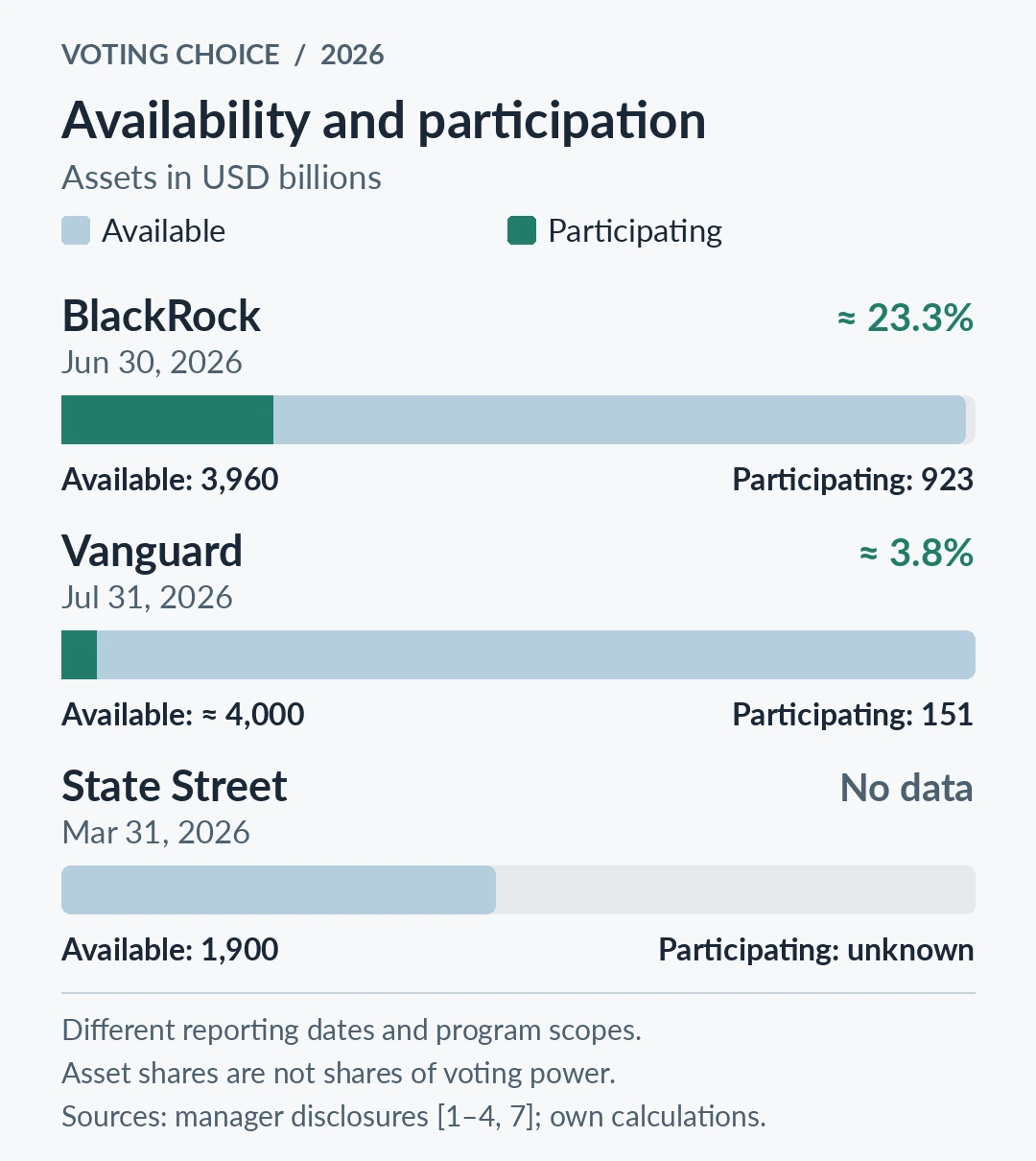
According to BlackRock's figures as of June 30, 2026, the company managed $8.79 trillion in index equity assets. The program was available for $3.96 trillion, and clients with approximately $923 billion in assets were using the option. Our calculations yield approximately 23.3 percent of eligible assets, or 10.5 percent of total index equity assets under management. The data come from the indexed current webpage and an October 30, 2026 publication by BlackRock authors; the directly accessible webpage displayed an earlier snapshot. [1] [2]
This distinction matters: the program covers a large pool of capital, but the figures do not tell us how many investors independently decided on an individual proposal or how many votes were cast differently because of the program.
Vanguard Investor Choice
Vanguard introduced Investor Choice in 2023. According to its September 29, 2026 announcement, the number of participating investors rose from 82,000 to 507,000 between 2025 and 2026, while participating assets increased from $9 billion to $151 billion. Relative to approximately $4 trillion in eligible assets, participation by asset value was about 3.8 percent in July 2026. Policies had already been selected in advance for an additional $120 billion, but those assets were in funds scheduled to join the program later. We therefore do not include them in the assets already participating. [3] [4]
Vanguard offers five different policies. The following snapshot shows selections weighted by the value of participating investors' assets in 32 eligible mutual funds and ETFs, rather than the proportion of all investors or all votes.
| Voting policy | Share of assets with active policy selections, July 31, 2026 |
|---|---|
| Company Board-Aligned | 38% |
| Fund Proxy Policy | 28% |
| Egan-Jones Wealth-Focused | 22% |
| Glass Lewis ESG | 12% |
| Mirror Voting | 1% |
Source: Vanguard, corrected publication of Investor Choice results. The figures add up to 101 percent due to rounding. [3] [4]
The first policy follows the recommendations of the company's board of directors, Fund Proxy Policy follows the policy adopted by the relevant governing body of the fund, and the Egan-Jones and Glass Lewis policies follow recommendations from external providers with different criteria. Under mirror voting, votes are allocated approximately in proportion to other shareholders' votes available through the relevant intermediary's network at the time of calculation; if this cannot reasonably be done, the shares concerned are not voted. If an investor does not select a policy, the fund's default policy remains in effect. [3]
On November 9, 2026, Vanguard announced that it would expand the program to its entire US equity index product lineup in early 2027. According to its announcement, this would make $8.2 trillion in assets eligible. This is a projection of program coverage, not participation already achieved. [5] New options are also emerging in Europe: a notice dated November 10, 2026, from the Irish company Vanguard Funds plc concerning two UCITS funds provides for enrollment from November 16 and implementation from approximately March 1 through June 30, 2027, but only for eligible professional intermediaries. The notice had not yet been reviewed by the Central Bank of Ireland. It does not establish that the program is generally available to retail investors in Slovenia. [6]
State Street Proxy Voting Choice
State Street Investment Management allows clients in eligible separate accounts and certain mutual funds and ETFs to choose voting policies. Policies from external providers, including ISS, Glass Lewis and Egan-Jones, are also available, subject to product, regional and other restrictions. For clients who do not participate, the existing voting arrangements generally remain in effect. Some separate-account clients who have not delegated voting authority to the manager can continue to vote directly. [7]
The more recent indexed official webpage for March 31, 2026, reports that the program covers $1.9 trillion in assets, or 81 percent of eligible index equity assets as defined by the company. The directly accessible earlier version of the page reports $2.2 trillion and 80 percent at the end of 2025. Because the reporting dates and versions of the webpage differ, we do not infer a trend from these figures. We did not find data on the assets for which clients had actually opted to participate. [7]
| Program and reporting date | Eligible or accessible assets (USD billions) | Participating assets (USD billions) | Participation rate |
|---|---|---|---|
| BlackRock, June 30, 2026 | 3,960 | 923 | ~23.3% |
| Vanguard, July 31, 2026 | ~4,000 | 151 | ~3.8% |
| State Street, March 31, 2026 | 1,900 | No data | Not determinable |
Sources: Asset managers' publications and our calculations based on rounded figures. Differences in reporting dates and program scopes limit direct comparability; the table is not used to calculate a combined share of voting power. [1] [2] [3] [4] [7]
Tesla and ExxonMobil: Do different policies lead to different votes?
Vanguard's December 2025 briefing shows how the policies were applied to a vote on compensation for Tesla's chief executive officer at its November 6, 2025 annual meeting. A second briefing, published in June 2026, examines the proposal to change ExxonMobil's state of legal domicile from New Jersey to Texas at the May 27, 2026 annual meeting. For both proposals, reported voting directions differ across policies. [8] [9]
| Policy | Tesla, Proposal 4 (2025) | ExxonMobil, Proposal 4 (2026) |
|---|---|---|
| Company Board-Aligned | For | For |
| Egan-Jones Wealth-Focused | For | For |
| Glass Lewis ESG | Against | Against |
| Mirror Voting | Proportionate | Proportionate |
| Fund policy | For | For (VCM and VPM) |
At the time of the Tesla vote, the fund policy was called Vanguard-Advised Funds Policy; for ExxonMobil, separate fund policies for Vanguard Capital Management (VCM) and Vanguard Portfolio Management (VPM) are listed. Sources: Vanguard's two briefings; the original table was reviewed for Tesla and the document text for ExxonMobil. [8] [9]
Tesla: Vanguard executive pay briefing (2025)
ExxonMobil: Vanguard redomiciliation briefing (2026)
The corporations' official filings also show the aggregate results. Tesla reported 1,892,235,822 votes for and 564,940,908 against the compensation proposal, with 12,227,846 abstentions and 302,456,274 broker non-votes (votes that brokers could not cast because they lacked the relevant authority). For its redomiciliation proposal, ExxonMobil reported 2,216,403,048 votes for and 896,852,562 against, with 30,111,060 abstentions and 493,518,532 broker non-votes. [10] [11]
Tesla: official annual meeting results (Form 8-K, 2025)
ExxonMobil: official annual meeting results (Form 8-K, 2026)
Among votes cast for or against, support amounted to about 77.0 percent at Tesla and 71.2 percent at ExxonMobil. These are the results for all shareholders, not just participants in Vanguard's program. At the same ExxonMobil meeting in 2026, a separate proposal to expand the choice of policies in the company's own voting program for retail shareholders received 23.5 percent support among votes cast for or against. This is a different program, not Vanguard Investor Choice. [10] [11]
The two cases demonstrate that voting decisions within investment funds can differ. Without detailed quantitative records for individual funds and policies, however, it is not possible to determine how many votes each policy contributed or whether the outcome would have been different without that choice. Form N-PX can disclose the direction and quantity of votes or voting instructions, but it does not guarantee that each vote can be linked to the selected policy or the identity of the ultimate investor. We were unable to review all the relevant records for 2026 in this research. [12]
Democratization of capital or a new form of intermediation?
The programs offer investors an additional way to express their preferences, but they do not establish a system of one person, one vote. Voting weight derives from the rights attached to an investment; the votes actually available may be affected by securities lending, voting restrictions and intermediaries' ownership data. [3] Nor does choosing a policy from an external adviser eliminate intermediation; instead, it may shift some decision-making to the policy provider.
In July 2026, Andrey and Nadya Malenko published a study titled Voting Choice in The Review of Financial Studies. Their theoretical model suggests that choice can better reflect investors' differing preferences, but when information is costly or interests diverge, it can weaken informed decision-making and asset managers' incentives to acquire information. This does not establish that specific programs are harmful or beneficial; the study provides a framework for assessing their potential effects. [13]
Conclusion: Who holds voting power?
Voting policy choice enables a partial dispersion of decision-making. The two documented cases show that different policies can lead to different voting directions. At the same time, the availability and participation figures indicate that we cannot yet speak of a general transfer of decision-making to investors. When assessing the programs, we must therefore look beyond their reach and monitor actual participation, the design of default policies, the role of external advisers and the votes executed.
This concludes our section on the giants of global capital. Ownership, asset management, custody and voting authority are distinct but interconnected dimensions of economic power. In the next section, we will turn to institutional capital, beginning with pension funds: whose money is invested around the world through them?
Sources and further reading
- BlackRock (2026). [BlackRock Voting Choice](), participation options, FAQ and footnotes 4–7; indexed snapshot as of June 30, 2026. Source
- Roe, J. and Balic, A. (October 30, 2026). [2026 Global Voting Spotlight](), Harvard Law School Forum on Corporate Governance, BlackRock Voting Choice section; indexed authors' summary, BlackRock data. Source
- Vanguard (2026). [Vanguard Investor Choice](), How it works, Policy options and footnotes; earlier accessible version and current indexed snapshot as of July 31, 2026. Source
- Vanguard (September 29, 2026). [Vanguard Investor Choice Participation Grows More Than Sixfold, Surpassing Half a Million Investors](), 2026 Investor Choice Data; [corrected release on PR Newswire](), policy table; [How Investors Vote]() (October 27, 2026), authors' summary, Significant Growth section. Indexed records from the same issuer. Source 1 Source 2 Source 3
- Vanguard (November 9, 2026). [Vanguard Expands Investor Choice to All U.S. Equity Index Products](), indexed official announcement of the planned expansion in 2027. Source
- Vanguard Funds plc (November 10, 2026). [Notice to the Shareholders of Vanguard S&P 500 UCITS ETF and Vanguard FTSE All-World UCITS ETF](), pp. 1–2, dates, eligible participants and regulatory disclaimer; document text reviewed, visual preview unavailable. Source
- State Street Investment Management (2026). [Proxy Voting Choice](), About the program, Voting policy options and footnotes; accessible earlier version and current indexed snapshot as of March 31, 2026. Source
- Vanguard (December 2025). [Executive pay at Tesla, Inc.](), Proposal 4, p. 2, table and footnotes. Source
- Vanguard (June 2026). [Investor Choice Voting Briefs: ExxonMobil redomiciliation](), Proposal 4, pp. 2–3, table and footnotes; document text reviewed, visual preview unavailable. Source
- Tesla, Inc. (November 7, 2025). [Form 8-K – Annual Meeting Voting Results](), Item 5.07, Proposal 4. Source
- Exxon Mobil Corporation (May 29, 2026). [Form 8-K – Annual Meeting Voting Results](), Item 5.07, Proposals 4 and 6. Source
- U.S. Securities and Exchange Commission (December 21, 2022). [Enhanced Reporting of Proxy Votes – A Small Entity Compliance Guide](), Quantitative Disclosures. Source
- Malenko, A. and Malenko, N. (July 13, 2026). [Voting Choice](). The Review of Financial Studies, hhag065; bibliographic record and [ECGI working paper abstract](), Finance Working Paper 910/2023, revised July 1, 2026. Source 1 Source 2