Common Ownership of Competitors: Does It Affect Prices and Competition?
Reviews research and debate about common institutional ownership of competing firms and its possible competitive effects.

Artistic illustration of investments in competing companies within the same portfolio. It does not depict actual ownership stakes or constitute evidence of effects on prices or cartel conduct. AI-generated.
When we buy an airline ticket, choose a bank or compare offers from competing companies, we expect those companies to compete for our money. But what happens when the same financial institutions manage a significant proportion of their shares? Can the shared interests of investors influence how companies compete with one another?
In the previous articles, we examined overlapping portfolios at BlackRock, Vanguard and State Street, as well as the exercise of voting rights. We will now explore the potential consequences for consumers. We will draw on conflicting economic studies from the United States and a case from Norway, without automatically extending their findings to the global economy.
What is common ownership of competitors?
Common ownership occurs when the same investors hold stakes in several companies that compete with one another. It differs from cross-ownership, in which a company holds a stake in its competitor. Neither form of ownership in itself constitutes a cartel, which involves prohibited anticompetitive coordination. [1] [13]
For savers, investment diversification can be beneficial: the failure of one company has less impact on the overall portfolio. However, when large portfolios overlap, the question arises whether the interest in the performance of the entire portfolio may differ from the interest of an individual company in gaining market share at its competitors' expense. [1]
How might economic incentives change?
Imagine two competing companies. Company A lowers its price, attracts customers and increases its profit by ten million euros. Company B loses fifteen million euros in profit because it loses customers. An investor with a five percent stake in company A alone gains a proportionate interest in the additional profit amounting to half a million euros. An investor with the same stake in both companies, however, faces a different outcome.
| Change in proportionate interest in profits | Owner of A only | Common owner of A and B |
|---|---|---|
| Company A (5% stake) | +€500,000 | +€500,000 |
| Company B (0% or 5% stake) | €0 | −€750,000 |
| Total | +€500,000 | −€250,000 |
Author's hypothetical calculation; this does not represent actual investments, dividend payments or a price forecast.
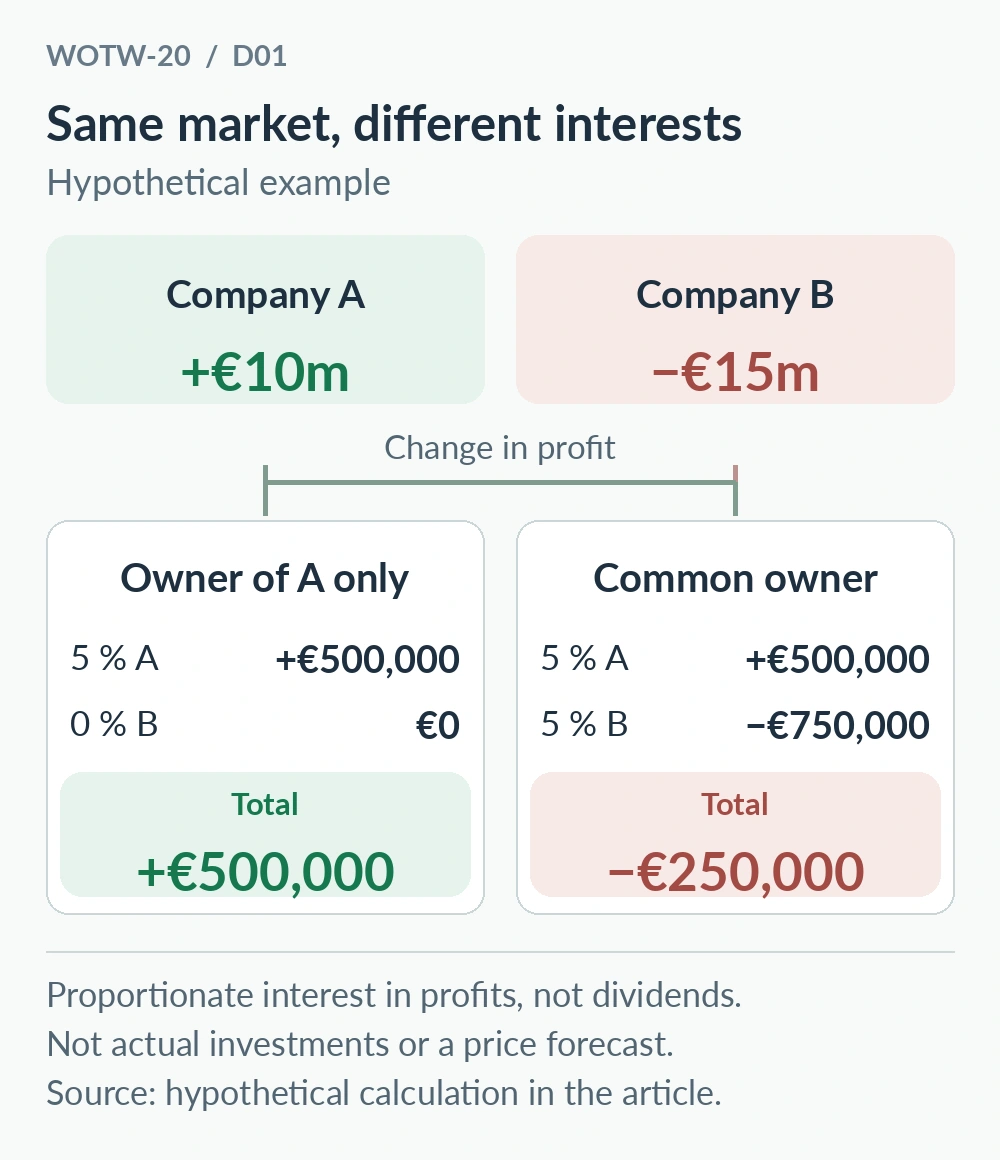
If company A's management were to take the common owner's interest in company B into account when setting prices, its incentive to compete aggressively could diminish. But this condition is crucial. An asset manager is not necessarily the ultimate economic owner, and a company's management does not automatically act in accordance with an individual shareholder's entire portfolio. Potential channels of influence include engagement with management, voting authority and executive compensation arrangements. The existence of these channels does not establish that they have been used to reduce competition. [1] [2]
The airline industry: The debate over ticket prices
In 2018, José Azar, Martin C. Schmalz and Isabel Tecu published a study of the US airline industry in The Journal of Finance. They found a positive association between changes in common ownership and ticket prices on the same airline routes. In their attempt to identify causality, they drew, among other things, on changes in ownership relationships associated with BlackRock's acquisition of Barclays Global Investors. [2]
Azar, Schmalz and Tecu: original common ownership study (2018)
The researchers used the modified Herfindahl–Hirschman Index (MHHI). The standard HHI measures the concentration of companies' market shares, while the modified measure also accounts for ownership relationships and assumptions about shareholder influence. These assumptions matter because the result depends not only on ownership data but also on how markets and control are measured. [2] [3]
In 2022, Patrick Dennis, Kristopher Gerardi and Carola Schenone published a reanalysis and found that the original association with prices could be explained primarily by the market-share component of the concentration measure, rather than its ownership and control components. The results were also sensitive to the treatment of companies undergoing bankruptcy proceedings and to assumptions about investor influence. [3] In their 2017 working paper, Kennedy and colleagues likewise found no evidence of higher prices due to common ownership. In 2021, however, Azar, Schmalz and Tecu challenged their methodology, particularly their sample selection and model estimation approach. [4] [5]
Dennis, Gerardi and Schenone: explanation of the reanalysis (2022)
José Azar and Xavier Vives offered an important addition to the debate in a January 2025 working paper. Their analysis of US airline data for 2001–2019 distinguishes between common ownership within industries and across industries. In their model, the former is associated with higher prices and the latter with lower prices. For the Big Three, the estimated net effect of the two relationships in their analysis points toward lower prices. Not all estimates are statistically significant, and the result depends on the model used. [6] The debate is therefore not simply a choice between the claims that common ownership always harms competition or that it never affects it.
Banking: Does common ownership affect savers?
In a study published in Financial Management in 2022, José Azar, Sahil Raina and Martin Schmalz examined deposit interest rates, account maintenance fees and fee thresholds. While the standard HHI showed no association with the outcomes examined, their generalized measure of concentration (GHHI) was associated with all the pricing indicators studied. Because the GHHI incorporates both common ownership and cross-ownership, the finding cannot be attributed to common ownership alone. [7]
In a revised 2024 working paper, Serafin Grundl and Jacob Gramlich used more extensive ownership data and compared local banking markets. After controlling for individual bank-quarter effects, their results generally did not support the hypothesis. According to their 95 percent confidence intervals, the tripling of the common ownership measure for publicly traded banks between 2005 and 2022 corresponded to a change in deposit interest rates of less than 0.0025 percentage points in either direction. Their results for deposit quantities also did not support the hypothesis. [8]
These are the findings of the working paper's authors, not an official position of the US Federal Reserve. Nor can they be generalized to all banking services, lending rates or other countries.
Norway: What do ultimate owners reveal?
In 2025, Inga Heiland published a study of Norwegian companies that included the ultimate owners of both public and private firms. To better isolate changes in ownership from other economic factors, she examined cases in which marriages between shareholders created new connections among the owners of competing companies. [9]
| Comparative research design | Estimated difference in profit margins |
|---|---|
| Comparison of firms within the same marriages | +15.6 percentage points |
| Comparison of firms within the same industry | +6.8 percentage points |
Source: Heiland (2025), Table 7, columns 2 and 4, period 2005–2018. The first estimate is statistically significant at the 10 percent level and the second at the 5 percent level. [9]
The findings support the possibility that changes in common ownership can affect business outcomes under certain circumstances. Higher profit margins, however, are not the same as higher retail prices: costs and other factors may also affect margins. Moreover, this study concerns connections among ultimate owners in Norway, so these estimates cannot be attributed to the Big Three asset managers.
What does more recent research show, and what do regulators recognize?
In their 2024 critical review of the literature, Kristopher Gerardi, Michelle Lowry and Carola Schenone concluded that a scientific consensus had yet to emerge and that the studies with the most convincing causal identification methods at the time provided relatively little evidence that common ownership reduced competition. This is the review authors' assessment of the literature up to 2024, not a definitive assessment of all subsequent research. [10]
In October 2026, Saeed Janani and colleagues reported in a study of US aviation for 1995–2025 that greater common ownership was associated with higher prices and lower service quality. Their main measure is based on the number of common institutional investors at a five percent threshold, using data on sole voting power. [11] Another 2026 study, published by Huaizhou Li and colleagues, used US antitrust lawsuits and found no robust association between common ownership of two companies and the likelihood that they would be sued together. [12] Both findings are summarized from indexed portions of the publications, as their full texts were not directly accessible for review. The studies measure different phenomena: the absence of an association with lawsuits does not rule out higher prices or less intense competition, while an association with prices does not establish a cartel agreement.
In Guideline 11 of their joint 2023 Merger Guidelines, the US Department of Justice (DOJ) and the Federal Trade Commission (FTC) address the potential adverse effects of acquiring minority stakes. They highlight the possibility of influencing competitive decisions, reducing incentives to compete and gaining access to competitively sensitive information. In February 2025, the FTC confirmed the continued use of these guidelines. [13] This is a nonbinding regulatory framework, not a court ruling on the legality of all common investments.
Conclusion: Capital concentration and the future of competition
Common ownership raises an important question about the relationship between the benefits of diversified investing and the independence of competitors. Some empirical studies support the hypothesis of anticompetitive effects, while others do not; no general effect across all markets can be inferred. A more reliable assessment requires establishing the extent of ownership ties, the relevant powers, evidence that incentives translate into decisions, and an analysis of actual or likely market consequences. We have not independently replicated the econometric analyses of the studies discussed in this article.
If a significant part of economic influence derives from delegated voting rights, another question arises: can some of the decision-making power be returned to investors? In the next article, we will examine Voting Choice programs, what they actually make possible and their limitations.
Sources and further reading
- OECD (December 6, 2017). [Common Ownership by Institutional Investors and its Impact on Competition](), roundtable summary and key findings. Source
- Azar, J., Schmalz, M. C. and Tecu, I. (2018). [Anticompetitive Effects of Common Ownership](). The Journal of Finance, 73(4), 1513–1565, abstract; [IESE working paper WP-1169-E]() (2017), introduction and methodology. Source 1 Source 2
- Dennis, P., Gerardi, K. and Schenone, C. (2022). [Common Ownership Does Not Have Anticompetitive Effects in the Airline Industry](). The Journal of Finance, 77(5), 2765–2798, abstract; [authors' explanation](), November 7, 2022. Source 1 Source 2
- Kennedy, P., O’Brien, D. P., Song, M. and Waehrer, K. (2017). [The Competitive Effects of Common Ownership: Economic Foundations and Empirical Evidence](), working paper, indexed abstract. Source
- Azar, J., Schmalz, M. C. and Tecu, I. (2021). [Research on the Competitive Consequences of Common Ownership: A Methodological Critique](). The Antitrust Bulletin, 66(1), 113–122, indexed abstract. Source
- Azar, J. and Vives, X. (January 20, 2025). [Revisiting the Anticompetitive Effects of Common Ownership](), working paper, abstract, Section 8, Table 6 and Figure 3. Source
- Azar, J., Raina, S. and Schmalz, M. (2022). [Ultimate ownership and bank competition](). Financial Management, 51(1), 227–269, abstract; [RePEc bibliographic record and abstract](). Source 1 Source 2
- Grundl, S. and Gramlich, J. (2024). [Assessing the Common Ownership Hypothesis in the US Banking Industry](). Finance and Economics Discussion Series, 2024-022r1, abstract, pp. 1 and 4, estimates on pp. 15–16. Source
- Heiland, I. (2025). [Common Ownership and Competition: Evidence from Ultimate Owners of Private and Public Firms](). The Review of Corporate Finance Studies, cfaf017, Section 3.2 and Table 7. Source
- Gerardi, K., Lowry, M. and Schenone, C. (2024). [A Critical Review of the Common Ownership Literature](). Annual Review of Financial Economics, 16, 89–114, abstract. Source
- Janani, S., Aghaie, S., Fotheringham, D. and Houston, M. B. (October 26, 2026). [Common ownership and consumer welfare](). Journal of the Academy of Marketing Science, indexed abstract and excerpts from the methodology section. Source
- Li, H., Liu, L., Masulis, R. and Zein, J. (2026). [Does common ownership raise antitrust concerns?](). Journal of Corporate Finance, 100, 103037, indexed abstract and excerpts from the introduction. Source
- U.S. Department of Justice and Federal Trade Commission (2023). [2023 Merger Guidelines, Guideline 11](), Section 2.11; FTC (February 18, 2025), [confirmation of continued use of the guidelines](). Source 1 Source 2