Who Actually Votes in the World's Largest Corporations?
How institutional shareholders vote and how voting mandates differ from economic ownership.

Artistic illustration of delegated voting authority and its concentration among institutional representatives. Not a depiction of an actual voting procedure. AI-generated.
Millions of people invest their money in investment and pension funds that buy shares in large corporations. Although investors have an economic interest in these investments, they do not usually decide directly on the composition of the boards of all the companies in the portfolio. Who, then, exercises the rights attached to capital on their behalf, and how much power do those who make voting decisions have?
In the previous articles, we explored the overlap in the investments of BlackRock, Vanguard and State Street. This time, we will examine documented cases from the United States to understand how potential voting power translates into actual decisions. US rules do not represent a universal framework for all capital markets around the world.
From the investor to the shareholder vote
When investors purchase shares in a fund, they acquire rights arising from their investment in the fund, but not automatically the right to vote directly on every share held in its portfolio. Who exercises voting rights depends on the fund's legal structure, its contractual mandate and applicable law. Voting authority may be delegated to an investment adviser, who uses its own voting policies and analysis when making decisions. [1]
Proxy voting allows shareholders to participate in a meeting without being physically present. It is important to distinguish between the party authorized to decide how to vote, the party making a recommendation and the party responsible for transmitting the voting instruction. A proxy adviser may influence the decision through its recommendation without itself having the authority to vote the shares in question.
In 2003, the US Securities and Exchange Commission (SEC) adopted Rule 206(4)-6. For investment advisers registered or required to register under the relevant federal law who exercise voting authority over client securities, the rule requires written policies and procedures designed to ensure voting in clients' best interests, address material conflicts of interest and inform clients how to obtain information about voting. [1] The existence of such an obligation does not establish that every adviser always complies with it in practice.
How can actual voting be verified?
Examining ownership lists alone is not enough when investigating economic power. Form 13F discloses certain institutional investment positions, while Schedule 13D and 13G filings disclose powers that may arise from the authority to vote or dispose of securities. Neither type of document alone reveals how an individual investor voted on a specific proposal. [2] [3]
| Document | What it allows us to examine |
|---|---|
| Form 13F | Reported investment positions |
| Schedule 13D or 13G | Disclosed ownership interests and voting authority |
| Proxy statement | Proposals, voting eligibility and voting rules |
| Form N-PX | Reported voting decisions |
| Form 8-K, Item 5.07 | Aggregate meeting results |
In 2022, the SEC adopted amendments to Form N-PX. The first filings under the revised rules were due by August 31, 2024, for the period from July 1, 2023, through June 30, 2024. The disclosures also cover the number of shares voted in each direction and the number of shares loaned and not recalled. The separate reporting obligation for institutional investment managers under Rule 14Ad-1 concerns executive compensation votes (say-on-pay) on which they exercised voting power; its scope therefore differs from that of reporting by registered investment funds. [4] [5]
One important limitation of the form is that a reporting entity that has not received confirmation of the actual number of votes cast before filing may report the number of shares for which voting instructions were issued. [4] When reading Form N-PX, we must therefore distinguish between a reported decision and independent confirmation that it was carried out. Comparisons must align the meeting date, security, fund and individual proposal, while avoiding counting the same voting rights more than once. A single share may be voted on several separate proposals at the same meeting.
What does an individual N-PX entry reveal?
In the voting record of BNY Mellon ETF Trust II for the period ended June 30, 2025, we find an entry concerning the election of ExxonMobil director Kaisa H. Hietala. For the meeting on May 28, 2025, the record for series S000087737 reports support for the candidate with respect to 10,565 shares, in line with management's recommendation. The reported number of shares loaned and not recalled was zero. Indexed information from the same filing identifies the series as BNY Mellon Concentrated Growth ETF. [6]
BNY Mellon: N-PX voting record – ExxonMobil 2025
This is not an example of a Big Three fund, nor does it describe all of BNY Mellon's investments. Its purpose is to show how a public record can link a specific fund, corporation, proposal and voting direction. This research does not provide a comprehensive quantitative review of the voting records of all three major asset managers under discussion for the reporting period ended June 30, 2026.
ExxonMobil: When shareholders change the composition of the board
At ExxonMobil's annual meeting on May 26, 2021, activist investor Engine No. 1 nominated four candidates for the board of directors. Some of the candidates also received support from major institutional investors. According to an accessible third-party reproduction of its voting bulletin, BlackRock supported three candidates, while Vanguard and State Street Global Advisors each supported two according to their own publications, although not exactly the same two. A comparative analysis on the Harvard Law School Forum on Corporate Governance confirms these differences. [7] [8] [9] [10]
| Candidate | BlackRock | Vanguard | State Street Global Advisors |
|---|---|---|---|
| Kaisa Hietala | Yes | Yes | Yes |
| Gregory J. Goff | Yes | Yes | No |
| Alexander A. Karsner | Yes | No | Yes |
| Anders Runevad | No | No | No |
The table shows publicly reported support for the candidates, not the number of votes cast by individual funds. BlackRock's original bulletin was not directly accessible; a published reproduction and a separate comparative analysis were used. [7] [8] [9] [10]
In their explanations, the asset managers emphasized issues concerning board composition, business strategy and risks associated with the energy transition. [7] [8] [9] These are their publicly stated reasons, not independently established internal motives. More direct evidence of an actual change comes from the corporation's own final report.
On June 21, 2021, ExxonMobil published the certified meeting results. Of the 4,233,538,767 shares entitled to vote as of the record date of March 29, 2021, at least 3,047,661,428 shares, or 72.0 percent, were voted at the meeting in person or by proxy. The twelve candidates who received the most votes in favor were elected. Three of them were Engine No. 1 nominees. [11]
| Engine No. 1 candidate | Total votes in favor | Outcome |
|---|---|---|
| Kaisa Hietala | 1,510,819,249 | Elected |
| Gregory J. Goff | 1,425,523,196 | Elected |
| Alexander A. Karsner | 1,218,032,919 | Elected |
| Anders Runevad | 295,055,259 | Not elected |
Source: ExxonMobil, final certified results, Form 8-K/A, June 21, 2021. [11]
ExxonMobil: final certified results of the 2021 annual meeting
This case shows that institutional investors can participate in significant changes to the governance of a large corporation. However, the final result does not disclose the number of votes cast by each asset manager separately. Nor can we determine what the outcome would have been without the support of a particular institution if we lack data about its contribution and the other circumstances of the vote. The different sets of candidates supported show why we cannot automatically treat the Big Three as a single voting bloc.
Chevron–Hess: When does a majority mean a majority?
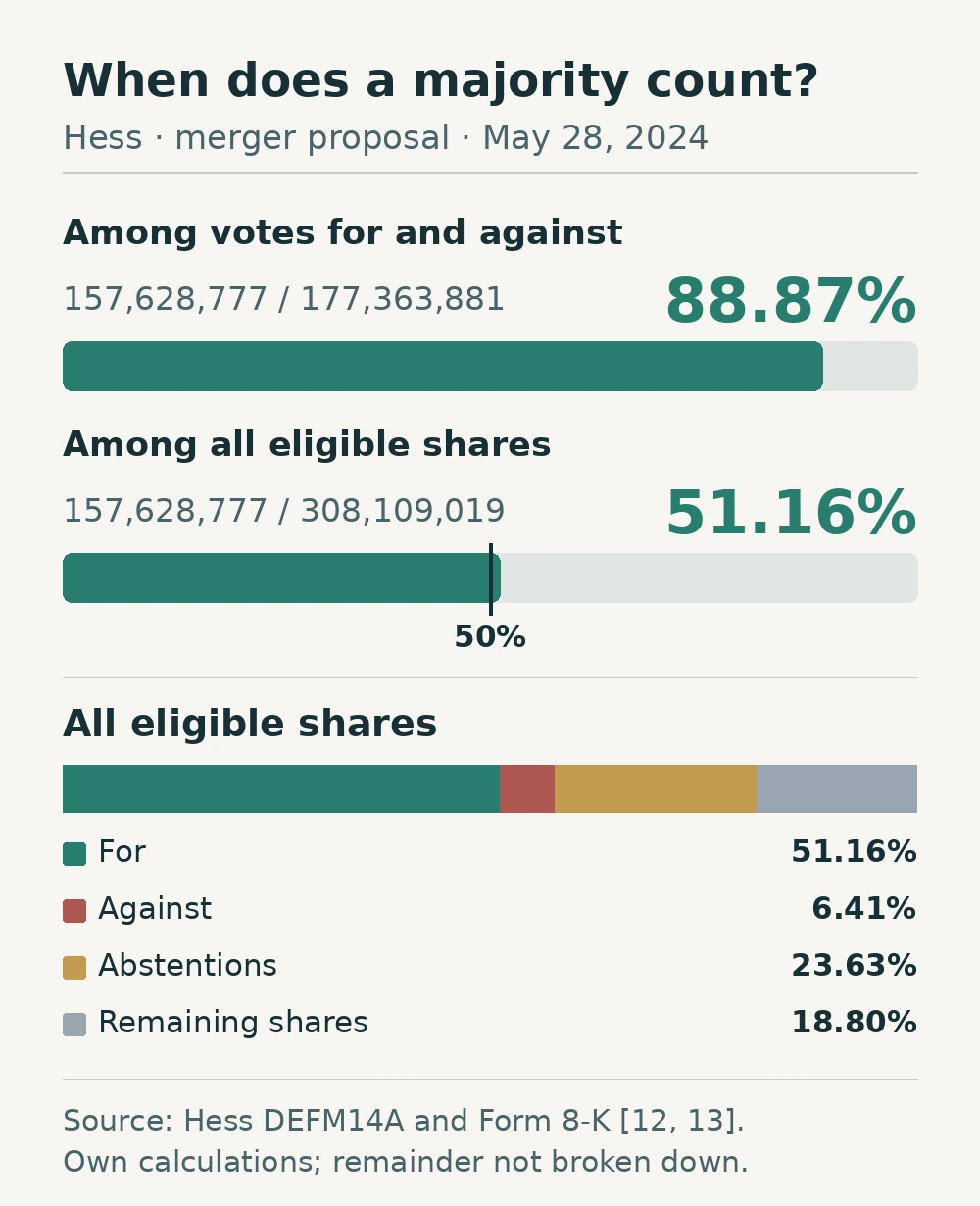
A different example of economic decision-making is the Hess special meeting on May 28, 2024, at which shareholders voted on the proposed merger with Chevron. As of the record date of April 12, 2024, 308,109,019 common shares were entitled to vote, each carrying one vote. Adoption of the merger proposal required a majority of all eligible shares, not merely a majority of the votes cast for or against. [12]
| Voting decision | Number of shares |
|---|---|
| For | 157,628,777 |
| Against | 19,735,104 |
| Abstentions | 72,818,634 |
| Remaining eligible shares | 57,926,504 |
The remainder is calculated from the total number of eligible shares and the three published categories. Source: Hess, special meeting materials and Form 8-K, May 31, 2024. [12] [13]
Hess: results of the 2024 special meeting on the merger
The proposal received 88.87 percent of the votes if we count only votes for and against. Relative to all eligible shares, however, support was 51.16 percent. The minimum number of votes in favor required was 154,054,510, so the proposal exceeded the required threshold by 3,574,267 votes. In this vote, abstentions, votes not cast and broker non-votes (where a broker lacked authority to vote) had the same effect on reaching the threshold as votes against, although they were not recorded as votes against. [12] [13]
On the same day, a separate, nonbinding advisory proposal concerning merger-related executive compensation was rejected, even though it received more votes for (112,970,138) than against (109,888,516). There were 27,323,861 abstentions, and the required majority was a majority of the shares present in person or represented by proxy and entitled to vote on that proposal. [12] [13] Two proposals at the same meeting may therefore be subject to different majority requirements. These figures do not reveal how the Big Three voted, nor do they themselves establish that the business transaction was completed.
Conclusion: The power to decide on behalf of capital
The modern system of collective investment allows dispersed economic interests to be pooled in large portfolios, while voting authority may become concentrated in a relatively small number of institutions. This creates an important mechanism of economic influence that cannot be fully understood by examining ownership stakes alone. At the same time, voting authority is not unlimited: we must consider mandates, the rules of individual meetings, other shareholders and the distinction between reported decisions and those actually carried out.
The question of capital concentration, however, extends beyond the governance of a single corporation. What happens when the same major asset managers invest in several companies that compete with one another? In the next article, we will examine whether, and under what conditions, common ownership of competitors can affect prices and competition.
Sources and further reading
- U.S. Securities and Exchange Commission (2003). [Proxy Voting by Investment Advisers, Release IA-2106](), section II.A and rule text; [17 CFR § 275.206(4)-6](), paragraphs (a)–(c). Source 1 Source 2
- U.S. Securities and Exchange Commission. [Frequently Asked Questions About Form 13F](), SEC staff guidance on the scope of reporting and voting authority. Source
- 17 CFR § 240.13d-3(a). [Determination of beneficial owner](). Source
- U.S. Securities and Exchange Commission (2022). [Enhanced Reporting of Proxy Votes by Registered Management Investment Companies; Reporting of Executive Compensation Votes by Institutional Investment Managers, Release 33-11131](), section II.C.3, pp. 33–41, and Special Instruction D.5. Source
- U.S. Securities and Exchange Commission (December 21, 2022). [Enhanced Reporting of Proxy Votes – A Small Entity Compliance Guide](), SEC staff guidance. Source
- BNY Mellon ETF Trust II (August 29, 2025). Form N-PX, period ended June 30, 2025, accession 0001627854-25-000012: [voting record](), [cover page]() and [filing index](); series identity from indexed information. Source 1 Source 2 Source 3
- BlackRock Investment Stewardship (May 26, 2021). [Vote Bulletin: ExxonMobil Corporation](), third-party reproduction on Readkong, BlackRock Vote and Rationale sections; original not directly accessible. Source
- Vanguard (May 2021). [Voting insights: A proxy contest and shareholder proposals related to material risk oversight at ExxonMobil](), pp. 1–2. Source
- State Street Global Advisors (May 27, 2021). [2021 Proxy Contest: Exxon Mobil Corporation (XOM)](), Vote decisions section, p. 2; document text reviewed. Source
- Harvard Law School Forum on Corporate Governance (July 24, 2021). [Was the Exxon Fight a Bellwether?](), comparative table of candidate support. Source
- Exxon Mobil Corporation (June 21, 2021). [Form 8-K/A – final certified voting results of the 2021 Annual Meeting](), Item 5.07, Proposal 1, pp. 2–3. Source
- Hess Corporation (April 26, 2024). [Definitive Proxy Statement (DEFM14A) – proposed Chevron merger](), Q&A, pp. 3–5, Record Date and Required Vote, pp. 26–27 and 129. Source
- Hess Corporation (May 31, 2024). [Form 8-K – special meeting voting results](), Item 5.07, Proposals 1 and 2. Source