BlackRock, Vanguard and State Street: What Does the Overlap in Their Investments Mean?
Explains why BlackRock, Vanguard and State Street appear in overlapping shareholder registers and what that means.

Symbolic illustration of overlapping investment portfolios across the same economy. The layers do not represent actual ownership stakes, an ownership hierarchy or proven coordination among asset managers. AI-generated illustration.
When we examine the ownership structures of large US corporations, the names BlackRock, Vanguard and State Street appear time and again among their reported shareholders. How is it possible that the same financial institutions are linked to such diverse companies, from food producers to technology giants? And what does their presence mean for the distribution of economic power?
In the previous three articles, we explored the different roles of these institutions. Our focus now extends beyond the size of individual asset managers to the network of investment relationships that emerges when several managers invest in the same companies.
Why do investments overlap?
One reason is index investing. An index fund seeks to track the performance of a selected market index. If several large funds track the same index, we can expect their portfolios to contain shares in many of the same companies. In a market-capitalization-weighted index, larger companies generally carry greater weight. Similar portfolios can therefore emerge without direct coordination between their managers. [9]
Good examples are the iShares Core S&P 500 ETF (IVV), Vanguard 500 Index Fund, whose exchange-traded share class is VOO, and SPDR S&P 500 ETF Trust (SPY). All three track the S&P 500 index, but they are not the same fund. Their portfolios differ in size, and the funds have different investors and legal structures. When comparing them, we must therefore distinguish between an individual fund and the broader financial group within which its services are provided. [4] [5] [6]
What do ownership filings actually reveal?
One of the most important US sources for researching institutional investments is Form 13F. The reporting requirement applies, among others, to institutional investment managers exercising investment discretion over securities in the prescribed category with a value of at least $100 million on the last trading day of any month of a calendar year. The prescribed deadline for the relevant quarterly filings is 45 days after the end of the period. [1] [2]
The form allows us to examine reported positions and distinguish between investment discretion and voting authority. It is not, however, a complete register of all assets managed by an institution, ultimate economic beneficiaries or votes actually cast. The category of beneficial ownership in Schedule 13D and 13G filings also has a specific legal meaning: it may arise from the power to vote or dispose of securities. [3]
When compiling an overall picture of ownership, we must therefore check the reporting date, the class of securities, any amended filings and the relationships between reporting entities. If an asset manager already reports the shares held by a particular fund, those shares must not be counted again in addition to its aggregate position. Likewise, call or put options are not equivalent to direct holdings of the underlying shares. [1] [2]
PepsiCo: The same company in three portfolios
PepsiCo provides an opportunity to observe overlapping investments directly in the documentation of three specific funds. The following figures refer to the same date, March 31, 2026. [4] [5] [6]
| Fund | Number of PepsiCo common shares |
|---|---|
| iShares Core S&P 500 ETF (IVV) | 17,567,314 |
| Vanguard 500 Index Fund (all share classes) | 34,799,301 |
| SPDR S&P 500 ETF Trust (SPY) | 15,839,639 |
The table shows the positions of individual funds, not all the investments of BlackRock, Vanguard and State Street. For Vanguard, it includes all share classes of Vanguard 500 Index Fund, rather than only the exchange-traded VOO share class. Differences in the size of these positions do not in themselves reveal which asset manager has the greatest influence over PepsiCo.
PepsiCo's 2026 proxy statement offers another perspective. It lists The Vanguard Group with 137,677,940 shares, or 10.1 percent of the class, and BlackRock with 111,846,376 shares, or 8.2 percent of the class. However, Vanguard's position relates to May 30, 2025, while BlackRock's relates to December 31, 2023. Both percentages are calculated using the number of outstanding shares entitled to vote as of February 26, 2026. [7]
PepsiCo: 2026 proxy statement – ownership of common stock
This means that even an issuer's official table does not necessarily provide a snapshot based on a single date. Adding these percentages together and presenting the result as the institutions' current combined holding would be unjustified. Nor does State Street's absence from this particular table mean that its funds do not hold PepsiCo shares, as the SPY portfolio itself demonstrates.
Meta: A large shareholding does not necessarily mean a majority of the votes
Similar overlap can be found at Meta Platforms. As of March 31, 2026, Vanguard 500 Index Fund and SPY reported holdings of 55,698,056 and 25,363,279 Meta Class A shares, respectively. [5] [6] In this example, we do not give the exact number of shares held by the third fund, IVV, because the discrepancy between the text and visual rendering of its report could not be resolved. [4]
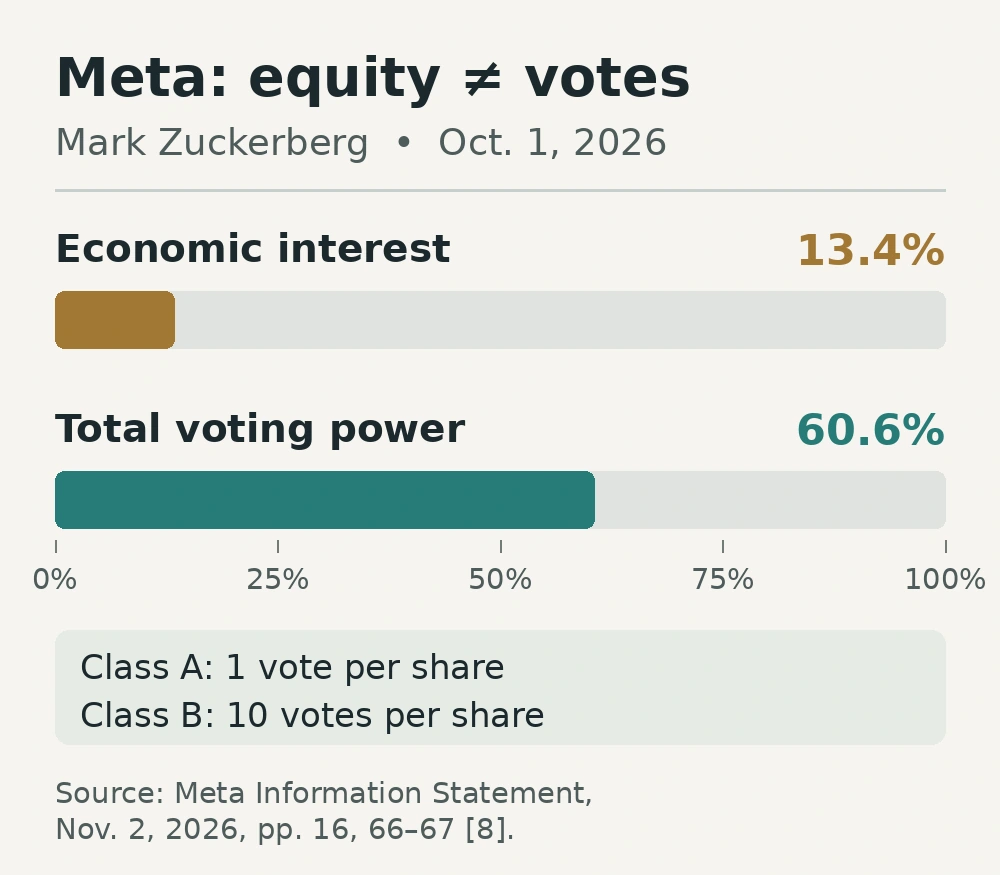
Meta's share structure is more important for understanding the power of its shareholders. In a document dated November 2, 2026, the company explains that each Class A share carried one vote and each Class B share carried ten votes. In the ownership snapshot as of October 1, 2026, approximately 60.6 percent of the total voting power was attributed to Mark Zuckerberg, although his disclosed economic interest was approximately 13.4 percent. [8]
Meta: Information Statement, November 2, 2026 – economic interest and voting rights
| Reporting entity or individual | Percentage of Class A shares | Percentage of total voting power according to the issuer's table |
|---|---|---|
| Entities associated with Vanguard Capital Management | 7.4% | 2.9% |
| Entities associated with BlackRock | 7.1% | 2.8% |
| Mark Zuckerberg | less than 1% | 60.6% |
Source: Meta Information Statement, November 2, 2026, pp. 66–67. The institutional holdings are based on filings with different filing dates (April 30, 2026, and February 12, 2024). [8]
The total voting power column in this table reflects the weight of the disclosed shares relative to the votes of both classes. It does not necessarily establish that each asset manager has independent voting authority over all those shares. This example shows how a particular share-class structure can preserve a founder's decisive voting power even in the presence of large institutional investments. It is a dated snapshot, not a claim that the situation will remain unchanged in the future.
How widespread is the overlap among the Big Three?
In 2017, researchers Jan Fichtner, Eelke M. Heemskerk and Javier Garcia-Bernardo published an analysis of historical ownership data for publicly traded US companies. In the 2015 data, BlackRock, Vanguard and State Street, when their positions were considered together, constituted the largest shareholder in 438 of the 500 companies in the S&P 500 index. [9]
This finding means that the combined position of the Big Three, for analytical purposes, exceeded that of any other individual shareholder in approximately 88 percent of the companies analyzed in the index. It does not mean that they owned 88 percent of those companies' capital, held a majority stake in each of them or acted as a single legal entity. Nor is it a measurement for 2026.
The research raises the question of structural power. An asset manager with large, long-term positions in numerous corporations may play an important role in their governance. In index investing, the ability to exit an individual investment because of disagreement with management is constrained by the investment mandate. Such a constraint may limit certain forms of influence while increasing the importance of others, such as participating in shareholder votes and engaging with management. [9]
Conclusion: Overlap, influence or control?
Documented investments show that BlackRock, Vanguard and State Street funds participate in the same capital markets and hold positions in many of the same companies. Tracking common indexes provides an important explanation for this phenomenon. But explaining how overlap arises does not yet answer the question of how much institutional influence becomes concentrated as a result.
Overlap alone does not establish coordinated action, a common economic owner or control over corporations. Such conclusions require additional evidence of actual powers and conduct. The important question, therefore, is not just how many shares individual funds hold, but also who can exercise the rights attached to those shares and under what conditions.
In the next article, we will examine precisely this issue: who actually votes in the world's largest corporations, and how voting records can help us distinguish between potential and exercised influence.
Sources and further reading
- U.S. Securities and Exchange Commission. [Form 13F](), General Instructions 1–4 and Special Instructions. Source
- U.S. Securities and Exchange Commission. [Frequently Asked Questions About Form 13F](), questions 6, 7, 37, 38, 44, 48 and 50a; SEC staff guidance. Source
- 17 CFR § 240.13d-3(a). [Determination of beneficial owner](). Source
- iShares Trust (2026). [2026 Annual Financial Statements and Additional Information – iShares Core S&P ETFs](), as of March 31, 2026, Schedule of Investments for IVV, pp. 3 and 6; inconsistent visual preview of p. 6. Source
- Vanguard 500 Index Fund (2026). [Schedule of Investments (unaudited)](), as of March 31, 2026, Communication Services and Consumer Staples sections. Source
- State Street SPDR S&P 500 ETF Trust (2026). [Semi-Annual Report, March 31, 2026](), Schedule of Investments (unaudited), Meta Platforms and PepsiCo entries. Source
- PepsiCo, Inc. (2026). [2026 Proxy Statement (DEF 14A)](), pp. 97–98, Ownership of PepsiCo Common Stock, footnotes 1–3. Source
- Meta Platforms, Inc. (November 2, 2026). [Information Statement (DEF 14C)](), section on recapitalization and the founder's economic interest, pp. 66–67 and footnotes 1, 16, 17. Source
- Fichtner, J., Heemskerk, E. M. and Garcia-Bernardo, J. (2017). [Hidden power of the Big Three? Passive index funds, re-concentration of corporate ownership, and new financial risk](). Business and Politics, 19(2), 298–326, section 3.2 and figure 2. Source