State Street: Asset Management, Custody and SPDR
Examines State Street’s roles in fund management, custody and the SPDR investment products.

Symbolic illustration of financial infrastructure: custody, recordkeeping and transaction processing support the visible economy. It does not depict actual State Street facilities or unified control of the financial system. AI-generated illustration.
When investors buy shares in an investment fund, they usually encounter the name of its manager. Behind the investment, however, lies an infrastructure that enables asset recordkeeping, transaction processing and the operation of the fund. State Street plays an important role in this less visible part of the financial system. Its example raises the question of whether economic power also arises from other institutions' dependence on financial services they do not perform themselves.
A different kind of financial giant
State Street Corporation is a US bank holding company based in Boston, whose shares are listed on the New York Stock Exchange under the ticker STT. Its principal banking subsidiary is State Street Bank and Trust Company. In addition to managing investments, the group provides numerous services to institutional investors. [1] [2]

At the end of September 2026, it reported $59.17 trillion in assets under custody and/or administration and $6.31 trillion in assets under management. [2] How should we understand these two measures in relation to the company's own assets?
| Financial measure (billions of USD) | Dec. 31, 2025 | Sept. 30, 2026 |
|---|---|---|
| Assets under custody and/or administration (AUC/A) | 53,800 | 59,170 |
| Assets under management (AUM) | 5,670 | 6,310 |
| Consolidated balance sheet assets | 366.047 | 403.341 |
| Shareholders' equity | 27.841 | 28.710 |
Sources: State Street's annual report and quarterly filing; the September 2026 balance sheet figures are unaudited. [1] [2]
AUC/A encompasses client assets for which the company provides custody or administrative services. AUM describes the scale of assets covered by management, advisory or distribution services; according to the company's definition, client assets in this category are not included on its balance sheet. [1] The two measures may overlap, so adding them together would be misleading. Balance sheet assets, meanwhile, are an accounting category distinct from shareholders' equity.
A particular detail in the quarterly release of October 14, 2026, shows that the company's role is not the same for all assets included in AUM. Approximately $172 billion relates to SPDR products for which its affiliate, State Street Global Advisors Funds Distributors, provides marketing services only. [3] The scale of the measure alone therefore does not reveal what authority an institution has over any particular investment.
What does a custodian bank do?
A fund manager is responsible for investing in accordance with the investment objective and the authority granted to it. A custodian bank has a different role: it safeguards securities or maintains records of them and may provide additional transaction-related services. The State Street group also offers fund accounting, administration, reporting and technology solutions for institutional investors. [1]
In the previous article, we examined Vanguard 500 Index Fund. The April 2026 Statement of Additional Information (SAI) for Vanguard Index Funds identifies State Street Bank and Trust Company as its custodian bank. [4] Vanguard's asset management and State Street's custody services are therefore distinct activities within the same investment structure. Such a business relationship does not establish that State Street owns the fund's investments or that it owns Vanguard.
The importance of custody is easier to appreciate if we imagine a large institution with millions of transactions and investments across different markets. Without reliable records, settlement and data, it cannot operate smoothly, even if it formally retains all its ownership rights. The provider of these services can be an important part of its business infrastructure. This is a form of economic dependence distinct from direct ownership.
State Street Investment Management and SPDR
The asset management business, long known as State Street Global Advisors, adopted the new brand name State Street Investment Management on June 30, 2025. [5] The rebranding did not necessarily entail a change in the names of all legal entities within the group.
Among the best-known SPDR products is the exchange-traded SPDR S&P 500 ETF Trust (SPY), which began operations on January 22, 1993. Its objective is to track the S&P 500 index before expenses. It is legally structured as a US unit investment trust, whose investors hold a proportionate undivided interest in its portfolio. [6]
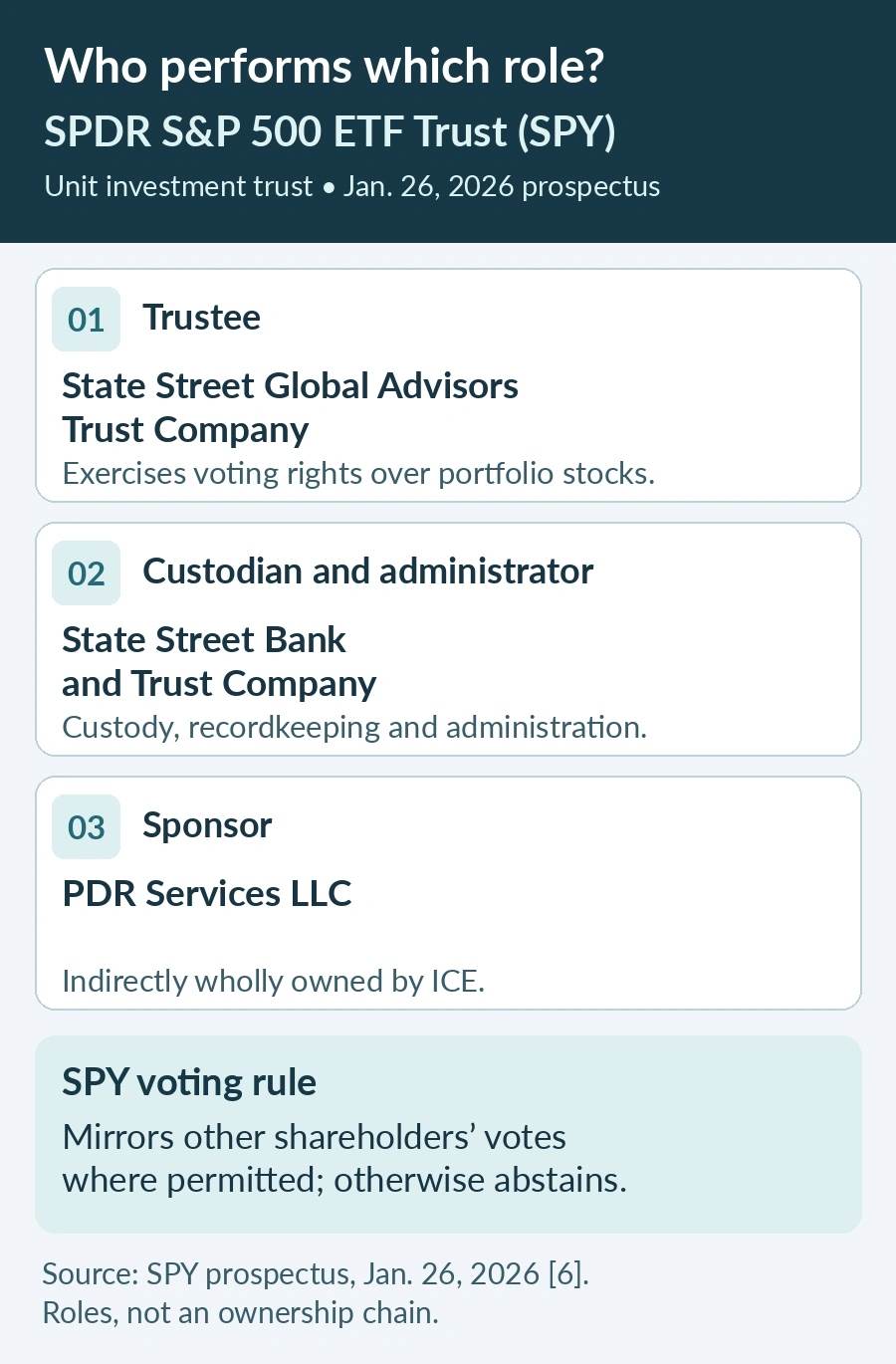
The prospectus dated January 26, 2026, explains how responsibilities are divided. The trustee is State Street Global Advisors Trust Company, while the sponsor is PDR Services LLC, an indirect wholly owned subsidiary of Intercontinental Exchange. The trustee's parent company, State Street Bank and Trust Company, provides custody and administrative services. The prospectus estimates SPY's ordinary annual expenses at 0.0945 percent, excluding potential brokerage costs associated with trading. [6] This division shows how several legal entities can be involved in a product the public knows under a single brand.
Who votes on behalf of SPY?
SPY's prospectus gives the trustee exclusive authority to vote the shares in the portfolio. At the same time, it imposes a specific restriction: where permitted, it must vote in proportion to the votes of other shareholders of each issuer; otherwise, it abstains. This is known as mirror voting. [6] It is not equivalent to independently deciding how to vote the fund's entire position.
The documentation also contains an interesting example of intertwined relationships. As of September 30, 2025, SPY held 3,377,124 shares of State Street Corporation in its portfolio, valued at $391,780,155. [6] This is an investment by the fund's portfolio in shares of the custodian bank's parent company, not proof that the group economically owns those shares for its own account.
SPY's voting rules do not establish how the trustee actually voted on individual proposals, nor do they automatically apply to all SPDR products. To assess influence, we would need to examine actual votes and the specific mandates of individual funds.
Who owns State Street?
As with BlackRock, when examining State Street Corporation we must distinguish between the ultimate economic interest and the category of beneficial ownership in US SEC disclosures. For the purposes of these disclosures, voting power or the power to dispose of shares may be sufficient. [7]
State Street's 2026 proxy statement lists BlackRock as holding 24,910,069 shares, or 8.99 percent of all common shares. However, the percentage is calculated using the number of shares outstanding on March 25, 2026, while the reported position itself relates to December 31, 2023. The same document explains The Vanguard Group's zero-position filing following its reorganization in January 2026. [8]
The subsequent separate filings by Vanguard entities for March 31, 2026, show the following figures. [9] [10]
| Reporting entity | Reported shares | Percentage of class | Sole voting power (shares) |
|---|---|---|---|
| Vanguard Capital Management | 20,493,476 | 7.35% | 2,839,806 |
| Vanguard Portfolio Management | 16,181,474 | 5.80% | 66,218 |
Both filings report sole dispositive power over all reported shares, but sole voting power over only a portion of those shares. [9] [10] The disclosures therefore do not allow us to equate the size of a reported position with voting power.
The joint filing submitted in August by FMR LLC and Abigail P. Johnson for June 30, 2026, lists approximately 13.85 million shares, or 5.0 percent of the class, for each reporting person. [11] This is the same reported extent of rights for two reporting persons, not two separate investments that can be added together. All these disclosures are snapshots limited to particular dates, not a complete current ranking of State Street's owners.
Systemic importance and the limits of power
In its list of global systemically important banks published on November 27, 2025, the Financial Stability Board placed State Street in the first bucket. That classification implies an additional capital buffer of one percent of risk-weighted assets for 2027. [12] This is regulatory recognition of systemic importance, not proof of complete control over the financial system.
State Street also depends on its clients. In its annual report, it warns of price competition, the potential loss of large institutional clients and their decisions to perform certain services in-house. [1] The existence of competition does not rule out significant dependence on an individual provider's infrastructure, but without further evidence we cannot reliably assess the actual cost of replacing that provider or claim that it abuses this dependence.
Conclusion: The power of financial infrastructure
State Street reveals another dimension of modern economic power. In addition to the ownership of capital and the authority to manage it, it matters who provides the infrastructure without which large investment institutions struggle to operate. Custody, administration and asset management are distinct functions, even though they can be combined within the same financial group.
BlackRock, Vanguard and State Street therefore differ not only in size but also in their legal structures and roles. In the next article, we will examine why their names appear so frequently among the same corporations and what the overlap in their investments actually tells us about the concentration of economic power.
Sources and further reading
- State Street Corporation (2026). [Form 10-K, fiscal year ended December 31, 2025](), Item 1, Item 1A, MD&A and Glossary. Source
- State Street Corporation (2026). [Form 10-Q, quarterly period ended September 30, 2026](), Overview and Consolidated Statement of Condition, p. 46. Source
- State Street Corporation (October 14, 2026). [State Street Corporation (NYSE: STT) Reports Third-Quarter 2026 Financial Results](), AUM footnote. Source
- Vanguard Index Funds (April 28, 2026). [Statement of Additional Information](), Corporate address and custodians, p. B-2. Source
- State Street Corporation (June 30, 2025). [State Street Global Advisors Rebrands as State Street Investment Management](). Source
- SPDR S&P 500 ETF Trust (January 26, 2026). [Prospectus (Form 497)](), Summary, Notes to Financial Statements, Schedule of Investments (p. 46), Trust Agreement (p. 88). Source
- 17 CFR § 240.13d-3(a). [Determination of beneficial owner](). Source
- State Street Corporation (2026). [2026 Notice of Meeting and Proxy Statement (DEF 14A)](), p. 112, footnotes 1–2. Source
- Vanguard Capital Management (2026). [Schedule 13G – State Street Corp](), date of the event requiring the filing March 31, 2026, rows 5–12 and clarification of reporting scope. Source
- Vanguard Portfolio Management (2026). [Schedule 13G – State Street Corp](), date of the event requiring the filing March 31, 2026, rows 5–12 and clarification of reporting scope. Source
- FMR LLC and Abigail P. Johnson (2026). [Schedule 13G – State Street Corp](), date of the event requiring the filing June 30, 2026, reporting persons' cover pages and Item 5. Source
- Financial Stability Board (November 27, 2025). [2025 List of Global Systemically Important Banks (G-SIBs)](), p. 3 and footnote 12. Source