Vanguard: Who Owns One of the World's Largest Asset Managers?
Explores Vanguard’s structure, its funds and investors, distinguishing ownership of the manager from fund assets.

An artistic metaphor for Vanguard's indirect ownership through funds and the separate level of institutional decision-making. AI-generated illustration; not a depiction of its actual headquarters or specific ownership stakes.
In examining BlackRock's economic power, we established that owning assets is not the same as having the authority to make decisions about them. Vanguard raises a different question: what happens when the owners of an asset manager are the very funds whose capital it manages? Does financial power thereby pass into the hands of investors, or does this primarily change the way that power is organized?
Vanguard is one of the world's largest asset managers, but unlike BlackRock, its parent company is not publicly traded. What sets it apart is the ownership relationship between investors, funds and the asset manager. [1]
The origins of a different ownership model
John C. Bogle conceived Vanguard as an alternative to the conventional model of investment fund management. The company began operations on May 1, 1975, and the following year offered investors an index fund that evolved into today's Vanguard 500 Index Fund. The underlying idea was to make investing widely accessible and reduce the costs borne by investors. [2]

Under the conventional asset management model, fund investors and the owners of the management company have separate economic interests. The former seek the highest possible net returns, while the latter can earn money from the fees their company charges the fund for its services. This does not mean that their interests are always at odds, but conflicts can arise between them. Vanguard's model seeks to change precisely this relationship: ownership of the asset manager is tied to the funds it serves.
Funds as owners of the asset manager
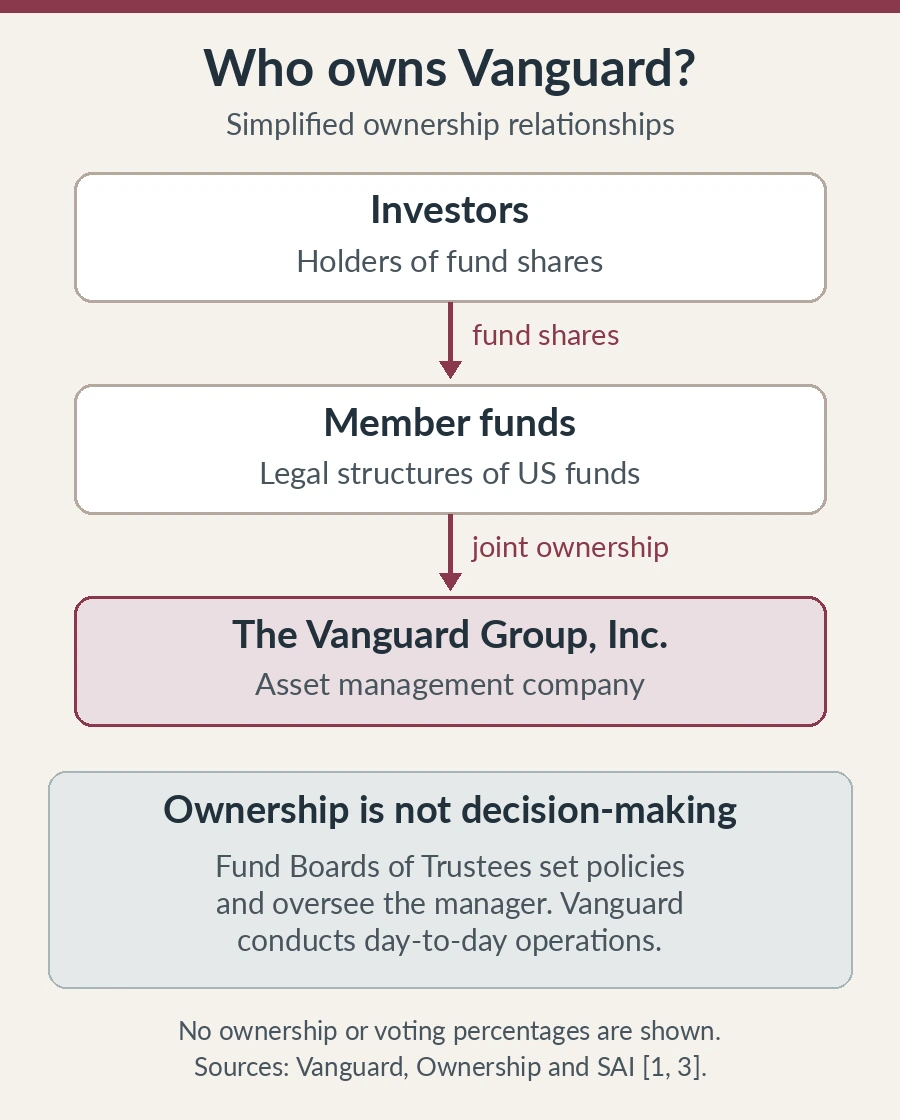
Vanguard describes itself as a company owned by its member funds, which in turn are owned by their investors. [1] A more precise legal description can be found in the Statement of Additional Information (SAI) for Vanguard Index Funds dated April 28, 2026. The funds in question are individual series of a legal structure known as a Delaware statutory trust. The funds' legal entities jointly own The Vanguard Group, Inc. [3]
This does not mean that an individual who buys a share in a Vanguard fund acquires a direct share in the management company. The individual's investment is in the fund, and the link to ownership of the manager is indirect. Nor can all Vanguard clients worldwide automatically be regarded as direct owners of the US parent company.
The prospectus documentation also discloses the funds' actual capital contributions. The Funds’ Service Agreement allows a fund to contribute up to 0.40 percent of its net assets to Vanguard's capital. The following table shows two actual contributions as of December 31, 2025. [3]
| Fund | Contribution in USD | Percentage of Vanguard's capitalization |
|---|---|---|
| Vanguard 500 Index Fund | 35,071,000 | 14.03% |
| Vanguard Total Stock Market Index Fund | 48,834,000 | 19.53% |
The fund names used here are those in the disclosure for 2025; the second fund was renamed Vanguard Morningstar Total Stock Market Index Fund on July 29, 2026. [3]
These figures show that the ownership relationship is more than a statement of business philosophy: it involves actual capital contributions. The percentages, however, should not be interpreted as shares of Vanguard's market value or as percentages of voting rights. Nor is the table a complete list of its owners. To establish who has the greatest power in governing the company itself, we would need more detailed documentation on its governing bodies, their authority and the rights of individual owners.
The business model and costs
It is often claimed that Vanguard operates at cost or without making a profit. The documentation presents a more nuanced picture. Under the agreement, certain services to the funds are provided on the basis of the full cost of operations. On its official ownership page, however, Vanguard explicitly states that the company does not operate at cost. [1] [3]
The two statements refer to different scopes of business activity. The contractual basis on which services are charged to individual funds does not establish that the group as a whole makes no profit. Its distinctive ownership structure may allow more of the benefits of its operations to reach investors through lower costs, but these disclosures do not establish the amount of the group's profits or fully explain how they are distributed.
Vanguard's prospectus for Vanguard S&P 500 ETF (VOO), dated April 28, 2026, states that as of December 31, 2025, the company acted as investment adviser to approximately $9.9 trillion in assets. This figure reflects the scale of assets covered by advisory services, not Vanguard's own assets or necessarily its total global assets under management. [4]
For the end of 2025, the company also reports more than 50 million investors and a weighted average annual expense ratio of 0.07 percent for its US mutual funds and ETFs. [5] According to the prospectus, VOO, the exchange-traded share class of Vanguard 500 Index Fund that tracks the S&P 500 index, has annual fund operating expenses of 0.03 percent: 0.02 percent in management fees and 0.01 percent in other expenses. These figures do not include all potential trading costs. [4]
Low costs matter to investors because they reduce the share of investment returns spent on financial services. At the same time, they can facilitate the asset manager's growth: a larger scale of operations can allow fixed costs to be spread more widely. Benefits for investors and the concentration of economic power are therefore not mutually exclusive.
How much power does an individual investor have?
An ownership interest does not necessarily mean that all investors have an equal say. The SAI for Vanguard Index Funds states that voting power on fund matters is generally tied to the value of an investor's holdings: one vote per US dollar of the net asset value of those holdings on the record date, unless otherwise required by law. [3]
We must also distinguish between voting on fund matters and voting at shareholder meetings of companies whose shares the fund holds in its portfolio. The former arises from the investor's rights in the fund, while the latter arises from the rights attached to the fund's securities. Simply buying a share in a fund does not give an investor the right to vote personally on every proposal at each corporation's shareholder meeting.
The fund's Board of Trustees establishes policies and oversees the asset manager's work, while Vanguard conducts day-to-day operations. [3] This arrangement enables coordinated decision-making on behalf of a large number of investors. Assessing its effectiveness requires us to consider how much actual influence an individual can exercise through oversight mechanisms, not merely what rights are set out in the documents.
The 2026 reorganization
On January 12, 2026, Vanguard announced that it had completed a multiyear reorganization of its US investment advisory activities. The reorganization established two separate, wholly owned investment advisory companies: Vanguard Capital Management (VCM) and Vanguard Portfolio Management (VPM). [6]
VCM focuses primarily on broad index strategies and fixed-income investments, while VPM focuses on quantitative strategies and certain sector- and style-oriented equity strategies. Vanguard states that the companies have separate investment management teams and separate teams responsible for exercising proxy voting authority. [6]
The reorganization also matters when reading shareholder lists. In the previous article, we saw how The Vanguard Group reported a zero position in its filing concerning BlackRock shares, with March 13, 2026, as the date of the event requiring the filing, while Vanguard Capital Management reported 6.87 percent of BlackRock's common stock in a separate filing for March 31. The explanations in these filings reveal changes in reporting boundaries. [7] [8] This is not, in itself, evidence that all the shares were sold, that Vanguard's ownership changed or that two unrelated financial groups emerged.
For the relevant funds, authority over voting the shares held in their portfolios remains with the funds, while the VCM and VPM teams implement the voting policies adopted by the funds' Boards of Trustees. There are also limitations and exceptions. Vanguard Investor Choice allows eligible investors in participating funds to select voting guidelines for a proportionate share of their investment. [3] The extent to which this actually disperses voting power is a question that requires separate analysis.
The advantages and limits of the distinctive model
Vanguard's model removes the direct need to reconcile investors' interests with those of external shareholders in the asset manager. Institutional power, however, is not measured solely by who owns the management company. It also matters who sets investment policies, who exercises voting rights and how effectively all these processes are overseen.
Vanguard is not the only institution involved in the operation of its funds. The documentation identifies State Street Bank and Trust Company as the custodian bank of Vanguard 500 Index Fund. [3] Custody is a different function from investment management and does not in itself imply economic ownership of the assets. A single investment structure can therefore involve several large financial institutions performing different roles.
Vanguard's ownership model is therefore neither proof that the company has unlimited influence over the economy nor proof that such a concentration of influence does not exist. Likewise, disclosures concerning BlackRock shares under management do not establish the existence of a hidden ownership hierarchy between the two companies. Any coordination between them is a separate research question that can only be answered through concrete evidence of their conduct and decisions.
Conclusion: Investor ownership and institutional power
Vanguard demonstrates that a financial institution can be structured differently from a conventional publicly traded corporation. Indirect ownership by investors through funds can change the asset manager's economic incentives, but it does not automatically transfer all its decision-making authority to individuals.
The central question, then, is not only who owns Vanguard, but also how power is distributed within its structure and how investors can influence the institution acting on their behalf. In the next article, we will examine State Street, where asset management intersects with another, less visible function of the financial system: the custody of securities.
Sources and further reading
- Vanguard. [Ownership](), Why our ownership structure matters section and clarification on operating at cost. Source
- Vanguard. [Our history](), 1975–1976 timeline; [Vanguard’s history](), sections on the company's origins and index investing. Source 1 Source 2
- Vanguard Index Funds (April 28, 2026). [Statement of Additional Information](), pp. B-2–3, B-25–29, B-62 and B-93–94; supplement dated July 29, 2026. [Base edition of the SAI](). Source 1 Source 2
- Vanguard 500 Index Fund (April 28, 2026). [Vanguard S&P 500 ETF – Prospectus](), pp. 1–2 and 19–20; [Summary Prospectus (Form 497K)](), Investment Objective, Fees and Expenses, Principal Investment Strategies. Source 1 Source 2
- Vanguard. [Vanguard at a glance – Facts and figures](), data for 2025; Vanguard and Morningstar. Source
- Vanguard (January 12, 2026). [An update on our U.S. investment advisory structure](), official announcement and Vanguard Fund Alignment section. Source
- The Vanguard Group (2026). [Schedule 13G/A, Amendment No. 7 – Blackrock Inc](), date of the event requiring the filing March 13, 2026, explanatory note on the filing's cover page. Source
- Vanguard Capital Management (2026). [Schedule 13G – Blackrock Inc](), date of the event requiring the filing March 31, 2026, rows 5–12 and clarification of reporting scope. Source