BlackRock: What Does It Mean to Manage Trillions of Dollars?
What BlackRock assets under management mean, who owns the assets and how voting authority is exercised.

An artistic metaphor for capital intermediation and concentrated management authority; not a depiction of ownership structure or total control. AI-generated illustration.
When we talk about the world's most powerful economic institutions, one name comes up time and again: BlackRock. On October 14, 2026, the company announced that it had approximately $15.5 trillion in assets under management at the end of September. [1] But what does that figure actually mean? Who owns that capital, who makes decisions about it, and how much influence does the institution managing it wield?
Answering these questions requires us to distinguish between owning assets and having the authority to make decisions about them. The gap between the two reveals an important mechanism of modern economic power.
A company that manages other people's capital
BlackRock, Inc. is a publicly traded company whose shares are listed on the New York Stock Exchange under the ticker BLK. Its business encompasses investment management for individuals and institutional investors, including pension funds, as well as other financial and technology services. Its role differs from that of a company buying other businesses with its own money: much of the capital over which it makes decisions comes from clients and funds. [2]

The annual report for 2025 provides a comparable financial snapshot. [2]
| Financial measure | Value in billions of USD |
|---|---|
| Assets under management (December 31, 2025) | 14,041.5 |
| Consolidated balance sheet assets (December 31, 2025) | 170.0 |
| Revenue in 2025 | 24.2 |
These three figures measure different things. Assets under management (AUM) describe the size of the portfolios being managed. Depending on the nature of the portfolios, the measure may be based on net asset value, total assets or committed capital. Balance sheet assets are an accounting category that includes certain consolidated assets and is not equivalent to shareholders' equity. Revenue, meanwhile, is the amount generated over a given period, not the value of assets on a particular date. [2]
Describing all $15.5 trillion as BlackRock's own money would confuse two fundamentally different economic roles. Yet it does not follow that the scale of its asset management business is irrelevant to the question of power.
From individual savings to corporate shares
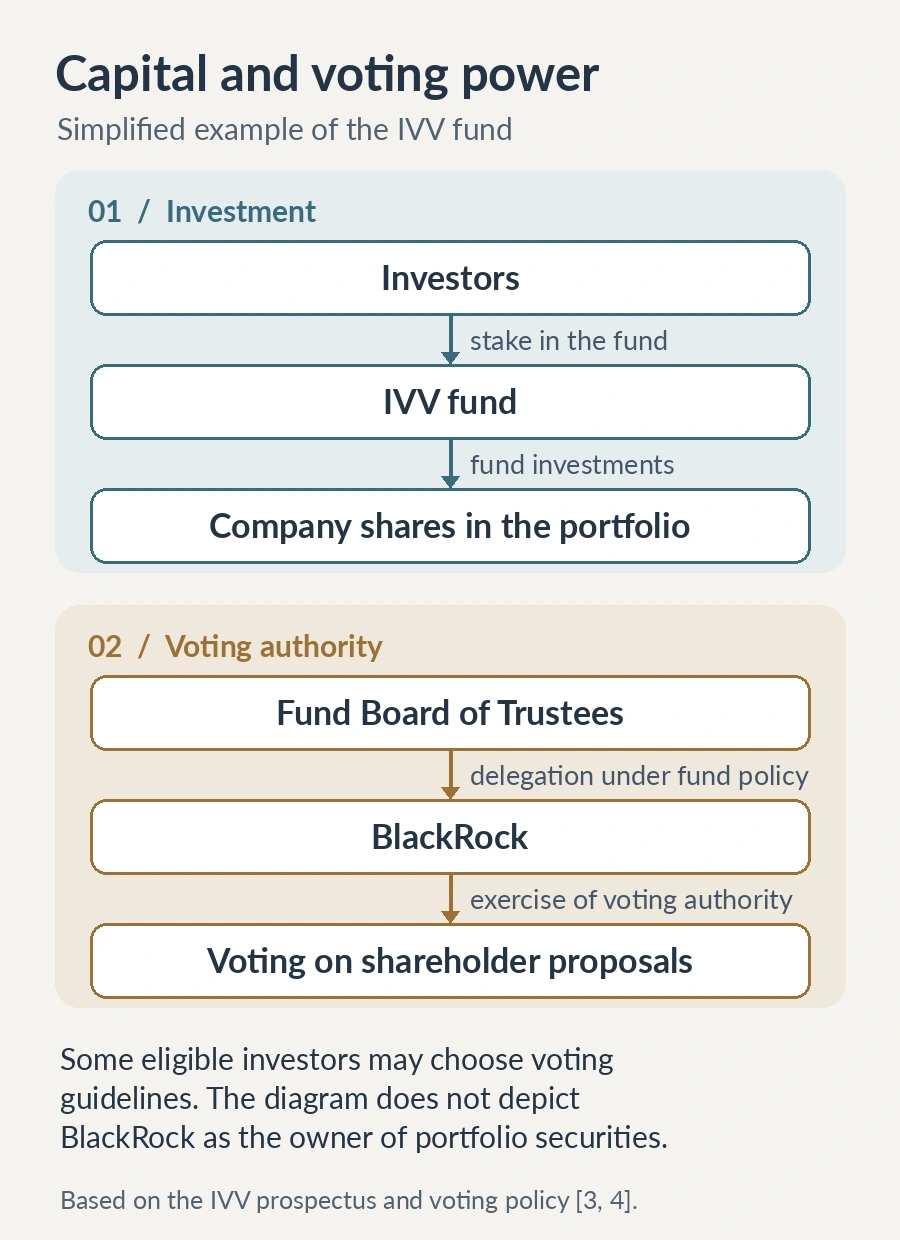
Imagine someone investing part of their savings in an investment fund. The fund pools capital from multiple investors and invests it in accordance with its investment objective. Investors own a stake in the fund and are exposed to its gains and losses, but they do not thereby become direct shareholders in every company in its portfolio. The fund manager makes decisions within the authority granted under its contract.
One example is the iShares Core S&P 500 ETF (IVV), one of BlackRock's exchange-traded funds. Its objective is to track the S&P 500 index of large US companies. The summary prospectus dated July 31, 2026, lists an annual management fee of 0.03 percent. [3] The manager's commercial interest is therefore linked, among other things, to the amount of capital for which it provides services, rather than to appropriating the entire value of the investments.
This example does not describe all BlackRock products. An institutional investor might, for instance, have a separately managed account with a different set of rights and delegated powers. Even within a single asset management firm, there are different ways of investing. A name on a list of shareholders therefore cannot, without further information, reveal the entire relationship between the investor, the fund and the manager.
Investment decisions and voting power
In active management, the manager can choose between different investments within the limits of the investment mandate. With an index fund, its freedom of choice is considerably more restricted because it must track a particular index. But limited freedom to buy and sell shares does not mean that the manager has also been deprived of voting authority.
Voting shares allow their holders to participate in shareholder decisions, such as electing directors or voting on other proposals at shareholder meetings. In the case of IVV, oversight of proxy voting rests with the fund's Board of Trustees, which has delegated the exercise of voting authority to BlackRock under the terms of a specific policy. The policy allows certain eligible investors to choose voting guidelines, but this option is neither unrestricted nor available to everyone. [4]
Based on data from BlackRock and ISS for the 2025 calendar year, BlackRock Investment Stewardship (BIS) reports having voted on approximately 154,000 proposals at companies held in index equity portfolios. [5] This figure illustrates the scale of its activity, not the number of corporations BlackRock controls, the number of seats it holds on their boards, or the outcomes it achieved on its own.
This is where economic influence differs from control. A large asset manager can participate in decision-making and engage with the management of numerous companies. To establish that it actually caused a particular decision, however, we would need to examine specific votes, the distribution of voting power, the authority of the relevant governing bodies and other evidence.
Who owns BlackRock?
As a publicly traded company, BlackRock has shareholders of its own. When reading US ownership disclosures, it is important to understand the term beneficial ownership. For reporting purposes under Sections 13(d) and 13(g) of the US Securities Exchange Act, this category can arise from voting power or the power to dispose of securities. It does not necessarily identify the person ultimately entitled to the economic benefit of an investment. [6]
BlackRock's proxy statement from April 2026 lists, among others, a 6.17 percent holding under the name BlackRock, Inc. and a 5.14 percent holding under the name Kuwait Investment Authority, acting on behalf of the government of Kuwait. Laurence D. Fink's holding is listed in the same table as less than one percent. [7]
These figures, however, are based on information from different points in time. Although the table is presented as of March 31, 2026, the footnote concerning BlackRock's holding refers to a filing from February 2024, while the footnote concerning the Kuwaiti holding refers to a filing from July 2020. The former also explains that the shares are held by funds managed by BlackRock subsidiaries and that an independent third-party provider makes voting recommendations concerning those shares. [7]
The separate filings by entities bearing the Vanguard name are also noteworthy. The Vanguard Group reported a zero position in its filing for which the event requiring the filing occurred on March 13, 2026. Its explanatory note describes an internal reorganization on January 12, 2026, following which certain subsidiaries or business units report these rights separately. The zero-position filing is therefore not evidence that Vanguard sold all its BlackRock shares. As of March 31, 2026, Vanguard Capital Management reported 10,700,618 BlackRock shares, representing 6.87 percent of the common stock class. It reported sole dispositive power over all these shares, but sole voting power over 1,460,018 shares. [8] [9]
These historical disclosures do not allow us to construct a reliable ranking of all current owners. They do, however, demonstrate why it is not enough to say that one financial company owns another. We must determine on whose behalf the shares are reported and which rights are actually concentrated in the hands of each reporting entity.
The limits of power and the question of accountability
An asset manager's size does not in itself determine its legal powers. The US Securities and Exchange Commission's proxy voting rule requires investment advisers subject to the rule to adopt appropriate written procedures for voting in their clients' interests, addressing material conflicts of interest and making disclosures to clients. [10] The existence of such a requirement is not proof that it is consistently observed in every case.
Asset managers depend on the decisions of their clients. Contracts may, under certain conditions, allow clients to withdraw their assets or change managers, although the options differ across types of investments. [2] Competition and legal oversight also constrain managers' conduct. These mechanisms, however, do not resolve the question of how much decision-making authority can be concentrated in the hands of a relatively small number of institutions.
In 2017, researchers Jan Fichtner, Eelke M. Heemskerk and Javier Garcia-Bernardo identified the concentration of index fund management at BlackRock, Vanguard and State Street as a potential source of structural power. [11] Their historical analysis raises the question of influence arising from the position of large asset managers within the financial system, rather than solely from direct interventions in corporate operations. It does not, however, measure their influence in 2026 or prove that the three institutions act under unified leadership.
Conclusion: Ownership is not the only form of power
BlackRock does not own all the assets it manages. Yet managing other people's capital can entail a significant concentration of authority, information and influence. An individual investor may have an economic interest in a fund, while decisions concerning investments and voting are delegated to varying degrees to the institutions providing services on the investor's behalf.
The study of economic power must therefore go beyond lists of owners. We must also ask who has the power to make decisions, to whom they are accountable, how their decisions are overseen, and whether the people whose capital they manage have a meaningful opportunity to influence how that authority is exercised.
In the next article, we will examine Vanguard, whose different ownership structure raises a new question: does ownership of the asset manager by its funds change the relationship between investors and financial power?
Sources and further reading
- BlackRock, Inc. (October 14, 2026). [BlackRock Reports Third Quarter 2026 Diluted EPS](), summary of results. Source
- BlackRock, Inc. (2026). [Form 10-K, fiscal year ended December 31, 2025](), Items 1, 1A, 7 and 8. Source
- iShares Trust (July 31, 2026). [iShares Core S&P 500 ETF – Summary Prospectus](), Investment Objective; Fees and Expenses; [official fund page, Fees section](). Source 1 Source 2
- iShares Trust / BlackRock (2025). [iShares Core S&P 500 ETF – Proxy Voting Policy](), pp. 1–2; document last reviewed September 17, 2025. Source
- BlackRock. [BlackRock Investment Stewardship](), Stewardship efforts at a glance; BlackRock/ISS data for 2025, captured March 27, 2026. Source
- 17 CFR § 240.13d-3(a). [Determination of beneficial owner](). Source
- BlackRock, Inc. (April 10, 2026). [2026 Proxy Statement (DEF 14A)](), pp. 47–48, footnotes 3–4. Source
- The Vanguard Group (2026). [Schedule 13G/A, Amendment No. 7 – BlackRock, Inc.](), date of the event requiring the filing March 13, 2026, explanatory note on the filing's cover page. Source
- Vanguard Capital Management (2026). [Schedule 13G – BlackRock, Inc.](), date of the event requiring the filing March 31, 2026. Source
- U.S. Securities and Exchange Commission (2003). [Proxy Voting by Investment Advisers, Release IA-2106](); [17 CFR § 275.206(4)-6](). Source 1 Source 2
- Fichtner, J., Heemskerk, E. M. and Garcia-Bernardo, J. (2017). [Hidden power of the Big Three? Passive index funds, re-concentration of corporate ownership, and new financial risk](). Business and Politics, 19(2), 298–326. Source