Financial Crises: Who Bears the Losses and Who Makes the Decisions?
An examination of financial crises, bank resolution, public costs and decision-making authority during emergencies.

Artistic illustration of the allocation of financial burdens during a crisis, not a depiction of a specific event.
When a bank performs well, its owners may receive dividends, its employees may receive salaries and bonuses, its creditors may receive the agreed payments, and the state may collect taxes. When it starts losing capital and faces failure, however, its problems may extend beyond the individual company. Savings, payment services, financing for the economy and other financial institutions are at risk. The crucial question then becomes who is authorised to decide which liabilities will be protected, which will be written off and how much risk the public will assume. Financial crises thus reveal a mechanism of economic power that cannot be discerned from a list of the largest bank shareholders alone.
When a bank's balance sheet becomes a systemic risk
On one side of a bank's balance sheet are assets such as loans and securities; on the other are liabilities to depositors and other creditors, together with equity. If borrowers fail to repay their debts or the value of other assets falls, the bank may incur losses. Equity is the first line of defence against these losses. A further difficulty is that banks finance some of their long-term investments with liabilities that may fall due sooner. If many customers demand their money at the same time, the bank may be unable to realise sufficient assets quickly enough without incurring substantial losses.
Liquidity and solvency are therefore not the same. The former describes the ability to meet obligations as they fall due; the latter, in simplified balance-sheet terms, describes the ability to cover liabilities with the value of assets. Imagine a bank with assets of 100, liabilities of 90 and equity of 10. If the value of its assets remains unchanged but the bank is short of 20 units of liquid assets needed to pay depositors, an liquidity loan backed by adequate collateral may enable it to make those payments. This does not erase a loss or increase equity.
If the value of the same bank's assets falls from 100 to 85 before intervention, while liabilities remain at 90, its equity is negative, at −5. A new capital injection of 5 or a write-down of liabilities by the same amount would restore equity to zero, other balance-sheet items remaining unchanged. Further capital would generally be required to comply with applicable capital requirements. This is a hypothetical numerical example, not a description of a particular bank or a prediction of its eligibility for assistance.
Systemic risk arises when losses and uncertainty at one institution threaten the functioning of the wider financial system. When assessing the measures needed, it is therefore important to consider not only shareholders' wealth but also the possibility that the crisis may spread to other banks, businesses and households. Yet the threat of a wider crisis does not in itself establish which form of intervention is most appropriate or how losses should be distributed fairly.
How are banks rescued?
A central bank may provide a liquidity loan, the state may issue a guarantee or inject capital, and the competent authority may order a bank to be restructured or resolved. The European Central Bank explains that emergency liquidity assistance (ELA) is intended for solvent financial institutions experiencing temporary liquidity difficulties, outside the Eurosystem's regular monetary policy operations. Assistance is provided by national central banks, while the ECB's Governing Council has powers to assess whether it is consistent with the objectives and tasks of the European System of Central Banks. [1]
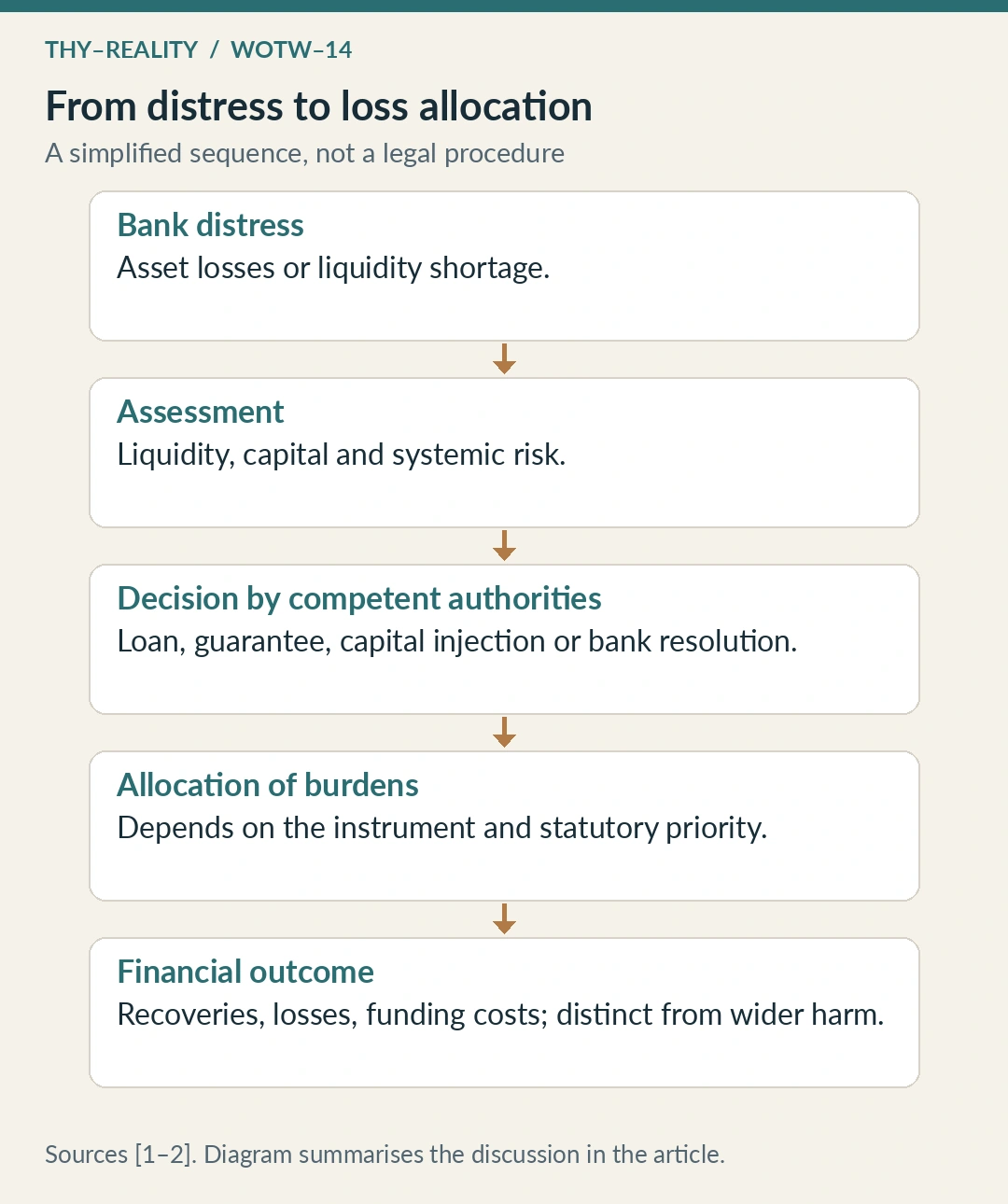
When a loan is granted, the lender acquires a claim and assumes the risk of non-payment. A guarantee represents a contingent liability for the guarantor, which may give rise to expenditure if the guarantee is called. By injecting capital, the state may acquire an equity stake; any subsequent sale of that stake and dividends received must be taken into account when assessing the financial outcome. By contrast, the bail-in tool allows certain bank liabilities to be written down or converted into equity subject to statutory conditions. Its purpose is to allocate losses to investors who have assumed the relevant risks and enable the bank's critical functions to continue. [2]
The colloquial expression 'bank bailout' thus encompasses substantially different forms of intervention. The authorised ceiling for assistance is not the same as the amount actually disbursed; a disbursement is not the same as a net loss; and the net fiscal cost is not the same as the overall economic damage caused by the crisis. If the state finances an intervention through borrowing, it may also incur financing costs. Comparisons must take account of the period, accounting method and scope of the programmes covered.
The United States in 2008: TARP and the Federal Reserve
In 2008, the US Congress established the Troubled Asset Relief Program (TARP) by passing the Emergency Economic Stabilization Act. Its initially authorised funding limit was 700 billion dollars. The programme was administered by the US Department of the Treasury; in addition to financial-sector measures, it included assistance for the automotive industry and housing-related measures. According to the CBO, the final outstanding investment was repaid in September 2023. [3]
Lehman Brothers bankruptcy chronology (FCIC records)
The Treasury published the following cash-basis financial statement for the period from the programme's inception to 30 September 2023. [4]
| TARP item | USD millions |
|---|---|
| Actual disbursements | 443,532 |
| Repayments of investments | 376,676 |
| Investment income | 48,827 |
| Interest expense | 13,083 |
| Reported net cost | 31,111 |
Source: US Treasury, Table 1. Repayments and income reduce the net cost, while interest expense increases it. The calculation using the rounded figures differs from the reported result by one million dollars; the source notes that figures are rounded. The table excludes proceeds from additional AIG shares held by the Treasury outside TARP. [4]
The individual schemes had different financial outcomes. According to the Treasury's account, the Capital Purchase Program, which involved investments in bank capital, generated approximately 16.3 billion dollars in net income. TARP as a whole nevertheless recorded a net cost. The independent Congressional Budget Office (CBO), in its final report dated 19 April 2024, estimated the subsidy cost at approximately 31 billion dollars. This is an estimate based on a separate methodology, not an additional loss to be added to the Treasury's calculation. [3][4]
Alongside the Treasury's interventions, the Federal Reserve also authorised emergency loans. For the insurance group AIG, the initial credit facility granted by the Federal Reserve Bank of New York in September 2008 had a limit of 85 billion dollars. In connection with the establishment of this facility, a dedicated trust (the AIG Credit Facility Trust) was set up for the benefit of the US Treasury and acquired a 79.9% equity interest in AIG. The assistance was subsequently restructured and also included TARP investments. The original credit facility cannot therefore simply be added to total TARP disbursements and the resulting figure declared a loss. [5]
These measures reduced the immediate threat to certain financial institutions and their counterparties, while public institutions assumed substantial risks. Subsequent repayments do not mean that those risks did not exist, nor do they account for the jobs, incomes and homes lost during the recession. When assessing fairness, it is also important to consider which liabilities were protected and on what terms.
Slovenia, 2013–2014: bank restructuring and write-offs of investors’ holdings
The Slovenian bank restructuring similarly combined public capital injections, bank asset valuations and interventions in the rights of private investors. In 2013, Banka Slovenije organised an asset quality review (AQR) and stress tests. External service providers Deloitte and Ernst & Young participated in the asset quality review, while Oliver Wyman (bottom-up) and Roland Berger (top-down) were involved in different approaches to stress testing. Their work formed an important basis for supervisory assessments, but the statutory authority to impose extraordinary measures remained with Banka Slovenije. [6]
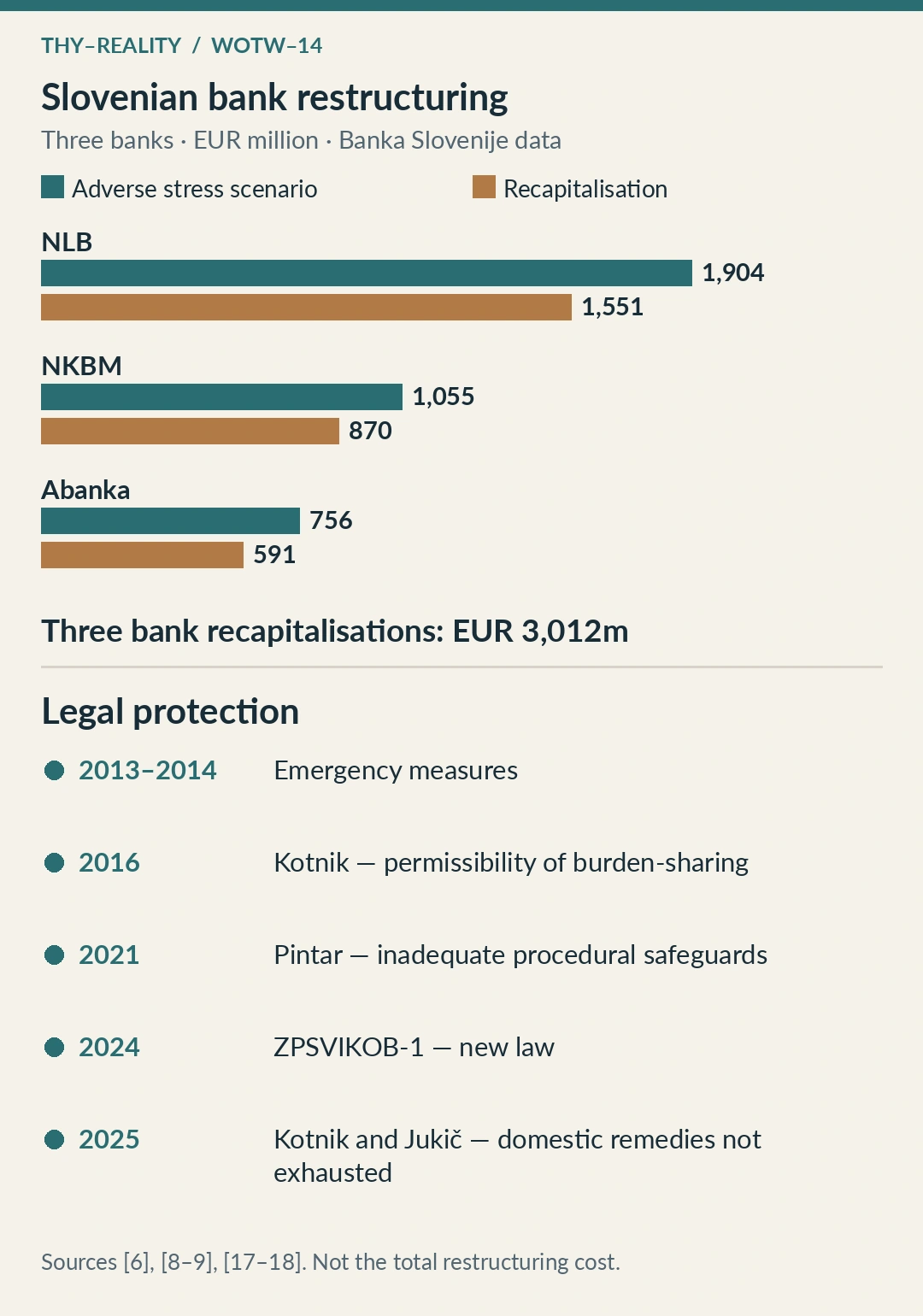
The published results of the adverse stress scenario showed a combined capital shortfall of EUR 4,778 million for eight banks. This figure represents a projection, not an actual disbursement. The sum of the eight published whole-number figures is EUR 4,779 million; the difference of one million from the reported total is consistent with possible rounding, although the source does not explain it in the table. Banka Slovenije separately published figures for the recapitalisation of three banks. The intervention took place in several stages, so the amounts in the table below should not be interpreted as consisting entirely of cash transfers made on a single day. [6]
| Bank | Shortfall under the adverse scenario (EUR million) | Recapitalisation (EUR million) |
|---|---|---|
| NLB | 1,904 | 1,551 |
| NKBM | 1,055 | 870 |
| Abanka | 756 | 591 |
| Total for the three banks | 3,715 | 3,012 |
Source: Banka Slovenije; the adverse scenario total in this table covers only the three banks shown. The recapitalisation figure does not represent the total cost of Slovenia's bank restructuring. [6]
On 17 December 2013, Banka Slovenije issued decisions to implement extraordinary measures the following day at NLB, NKBM, Abanka, Factor banka and Probanka. The measures included the extinguishment of qualifying liabilities and state recapitalisation. Decisions concerning Banka Celje were issued on 19 November and 16 December 2014. The write-offs affected existing holders of shares and subordinated liabilities; the supervisor's statements concerning negative equity do not substitute for an independent assessment of the accuracy of each bank's valuation. [6]
Subsequent proceeds from the sale of state-owned stakes and dividends affect the financial outcome of the restructuring. In addition to capital injections, other financial measures were taken, including guarantees and transfers of non-performing receivables to the Bank Assets Management Company (DUTB). In its audit of the final accounts for 2014, the Court of Audit highlighted approximately EUR 432 million in state guarantees that had been called, of which approximately 99% related to Probanka and Factor banka. The auditors found that Banka Slovenije had disbursed some of the funds to the two banks after terminating the loan agreements; in the Court of Audit's assessment, there was therefore no legal basis for those disbursements or their subsequent reimbursement from state funds. This is an audit finding, not a criminal judgment. [7]
A definitive assessment of the fiscal cost would require reconciling capital injections, guarantees, DUTB's financial flows, subsequent sales, dividends and financing costs, while eliminating double counting. The sources used do not provide such a comprehensive final account. Any compensation claims still outstanding cannot be treated as compensation already paid.
Two judgments illuminate the legal dimension of the restructuring. On 19 July 2016, in Kotnik (C-526/14), the Court of Justice of the European Union examined the rules governing state aid to banks and burden-sharing. It confirmed the permissibility of the principle that shareholders and subordinated creditors contribute to covering losses as a condition for approving state aid to banks with capital shortfalls. The Commission's Banking Communication does not in itself oblige Member States to adopt a particular measure. This is not, however, judicial confirmation of the validity of each individual write-off decision or the accuracy of each valuation. [8]
On 14 September 2021, in Pintar and Others v. Slovenia, the European Court of Human Rights found a violation of Article 1 of Protocol No. 1 to the European Convention on Human Rights owing to insufficient procedural safeguards. During the period covered by the judgment, the affected investors had no effective means of challenging the measures or claiming compensation. The Court did not determine whether each write-off served the public interest or whether a fair balance had been struck. [9] The right to have decisions reviewed is thus separate from the question of whether absorbing losses with private capital was economically justified.
The Act on the Procedure for Judicial Protection of Former Holders of Qualifying Bank Liabilities (ZPSVIKOB-1) entered into force on 15 June 2024. In March 2025, in the subsequent case of Kotnik and Jukič v. Slovenia, the European Court of Human Rights declared the applications inadmissible because the domestic remedies made available by the new Act had not been exhausted. According to the Registry's communication dated 6 March 2025, it also stressed the need for claims to be dealt with swiftly. This is not a decision on entitlement to compensation in an individual case and does not overturn the finding of a violation in the Pintar judgment. [17][18]
The European bank resolution mechanism
The European Bank Recovery and Resolution Directive (BRRD) of 2014 established a common framework for emergency measures, including the prescribed order of loss absorption and statutory exceptions. Article 44(2) excludes covered deposits from the bail-in tool. As a rule, shareholders bear losses on their equity before subordinated creditors bear losses, while other liabilities are treated according to their legal ranking and applicable conditions. This later framework must not be applied retroactively when interpreting Slovenia's measures in December 2013. [2]
Banco Popular resolution decision
The Spanish bank Banco Popular provides a practical example of the European mechanism. On 6 June 2017, the ECB assessed the bank as failing or likely to fail. The following day, the Single Resolution Board (SRB) adopted a decision endorsed by the European Commission, with implementation undertaken by the Spanish authority FROB. Following the write-down or conversion of the relevant capital instruments, Santander acquired Banco Popular for the symbolic price of one euro. The SRB stated that no public funds had been used in the resolution. [10]
The price of one euro does not mean that all the acquired bank's assets were worth one euro. The acquirer took over the business with its assets, liabilities and risks. When assessing whether former investors were disadvantaged, it is also important to consider the principle that a creditor should not be worse off as a result of resolution than under normal insolvency proceedings. The assessment of this difference relies on a valuation of a hypothetical alternative outcome. [2]
On 18 March 2020, the SRB decided that the affected shareholders and creditors of Banco Popular would not have been better off under normal insolvency proceedings and were therefore not entitled to compensation on that basis. [19] This is not the same as ruling on all other possible legal claims. In Case C-687/23 on 11 September 2025, the Court of Justice of the European Union clarified that rights arising from certain actions for damages and declarations of nullity brought before the bank's resolution may be enforceable against its legal successor, Banco Santander. [20] Without examining all the legal grounds and case files, we cannot assess each individual claim.
The United States in 2023: who pays for deposit protection?
The failures of Silicon Valley Bank and Signature Bank in March 2023 demonstrated another way of distributing the burden. Following recommendations from the boards of the FDIC and the Federal Reserve, the US Treasury Secretary, after consulting the President, approved measures under the systemic risk exception. All deposits at both banks were protected, including those above the standard deposit insurance limit, but shareholders and certain unsecured creditors were not protected. [11]
Joint Treasury, Fed and FDIC statement
In November 2023, the Federal Deposit Insurance Corporation (FDIC) estimated that approximately 16.3 billion dollars of losses to the deposit insurance fund resulted from protecting uninsured deposits. It provided for these losses to be covered through a special assessment on banks. In an announcement dated 16 December 2025, the FDIC reported an updated estimate of approximately 16.7 billion dollars as at 30 September 2025. The estimates are not two separate losses, but versions of the same calculation, revised as the outcome of the proceedings becomes clearer. [12][13]
The direct burden of the special assessment falls on the banking organisations subject to it, not the state budget. The assessment base was linked to the volume of uninsured deposits, excluding the first five billion dollars of such deposits at the level of an individual bank or banking group. [12] Who ultimately bears the full economic burden is a further question: the assessment may reduce bank profits or affect business decisions and the terms offered to customers. The statistics used do not permit a precise allocation of this indirect effect.
At the same time, the Federal Reserve introduced a separate liquidity programme, the Bank Term Funding Program (BTFP). It enabled eligible depository institutions to obtain loans of up to one year, secured by eligible securities valued at par. The Treasury announced a backstop of up to 25 billion dollars from the Exchange Stabilization Fund. Such a credit backstop is not the same as an actual disbursement or a definitive loss. [14] The programme stopped granting new loans on 11 March 2024, and according to the Reserve Banks' quarterly report, all remaining loans were repaid on 7 March 2025. [21] Repayment of principal alone does not make it possible to calculate all the programme's wider economic effects.
The supervisor's own assessment is also noteworthy. In April 2023, the Federal Reserve's report on Silicon Valley Bank highlighted deficient risk management, delayed supervisory responses and weaknesses in the regulatory approach. [15] This document is important for understanding institutional accountability, although it does not substitute for an independent audit or a judicial assessment of individual responsibility.
Who makes the decisions and who profits during crises?
The cases reveal several different levels of decision-making. The legislature establishes the framework, the supervisor assesses the situation, the resolution authority selects measures, the central bank may authorise liquidity assistance, and the ministry decides on measures falling within its fiscal powers. Valuers, audit firms and asset managers may participate in implementation. Their professional assessments can influence the final decision, even though they themselves have no statutory authority to write off shares or grant state aid.
A particular risk arises when financial firms implementing crisis programmes also operate in the markets affected by those programmes. In its 2011 review of Federal Reserve emergency assistance, the US Government Accountability Office (GAO) identified opportunities to improve procedures for selecting contractors and managing conflicts of interest. [16] The existence of such a risk does not in itself establish misconduct. Specific allegations require analysis of contracts, decisions, payments and oversight mechanisms. A more detailed investigation of private-sector asset managers' involvement in the programmes of 2020 follows in a later part of the series.
A crisis can provide favourable opportunities for buyers of assets, service providers or investors with sufficient liquidity during forced sales. This is not evidence that those actors caused the crisis. Yet the distribution of benefits is just as important as the distribution of losses. If management teams or creditors expect unconditional protection regardless of their previous decisions, moral hazard arises. Conversely, a failure to intervene can also endanger people who were not involved in risky investments. The cost of the counterfactual scenario without intervention cannot be observed directly and must therefore be treated as an estimate.
Privatisation of profits and socialisation of losses?
The claim that profits are privatised while losses are socialised raises an important question about the relationship between private risk-taking and public protection. The cases examined, however, do not establish a universal rule under which all shareholders are always protected and all costs are always passed on to taxpayers. TARP involved both investments that generated repayments and actual net costs; Slovenia's bank restructuring combined public capital injections with write-offs imposed on private investors; Banco Popular was resolved using the sale of business tool; and in the US case of 2023, provision was made for a special assessment on the banking organisations subject to it to cover the costs of protecting uninsured deposits.
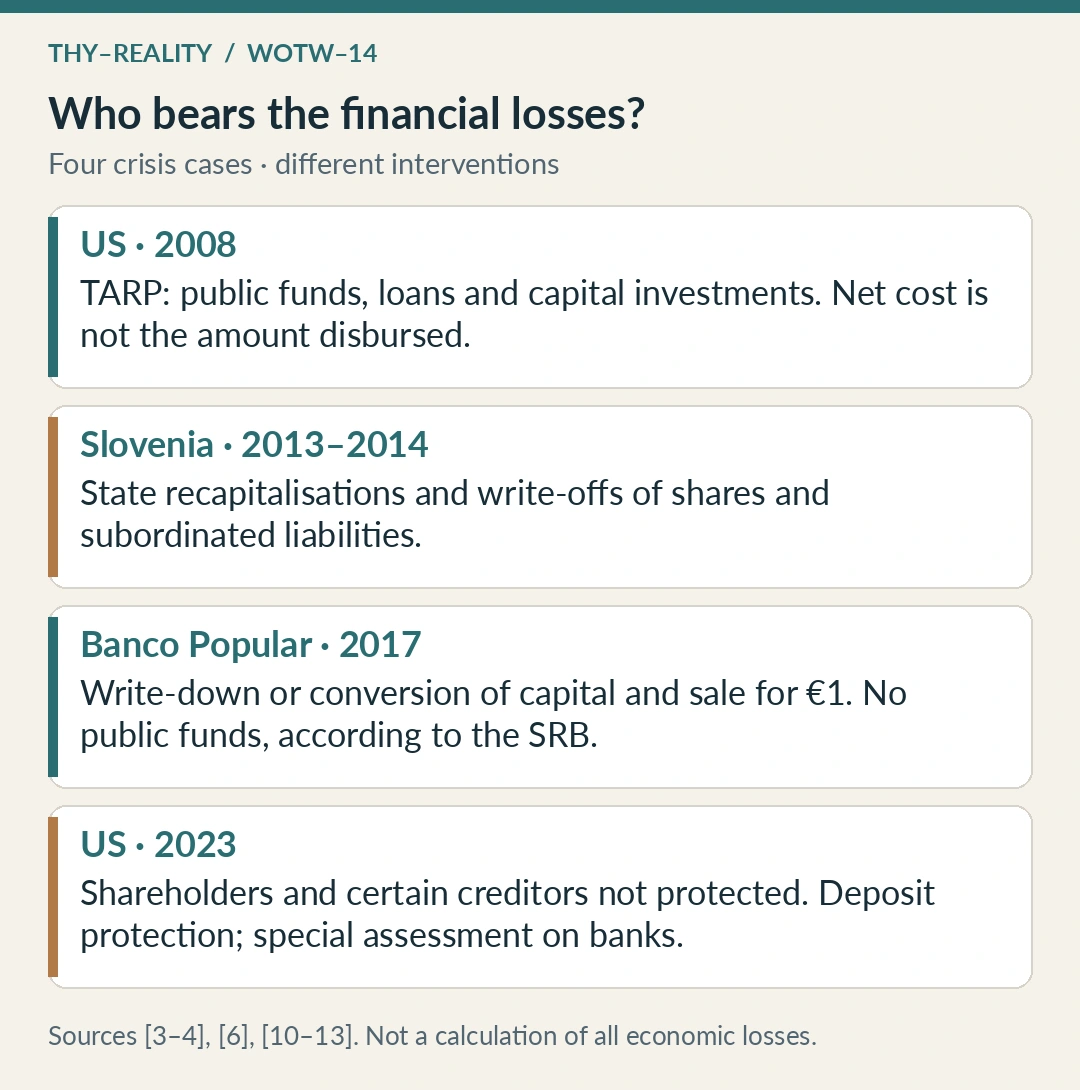
What these cases have in common is the allocation of the financial burden through decisions made in exceptional circumstances. Fairness therefore requires transparent valuations, disclosure of the criteria for protecting particular groups, independent oversight, management of conflicts of interest and effective judicial protection. Even when a measure is intended to prevent wider economic damage, the public interest does not eliminate the need for accountability on the part of those who select and implement it.
The investigation of financial power thus does not end with the ownership of banks or government bonds. Equally important is the position of institutions that can determine the conditions for continuing operations, protecting liabilities and transferring losses in exceptional circumstances. In the following sections, we will relate this question to major asset managers and the financial infrastructure of the global economy.
Sources and further reading
- ECB, Emergency liquidity assistance (ELA) and monetary policy, 2024-09 (agreement cited). Source
- EU, Directive 2014/59/EU (BRRD), 2014-05-15. (original text of the 2014 Directive). Source
- Congressional Budget Office, Final Report on the Troubled Asset Relief Program, 2024-04-19. Source
- U.S. Department of the Treasury, Troubled Asset Relief Program (TARP), 2023-09-30 (as at that date). Source
- Federal Reserve Board, American International Group (AIG), Maiden Lane II and III, undated. Source
- Banka Slovenije, Nadzorniške prakse, postopki in ukrepi, undated. Source
- Court of Audit of the Republic of Slovenia, Revizija zaključnega računa proračuna Republike Slovenije za leto 2014, 2015. Source
- Court of Justice of the European Union, Tadej Kotnik and Others v Državni zbor Republike Slovenije, C-526/14, 2016-07-19. (indexed judgment and official legal summary). Source
- European Court of Human Rights, Pintar and Others v. Slovenia, 2021-09-14. (official legal summary of the judgment). Source
- SRB, The Single Resolution Board adopts resolution decision for Banco Popular, 2017-06-07. Source
- Treasury, Federal Reserve, FDIC, Joint Statement by Treasury, Federal Reserve, and FDIC, 2023-03-12. Source
- FDIC, FDIC Board of Directors Issues a Final Rule on Special Assessment Pursuant to Systemic Risk Determination, 2023-11-16. . Source
- FDIC, FDIC Board of Directors Issues an Interim Final Rule to Amend the Collection of the Special Assessment, 2025-12-16. . Source
- Federal Reserve Board, Federal Reserve Board announces it will make available additional funding to eligible depository institutions, 2023-03-12. Source
- Federal Reserve Board, Review of the Federal Reserve’s Supervision and Regulation of Silicon Valley Bank: Executive Summary, 2023-04-28. Source
- GAO, Federal Reserve System: Opportunities Exist to Strengthen Policies and Processes for Managing Emergency Assistance (GAO-11-696), 2011-07-21. Source
- National Assembly of the Republic of Slovenia, Zakon o postopku sodnega varstva nekdanjih imetnikov kvalificiranih obveznosti bank (ZPSVIKOB-1), 2024-05-31. (metadata, unofficial consolidated text NPB 2). Source
- European Court of Human Rights, European Court rejects as inadmissible complaints concerning financial-emergency measures in Slovenia, ECHR 063 (2025), 2025-03-06. (Registry communication, not the full decision). Source
- SRB, SRB decides no compensation due to Banco Popular shareholders and creditors, finding that insolvency would have been more costly, 2020-03-18. . Source
- Court of Justice of the European Union, Banco Popular: the rights arising from actions for a declaration of nullity and for damages brought before the resolution of that bank are enforceable against Banco Santander, C-687/23, 2025-09-11. (press release, not the full judgment). Source
- Federal Reserve Board, Federal Reserve Banks Combined Quarterly Financial Report, 2025-06-30, p. 5. (unaudited report, text reviewed; visual review unsuccessful). Source