To Whom Do Governments Owe Money?
Who finances sovereign debt, how government bonds are held and what creditor data can and cannot reveal.

Editorial allegory of debt-financed public infrastructure, not a documentary photograph.
When government debt is discussed, its size almost always takes centre stage. We less often ask who stands on the other side of that obligation. Every debt is a liability for the borrower and a financial asset for the creditor. If a government borrows to build a railway, pay pensions or refinance existing debt, someone acquires the right to be repaid the money lent. Yet that someone need not be a bank, a foreign government or a wealthy family. It could also be a pension fund, a central bank or a citizen who has bought a government bond. Investigating government debt therefore requires us to look at both sides of the balance sheet and the relationships of power between them.
How does government debt arise?
A government can raise funds by issuing debt securities or taking out loans. By buying a bond at issuance, an investor provides funds to the government in exchange for a financial claim under specified terms. A conventional bond has a face value, a maturity date and an interest rate, or coupon. Some instruments do not pay regular interest; instead, the return is linked to the difference between the purchase price and the payment at maturity. The US Treasury, for example, sells marketable government securities at auction, and investors can also buy them on the secondary market. [1]
Second Liberty Loan poster, 1917
Consider a simplified example of a five-year bond with a face value of 1,000 euros, issued at par, with a fixed annual coupon of 3%. The issuer receives 1,000 euros, while the holder, assuming all obligations are duly met, receives 30 euros each year and the principal at maturity. If the holder sells the bond to another investor after the first year, the right to future payments passes to the new holder. The price may be above or below face value, and in a normal sale between investors the government receives no new proceeds. The coupon and the yield to the new buyer are therefore not necessarily the same.
A government does not have to repay every maturing bond from current tax revenue. It can issue new bonds and use the proceeds to repay existing ones. This is known as refinancing. If the yields investors demand on new issues rise, funding costs may gradually increase, even though the terms of existing fixed-coupon bonds remain unchanged. What matters, therefore, is not only the total amount of debt and its interest rate, but also its maturity profile, currency and access to fresh funding.
What lies behind the total amount of debt?
A deficit in public finances is the excess of expenditure over revenue during a given period, whereas debt is the outstanding stock of liabilities at a particular date. The two are related, but the change in debt does not necessarily equal the deficit: a government can also borrow to increase its cash reserves or acquire financial assets. Gross debt is measured without deducting the government's financial assets, whereas net measures take certain types of assets into account. When comparing countries, we need to know which institutions and instruments are covered. [2][3]
European Maastricht debt is gross consolidated general government debt at nominal value. It covers currency and deposits, debt securities and loans. Consolidation eliminates liabilities between the government units included in the sector. This is not the same as central government budget debt, since the broader general government sector also includes local government and social security funds. Central banks are generally outside this statistical sector. [2][4][3]
Another distinction is between domestic and foreign creditors. External debt statistics use the creditor's residency rather than citizenship. A government bond denominated in domestic currency can thus constitute external debt if it is held by a non-resident. Conversely, a domestic investor may hold a bond issued by their own country in a foreign currency. Residence-based statistics do not automatically reveal every individual who derives an economic benefit from an investment through funds or other intermediaries. [5]
The United States of America and its creditors
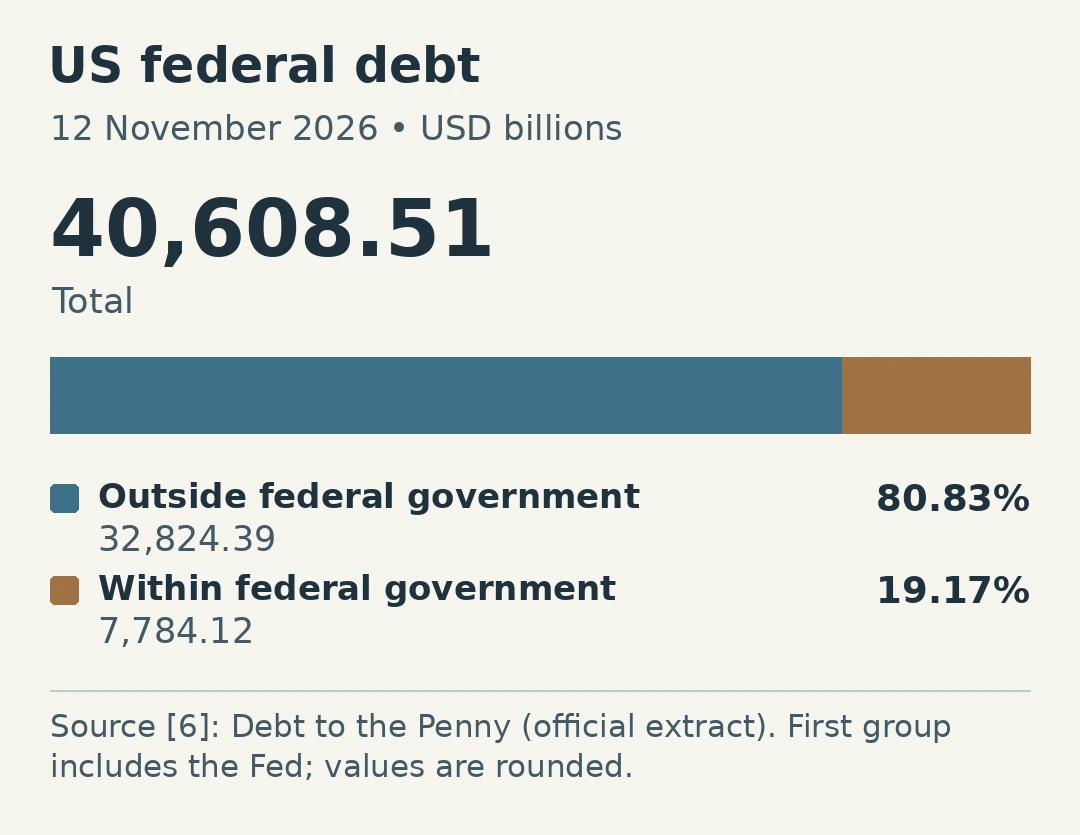
In its Debt to the Penny dataset, the US Treasury distinguishes between federal debt held outside the federal government (Debt Held by the Public) and holdings within the federal government (Intragovernmental Holdings). According to the official data extract, total federal debt on 12 November 2026 amounted to 40,608.51 billion US dollars. Of this, 32,824.39 billion, or approximately 80.83%, fell into the first category, and the remaining 7,784.12 billion, or approximately 19.17%, to the second. The values are rounded. [6]
Intragovernmental debt arises in part from the holdings of government funds. It represents a claim for the individual fund and a liability for the Treasury. Although this is an internal public-sector relationship, it does not follow that the government can disregard its obligations to the beneficiaries of those funds. It is also important that the US category Debt Held by the Public includes the Federal Reserve. Holders outside the federal government are therefore not necessarily private or foreign creditors. The Treasury expressly excludes from this category securities issued by the Federal Financing Bank (FFB), which are included among intragovernmental holdings in the Debt to the Penny dataset. [6]
The Federal Reserve's Financial Accounts (Z.1) offer a more detailed picture. The following table uses a snapshot from the archived release of 11 September 2026, covering the end of the second quarter of 2026. Table F3.2.s covers marketable Treasury securities net of premiums and discounts, classified by sector according to the Fed's methodology. It also specifically includes long-term marketable FFB securities issued to the Civil Service Retirement Fund. Its coverage therefore differs from that of total federal debt. [7]
| Selected holder sectors | Holdings in USD billions |
|---|---|
| Rest of the world | 9,269.2 |
| Central bank | 4,082.7 |
| Money market funds | 3,281.6 |
| Household sector | 2,831.1 |
| US-chartered depository institutions | 1,799.1 |
| Mutual funds | 1,741.2 |
| State and local governments | 1,647.6 |
| Exchange-traded funds (ETF) | 807.6 |
| Private pension funds | 590.2 |
Source: Federal Reserve, Z.1, 11 September 2026, table F3.2.s, p. 131, selected rows. [7]
In the same table, total liabilities amount to 30,878.3 billion dollars, while total reported holdings amount to 29,013.6 billion. According to the note accompanying the table, the difference of 1,864.7 billion is the cumulative valuation difference between securities issued and securities held. It is not an additional category of creditors. We cannot add it to the assets of any bank or individual, nor can we use these data to calculate shares of total federal debt in November. [7]
Financial Accounts of the United States, Z.1 – September 2026
The central bank's presence among the creditors is particularly significant. The Treasury also pays interest on bonds in the central bank's portfolio, but the interest received is not equivalent to its net profit. The central bank has its own expenses and rules governing the allocation of its financial results, as discussed in the article on the Federal Reserve. A central bank's purchase of a bond therefore does not in itself extinguish the government's liability, nor do all payments automatically constitute profits for private banks.
Foreign investors, custodians and ultimate beneficiaries
When rankings of the countries holding the most US bonds appear in public debate, they may be understood as a list of foreign governments lending money to the United States. Yet data from the US Treasury’s international capital reporting system, Treasury International Capital (TIC) include both private and official foreign holders. In its release for August 2026, the US Treasury highlights a further limitation: geographical allocation is based primarily on information from custodial institutions, so assets held in a third country or managed through a foreign portfolio manager are not necessarily attributed to the country of the ultimate owner. [8]
In the officially indexed TIC table for the end of August 2026, some of the largest geographical categories are Japan (1,068.3 billion USD), the United Kingdom (1,009.5 billion), mainland China (590.7 billion) and Belgium (490.5 billion). These are selected categories of holdings, not amounts directly controlled by the respective governments. The complete dated table has not been directly verified, so these figures are not used to calculate overall shares. [9]
This distinction matters in financial centres that provide custody services to international investors. If a pension fund in one country buys an investment through a manager in another and the security is held in a custody account in a third country, the country label in an aggregate table alone cannot tell us who derives the economic benefit from the investment. The US system for holding securities also allows for direct holdings or multi-tiered indirect holdings through financial institutions. [1][8]
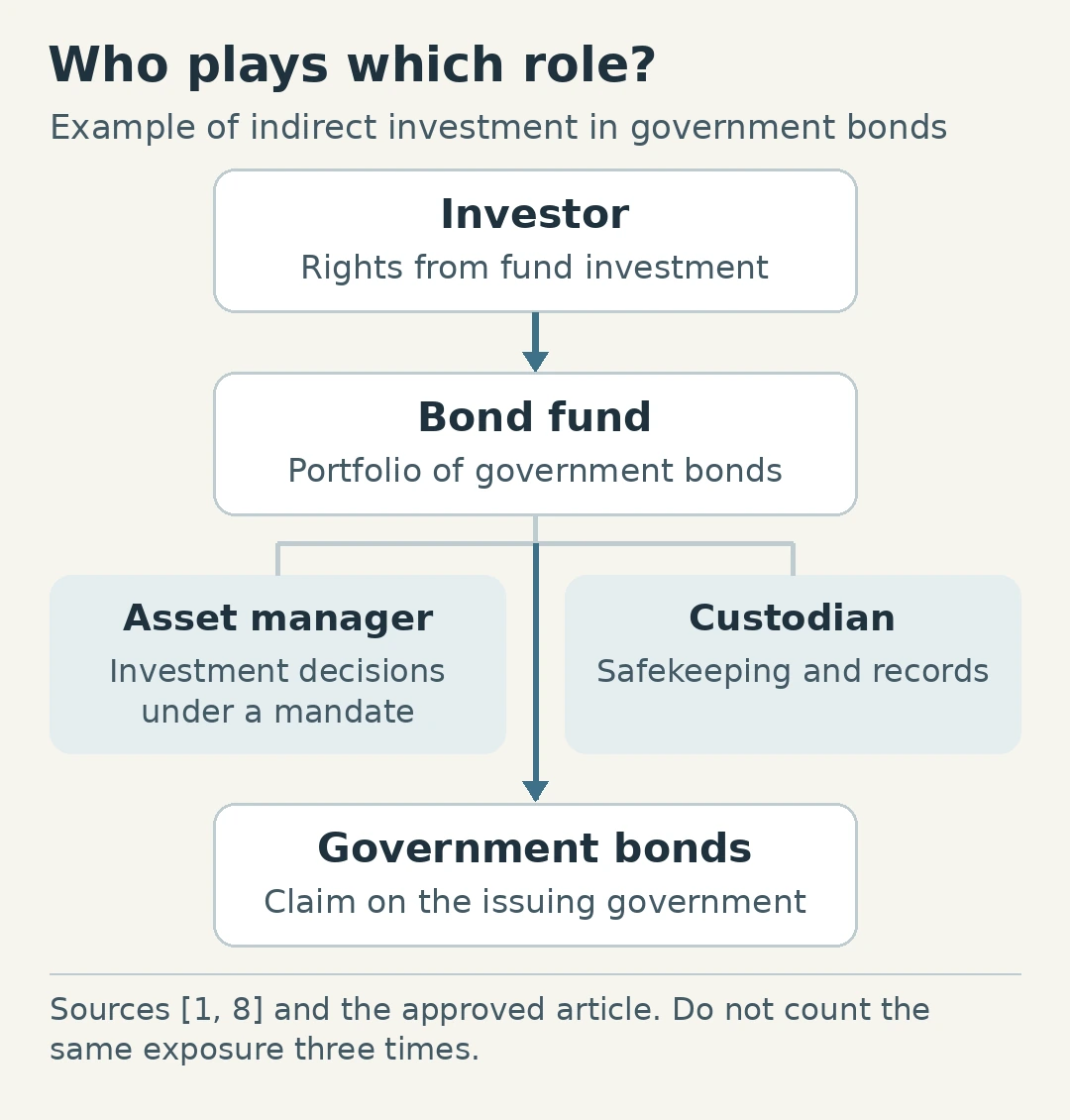
An investment fund manager makes investment decisions within the scope of a mandate and may thereby acquire considerable influence over capital flows. However, assets managed on behalf of clients are not automatically the manager's own assets. An investor in a bond fund is generally not the direct individual holder of every bond in its portfolio; the investor has rights arising from the investment in the fund. If we treated the fund's entire portfolio, the manager's assets under management and the value of investors' fund units exposed to those same bonds as three separate claims against the government, we would count the same economic exposure more than once. This distinction between ownership, custody and management is one of the central themes of this series.
Public TIC data provide valuable insight into international financing, but not a complete reconstruction of all ownership chains leading to ultimate owners. Assessing the influence of a particular country or financial institution therefore requires more than simply looking at the size of its holdings in a ranking. We must consider the nature of the holder, portfolio concentration, the ability to sell and the issuer's dependence on future funding.
Europe and Slovenia's government debt
Eurostat monitors the composition of government debt, including by institutional sector and the residence of holders. The balance between domestic and foreign financing differs across European countries, so there is no single creditor structure for Europe. Even within the euro area, government bonds issued by individual member states remain liabilities of their issuers; a common currency does not in itself combine these debts into one. [2][4]
According to the October revision by the Statistical Office of the Republic of Slovenia (SURS), gross consolidated general government debt at the end of 2025 amounted to 46,332 million euros, or 65.1% of GDP. According to the release of 30 September 2026, it reached 47,707 million euros, or 64.7% of GDP, at the end of the second quarter of 2026. Debt thus increased in absolute terms, while its ratio to GDP declined. This illustrates why the two measures must be considered together. SURS also reports general government interest expenditure of 899 million euros for 2025; in 2022 it amounted to 641 million euros. These figures record expenditure by the entire sector; they do not directly identify the recipients of the interest. [10][11] Source: SURS.
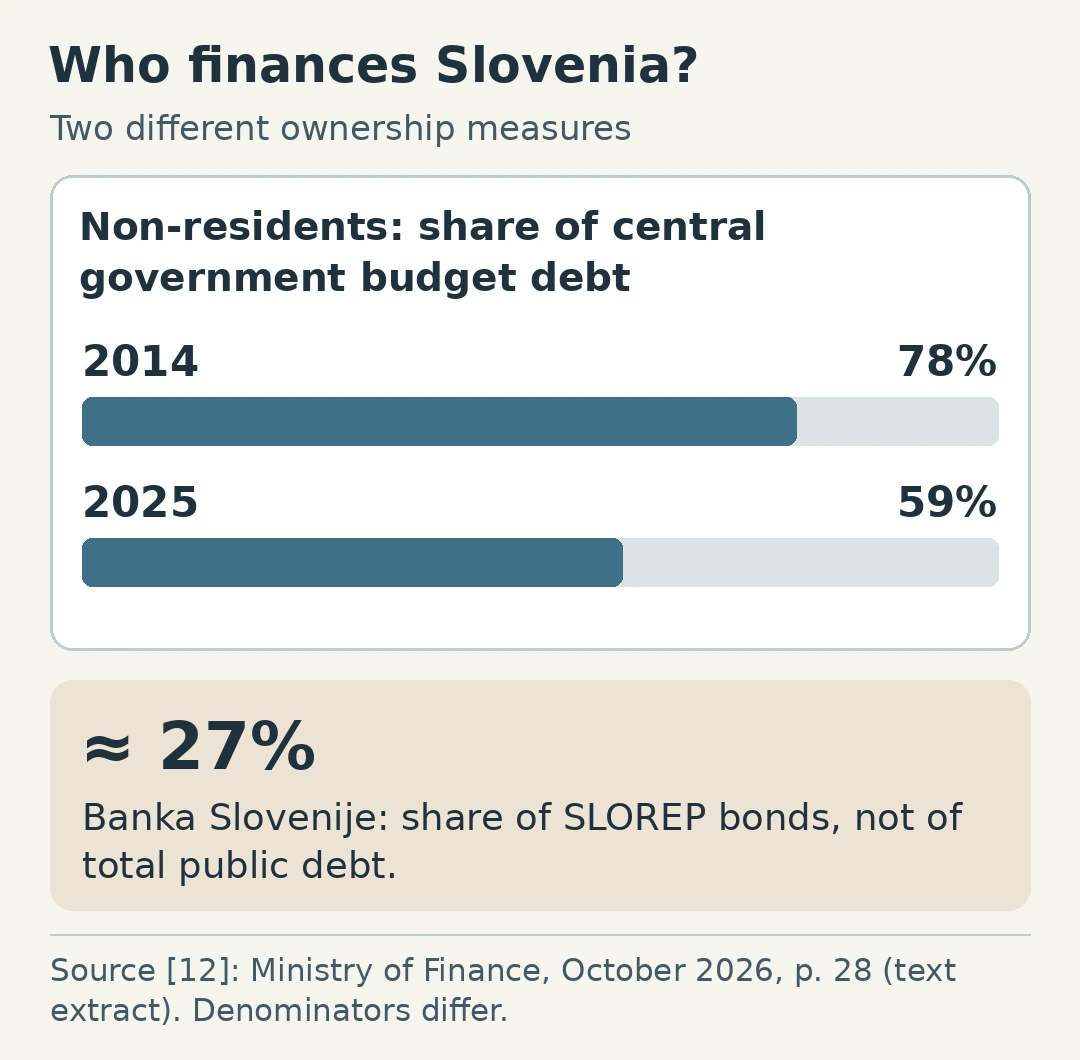
To whom does Slovenia owe this money? In its October 2026 investor presentation (data as at 30 September), the Ministry of Finance reports a measure with a different definition: the share of non-residents among holders of central government budget debt fell from 78% in 2014 to 59% in 2025. The calculation also takes account of developments on the secondary market. The Ministry additionally highlights Banka Slovenije, which, through securities purchase programmes, became a significant individual holder of Republic of Slovenia bonds designated SLOREP, holding around 27% of those bonds. [12]
The last percentage refers to SLOREP bonds, not to total consolidated government debt; its denominator is also not necessarily the same as that used for the non-resident share of central government budget debt. The percentages must therefore not be combined into a single ownership breakdown. A detailed picture of individual sectors would require data with the same coverage, date and methodology.
Banka Slovenije's position as a bondholder must be distinguished from the direct financing of the central government budget. Article 123 of the Treaty on the Functioning of the European Union prohibits the ECB and national central banks from extending credit to certain public entities and from purchasing their debt instruments directly. The second paragraph of the article provides a narrow exception for publicly owned credit institutions in the provision of reserves. Purchases on the secondary market are a different mechanism, but must be undertaken with appropriate safeguards. In Weiss (C-493/17, 11 December 2018, paragraphs 102–108), the Court of Justice of the EU explained that purchases must not have an effect equivalent to direct purchases or undermine the incentive to pursue sound budgetary policy. The assessment depends on the features of the programme and the economic circumstances. [13][14]
The World Bank, the IMF and other international creditors
In addition to marketable bonds, loans from other countries and international institutions are important for many countries, particularly those with limited access to capital markets. In its International Debt Report 2026, the World Bank presents the external debt of 119 low- and middle-income countries. According to the figures for the end of 2025, their total external debt reached approximately 9,445 billion dollars. The report classifies 4,274 billion of this amount as part of the public and publicly guaranteed debt segment, which in this presentation includes IMF credit and allocations of special drawing rights (SDRs). The remainder cannot automatically be treated as government debt, since it also includes private non-guaranteed and short-term debt. [15]
| Creditor type in the public and publicly guaranteed segment | USD billions, end of 2025 |
|---|---|
| Private creditors | 2,281 |
| Multilateral creditors | 1,494 |
| Bilateral creditors | 500 |
| Total as reported | 4,274 |
Source: World Bank, International Debt Report 2026, aggregate profile for 119 countries, figure 2. The sum of the rounded components is one billion higher than the published total. [15]
A bilateral creditor may be another country or one of its public financial institutions, whereas a multilateral creditor is an international institution. Private creditors include various participants in financial markets. Different types of debt can have very different interest rates, maturities, terms and restructuring options. Here, too, the figures represent a specifically defined portion of the external liabilities of a selected group of countries, not a global ranking of government debt ownership.
How can creditors influence government decisions?
The most direct source of leverage for market-based creditors is their willingness to provide funding at a given price. If investors demand higher yields or are unwilling to buy new bonds, a government may face a choice between more expensive refinancing, changing expenditure, increasing revenue or finding other sources of funding. A large holder can affect market conditions by selling bonds, but the sale itself generally does not change the rights and obligations associated with an instrument already issued. The precise effect depends on market depth, maturity, the currency regime and the conduct of other investors.
International loans can bring more direct contractual conditions. The International Monetary Fund (IMF) provides financial assistance to members facing macroeconomic difficulties. Most of its financing is disbursed in instalments linked to agreed measures. Conditionality and monitoring include prior actions, quantitative performance criteria, indicative targets and structural benchmarks. The Executive Board assesses progress during programme reviews and may grant a waiver when a quantitative performance criterion has not been met. Failure to meet indicative targets or structural benchmarks is assessed in the context of the programme as a whole. The nature and stringency of the conditions depend on the instrument and the specific programme. [16][17]

Supporters of such conditionality emphasise the objectives of stabilising the economy, ensuring the capacity to repay funds and restoring access to financing. A critical assessment, however, must examine who sets the conditions, how the burdens of adjustment are distributed and how much bargaining power a government has when it urgently needs funds. The IMF's general rules do not in themselves establish that a particular programme caused specific social or economic outcomes. Such an assessment requires the actual agreements, national decisions and data on their actual effects.
Creditors' power can therefore increase significantly during periods of financial pressure. However, a bond does not in itself grant its holder a vote on the government budget, rights to national territory or ownership of state institutions. Any specific contractual rights, collateral and consequences of default must be assessed separately. It is precisely the distinction between formal rights and actual bargaining power that lies at the heart of investigating financial dependence.
Government debt, financial dependence and sovereignty
There is no single answer to the question of whom governments owe money. Claims are distributed among public funds, central banks, commercial banks, private and public investors, pension funds, other countries and international institutions. Aggregate statistics reveal much of this institutional structure, but not the names of all ultimate beneficiaries. This does not substantiate the hypothesis of a single owner of all government debt, nor does it in itself rule out a concentration of managerial or bargaining influence in particular markets.
Public accountability therefore requires transparent borrowing terms and accessible data on holders, the currency composition and maturity profile of debt, contractual collateral and the conditions of international loans. We must ask who makes borrowing decisions, who receives interest income and who ultimately bears the risk when funding can no longer be renewed on acceptable terms. Debt does not constitute ownership of the state, but it can constrain the scope a government has to pursue its political and economic decisions.
The next article will therefore examine financial crises: who bears the losses and who makes the decisions when ordinary funding mechanisms fail.
Sources and further reading
- U.S. Department of the Treasury, TreasuryDirect. FAQs About Treasury Marketable Securities. Sections on buying and selling and on how securities are held. Source
- Eurostat. Structure of government debt (gov_10dd_sgd): reference metadata. ESA 2010 methodology. Source
- Eurostat. Government deficit and debt (gov_10dd): reference metadata. Updated 21 October 2026, section 3.1. Source
- Eurostat. Structure of government debt. Data extract, June 2026; the general explanation of the structure is used, not the figures from the caption with inconsistent dates. Source
- European Central Bank, ECB Data Portal. What is external debt? Methodological explanation of residence and external debt. Source
- U.S. Department of the Treasury, Fiscal Data. Debt to the Penny. Data row for 12 November 2026 and data dictionary; official indexed extract. Source
- Board of Governors of the Federal Reserve System. Financial Accounts of the United States – Z.1, 11 September 2026, second quarter of 2026, p. 131, table F3.2.s, notes 1–4. Dated archived release. Source
- U.S. Department of the Treasury. Treasury International Capital Data for August 2026. 16 October 2026, About TIC Data section; official indexed extract. Source
- U.S. Department of the Treasury, TIC. Table 5: Major Foreign Holders of Treasury Securities. August 2026, selected rows of the official indexed extract; dynamic table, complete release not directly verified. Source
- Statistical Office of the Republic of Slovenia. Temeljni agregati sektorja država (oktobrsko EDP poročanje), 2022–2025. October 2026, table of main aggregates; official indexed extract. Source: SURS. Source
- Statistical Office of the Republic of Slovenia. Temeljni agregati sektorja država, 2. četrtletje 2026. 30 September 2026, quarterly table; official indexed extract. Source: SURS. Source
- Republic of Slovenia, Ministry of Finance. Republic of Slovenia – Investor Presentation, October 2026. P. 28, Debt Composition by Residence of Investors; text extract. Source
- European Union. Consolidated version of the Treaty on the Functioning of the European Union, Article 123. 26 October 2012. Source
- Court of Justice of the European Union. Judgment of the Court (Grand Chamber), Weiss and Others, C-493/17, 11 December 2018, ECLI:EU:C:2018:1000, paragraphs 102–108. Source
- World Bank. International Debt Report 2026 – Aggregate and Country Profiles. November 2026, All Low- and Middle-Income Countries aggregate, figure 2; data from the official indexed extract, direct visual inspection unsuccessful. Source
- International Monetary Fund. IMF Lending. Updated April 2025. Source
- International Monetary Fund. IMF Conditionality. How conditionality is assessed and structured section; official indexed extract. Source