ECB and BIS: Who Shapes the Rules of Central Banking?
An examination of the ECB and BIS, their governance and the relationship between central banks and public accountability.

Editorial illustration of institutional coordination; the buildings are not shown at an actual shared location.
When the European Central Bank changes interest rates, the effects are felt even by people who have never set foot on its premises. The cost of a mortgage, business financing or refinancing government debt may change. Yet decisions on interest rates are only one form of financial power. Banks' operations are also shaped by rules governing their capital, risks and liquidity, which are developed with the participation of institutions outside the European Union. To understand who holds power in this system, we must distinguish between ownership, monetary policy, banking supervision and the development of international standards.
The ECB, the European System of Central Banks and the Eurosystem
The European Central Bank (ECB) is not the same as the entire European central banking system. The European System of Central Banks (ESCB) comprises the ECB and the national central banks of all European Union Member States, while the Eurosystem brings together the ECB and the national central banks of countries that use the euro. Following Bulgaria's entry into the euro area on 1 January 2026, the Eurosystem comprises 21 national central banks, while the ESCB includes the central banks of all 27 EU Member States. [1][2][3]

The distinction matters because membership of the broader system does not confer equal powers in determining euro area monetary policy. The national central bank of a country that has not yet adopted the euro participates in the ESCB, but its governor is not a member of the ECB's Governing Council, which determines the monetary policy of the Eurosystem. Banka Slovenije did not cease to exist when Slovenia adopted the single currency: it became part of a system in which key monetary decisions are taken jointly. [1][4]
Who holds the ECB's capital and who votes?
Unlike an ordinary joint-stock company, the ECB does not have shares that private investors can freely purchase on a stock exchange. Under Article 28 of the Statute of the ESCB and of the ECB, national central banks are the sole subscribers to and holders of its capital, which they cannot dispose of in the same way as ordinary shares: their shares may not be pledged or attached, and transfers are restricted to the legally prescribed adjustment of the capital key. The capital key is determined by each country's share of the population and gross domestic product of the entire EU, with equal weight assigned to both criteria. [1][2]
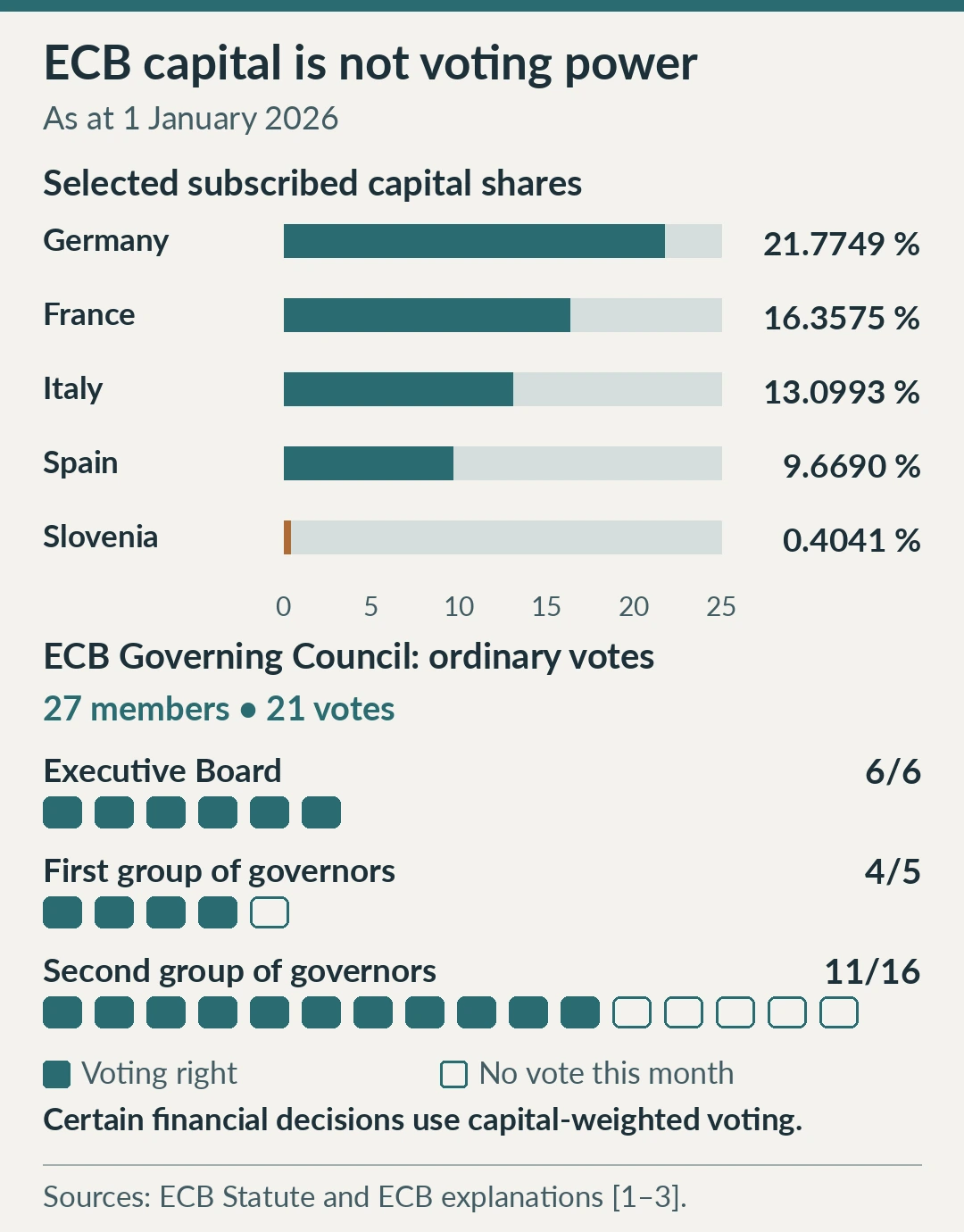
On 1 January 2026, the ECB's subscribed capital amounted to €10,825,007,069.61. The national central banks of the euro area had paid up a total of €8,957,303,649.83, while the central banks of countries outside the euro area had paid up €70,038,878.24. Subscribed capital and paid-up capital therefore differ. Central banks outside the euro area pay up 3.75% of their subscribed share as a contribution to the operating costs of participation in the ESCB; they are not entitled to a share of the ECB's distributable profit and are not required to cover its losses. [2]
| National central bank | Share of total subscribed capital |
|---|---|
| Deutsche Bundesbank (Germany) | 21.7749% |
| Banque de France (France) | 16.3575% |
| Banca d’Italia (Italy) | 13.0993% |
| Banco de España (Spain) | 9.6690% |
| Banka Slovenije (Slovenia) | 0.4041% |
Selected capital shares as at 1 January 2026; the table does not show all holders of capital or votes on monetary policy. Source: ECB [2].
If the power to decide interest rates depended directly on capital, the largest countries would carry considerably more weight than the smallest. However, the ECB's Governing Council uses a different system for ordinary monetary policy decisions. All six members of the Executive Board have permanent voting rights, while the 21 governors of the national central banks of the euro area share 15 voting rights on a rotating basis. Five governors from the highest-ranked countries in terms of the size of their economies and financial sectors (Germany, France, Italy, Spain and the Netherlands) share four votes; the remaining sixteen share eleven. In ordinary voting, each member entitled to vote has one vote. Rotation takes place monthly, and all members may participate in discussions. [1][3]
| Group of Governing Council members | Number of members | Voting rights |
|---|---|---|
| Executive Board | 6 | 6 |
| First group of governors | 5 | 4 |
| Second group of governors | 16 | 11 |
| Total | 27 | 21 |
Ordinary voting arrangements from 1 January 2026. Source: the Statute and ECB explanation [1][3].
There is, however, an important exception. For certain financial decisions relating to capital, the capital key, the transfer of foreign reserve assets and the allocation of monetary income and profits or losses (Articles 28, 29, 30, 32 and 33 of the Statute), the Statute provides for votes to be weighted according to the national central banks' capital shares. Under these arrangements, the votes of Executive Board members carry no weight, and the shares of euro area central banks are taken into account. Where a qualified majority is required under these arrangements, the votes in favour must represent at least two-thirds of the euro area's subscribed capital and at least half of the holders of that capital. It would therefore be incorrect to claim either that capital always determines decision-making power or that it plays no role in decision-making at all. [1]
Independence, accountability and the Slovenian example
The Treaty on the Functioning of the European Union establishes price stability as the primary objective of the ESCB. It safeguards institutional independence by restricting the acceptance of instructions from governments, EU institutions or other bodies in the performance of Treaty-based tasks. Members of the ECB's Executive Board are appointed by the European Council, acting by a qualified majority on a recommendation from the Council of the EU after consultation with the European Parliament and the ECB's Governing Council. They serve an eight-year term and may not be reappointed. Among other obligations, the ECB must submit an annual report on its activities and monetary policy to the relevant European institutions, and its President presents the report to the Council and the European Parliament. Members of the Executive Board may attend hearings before the competent parliamentary committees. The Statute also provides for independent external audits of the accounts of the ECB and the national central banks, while the proceedings of the Governing Council are in principle confidential. [4][1]
A similar distinction between ownership and autonomy can be seen in Slovenia. Article 1 of the Bank of Slovenia Act defines Banka Slovenije as a legal person governed by public law, exclusively owned by the state and enjoying financial and managerial autonomy. Article 2 establishes its independence in carrying out its tasks. The Slovenian state therefore owns its central bank, but this does not entitle the government to instruct the governor how to vote on interest rates. [4][5]
As at 1 January 2026, Banka Slovenije had paid up €43,743,853.57 of capital in the ECB. Its share in the overall EU capital key was 0.4041%, while its share in the Eurosystem capital key, which includes only the national central banks of the euro area, was 0.4884%. [2] These figures illustrate how different denominators can produce different percentages, even when both refer to the same institution.
Central bank independence serves an understandable purpose: to limit the possibility of short-term political interests directly dictating monetary policy. At the same time, central bank decisions affect many areas of life, making it important to ask to whom these institutions are accountable, how they explain their decisions to the public and how much insight we have into the decision-making process. Legally guaranteed independence does not in itself answer every question about actual influence and accountability.
BIS: from private shares to central bank ownership
The Bank for International Settlements (BIS), established in 1930 and based in Basel, is a different type of institution. Its Statutes assign it the task of promoting cooperation between central banks and facilitating international financial operations. According to its current official membership list, it has 63 member central banks and monetary authorities, including the ECB and Banka Slovenije. The BIS states that its capital is owned by central banks. [6][7]

Historically, however, this was not always the case. Some BIS shares were offered to private investors when the bank was established, and some of them were traded on European stock exchanges. According to the BIS note to private shareholders dated 15 September 2000, of the 529,165 issued shares, 456,517 were held by central banks and the remaining 72,648, or 13.73%, were privately held. These comprised 33,078 shares of the US issue, 16,415 of the Belgian issue and 23,155 of the French issue. Private shareholders had economic rights but no right to attend or vote at BIS General Meetings. [8][9]
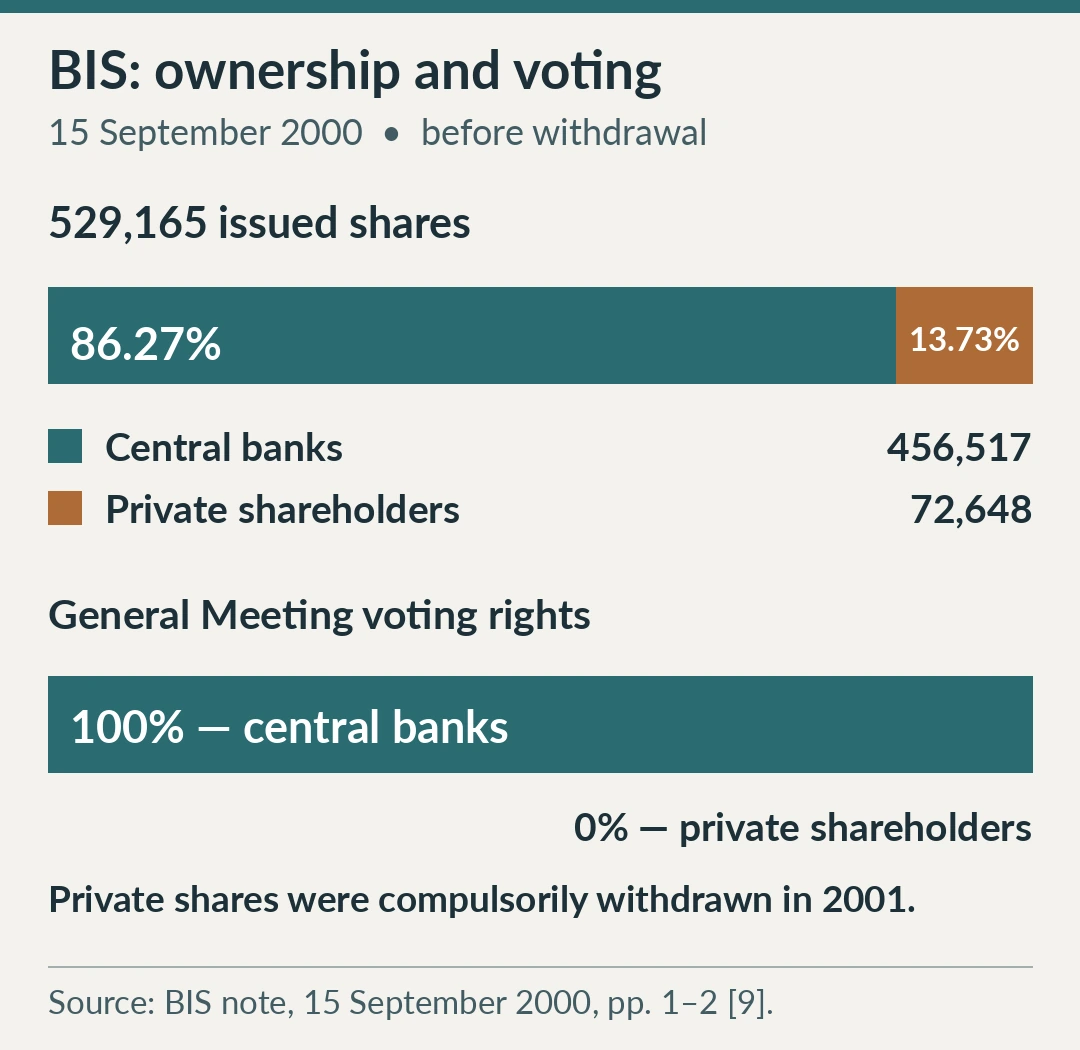
On 8 January 2001, an Extraordinary General Meeting resolved on the compulsory withdrawal of these shares at an initial price of 16,000 Swiss francs per share. Former private shareholders initiated arbitration proceedings. In 2002, the arbitral tribunal in The Hague upheld the lawfulness of the withdrawal but required a valuation based on a proportionate share of the BIS's net asset value, subject to a 30% discount. Following the final award in 2003, the BIS paid all eligible former private shareholders an additional 9,052.90 Swiss francs per share. According to the official BIS summary, the total payment per share thus amounted to 25,052.90 Swiss francs. The summary and accessible extracts of the arbitral awards confirm the difference between the initial price and the final settlement; the full awards were not reviewed. [8][10][11][12][13][14]
BIS note to private shareholders, 15 September 2000
Nevertheless, the BIS Statutes retain a special legal provision. Under Articles 14 and 15, a financial institution designated by the BIS Board of Directors may, under certain conditions, also participate in voting and shareholding. This is not a general opportunity for private investors to purchase shares, but a limited exception applicable where a central bank does not wish to exercise its rights and does not object to the designation of a financial institution in that country, or where a country has no central bank. [6] It is important to distinguish the existence of this provision from its actual application: the BIS's public disclosure states that its capital is owned exclusively by central banks, but we do not have the complete register of individual shareholdings in this investigation.
Who governs the BIS?
The BIS has a General Meeting of its members, a Board of Directors and a management team. The Board sets the bank's strategic direction and oversees its management. Its composition is not designed to give every member an automatic seat. The Statutes permit a maximum of eighteen members: six hold seats ex officio as the governors of the central banks of Belgium, France, Germany, Italy, the United Kingdom or the United States; these directors may jointly appoint one further member, and up to eleven other governors may be elected by the Board itself by a two-thirds majority. Article 27(5) of the Statutes requires certain decisions under Articles 6, 8, 9, 57 and 58 to be approved not only by a two-thirds majority of the Board but also by a simple majority of the ex officio directors. This is a special formal right in decisions concerning, among other things, capital and amendments to the Statutes, not a right to make every decision independently. [6][15]
At the General Meeting, too, voting rights are not simply a consequence of holding any individual share, but derive from specific arrangements governing representation and subscribed capital by country. Shares confer economic rights to participate in profits, but this does not mean that every holder has a direct vote on that basis. [6] The formal governance rules thus show that the positions of members are not entirely equal. To determine their actual relative power, we would also need data on voting, decisions and individual capital shares.
The BIS provides financial services to central banks and facilitates cooperation in international financial operations. Its powers, however, have limits. Article 19 of the Statutes provides that its operations must be consistent with the monetary policy of the central banks concerned, which, under prescribed conditions, may object before an operation is carried out. [6] In addition, Article 24 prohibits the BIS, among other things, from issuing notes payable to bearer at sight, making advances to governments and opening current accounts in their name. We therefore cannot infer from financial and organisational links that the BIS has a general right to dictate the monetary policy of national central banks. [6]
The Basel Committee and the development of international standards
The BIS is not the only institution operating in Basel. It also provides the secretariat for the Basel Committee on Banking Supervision (BCBS). The Committee brings together central banks and banking supervisory authorities and develops international standards for the prudential regulation of banks. Membership of the BIS and membership of the Basel Committee are not the same. According to its published organisational structure, the Committee has 45 member institutions from 28 jurisdictions. [16][17]
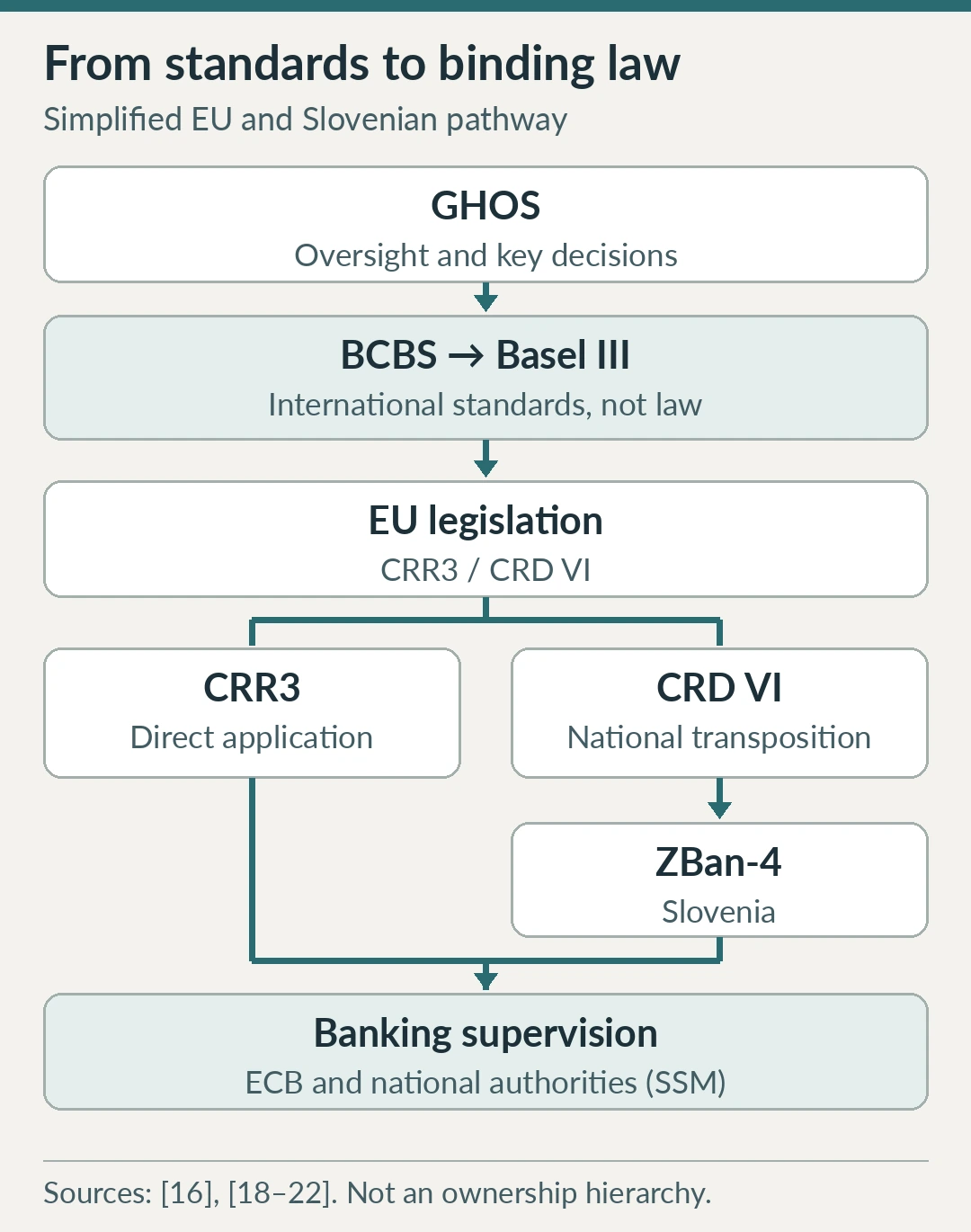
Within the Committee's organisational structure, the Group of Governors and Heads of Supervision (GHOS) provides oversight, directs its work and endorses major decisions. The Committee takes decisions by consensus. Its charter expressly states that it has no formal supranational authority and that its decisions have no legal force in themselves. Members have, however, committed to implementing the standards in their jurisdictions within agreed timeframes and to taking part in compliance assessments. The standards are generally minimum requirements, so individual jurisdictions may exceed them. The charter provides for public consultation on draft standards; this process does not mean that all participants have equal influence over the final decision. [16]
This is an important example of institutional influence without direct legislative authority. Standards such as Basel III establish common approaches to capital adequacy, liquidity and the treatment of risks. If a regulator requires a bank to hold more capital in relation to certain exposures, this may alter the bank's commercial assessment of which loans it will grant and on what terms. Such an effect is not automatic and also depends on the bank's actual capital, other constraints and demand for credit. This illustrates why technical rules may have significant social and economic consequences.
From an international standard to binding legislation
How can a standard developed in Basel become a rule for a bank in Slovenia? This process is illustrated by Regulation (EU) 2024/1623 (CRR3) and Directive (EU) 2024/1619 (CRD VI), adopted on 31 May 2024. Both acts form part of the European legislative framework associated with the reform of prudential requirements. The Regulation is directly applicable in the Member States; its general application began on 1 January 2025, subject to certain exceptions. The Directive, by contrast, requires its provisions to be transposed into national law. Its general deadline for the adoption and publication of national measures was 10 January 2026, and for their application 11 January 2026, with several exceptions. [18][19] In Slovenia, on 11 February 2026 the National Assembly adopted the new Banking Act (ZBan-4), which has been in force since 12 March 2026. Article 2 provides, among other things, for the transposition of amended Directive 2013/36/EU, which CRD VI also amends. This example illustrates the national legislative level, but does not in itself demonstrate that all CRD VI provisions were transposed fully or on time. [20] These acts therefore cannot be treated as a simple direct instruction from the BIS to European banks.
In the field of prudential supervision, the legal framework is supplemented by Council Regulation (EU) No 1024/2013, which establishes the basis for the Single Supervisory Mechanism (SSM). Within the SSM, the ECB directly supervises significant banks in cooperation with national supervisors, whereas less significant banks are generally directly supervised by national competent authorities under the ECB's oversight. In certain common procedures, such as the granting of banking licences and the assessment of acquisitions of qualifying holdings, the ECB also has powers in relation to less significant banks. [21][22] Supervisory authorities thus apply legally binding rules and exercise powers derived from European and national law.
International coordination does not end with the publication of a standard. Through its RCAP programme, the Basel Committee monitors the adoption and implementation of agreed rules. According to its report on implementation as at 30 September 2026, approximately three-quarters of the 27 monitored jurisdictions had published regulations covering the entire final Basel III package, while it had been fully implemented in 47% of the monitored jurisdictions. Russia is not included in this assessment. [23][24] The publication of regulations and their actual application are therefore distinct stages; timelines also vary between countries.
Common rules can play an important role in reducing financial risks and limiting competition between countries to lower supervisory requirements. At the same time, harmonised standards can restrict the scope for independently developing local rules and affect different types of banks differently. Whether a particular framework actually encourages banking concentration or makes access to credit more difficult is an empirical question that cannot be answered solely by examining institutional powers.
Conclusion
The ECB, the BIS and the Basel Committee are part of an interconnected financial environment, but they do not exercise the same kind of power. The ECB determines euro area monetary policy within the framework of the European Treaties and has legally defined supervisory powers. The BIS brings central banks together and provides financial services, while the Basel Committee develops common international standards that acquire legal force through the relevant legislative or regulatory procedures.
If we want to understand who shapes the rules of the monetary system, it is therefore not enough to draw a network of institutions and their interconnections. We need to establish who holds capital, who appoints decision-makers, who votes, who formulates proposals, who adopts binding rules and who implements them. The documented links do not prove the existence of a single hidden owner, but they clearly demonstrate the existence of structures within which decisions with wide-ranging economic consequences are shaped. In the next part of our investigation, we will apply this question to public finances: to whom do governments owe money?
Sources and further reading
- European Union. Protocol (No 4) on the Statute of the European System of Central Banks and of the European Central Bank. Consolidated version 2016, particularly Articles 1, 10, 11, 28, 33 and 42. Source
- European Central Bank. Capital subscription. Updated 1 January 2026, tables of subscribed and paid-up capital and the Eurosystem capital key. Source
- European Central Bank. Rotation of voting rights in the Governing Council. 1 December 2014, updated 1 January 2026. Source
- European Union. Treaty on the Functioning of the European Union, consolidated text, particularly Articles 127, 130 and 282–284. Versions on EUR-Lex: Source 1 Source 2
- Republic of Slovenia. Zakon o Banki Slovenije (ZBS-1) [Bank of Slovenia Act]. Unofficial consolidated text No 5, applicable from 12 March 2026, Articles 1 and 2. Source
- Bank for International Settlements. Statutes of the Bank for International Settlements. 20 January 1930, text as amended up to 7 November 2016, applicable from 1 January 2019, particularly Articles 3, 13–15, 19–27 and 44. Source
- Bank for International Settlements. BIS member central banks. Official membership list, checked on 16 November 2026. Source
- Bank for International Settlements. The BIS announces the withdrawal of all shares held by its private shareholders against payment of CHF 16,000 per share. 8 January 2001. Source
- Bank for International Settlements. Note to private shareholders: Withdrawal of all shares of the Bank for International Settlements held by its private shareholders. 15 September 2000, p. 2, section I.A. Source
- Permanent Court of Arbitration. Bank for International Settlements. Arbitration case record, awards dated 22 November 2002 and 19 September 2003. (Record cited in C1; direct reopening in C2 was unsuccessful.) Source
- Bank for International Settlements. Shares withdrawal. Official historical overview of the share withdrawal and arbitration proceedings. Source
- Bank for International Settlements. Hague Arbitral Tribunal decision regarding the repurchase of privately held shares of the Bank for International Settlements. 25 November 2002. Source
- Hague Arbitral Tribunal. Partial Award on the Lawfulness of the Recall of the Privately Held Shares on 8 January 2001 and the Applicable Standards for Valuation of those Shares, case 2000-04, 22 November 2002. Accessible indexed extracts from the WorldCourts transcript. Source
- Hague Arbitral Tribunal. Final Award on Claims for Compensation for the Shares Formerly Held by the Claimants, Interest Due Thereon and Costs of the Arbitration and on the Counterclaim of the Bank Against First Eagle Sogen Funds, Inc., case 2000-04, 19 September 2003. Accessible indexed extracts from the WorldCourts transcript. Source
- Bank for International Settlements. Board of Directors. Section on the composition of the Board of Directors. Source
- Basel Committee on Banking Supervision. BCBS charter. Particularly sections 2–6, 8.4, 11, 12 and 17. Source
- Basel Committee on Banking Supervision. BCBS organisation and governance. Sections on the secretariat and the institutions represented on the Committee. Source
- European Parliament and Council of the European Union. Regulation (EU) 2024/1623 (CRR3). 31 May 2024, particularly the recitals and Article 2. Source
- European Parliament and Council of the European Union. Directive (EU) 2024/1619 (CRD VI). 31 May 2024. Source
- Republic of Slovenia. Zakon o bančništvu (ZBan-4) [Banking Act]. Official Gazette of the Republic of Slovenia, No 15/26, 25 February 2026, act 576, Articles 1 and 2; in force since 12 March 2026. Source 1 Source 2
- Council of the European Union. Council Regulation (EU) No 1024/2013 (SSM Regulation). 15 October 2013, particularly Articles 4, 6 and 9. Source
- European Central Bank, banking supervision. Organisation of supervision and oversight for less significant institutions. Sections on the roles of the ECB and national competent authorities and on licensing. Source
- Basel Committee on Banking Supervision / BIS. Basel III applicable in almost all member jurisdictions by 2027. 5 October 2026, status as at 30 September 2026. Source
- Basel Committee on Banking Supervision. Implementation: Regulatory Consistency Assessment Programme (RCAP). Overview of the status up to 30 September 2026. Source