Federal Reserve: Who Owns the US Central Banking System?
How the Federal Reserve is organized, who holds regional Reserve Bank shares and who sets monetary policy.

Symbolic editorial illustration of distinct institutional routes into shared decision-making; it does not depict an actual FOMC meeting or its composition.
In previous parts of our investigation, we saw how commercial banks create deposit money and how different ownership structures influence the governance of large banking groups. The US central banking system, the Federal Reserve (Fed), raises a further question: can the banks that participate in its governance and receive dividends also be regarded as owners of the institution that shapes US monetary policy? Answering this requires an examination of the origins of the system, its statutory powers and the distribution of financial benefits.
How was the Federal Reserve established?
The banking panic of 1907 intensified efforts to reform the US monetary and banking system. In November 1910, a confidential meeting of six participants, including Senator Nelson Aldrich and banker Paul Warburg, took place on Jekyll Island off the coast of the US state of Georgia. The purpose of the meeting was to develop a proposal for banking reform. The role of financial sector representatives in drafting the proposal is also documented in a historical account published by the Fed. [1]
However, the proposal developed by this group was not identical to the law subsequently enacted. Following political debate, President Woodrow Wilson signed the Federal Reserve Act on 23 December 1913. Nor is the present arrangement an unchanged version of the original system: the Banking Act of 1935 transferred some powers from the regional banks to the central body in Washington and reorganised the leadership of the system. [2][3][4] The historical influence of private bankers is important, but assessing present-day ownership and powers also requires an examination of the legislation in force.
Federal Reserve Act – original legislation, 23 December 1913
The three main institutions of the system
The Federal Reserve is not a single company whose shares can be bought on a stock exchange. It comprises the central Board of Governors, twelve regional Federal Reserve Banks and the Federal Open Market Committee (FOMC), which brings together representatives of both parts of the system. [5][3][6][7]
The Board of Governors is a federal government agency in Washington. The law provides for seven members, appointed by the US President and confirmed by the Senate. A governor's full term is fourteen years; if a seat becomes vacant before the term ends, a successor is appointed for the remainder of that term. The US President appoints the Chair of the Board from among the governors, subject to Senate confirmation; this office has a separate four-year term. By law, Board members may not be officers or directors of banks, banking institutions, trust companies or Reserve Banks; nor may they hold stock in banks, banking institutions or trust companies. The regional Reserve Banks are separate legal entities established by statute, with distinctive capital and governance arrangements. [3][6]

In its official explanation, the Fed states that no one owns the system as a whole. [5] This explanation must be read alongside the law: the fact that the system has no conventional unified ownership structure does not mean that there is no private shareholding within it. This is precisely what we find at the level of the regional Reserve Banks.
What does it mean to be a shareholder in a Reserve Bank?
A bank joining the Federal Reserve System under the ordinary subscription rules must subscribe to stock in the Reserve Bank of its district in an amount equal to six per cent of its own paid-up share capital and capital surplus. The par value of each share is 100 US dollars. The bank pays in half of the required subscription, and the Board of Governors may call up the remaining half. The subscription is adjusted according to the capital base reported in the required regulatory filing (the Call Report). A different basis applies to mutual savings banks: 0.6% of their deposit liabilities; in some cases, a deposit is required instead of stock. [8][9]
If an ordinary member bank had a combined total of 100 million dollars in paid-up share capital and capital surplus, in this simplified example it would subscribe for six million dollars’ worth of stock in its regional Reserve Bank and pay in three million (excluding any additional amount calculated for the period since the last dividend payment). Six per cent is therefore not its ownership share in the Fed or its share of the Reserve Bank's assets, but the rate used to calculate the mandatory subscription on the basis of the member bank's capital.
These shares are not ordinary tradable shares: member banks cannot sell them to other investors or pledge them. When membership ceases, the shares are generally cancelled under the rules governing the refund of paid-in amounts. [10] If a Reserve Bank were liquidated, the assets remaining after debts and dividend obligations had been settled and the par value of its stock repaid would belong to the United States, not the shareholders. [8][11] Member banks thus hold special shares governed by statute, but holding these shares does not confer the same rights as ownership of an ordinary joint-stock company.
Who selects the directors and presidents of the Reserve Banks?
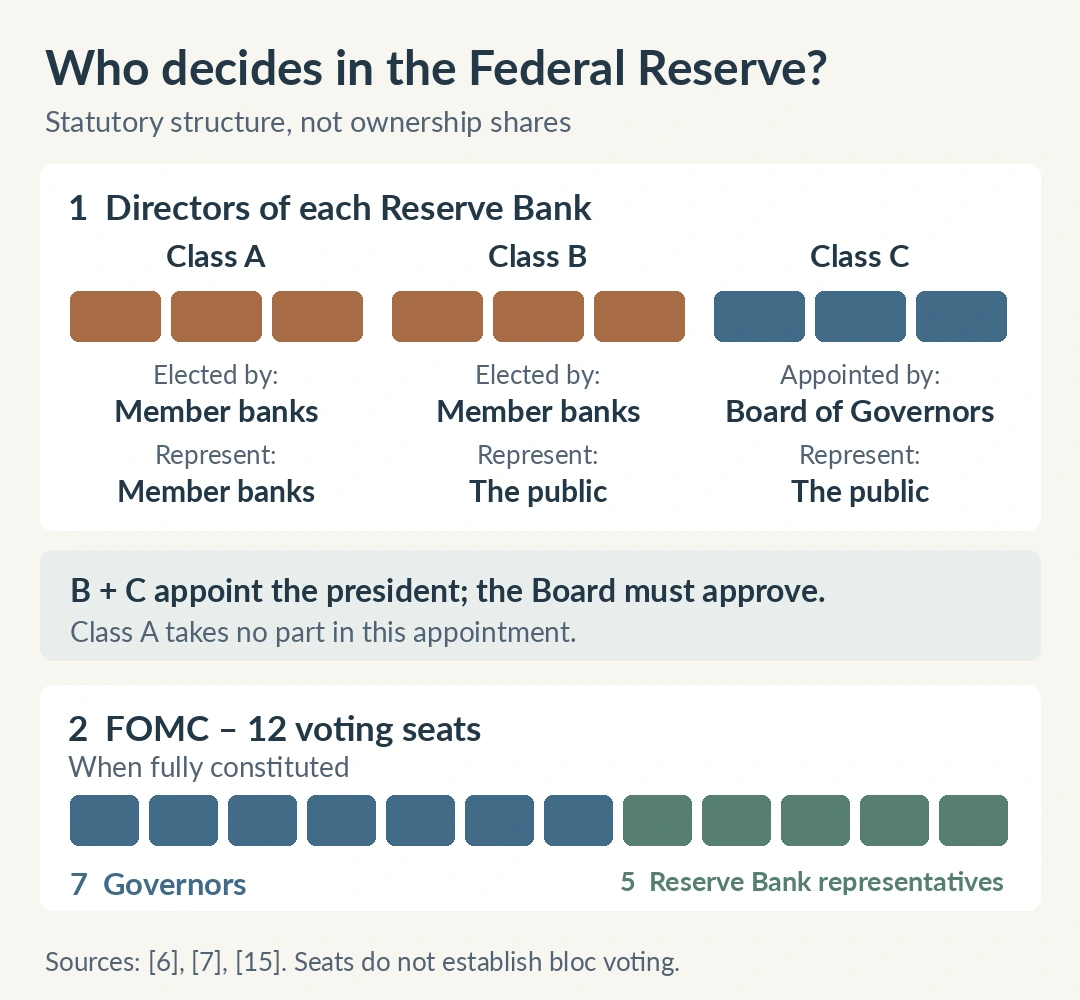
The role of the private banking sector does not end with its capital contributions. Each of the twelve Reserve Banks has nine directors, divided into three classes. Their regular term of office is three years. The statutory composition is as follows. [6]
| Class | Number of directors | Who selects them | Whom they represent by law |
|---|---|---|---|
| A | 3 | Member banks | Member banks |
| B | 3 | Member banks | The public |
| C | 3 | Board of Governors | The public |
Member banks thus elect six of the nine directors, but only three of these represent banks under the law. Class B directors may not be officers, directors or employees of a bank; Class C directors are also prohibited from holding bank stock. Elections are held in three groups of banks with comparable capitalisation. Each group elects one Class A and one Class B director. A member bank votes through an authorised person, rather than on the basis of one vote per share. In the case of banks in the same Federal Reserve district belonging to the same bank holding company, participation in a given election is restricted to one of them. [6]
What does such a procedure look like in practice? In the New York Fed's election circular dated 4 November 2024, voting group 1 comprised member banks with capital and surplus exceeding two billion dollars. The list of these banks includes Goldman Sachs Bank USA, HSBC Bank USA, N.A., JPMorgan Chase Bank, N.A., and Morgan Stanley Bank, N.A. [12] The document confirms their inclusion in the electoral records and identifies the positions of the persons authorised to vote. It does not disclose the number of shares held by those banks, their actual participation in the vote or the candidates for whom they voted.

The president of each Reserve Bank is appointed for a five-year term by the Class B and Class C directors, subject to approval by the Board of Governors. Class A directors do not participate in this appointment. [6] Member banks therefore have an indirect influence on the composition of the group that selects the president, but private banks do not have exclusive authority over this procedure. The Board of Governors also has general supervisory authority over the Reserve Banks and the power to remove their directors and senior officers. [13]
The law also provides for a Federal Advisory Council, with one representative from each district. The board of directors of each Reserve Bank selects its representative annually. The Advisory Council can make recommendations to the Board of Governors on matters including discount rates, reserves and open market operations. Membership of the Council does not in itself confer a voting seat on the FOMC. [14][7]
Who decides monetary policy?
When we hear that the Fed has raised or lowered interest rates, the decision to set the target range for its key short-term interest rate is generally made by the FOMC. When fully constituted, the Committee has twelve voting seats: seven for members of the Board of Governors and five for representatives of the Reserve Banks. The law stipulates that the latter must be presidents or first vice presidents of the Reserve Banks, elected annually by the boards of directors of the Reserve Banks in groups prescribed by law; each board has one vote in these elections. Under the usual arrangement, the president of the Federal Reserve Bank of New York has a permanent voting seat, while four other presidents serve on a rotating basis. Presidents who do not have a vote in a particular year also participate in meetings and discussions. [7][15]
The number of shares held by a commercial bank is therefore not the number of votes it can cast in monetary policymaking. Publicly appointed governors hold a majority of seats when the Committee is fully constituted, while the regional Reserve Banks play an important role in decision-making and the preparation of economic assessments. The seven-to-five ratio does not in itself establish that either group always votes as a bloc. Assessing actual influence would require an examination of specific decisions, minutes, voting records and the procedures by which individuals are appointed.
Dividends and financial flows to the US Treasury
Member banks that hold stock in the Reserve Banks are entitled to a statutory dividend on their paid-in capital. The entitlement is cumulative, meaning that unpaid dividend entitlements may carry forward to the next period. [11][9] In 2026, the threshold for a member bank's total consolidated assets is 13.182 billion dollars. Member banks with assets at or below this threshold are entitled to an annual dividend rate of six per cent. For larger member banks, the lower of two rates applies: six per cent or the highest accepted yield at the last auction of ten-year US Treasury notes before the dividend payment. The threshold is adjusted annually in line with the US gross domestic product price index. On 12 November 2026, a new threshold of 13.712 billion dollars was published; the regulation takes effect on 14 December 2026, and the new threshold applies from 1 January 2027. [11][16][17][9]
If the bank in our earlier numerical example had paid in three million dollars in capital to its Reserve Bank and were subject to the annual rate of six per cent, its dividend for the full year, assuming an unchanged capital base and rate, would be 180,000 dollars in this simplified example. The rate does not apply to the assets of the Fed as a whole or to the amount of money it has created. Dividends on capital are also distinct from the interest the Fed pays on eligible bank reserve balances.
After covering operating expenses and dividends and providing for the prescribed amount in the surplus fund, the Reserve Banks remit their remaining earnings to the US Treasury. At the end of 2025, the Reserve Banks' aggregate paid-in capital amounted to 39.152 billion dollars (37.182 billion at the end of 2024). This is an aggregate capital figure, not a disclosure of individual shareholders. [11][18] The audited combined financial statements for 2024 and 2025 provide the following figures. [11][18]
| Item (in millions of USD) | 2024 | 2025 |
|---|---|---|
| Dividends | 1,623 | 1,688 |
| Actual remittances to the Treasury | 3,533 | 6,281 |
| Increase in the deferred asset | 82,637 | 27,526 |
| Comprehensive loss | −77,481 | −19,557 |
Source: audited combined financial statements of the regional Reserve Banks, Note 12, pp. 58–59. [18] The penultimate row shows the magnitude of the increase in the deferred asset as a positive amount; it appears with a negative sign in the original table showing the allocation of financial results. The rows do not represent portions of a single profit figure.
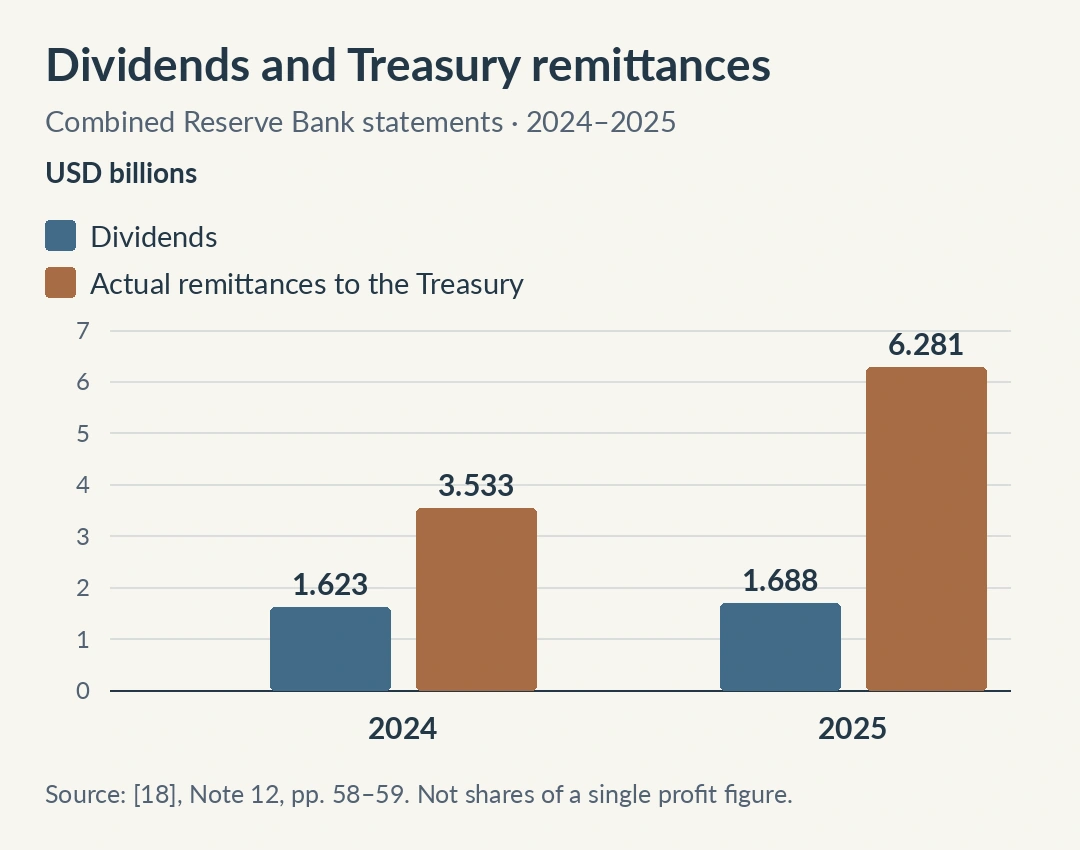
When the income of an individual Reserve Bank is insufficient to cover its expenses and other prescribed items, its remittances to the Treasury may be temporarily suspended. The deferred asset represents the amount of future net earnings the bank must generate before it resumes remitting surplus earnings. At the end of 2025, this item amounted to 243.481 billion dollars in aggregate, compared with 215.955 billion at the end of 2024. It is not an ordinary receivable that the Treasury is obliged to settle; it is recognised under the Fed's special accounting rules. Some Reserve Banks continued making remittances in the years examined even though the system reported a loss in its combined financial statements. [18] The figures thus confirm that member banks receive a financial benefit, but not the claim that they are entitled to all the system's surplus earnings.
Independence, accountability and the limits of oversight
The Board of Governors finances its expenses through assessments levied on the regional Reserve Banks, giving it a funding arrangement different from that of an ordinary government agency funded through the budget. At the same time, the law requires monetary policy reporting to Congress and twice-yearly hearings of the Chair of the Board. [3][19] Institutional independence is not the same as private ownership, nor does it mean that an institution is entirely independent of political or financial interests. Questions about its oversight and accountability are therefore legitimate.
It is sometimes claimed that the Federal Reserve is never audited. The law requires an annual independent audit of the financial statements of each Reserve Bank and the Board of Governors. [20] The combined financial statements of the Reserve Banks for 2025 and 2024 contain an opinion issued by KPMG LLP on 12 March 2026. The auditor assessed the financial statements against the special accounting basis prescribed by the Fed, rather than US generally accepted accounting principles (US GAAP). [18] However, a financial audit is not the same as an assessment of the appropriateness of monetary policy. Under 31 U.S.C. § 714(b), the audit authority of the US Government Accountability Office (GAO) is restricted in relation to certain international transactions, monetary policy decisions and operations, and related communications. Subsections (e) and (f), however, provide additional audit powers, including for certain emergency financing measures and for examining internal controls, collateral and possible undue preferential treatment of participants in certain lending programmes or transactions. [21] It is therefore inaccurate to claim either a complete absence of audits or unrestricted audit oversight of all activities.
A GAO report from October 2011 shows that the question is not merely theoretical. It drew attention to circumstances creating the appearance of conflicts of interest arising from Reserve Bank directors' connections with supervised financial institutions. At the same time, it found that directors had limited involvement in the direct supervision of individual banks. The report also highlights the change made in 2010, when the Dodd-Frank Act excluded Class A directors from the appointment of Reserve Bank presidents. The GAO recommended clearer rules and greater transparency; the official GAO website also records measures subsequently implemented. This is a historical review, not evidence of an actual present-day conflict of interest or abuse of office. [22]
In investigating the influence of private capital, it remains important to establish which individuals participate in appointments and how decisions affecting the economy are shaped. In this investigation, we do not have a complete register of individual stock subscriptions for all twelve Reserve Banks. We therefore cannot use partial electoral lists to calculate the ownership percentages of individual banks or their ultimate investors. Nor have all minutes and informal connections among decision-makers been systematically examined. The statutory framework is a starting point for such an investigation, not evidence that informal influence does not exist.
Conclusion
Who, then, owns the Federal Reserve? At the level of the system as a whole, there is no conventional private parent company whose owners could be listed in a single shareholder register. At the level of the twelve regional Reserve Banks, however, member banks hold shares, with an associated entitlement to dividends and statutory mechanisms for participating in governance. The documents examined do not support the claim that the entire Fed is owned by a single bank or family. Such a claim is also inconsistent with the formal structure of the system described here.
Ownership, however, is not the only source of economic power. The right to participate in the selection of directors, influence the appointment of leaders or advise monetary policymakers is significant even when someone does not hold a majority stake. If we want to understand the power of central banking, we must trace not only capital but also institutional powers, financial flows and demonstrable connections between institutions. In the next part, we will examine how the European Central Bank and the Bank for International Settlements (BIS) are organised in comparison with the US system.
Sources and further reading
- Gary Richardson and Jessie Romero. The Meeting at Jekyll Island. Federal Reserve History, 2015, historical account of the meeting and reform plan. Source
- Staff of the Federal Reserve Bank of Kansas City. Federal Reserve Act Signed into Law. Federal Reserve History, no publication date indicated; historical event of 23 December 1913. Source
- U.S. Congress. Federal Reserve Act, Section 10 — Board of Governors of the Federal Reserve System. 1913, as amended, especially paragraphs 1–4 and 7. Source
- Gary Richardson, Alejandro Komai and Michael Gou. Banking Act of 1935. Federal Reserve History, historical event of 23 August 1935. Source
- Board of Governors of the Federal Reserve System. Who owns the Federal Reserve? Official explanation, updated 28 May 2026. Source
- U.S. Congress. Federal Reserve Act, Section 4 — Federal Reserve Banks. 1913, as amended, especially paragraphs 4 and 9–20. Source
- U.S. Congress. Federal Reserve Act, Section 12A — Federal Open Market Committee. 1913, as amended, subsections (a) and (b). Source
- U.S. Congress. Federal Reserve Act, Section 5 — Stock Issues; Increase and Decrease of Capital. 1913, as amended, especially paragraph 1. Source
- Board of Governors of the Federal Reserve System. Regulation I — 12 CFR § 209.4: Amounts and payments for subscriptions and cancellations; timing and rate of dividends. Consolidated text, paragraphs (a)–(f), Cornell Legal Information Institute. Source
- Board of Governors of the Federal Reserve System. Regulation I — 12 CFR § 209.3: Cancellation of Reserve Bank stock; mergers involving member banks. Consolidated text, especially paragraphs (a) and (b), Cornell Legal Information Institute. Source
- U.S. Congress. Federal Reserve Act, Section 7 — Division of Earnings. 1913, as amended, subsections (a) and (b). Source
- Federal Reserve Bank of New York. Election of Directors — For Terms of Office Ending December 31, 2027. 4 November 2024, pp. 1 and 7. Source
- U.S. Congress. Federal Reserve Act, Section 11 — Powers of Board of Governors of the Federal Reserve System. 1913, as amended, points (f) and (j). Source
- U.S. Congress. Federal Reserve Act, Section 12 — Federal Advisory Council. 1913, as amended, paragraphs 1 and 2. Source
- Board of Governors of the Federal Reserve System. Federal Open Market Committee. Updated 28 October 2026, section “Structure of the FOMC”. Source
- Board of Governors of the Federal Reserve System. Federal Reserve Bank Capital Stock (Regulation I). Federal Register, 20 November 2025, 90 FR 52231–52232, FR Doc. 2025-20472. Source
- Board of Governors of the Federal Reserve System. Federal Reserve Bank Capital Stock (Regulation I). Federal Register, 12 November 2026, 91 FR 72769–72770, FR Doc. 2026-23060. ; complete issue of the Federal Register: Source 1 Source 2
- Federal Reserve Banks. Combined Financial Statements as of and for the Years Ended December 31, 2025 and 2024 and Independent Auditors’ Report. Published 25 March 2026, auditor's opinion (PDF p. 4), printed p. 3 and Notes 3r (p. 21) and 12 (pp. 58–59). Source
- U.S. Congress. Federal Reserve Act, Section 2B — Appearances Before and Reports to the Congress. 1913, as amended, subsections (a) and (b). Source
- U.S. Congress. Federal Reserve Act, Section 11B — Annual Independent Audits of Federal Reserve Banks and Board. Added in 1999 (12 U.S.C. 248b). Source
- U.S. Congress. 31 U.S.C. § 714 — Audit of financial institutions. Consolidated text, especially subsections (b), (e) and (f), Cornell Legal Information Institute. Source
- U.S. Government Accountability Office. Federal Reserve Bank Governance: Opportunities Exist to Broaden Director Recruitment Efforts and Increase Transparency. GAO-12-18, 19 October 2011, sections on conflicts of interest and conclusions; official page showing the status of recommendations. Source 1 Source 2