Who Owns the World’s Largest Banks?
Examines major banks, their shareholders and the limits of conclusions drawn from large equity stakes.

Symbolic illustration of different bank ownership structures; the size and stability of the foundations do not represent actual shareholdings or financial stability.
In the previous part of this investigation, we saw that commercial banks can create new deposit money when approved loans are drawn down. Their decisions affect individuals’ and businesses’ access to purchasing power. But who owns the institutions that make these decisions? When we trace their ownership links, we encounter large state-owned investment companies, private-sector investment companies, fund managers and a multitude of investors. Their roles are not the same, so we must examine not only ownership but also the rights that come with it.
What does it mean to own a bank?
When we buy a share in a banking company, we acquire a stake in its equity. Depending on the type of share, we may acquire the right to vote at shareholders’ meetings and to receive dividends if they are paid in accordance with the company’s rules. But we do not acquire the right to dispose directly of a corresponding proportion of the money in its customers’ accounts. Deposits are the bank’s liabilities to depositors, while loan receivables form part of its assets. A shareholder owns a stake in the company, not direct ownership of every individual asset on its balance sheet.
In large banking groups, we must also distinguish between a parent company and its subsidiaries. A shareholder in the parent company has an indirect economic interest in the group’s business. The way each individual bank is run, however, is determined by its governing bodies and the applicable regulations. The size of a bank therefore tells us nothing directly about either the wealth of its shareholders or the extent of their actual influence.
The world’s largest banks
According to the ranking published by S&P Global Market Intelligence on 29 April 2026, the world’s largest bank by total assets was the Industrial and Commercial Bank of China (ICBC), which had US$7.646 trillion in assets at the end of 2025. It was followed by the Agricultural Bank of China, China Construction Bank and Bank of China. All four are headquartered in China. [1]
The ranking is based predominantly on balance sheets at the end of 2025, with the methodology also taking certain mergers and acquisitions into account. Differences in accounting standards limit full comparability. [1] This measure is distinct from the banks’ market capitalisation, their profits and their owners’ wealth. Alongside the four leading Chinese banks, we will examine three other major Western banking groups: JPMorgan Chase, Bank of America and BNP Paribas. This is a selected comparative sample, not a comprehensive survey of global banking.
Central Huijin and Chinese state capital
If we examine the ownership structures of the four largest banks, we find Central Huijin Investment Ltd. in all of them. It is a state-owned investment company wholly owned by China Investment Corporation (CIC). According to the description in ICBC’s annual report, it exercises the state’s rights as an investor in major state-owned financial enterprises under authorisation from China’s State Council. [2]
| Bank | Direct stake held by Central Huijin | Direct stake held by the Ministry of Finance |
|---|---|---|
| Industrial and Commercial Bank of China | 34.79% | 31.14% |
| Agricultural Bank of China | 40.14% | 35.29% |
| China Construction Bank | 54.61% | 4.43% |
| Bank of China | 58.59% | 8.64% |
As at 31 December 2025. Sources: the banks’ reports [2][3][4][10]. The percentages refer to all issued ordinary shares of each bank. The table shows only the direct stakes held by these two state entities, not all state investments or voting rights.
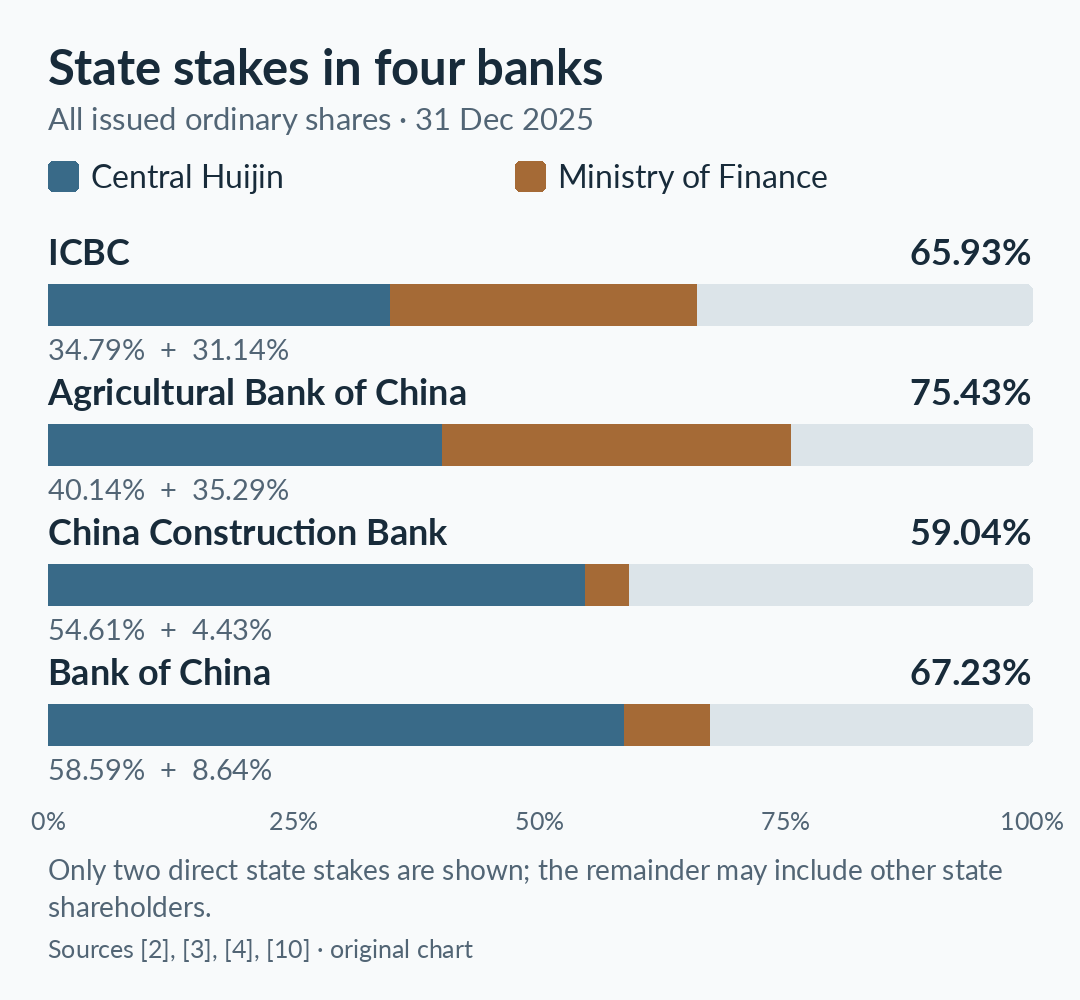
Central Huijin and the Ministry of Finance both hold large direct stakes in all four banks. In China Construction Bank and Bank of China, Central Huijin alone holds more than half of the ordinary shares. China Construction Bank identifies it as its controlling shareholder in its annual report. Additional investments through affiliated companies are not included in the direct stakes shown here. [2][3][4][10]
This is a concrete example of the concentration of financial ownership, but it does not establish that a single institution independently makes every business decision. ICBC states in its report that Central Huijin does not interfere in the day-to-day operations of the financial institutions it controls. The Agricultural Bank of China, meanwhile, states that it has no de facto controller, although it describes itself as a state-controlled bank. [2][3] These are statements by the banks, not independent assessments of their day-to-day conduct. The concentration of state capital can be demonstrated, but the way influence is actually exercised requires further investigation.

Who appears on the register of shareholders?
A share register is not always a direct list of the ultimate investors. ICBC’s annual report, for example, lists HKSCC Nominees Limited among its major registered shareholders, with 24.18% of all the bank’s ordinary shares. However, this company acts as a nominee holder for various institutional and individual investors. Its aggregate registered holding also includes some shares held by China’s national social security fund (SSF). [2] If we count the same shares first under the nominee and then under the investor, we may inadvertently count the same stake twice.
Another difficulty arises when a bank issues multiple classes of shares. Chinese A shares are listed in mainland China, while H shares are listed in Hong Kong. The Agricultural Bank of China’s annual report attributes to BlackRock, through its controlled corporations, a disclosed long position equivalent to 6.03% of H shares but only 0.53% of all the bank’s issued ordinary shares. [3] This is the same disclosed position expressed against two different denominators, not two separate stakes. Neither percentage by itself tells us how many votes BlackRock can actually cast.
Voting rights can also be separated from shareholding. The Agricultural Bank of China refers to an agreement from 2010 under which the SSF transferred the voting rights attached to 9,797,058,826 A shares to China’s Ministry of Finance. [3] A transfer of voting authority does not in itself establish a transfer of the rights to receive economic benefits. To understand ownership, therefore, it is not enough merely to read the name in the register or the percentage beside it.
JPMorgan Chase and Bank of America
We encounter a different structure in American banking groups. The disclosed holders of larger interests in common stock include investment managers as well as major investment companies such as Berkshire Hathaway. The following table presents figures from the documents prepared for the 2026 shareholders’ meetings (proxy statements); it is not a complete list of the owners of the two companies.

| Party with a disclosed interest | JPMorgan Chase [5] | Bank of America [6] |
|---|---|---|
| The Vanguard Group | 9.86% | 9.1% |
| BlackRock | 7.15% | 6.9% |
| Warren Buffett / Berkshire Hathaway | — | 7.9% |
JPMorgan Chase’s table has a reference date of 31 December 2025. The bank draws its Vanguard figure from Form 13F for the final quarter of 2025, and its BlackRock share count from Schedule 13G filed on 7 February 2024. Bank of America’s table has a reference date of 13 March 2026, but is based on Schedule 13G/A filings made on 30 January 2026 (Vanguard), 14 November 2025 (Buffett and Berkshire Hathaway) and 29 January 2024 (BlackRock). A dash indicates that the holder is not listed in this selected comparison. The percentages are figures reported in the two proxy statements, not a snapshot of current positions at a single date. [5][6]
The notes to Bank of America’s table illustrate the difference between share counts and voting authority. For Vanguard, they report 651,058,822 shares over which it has shared investment power, but shared voting power over 65,352,937 shares. For BlackRock, they report sole voting power over 445,519,442 out of 494,523,426 shares; this figure comes from a 2024 disclosure. [6] These figures do not tell us how the two firms voted at any particular shareholders’ meeting.
Berkshire Hathaway, an investment company, represents a different arrangement. The original Schedule 13G/A concerning Bank of America, filed on 14 November 2025, attributes to Warren Buffett and Berkshire Hathaway the same shared voting and dispositive power over 568,070,012 shares. It reports 7.8% as at 30 September 2025, whereas the bank’s later table reports 7.9% for the same number of shares. [6][11] These positions must not be added together as if they were two independent investments.
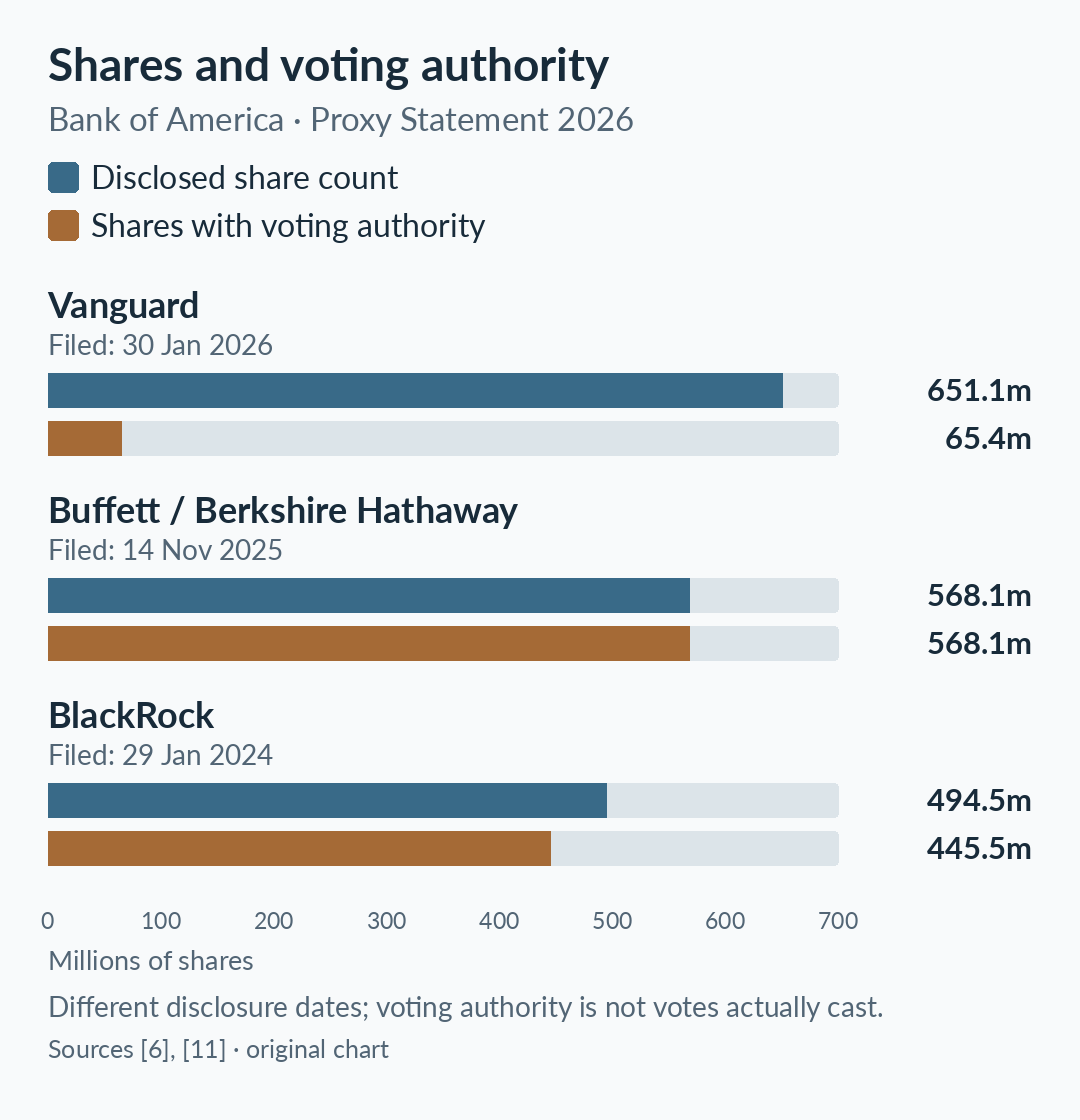
The American term beneficial ownership, used in these disclosures, has a specific legal meaning. For certain reporting obligations, SEC Rule 13d-3 encompasses direct or indirect, sole or shared power to vote or dispose of securities. [8] The figure therefore does not necessarily mean that the reporting manager owns all the assets concerned for its own account. A manager may make decisions within the scope of the authority it holds as a result of managing other investors’ money. Form 13F, meanwhile, is a report by institutional investment managers concerning certain securities over which they exercise investment discretion. The SEC explicitly distinguishes such discretion from voting authority. [12] It is precisely the ability to exercise such powers that constitutes an important form of financial influence.
BNP Paribas: state and institutional capital
The European banking group BNP Paribas offers another example. In its 2025 integrated report, it published the following breakdown of voting rights as at 31 December 2025. [7]
| Shareholder group | Share of voting rights |
|---|---|
| European institutional investors | 42.1% |
| Non-European institutional investors | 32.2% |
| BlackRock | 7.1% |
| Individual shareholders | 7.3% |
| SFPI – on behalf of the Belgian state | 5.7% |
| Luxembourg | 1.2% |
| Group employee fund (FCPE) | 3.5% |
| Direct employee shareholdings | 0.9% |
BlackRock is shown separately from both categories of institutional investors in the report. The table measures voting rights, not equity stakes; part of the classification is based on analyses of the shareholder structure, and the table is not a complete list of ultimate investors. [7] It illustrates the coexistence of private institutional capital, individual investors, state shareholdings and employees. However, we cannot infer from the aggregate percentage of institutional investors that they act as a single group with coordinated interests.
Can a minority shareholder control a bank?
When assessing economic power, it is not enough to establish whether someone owns more than half the shares. If only some shareholders attend a general meeting, or if several investors agree to act together, a considerably smaller stake may also become significant. We must consider rights to appoint members of governing bodies, contractual arrangements, actual voting and the rules that govern decision-making. These circumstances must be established for each institution individually.
In the United States, the Bank Holding Company Act defines criteria for control that include ownership or control of, or the power to vote, at least 25% of any class of voting securities, control over the election of a majority of directors or trustees, or a determination of controlling influence by the Board of Governors of the Federal Reserve. [9] This is a specific US legal framework with additional conditions and exceptions, not a universal rule applicable to all banks worldwide. Regulatory supervision by a central bank or another authority is also not the same as ownership of the company it supervises.
For major asset managers, it is therefore important to investigate not only the number of shares attributed to their companies but also the extent of their voting authority, the actual exercise of those rights and the limits of their mandate. A claim that several large investors jointly control a bank would require evidence of coordination or other mechanisms of joint control. The mere recurrence of the same names in ownership disclosures is not sufficient to reach such a conclusion, nor does it rule out the possibility of influence that warrants further investigation.
Conclusion
A comparison of seven banks reveals different forms of concentration of economic power. In the largest Chinese banks, this is visible through the large stakes held by state institutions; in the American banks examined, through the participation of major asset managers and investment companies; and in BNP Paribas, through a combination of different investor groups and state shareholdings. These are not identical models of ownership and decision-making.
To understand who holds power in the banking system, we must trace both the capital and the rights that enable decisions to be made about it. It is not enough to identify the shareholder at the top of an ownership list; we must also know on whose behalf it acts, who oversees it and what powers it holds. In the next part, we will apply this question to a different type of institution: the United States’ central banking system, the Federal Reserve.
Sources and further reading
- Adrian Jimenea and Cheska Lozano. The world’s largest banks by assets, 2026. S&P Global Market Intelligence, 29 April 2026. Source
- Industrial and Commercial Bank of China Limited. Annual Report 2025. 2026, pp. 97–99. Source
- Agricultural Bank of China Limited. Annual Report 2025. 2026, pp. 97–100. Source
- China Construction Bank Corporation. Annual Report 2025. 27 March 2026, pp. 158–160. — alternative publication of the same annual report (27 April 2026): Source 1 Source 2
- JPMorgan Chase & Co. 2026 Proxy Statement (DEF 14A). 6 April 2026, p. 76, notes 1–2. Source
- Bank of America Corporation. 2026 Proxy Statement (DEF 14A). 2026, pp. 37–38, notes 13–15. Source
- BNP Paribas. 2025 Integrated Report — Our shareholders and investors. 2026, p. 69. Source
- U.S. Securities and Exchange Commission. 17 CFR § 240.13d-3 — Determination of beneficial owner, paragraph (a). Text of the regulation, Cornell Legal Information Institute. Source
- U.S. Congress. Bank Holding Company Act of 1956, Section 2(a)(2), 12 USC 1841. Consolidated text, Federal Reserve Regulatory Service. Source
- Bank of China Limited. 2025 Annual Results Announcement. 30 March 2026, section “Number of Ordinary Shareholders and Particulars of Shareholding”. Source
- Berkshire Hathaway Inc. and co-filers. Schedule 13G/A (Amendment No. 7) — Bank of America Corporation. SEC EDGAR, 14 November 2025, as at 30 September 2025; cover pages for Warren E. Buffett and Berkshire Hathaway Inc., items 5–11. Source
- U.S. Securities and Exchange Commission. Frequently Asked Questions About Form 13F, questions 6 and 50a (the latter updated on 3 January 2023). Source