Who Creates Money?
Explains the creation of bank money, the role of lending and the functions of central banks.

When we receive our wages, pay a bill or buy a home, we use money without giving much thought to how it came into existence. We know how to earn, spend and save it, but we pay far less attention to the institutions that can create it. An investigation into ownership and economic power therefore raises a question that goes beyond the ownership of companies, property and financial assets: who can create new purchasing power, and who decides who will have access to it?
The two layers of the monetary system
The money we use every day is not limited to banknotes and coins. We make a large proportion of our payments using funds held in bank accounts. When we see a balance of a thousand euros in our account, it does not mean that a thousand euros in cash are waiting for us in a bank vault. The available balance in a current account represents our claim on the bank and the bank’s liability to us. As a rule, we can use it to make payments or withdraw it in cash.
The modern monetary system combines central bank money, which includes banknotes and banks’ reserves at the central bank, with commercial bank deposit money, also known as book money. Deposits account for most of the money held by households and businesses in a modern economy. Although a banknote and a deposit are different liabilities issued by different institutions, we treat a euro in either form as equivalent in everyday payments. [1][2][3] Euro coins are a special case: they are issued by euro area countries, with the volume of issuance approved by the European Central Bank (ECB). [4]
How does a bank create new money?
Imagine a business owner who takes out a bank loan of €10,000 to buy equipment. The bank assesses the borrower’s creditworthiness and the terms of the loan. When the loan is drawn down and the amount credited to the borrower’s account, two new accounting entries arise: the bank’s loan receivable from the business owner and its liability to the account holder. [1][2]
| Participant | Increase in assets | Increase in liabilities |
|---|---|---|
| Bank | Loan receivable: €10,000 | Customer deposit: €10,000 |
| Business owner | Deposit: €10,000 | Debt owed to the bank: €10,000 |
The table shows only the changes at loan drawdown, not the full balance sheets. It is an original, simplified example that excludes fees, impairments and other accounting items, based on the mechanism described in sources [1] and [2]. The business owner now has €10,000 in new purchasing power but has also assumed an equally large liability. This transaction alone has not increased the borrower’s net wealth. Nor has the bank made a net profit of €10,000.
To create this deposit, the bank does not need another saver to have previously transferred €10,000 to it. A bank does more than act as an intermediary for existing savings: it can create a new deposit through its own lending. This distinguishes a bank loan from a loan between two individuals, in which the lender generally transfers money that already exists. [1][2]

What happens when the money leaves the bank?
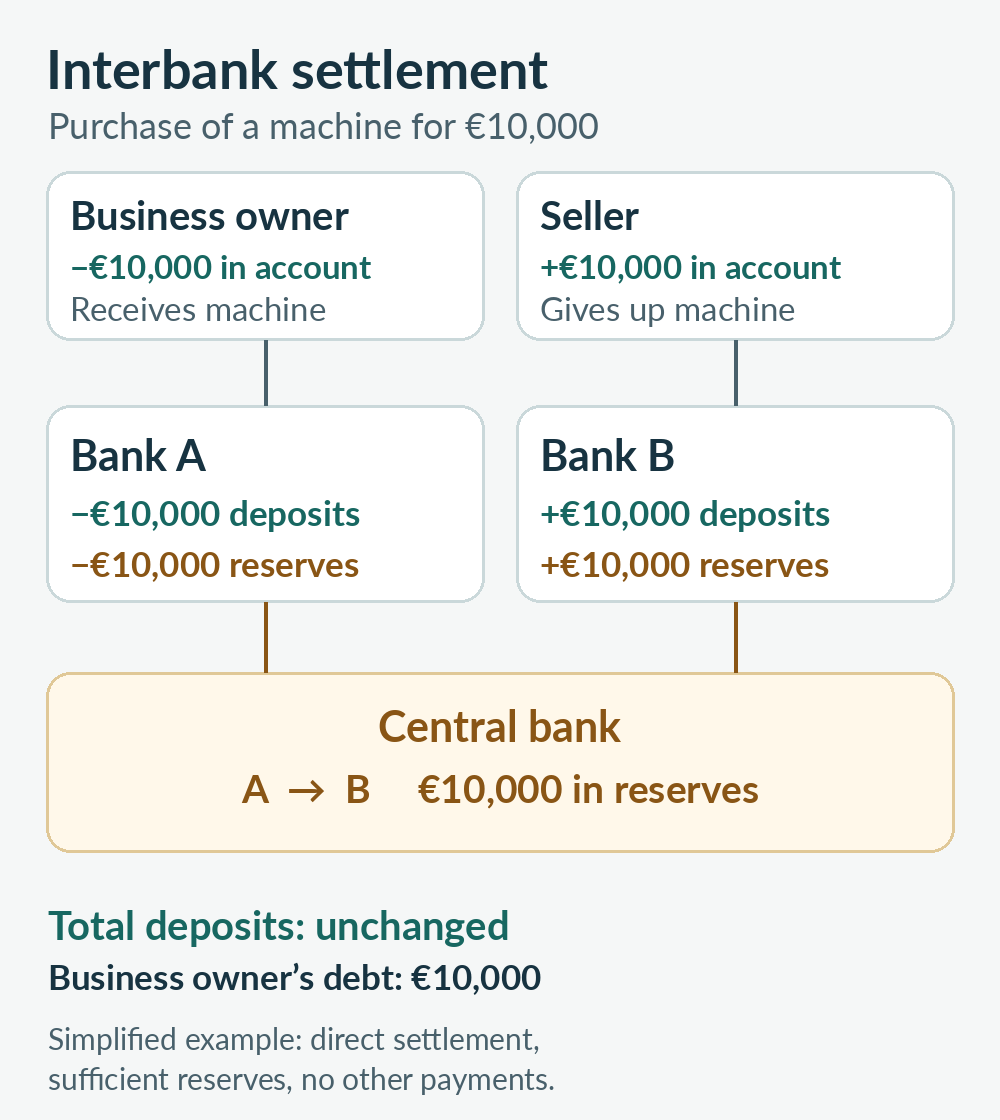
The business owner spends the entire €10,000 on a machine. If the seller has an account with another bank, the borrower’s bank must settle the payment with the seller’s bank. Assuming direct settlement through the central bank, sufficient reserves at the first bank and no other simultaneous payments, €10,000 in reserves is transferred between the banks’ central bank accounts, and the second bank credits the seller’s deposit account. In practice, banks may also net their mutual obligations. [2][3]
The business owner no longer has the borrowed amount in the account but now owns a machine and still owes the bank €10,000. The seller has received money in a bank account in exchange for the machine. If we look at the banking system as a whole, the new deposit has not disappeared as a result of the payment; it is now held by a different customer at a different bank. The first bank, however, has lost some of its reserves. This distinction helps explain why banks need adequate funding and liquidity despite their ability to create deposits.
How does money disappear from circulation?
When a borrower repays the principal of a bank loan using money held in an account, deposit money generally decreases by that amount. Let us return to our business owner. When the owner earns income by selling the business’s products and uses it to repay €1,000 of principal, both the bank’s loan receivable and the aggregate volume of deposits decrease by that amount in our simplified model. [1]
Repayment is not the same as writing off an uncollectable debt. If the business owner cannot repay the bank for money already paid to the seller, writing off the loan does not in itself erase the seller’s deposit. This follows from the separate balance sheet entries: the write-off reduces the carrying amount of the loan receivable, not automatically another person’s deposit. Any resulting loss is borne by the bank if it has not already been recognised through loan impairment. [1]
Loans are not the only way in which deposits can be created. A bank may, for example, purchase a security from a non-bank seller and credit a new deposit in return. The quantity of money is therefore not simply equal to the sum of all outstanding loans. [1][2]
Where does the money to pay interest come from?
Since much deposit money is created through lending, an important question arises: if a bank creates money equal to the principal but requires repayment of both principal and interest, where does the money to cover the difference come from? At first glance, it might seem that this missing money can only be created by taking on additional debt. But this reasoning requires us to distinguish between the quantity of money at a given point in time and payments made over time.
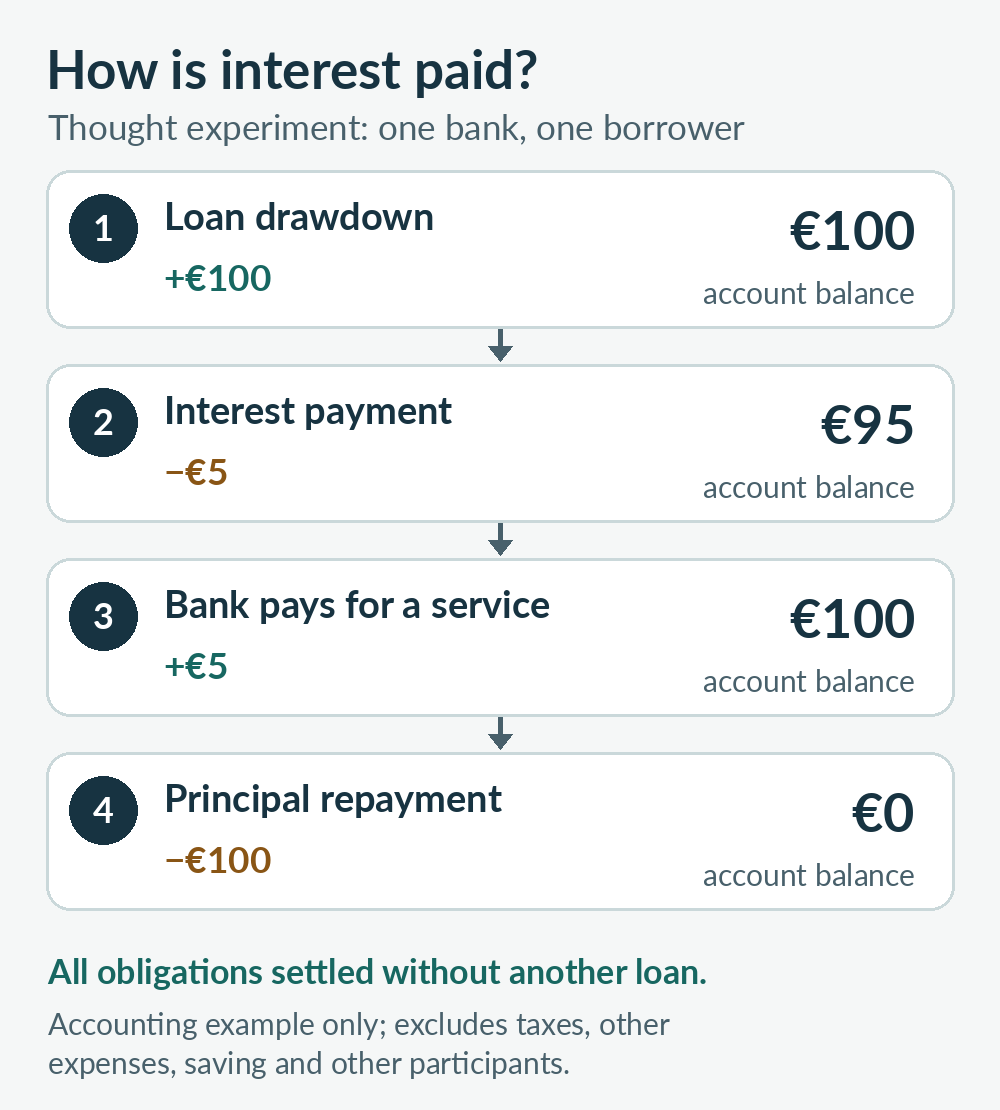
Imagine a deliberately simplified economy with one bank and one borrower. The bank creates a deposit when a €100 loan is drawn down, and the borrower must pay five euros in interest in addition to the principal. Assume the loan agreement allows interest to be paid first and principal later. If the borrower pays the interest first, €95 remains. The bank then purchases a service worth five euros from the borrower and pays for it by crediting the borrower’s account. The borrower once again has €100, with which the entire principal is repaid. In this example, all obligations have been settled without a second loan, while the bank’s interest income has been offset by the cost of the service.
This accounting thought experiment is not a description of a real economy. It excludes taxes, other expenses, saving and many other participants. It shows only that the arithmetic of interest payments does not necessarily require a new loan. In other cases, existing money can change hands several times, while banks’ spending helps recreate deposits held outside the banking sector. Interest income is not the same as banks’ net profit either: funding costs, operating expenses and credit losses, among other things, must be deducted. [1]
This does not resolve the broader problem of indebtedness. Borrowers must actually obtain the income they need, and both the burden of debt and opportunities to earn an income can be very unevenly distributed. Whether a particular way of organising debt encourages the concentration of wealth over the long term is an important question, but it cannot be settled merely by comparing principal and interest. To answer it, we need data on incomes, ownership, credit conditions and who receives the benefits or bears the losses.
Why can banks not create unlimited amounts of money?
The ability to create deposits does not mean that a bank can expand its lending at will. It must manage potential losses, maintain liquidity for payments and withdrawals, and comply with regulatory requirements. Loans involve different risks, funding costs and expected returns. It also matters whether there are people and businesses willing and able to borrow in the first place. [1][2]
A bank’s capital and its central bank reserves are not the same thing. Capital helps absorb losses, while reserves allow banks, among other things, to settle payments. A bank can obtain additional liquidity under appropriate conditions, but that does not mean it can withstand losses of any size. A loan that a borrower cannot repay may become a financial burden for the bank, even though the money was initially created by an accounting entry. [1][2]
The role of central banks
Central banks can also create money, but their role differs from that of commercial banks. Within the Eurosystem, which consists of the ECB and the national central banks of euro area countries, central banks can, for example, create new reserves when they provide appropriately collateralised funding to banks or purchase financial assets. By changing interest rates, they influence borrowing conditions and the decisions of banks, businesses and households. [2][3]
An increase in reserves does not in itself mean a proportional increase in lending to the public. Nor is every increase in central bank money equivalent to a direct transfer to household accounts. If a central bank purchases a bond from a domestic non-bank investor through a commercial bank, both reserves and the seller’s deposit may increase. If it purchases the bond from a commercial bank’s own portfolio, the composition of that bank’s assets changes directly, but the balances in the public’s bank accounts need not change. [1][2]
Money creation as a form of economic power
Lending decisions have consequences that extend beyond the relationship between an individual bank and a borrower. Imagine two companies: one wants to build a manufacturing plant, while the other wants to acquire existing properties. A loan to the first may enable it to create new jobs and production capacity; a loan to the second may enable it to acquire assets and earn rental income. These are illustrative possibilities, not guaranteed outcomes. In both cases, a financial decision gives someone the opportunity to make use of real economic resources.
Banks perform an important economic function in this respect. Financing enables people and businesses to make purchases and investments for which they do not currently have sufficient funds of their own. But access to credit is not automatically equal for everyone. Income, assets, collateral, risk and a bank’s business policy may all play a role in whether a loan is granted or refused. The criteria by which credit is allocated are therefore also a matter of economic and social organisation. [1][2]
The importance of assets as collateral is illustrated by a 2016 study by economists Ryan Banerjee and Kristian Blickle, published in the working paper series of the Bank for International Settlements (BIS). In their analysis of small firms in France, Italy, Spain and the United Kingdom, they found that the relationship between changes in house prices and firms’ borrowing and investment was stronger for firms whose financial position was less transparent to lenders. The effect was particularly pronounced in Italy and Spain. These are the findings of a specific study, not proof of the general dominance of property owners or an official position of the BIS. [5]
The mechanism of money creation does not in itself allow us to conclude that all banks operate on the instructions of a single owner or a common secret centre of control. Such a claim would require separate evidence of ownership, governance and coordination of decisions. What we can conclude, however, is that deciding who has access to new purchasing power is an important form of institutional power, and that it is worth investigating who exercises it, in whose interests and under what oversight.
Conclusion
Money and real wealth are not the same thing. An accounting entry may enable someone to buy a machine or a home, but it cannot itself manufacture the machine, build the home or grow food. Its economic power stems from the access it provides to labour, goods, services and assets that people create and exchange.
To understand the distribution of economic power, it is not enough to investigate who holds the most wealth today. We must also examine the institutions that enable access to capital and the rules by which they make decisions. This leads to the next question in our investigation: who owns the world’s largest banks?
Sources and further reading
- Michael McLeay, Amar Radia and Ryland Thomas. Money creation in the modern economy. Bank of England, Quarterly Bulletin, 2014 Q1 (14 March 2014), pp. 14–27, especially 15–20. Source
- Deutsche Bundesbank. The role of banks, non-banks and the central bank in the money creation process. Monthly Report, April 2017, pp. 13–33, especially 13–18. Source
- Philip R. Lane. The digital euro: maintaining the autonomy of the monetary system. Speech, European Central Bank, 20 March 2025, sections “Our current monetary system” and “Two sides of the same coin”. Source
- European Central Bank. Coins, section “Responsibility for coins” (no publication date indicated). Source
- Ryan N. Banerjee and Kristian S. Blickle. Housing collateral and small firm activity in Europe. BIS Working Papers, No. 575, 24 August 2016, abstract. Source