The Wallenbergs: Family Foundations, Investor AB and Swedish Industry
The Wallenberg foundations, Investor AB and the relationships between ownership, voting power and Swedish industry.

AI-generated editorial illustration of institutional economic power, not a depiction of an actual Wallenberg site.
How can a family's economic power endure for more than a century, even when a significant part of its capital is no longer the personal property of its members? Sweden's Wallenberg family offers a concrete example of this model. Its history began with private banking, continued through industrial investment and developed into a system of foundations and holding companies. Within this system, investors' interests, industrial needs and research funding intersect. To understand its scale, it is not enough to know the names of the companies associated with the family. We need to know who their shareholders are, how many votes they hold and under what rules they can influence the companies' future.
From a private bank to an industrial holding company
In 1856, André Oscar Wallenberg and his associates founded Stockholms Enskilda Bank. According to the family's historical account, the bank was modelled on Scottish banking. Mobilising savings and channelling them into entrepreneurial activity was important in an economy in which joint-stock companies were expanding, railways were being built and new industrial activities were emerging. [1]
André Oscar Wallenberg — portrait by Uno Troili, Nationalmuseum (NMGrh 1940), public domain.
A crucial shift occurred when the bank, faced with financial difficulties among its borrowers, had to decide whether to focus solely on recovering its loans or become more actively involved in restructuring the companies concerned. In some cases, it also became a significant shareholder. The Wallenbergs' historical account mentions Atlas Copco as one such example. The relationship between the bank and the company was thus no longer confined to a loan agreement: the bank acquired an ownership stake and thus an interest in the company’s long-term performance. [1]

The next generation developed this approach during a period of expansion in mechanical engineering, electrical engineering and the chemical industry. Investor AB was established in 1916 after a change in Swedish legislation made it more difficult for banks to hold industrial shares over the long term. According to the family's historical account, the bank transferred its holdings to the new holding company. The company's own historical overview states that its initial portfolio consisted primarily of holdings in the bank and Atlas Diesel (now Atlas Copco), and that Investor AB shares were listed on the Stockholm Stock Exchange in 1917. The exact wording of the legislation then in force and the individual transfer documents have not yet been examined directly in this research. [1] [17]
This development illustrates how economic power can evolve alongside the legal environment. Lenders and shareholders have different rights, while a holding company provides an organised means of owning stakes in multiple businesses. For the Wallenbergs, this structure became the foundation for further industrial development.
Knut and Alice Wallenberg: capital that outlives its founders
In 1917, Knut Agathon Wallenberg and his wife Alice established the foundation that bears their names. According to the foundation's historical account, its initial assets consisted of shares in the bank and Investor AB, then worth 20 million Swedish kronor. Its first statutes were dated 20 March 1918 and, in addition to science, provided for the promotion of various economic activities. In 1928, its purpose was changed to supporting scientific research and education for the benefit of Sweden. [2] [3]
An important characteristic of a foundation is the separation of its dedicated assets from the founders' personal wealth. The first chapter of the Swedish Foundations Act of 1994 provides that a foundation is formed by setting aside assets for permanent, independent management for a specified purpose. A foundation may acquire rights and assume obligations; it is liable for its obligations with its own assets. The Act also specifically regulates the auditing and supervision of foundations. This is the general legal framework, not a reconstruction of the foundation's founding instrument of 1917 or all its current rules. [4]
The distinction is fundamental. A family member involved in governing a foundation may have significant powers without personally owning its shares or being free to dispose of them at will. When investigating dynastic power, therefore, we cannot simply add up the assets of the foundations and attribute them to the family. We must also investigate how governing bodies are appointed, their mandates, the rules of governance and oversight of how the foundation fulfils its purpose. We have not yet examined the full founding instrument currently in force for the Knut and Alice Wallenberg Foundation.
The architecture of family foundations and holding companies
The term “Wallenberg Foundations” is a collective designation for several independent foundations established by members of the family or created through donations in their memory or honour. The largest include the Knut and Alice Wallenberg Foundation, the Marianne and Marcus Wallenberg Foundation and the Marcus and Amalia Wallenberg Foundation. Their institutional overview describes the link between research funding and the long-term management of industrial capital. [5] [6]
According to its own disclosures, Wallenberg Investments AB is wholly owned by the foundations and manages their assets. The group's public overview describes FAM AB as an unlisted holding company owned by the three largest foundations through Wallenberg Investments AB. FAM combines strategic holdings with other types of investment. Investor AB, by contrast, is a separate publicly listed company in which the foundations have significant holdings alongside numerous other shareholders. [5] [6] FAM and Investor AB are therefore distinct channels of ownership; Investor AB's portfolio is not wholly owned by the foundations or the family.
Within this architecture, several levels of decision-making must be distinguished. The governing bodies of the foundations are responsible for fulfilling their purposes, those of the holding companies for running those companies, and those of the portfolio companies for their respective operations. Ownership links can create lasting influence over strategy, but the existence of a link does not itself prove that all decisions were made by the same person or that legal boundaries between companies do not exist. Nor have the precise internal ownership stakes and the full range of powers within the Wallenberg Investments and FAM structure been disclosed in the documents examined for this article.
Class A and B shares: how capital acquires greater voting power
Investor AB's ownership structure is central to understanding the Wallenberg model. The company has two share classes: an A share carries one vote and a B share one tenth of a vote. According to the company's disclosures, both classes carry equal dividend rights. An investor whose holdings consist predominantly of A shares may therefore have up to ten times as many votes as an investor holding the same number of B shares. [7] [8]
As at 30 September 2026, the Knut and Alice Wallenberg Foundation held 20.07 per cent of Investor AB's share capital but 42.96 per cent of its voting rights. Its holdings were heavily concentrated in A shares. The Marianne and Marcus Wallenberg Foundation held 1.94 per cent of the capital and 4.15 per cent of the votes. For some other institutional investors, the relationship was reversed: Vanguard was listed with 3.26 per cent of the capital and 2.04 per cent of the votes, while BlackRock was listed with 2.70 per cent of the capital and 0.62 per cent of the votes. AMF Pension & Fonder held 2.85 per cent of the capital and 6.11 per cent of the votes. These figures are taken from the company's list of its largest shareholders, which also notes limitations in identifying owners where some shares are registered in nominees’ names. [9]
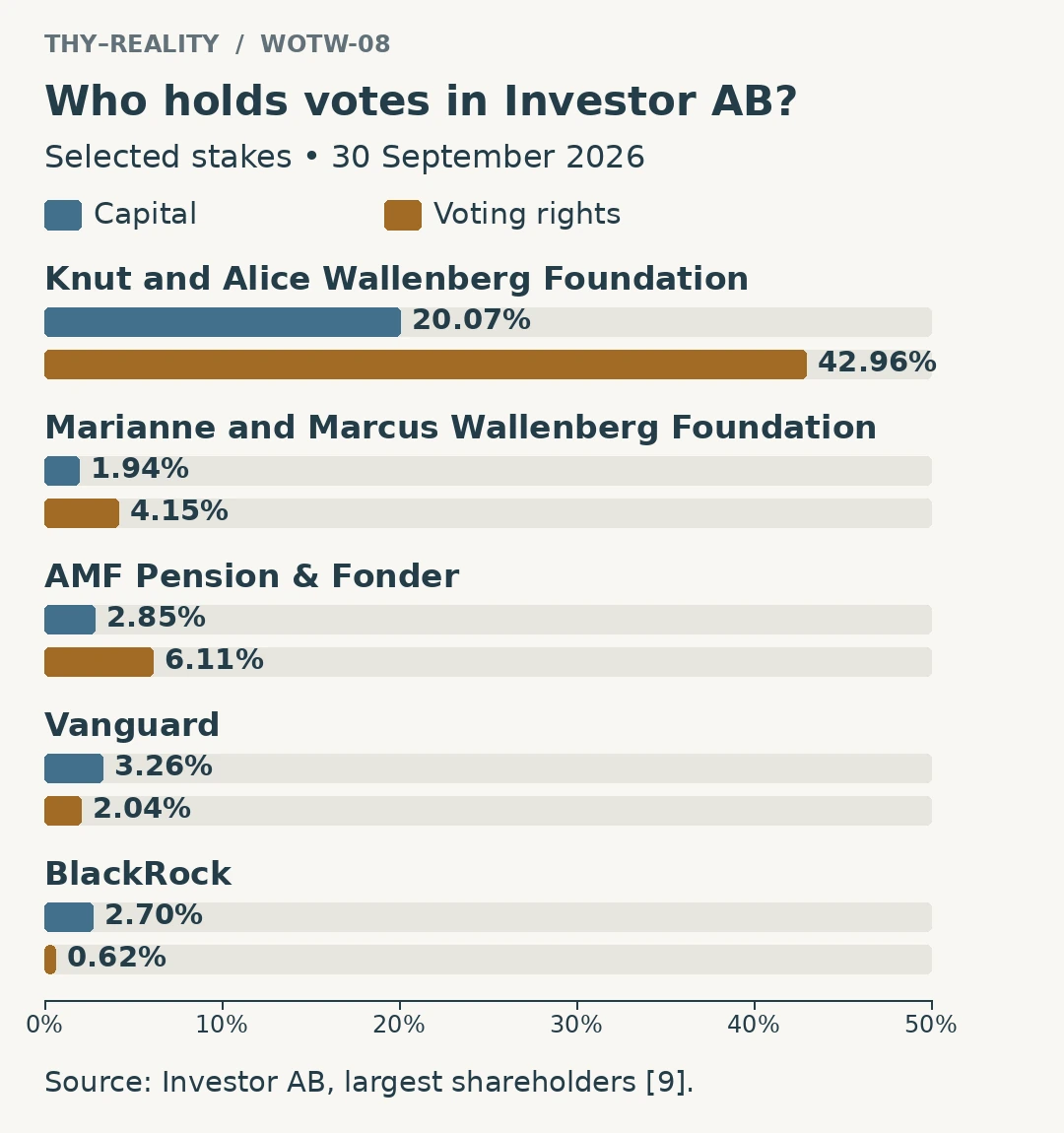
Investor AB's annual report for 2025 provides a more precise historical reference point: in the table concerning the Nomination Committee, the Wallenberg Foundations group is listed as holding 50.2 per cent of all votes as at 31 December 2025. A broader institutional description of the three largest foundations reports 23.3 per cent of the capital and 50 per cent of the votes, but without a clear reference date. Neither of these disclosures establishes the precise combined holding of the foundations on 30 September 2026 or the third foundation's holding on that date. The figures for Vanguard and BlackRock do not establish personal ownership of the assets by the executives of these asset managers either. [6] [9] [18]
Under the Swedish Companies Act, ordinary resolutions at a general meeting, other than elections, generally require more than half of the votes cast. An amendment to the articles of association, for example, generally requires at least two thirds of the votes cast and of the shares represented at the meeting; even stricter rules apply to certain amendments. A large block of voting rights can confer significant influence even without a majority of the share capital, but the percentage alone does not tell us who attended a particular general meeting, how the other shareholders voted or whether a particular resolution was passed. [10]
The composition of the board of directors is another important avenue of influence. Investor AB's published rules for the Nomination Committee provide for representatives of the four largest shareholders or shareholder groups by voting rights that are willing to participate, together with the chair of the board. The committee for the 2026 general meeting included, in addition to the chair of the board, representatives of the Wallenberg Foundations, AMF, the SEB foundation and Alecta. This arrangement is documented in the annual report for 2025. The committee prepares proposals for the general meeting, which elects the members of the board; this is not evidence that the largest shareholder appoints all board members on its own or that all representatives vote in unison. [8] [11] [18] It is precisely in these differences between capital, votes and governance powers that long-term influence takes shape.
Investor AB and Swedish industry
Investor AB's quarterly report makes it possible to identify the companies in which it holds specific ownership and voting rights. As at 30 September 2026, it held 9.9 per cent of Ericsson's capital and 24.8 per cent of its votes; in Saab, it held 30.2 per cent of the capital and 39.7 per cent of the votes. The corresponding figures for Atlas Copco were 17.1 and 22.3 per cent, respectively; for SEB, both were 22 per cent, and for ABB, both were 14.6 per cent. [12] These are not measures of the personal wealth of individual members of the Wallenberg family, but Investor AB’s stakes in its portfolio companies.
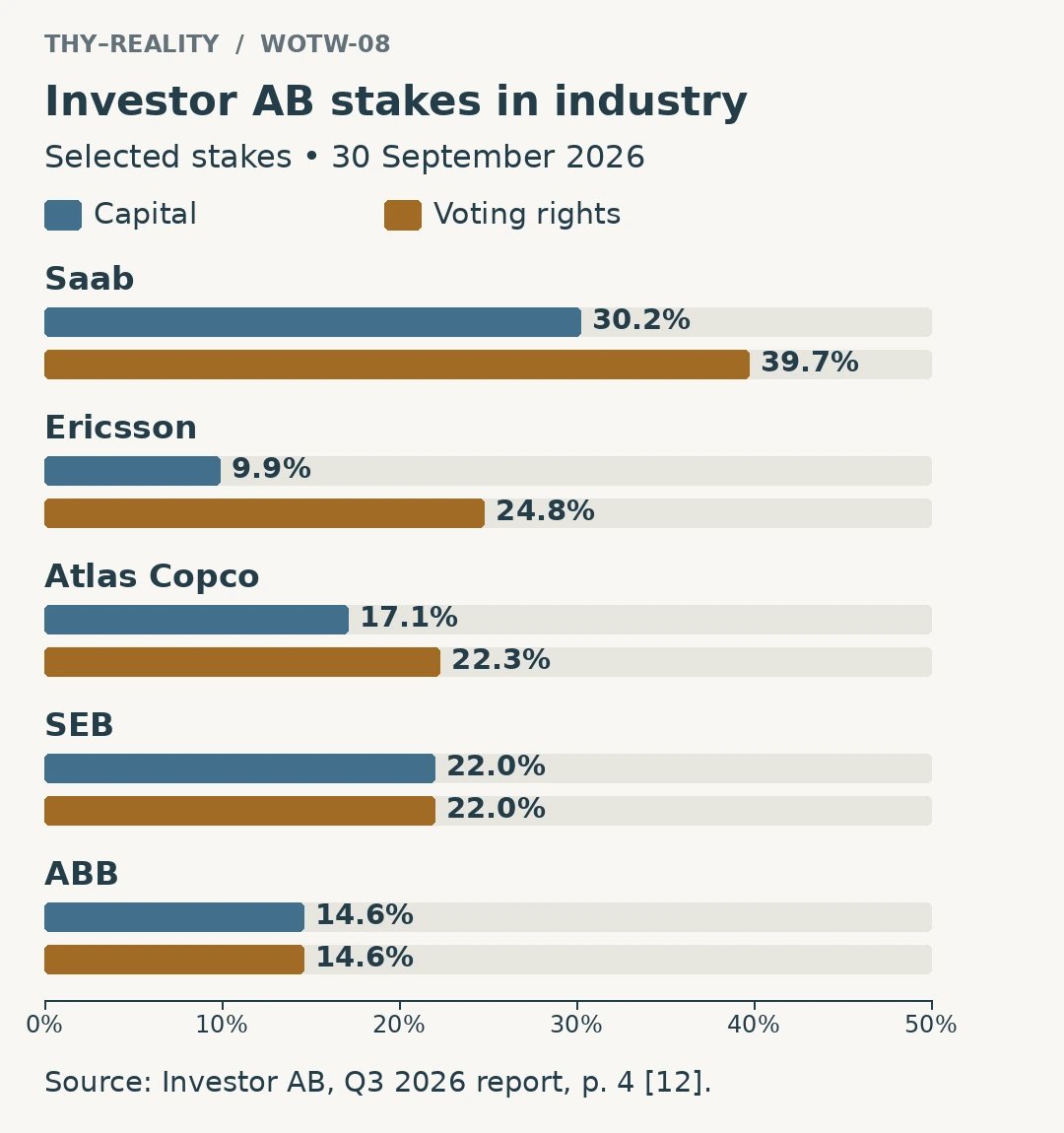
The significance of these holdings extends beyond the value of the shares. Ericsson operates in telecommunications, Saab in the defence and aerospace industries, Atlas Copco and ABB are associated with industrial technology, and SEB with banking. By holding stakes in companies across different industries, a holding company can participate in shaping long-term business strategies. Significant influence at company level, however, is not the same as direct control over an entire sector or the government policies regulating it. [12] [13]
How large is Investor AB? On the same reporting date, the company reported an adjusted net asset value (NAV) of 1,258,016 million Swedish kronor, or approximately 1.258 trillion kronor. Reported net asset value without these adjustments was 1,099,072 million kronor. The adjusted value takes into account, among other things, the estimated market value of certain investments and therefore differs from their accounting values. It is not the company's annual revenue, available cash, client assets under management or the family's personal wealth. [12]
The report divides adjusted asset value before deducting net debt and excluding cash held by Patricia Industries, into three main business areas: publicly listed companies account for approximately 74 per cent, Patricia Industries for 19 per cent and Investments in EQT for seven per cent. Patricia Industries comprises primarily majority-owned industrial investments, while the EQT business area consists of shares in EQT AB and fund investments. [12] [13] A single holding company therefore uses different forms of corporate ownership and investment, which should not all be treated as equivalent forms of control.
A concrete example of a related-party transaction is the purchase of EQT shares. On 16 October 2026, Investor AB announced that it had purchased 12.5 million shares in EQT AB from Wallenberg Investments for approximately 3.5 billion Swedish kronor. Following the transaction, its holding amounted to 14.98 per cent of the capital and votes; in September, it had been 14 per cent. According to the buyer, the market value was assessed by an independent third party, while board members with a potential conflict of interest did not participate in the decision-making. [12] [19] This is a business relationship between two separate companies. The published account of these safeguards is not equivalent to an independent audit of their implementation; we have not examined the valuation report or the minutes of the decision-making process.
From industrial dividends to research funding
One distinctive feature of the Wallenberg system is the link between investment capital and scientific research funding. Dividends from investments generate funds that can be reinvested or used for the purposes of the foundations. According to its public disclosure, the Knut and Alice Wallenberg Foundation approved more than 2.5 billion Swedish kronor in funding for research and education in 2025. Wallenberg Investments reports 3.1 billion kronor in approved funding for the wider group of foundations in the same year. The first figure forms part of the broader institutional total, so the two should not be added together. These are funding approvals reported by the institutions, not an independently verified total of all actual disbursements in that year. [5] [6] [14]
Who decides how these funds are used? According to the published description of the governing bodies of the Knut and Alice Wallenberg Foundation, the board of directors is responsible for final funding decisions, while external experts help assess applications. The listed board members include Peter Wallenberg Jr as chair, Marcus Wallenberg as vice-chair and Jacob Wallenberg as a member. The council of representatives of scientific and educational institutions (the Principals’ Council) may monitor the foundation's activities and make proposals; it also appoints one board member and the auditors. [14]
Long-term funding can be especially valuable to scientific institutions when research requires many years of work, expensive equipment and stable conditions. The social benefits, however, do not remove the need for accountability. When a private non-profit institution can direct substantial funds towards selected research programmes, it is important to understand the selection criteria, professional independence and mechanisms for preventing conflicts of interest. A public description of formal rules is a starting point for investigation, not proof that every procedure has operated without shortcomings in every instance. Nor is it evidence that the foundation determines the findings of the research it funds.
The concentration of economic power and democracy
The questions raised by the Wallenberg system are not new in Sweden. On 27 February 1979, the parliamentary Committee on Industry and Trade published report 1978/79:NU25 concerning a proposal to transfer the Wallenberg group into social ownership. The proponents saw concentrated ownership as contrary to the democratic principle of equality and sought to increase public and worker influence over the economy. The document contains a historical overview of the group and describes influence exercised through minority holdings. The proposal envisaged taking shares from large owners without compensation and compensating small savers with government bonds. The committee opposed the proposal in that form, partly because of the constitutional protection of property at the time, and recommended its rejection. [15] The committee’s recommendation does not necessarily establish the outcome of the parliamentary vote, which we have not yet verified separately.
A more recent comparative framework is provided by the OECD's analysis of the Swedish equity market in 2026. In its section on investment companies and family ownership, the analysis discusses the Wallenbergs as part of a broader Swedish tradition of active, long-term ownership. According to Table 2.2, the value of the shares held by Investor AB amounts to approximately four per cent of the total market capitalisation of publicly listed Swedish equities; the table presents the figure in rounded form. [16] This measure is not a share of Swedish gross domestic product, all national assets or political power, and cannot be used as evidence that the family controls four per cent of the country.
Proponents of long-term ownership may point to the stability of capital, knowledge of industry and companies’ ability to plan beyond short-term market fluctuations. On the other hand, a wide gap between the proportion of capital held and the number of votes can restrict the influence of minority shareholders and reduce the likelihood that changes in ownership structure will lead to a change in management. In an economy with large industrial groups, it is therefore legitimate to ask how entrepreneurial initiative and property rights can be preserved while ensuring transparency in decision-making and accountability to other stakeholders. [10] [15] [16]
How much power do the Wallenbergs actually have?
In the case of the Wallenbergs, an exceptionally enduring model of economic influence is documented. It encompasses foundations with dedicated capital, holding companies with long-term investments, share classes with different voting rights and participation in governing bodies. This model also links industrial activity to the funding of scientific and educational institutions. These public documents do not, however, make it possible to compile a complete register of the family's personal wealth or to prove that it plays a decisive role in every decision of companies to which it has institutional links.
This example illustrates why economic power should not be measured by wealth alone. The rights conferred by capital, the legal structures through which they are exercised and the ability to preserve them over time are all important. When examining particular hypotheses about influence, the next task is to identify specific decisions, votes or other documented mechanisms. Unanswered questions need not be set aside, but neither can we declare them already resolved.
This concludes our examination of selected financial families and dynasties. In the next part of this series, we will turn our attention from the historical holders of capital to banks, money and debt: how money is created, how the banking system is organised and which mechanisms enable its expansion.
Sources and further reading
- Wallenberg.com, History. First Generation and Second Generation sections. Institutional historical account. Source
- Knut and Alice Wallenberg Foundation, Establishment of the Foundation 1917. The founders and Beneficial to the nation sections. Source
- Knut and Alice Wallenberg Foundation, 100 Years in Support of Excellent Swedish Research and Education (2017). Pp. 68–69; previously examined text transcription (renewed direct access was unsuccessful). Source
- Sveriges riksdag, Stiftelselag (1994:1220). Chapter 1, §§ 2–4, Chapter 4, § 1, and Chapter 9, § 1; general legal framework. Source
- Wallenberg Investments AB, Our owners. Institutional description of governance and approved funding for 2025. Source
- Wallenberg.com, The ecosystem. The Wallenberg Foundations, Wallenberg Investments AB, Investor, FAM and Ownership sections. Combined holdings of the foundations without a specified reference date. Source
- Investor AB, Articles of Association, reg. no. 556013-8298. § 4; text transcription used. Source
- Investor AB, Annual General Meeting. Disclosure for 2026; indexed text concerning the rights of share classes and the powers of the general meeting. Source
- Investor AB, Investor’s largest shareholders. Table as at 30 September 2026 and methodological note on nominee registrations. Source
- Sveriges riksdag, Aktiebolagslag (2005:551). Chapter 7, §§ 40–42. Source
- Investor AB, Nomination Committee. Rules on appointment and the committee's duties; accessible older URL from the same publisher. Source
- Investor AB, Interim Management Statement January–September 2026, 16 October 2026. Pp. 2, 4 and 33–34; figures as at 30 September 2026. Source
- Investor AB, Our companies. Overview of companies and the three business areas. Source
- Knut and Alice Wallenberg Foundation, Board of Directors. Board composition, Principals’ Council and approved funding for 2025. Source
- Sveriges riksdag, Näringsutskottets betänkande 1978/79:NU25, 27 February 1979. Med anledning av motion om överförande av Wallenberggruppen i samhällelig ägo; Motionen, Aktuell redogörelse and Utskottet sections. Source
- OECD, The Swedish Equity Market, Assessment and Policy Recommendations 2026, Mapping the Swedish equity markets. Section 2.6, Figure 2.45 and Table 2.2. Source
- Investor AB, History. 1916 section (including the stock exchange listing in 1917); institutional historical account. Source
- Investor AB, Annual report 2025. Corporate governance report, Nomination Committee section, table Nomination Committee for the 2026 AGM (voting rights as at 31 December 2025); text examined, renewed visual inspection unsuccessful. Source
- Investor AB, Investor acquires shares in EQT from Wallenberg Investments, 16 October 2026. Corporate disclosure; statements about the valuation process and conflict of interest are the issuer's own statements. Source