The Warburgs: Banking, the American Financial System and the Federal Reserve
Warburg banking history, the formation of the Federal Reserve and the limits of claims about private control.

AI-generated editorial illustration of a banking panic inspired by 1907; not an archival photograph or a reconstruction of a particular bank.
How can a private banker influence the rules governing an entire country's monetary system? The history of the Warburg family offers a concrete example of how private capital, specialist expertise and public institutions intersect. Paul Moritz Warburg helped shape American banking reform and later became a member of the first Federal Reserve Board. Yet understanding his influence requires more than knowing which positions he held. We must also examine what he proposed, who shaped the final legislation, what powers he held and what happened to the companies that bear his family name.
From Altona to Hamburg: the emergence of a banking dynasty
In 1798, the brothers Moses Marcus and Gerson Warburg founded the banking house M.M. Warburg & Co. Its early business in Altona, then part of Holstein, centred on currency exchange and dealings in bills of exchange. As Hamburg's overseas trade expanded in the nineteenth century, the need to finance transactions between different countries increased. The bank developed into an internationally connected private institution. The bank’s own historical timeline also mentions its financing of German imperial colonial ventures. [1] This raises the question of private capital's role in colonial expansion, although the chronology does not provide sufficient information to assess the scale or consequences of individual transactions.
Such a bank did not need to own ports or merchant ships to play an important role in the business conducted through them. Credit, payment instruments and foreign exchange transactions facilitated trade between participants operating in different legal and monetary environments. It was precisely in this field that Paul Warburg developed the expertise he later brought to American banking.
Born in Hamburg in 1868, he gained his initial business experience in Germany before furthering his training in London and Paris. In 1895 he became a partner in the family bank; in 1902 he moved to New York and joined the banking house Kuhn, Loeb & Co. as a partner, retaining his partnership in the Hamburg bank until 1907. At the New York bank, he was responsible for international loans to several governments. In 1911 he became a United States citizen. [2]
Paul Warburg and American banking
At the beginning of the twentieth century, the American banking system had no central bank capable of coordinating access to reserves and helping to alleviate sudden liquidity pressures. Individual banks held reserves, but their ability to redistribute these effectively during a crisis was limited. When demand for cash surged, difficulties at one institution could spread to others. Moreover, the supply of banknotes was tied to the availability of certain government bonds, making it difficult to adjust to the seasonal needs of the economy. [4]
Warburg had already written publicly about these shortcomings in January 1907, before the outbreak of that year's major financial panic. He advocated the development of a market for short-term commercial receivables and provision for the rediscounting of bills of exchange. When discounting a bill, a bank purchases it before maturity at a price below its face value, reflecting the applicable discount; it can then rediscount the bill with another financial institution to obtain liquidity sooner. Through such instruments, Warburg sought to make lending more flexible and improve the provision of means of payment to the economy. His articles from 1907 and 1908 were subsequently published in a 1930 collection of his works. [3]
The Panic of 1907 increased political pressure for reform. On 30 May 1908, Congress passed the Aldrich–Vreeland Act and established the National Monetary Commission to study changes to American monetary arrangements. [4] [5] Economists, however, did not agree on how the new institution should be organised. In 1909, the economist O. M. W. Sprague raised the question of whether European models could be transferred effectively to the American system, where branch banking was organised differently. [6]
The need for reform did not, therefore, determine its outcome. Preventing financial panics was one question; deciding whom to entrust with the administration of the new system and how to limit potential conflicts of interest was another.
Jekyll Island: planning reform in secret
Between 20 and 30 November 1910, a small group of people connected with banking and the formulation of government financial policy gathered on Jekyll Island, off the coast of the US state of Georgia. Their aim was to develop a reform proposal in a confidential setting. A later historical reconstruction by Gary Richardson and Jessie Romero identifies those present as Senator Nelson Aldrich, Assistant Secretary of the Treasury A. Piatt Andrew, bankers Henry P. Davison and Frank Vanderlip, Aldrich's secretary Arthur Shelton, and Paul Warburg. [4]
The participants presented their trip as a duck-hunting expedition and addressed one another by their first names to reduce the risk of their identities being revealed. There is, however, disagreement even about who attended. An earlier account published by the Federal Reserve Bank of Minneapolis in 1989 also lists Benjamin Strong, whereas the 2015 reconstruction considers his presence unlikely. Strong contributed to the subsequent development of the plan, but this does not establish that he was personally present on the island. [4] [7]
The secrecy of the meeting is not merely a later conjecture but a documented part of the history of banking reform. In January 1911, Aldrich presented the plan to the monetary commission without explaining how it had been developed. [4] It is legitimate to ask why representatives of major private banks had such direct access to the preparation of a proposal for the country's monetary arrangements and how the wider public was represented in that process. Yet a proposal formulated at a private meeting was not yet law. Assessing its actual influence requires comparing the proposal with subsequent legislative changes.
From the Aldrich Plan to the Federal Reserve Act
Warburg's proposals did not begin on Jekyll Island. In his April 1908 proposal, he envisaged a Central Bank of Issue with capital of 100 million US dollars. Section 3 of his draft stipulated that the initial capital would be subscribed, paid in and owned by the United States. Any sale of this capital would be prohibited for the first ten years and would subsequently require a resolution of Congress. He also proposed a 41-member council: twelve shareholder representatives, twenty presidents of district banking associations, three government officials, and three representatives each from the Senate and the House of Representatives. [3]
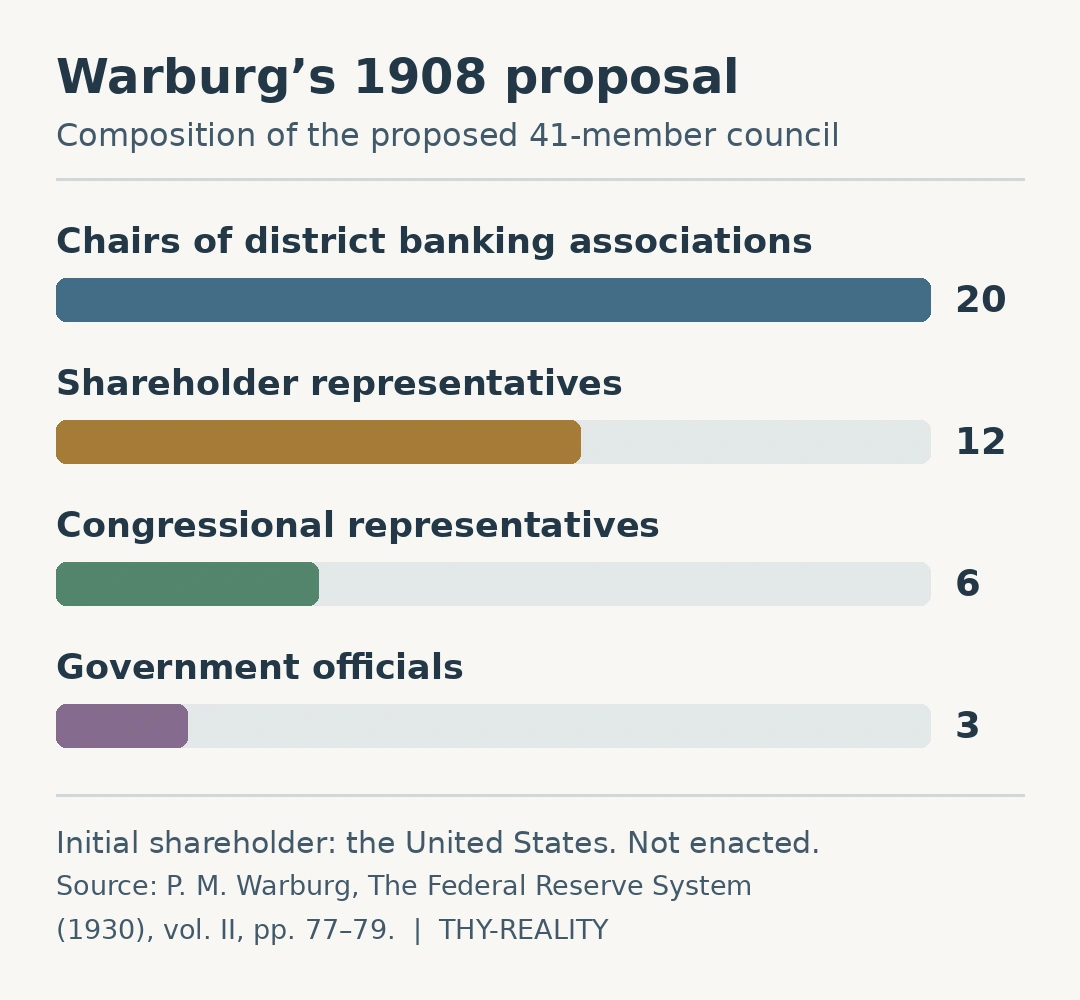
This detail matters because it shows that Warburg's ideas for a central bank cannot simply be characterised as a demand for complete private ownership. His draft did not become law, nor should it be equated with later proposals developed in collaboration with other reformers.
In January 1911, Aldrich presented a plan for a reserve association with fifteen branches and a 45-member board of directors. Twelve directors would be elected through voting weighted according to the number of shares held by banks in each district. Part of the electoral system would thus give greater weight to districts with a larger amount of subscribed capital. The revised proposal of the National Monetary Commission in January 1912 envisaged 46 directors: 30 from the districts, nine chosen through share-based voting and seven serving ex officio, including four government officials and three executives of the association. [8] [9]
The legislation signed by President Woodrow Wilson on 23 December 1913 differed from these proposals. The Federal Reserve Act provided for between eight and twelve reserve districts and a central, seven-member Federal Reserve Board. The Secretary of the Treasury and the Comptroller of the Currency served on the board ex officio, while the other five members were appointed by the president with the consent of the Senate. [10] [11] The legislative process, involving Carter Glass, Robert L. Owen and others, resulted in a distribution of powers different from that envisaged in Aldrich's original proposal. [5]
There was thus continuity between the drafts and the final legislation in certain technical arrangements, particularly the pooling of reserves and a more flexible money supply, alongside significant changes in governance. In 1912, the monetary commission advocated a combination of private shareholding and public authority, arguing that the proposed safeguards would limit the dominance of Wall Street. Opponents of the Aldrich Plan believed that the largest banks could nevertheless exercise disproportionate influence. [9] [4] [5] This is central to the question of influence: ideas can survive a political compromise without their authors retaining all the powers they originally proposed.
Warburg within the Federal Reserve
Paul Warburg did not remain simply an external advocate of reform. On 10 August 1914, he was sworn in as a member of the first Federal Reserve Board; on 10 August 1916, he was appointed vice governor (deputy to the board's then executive head), and on 9 August 1918, he resigned. [2] During this period, his influence was formalised through public office and no longer derived solely from his position in banking.
First Federal Reserve Board (c. 1914) — archival photograph in the FRASER collection.
After leaving the board, he served on the Federal Advisory Council, the Federal Reserve's advisory body, from 1921 to 1926. The annual report for 1921 identifies him as the representative of the second reserve district and vice-president of the council. [2] [12] Under Section 12 of the Act, the council has the authority to consult the system's leadership and make recommendations on banking and monetary matters. [13] A specific recommendation dated 22 February 1921 illustrates how this channel operated: the council unanimously advised against imposing interest on a specified portion of the Reserve Banks’ notes not backed by gold or gold certificates. [12] This was a collective recommendation of the council, not evidence that Warburg formulated it himself. Nor does the existence of the recommendation establish that the board accepted or acted upon it. Such a conclusion would also require a documented response from the decision-makers.
We must distinguish between legislative influence, public office, an advisory role and ownership. Today, the Board of Governors is a federal agency, while the twelve regional Federal Reserve Banks have a distinctive legal structure in which member banks are required by law to hold shares in their regional Reserve Bank. These shares are not equivalent to ordinary shares in a private company; holding them is a statutory condition of membership in the system. [14] The powers of the various bodies and the rights of member banks will be examined in greater detail in a separate article on the Federal Reserve. Warburg's membership of the board does not in itself demonstrate ownership of the system.
International Acceptance Bank and the Council on Foreign Relations
Following the end of the First World War, Warburg's activities were not confined to monetary policy. In 1921, he organised the International Acceptance Bank to promote US government financing of Europe's post-war reconstruction. [2] Such activity brings together trade finance, international payment instruments and wider economic interests.
During the same period, he was also active in the Council on Foreign Relations (CFR), an American institution devoted to the study of international relations. Its historical roster of board members records his service from 1921 to 1932. [15] This documents a personal connection between banking, the American monetary system and an institution concerned with foreign policy. The overlap of roles, however, does not demonstrate that one institution directly governed the other or that all its decisions stemmed from the interests of the same banker.
Economic power is not confined to the assets on a balance sheet. Access to people, information and expert discussions can influence which problems come to the fore and which solutions are considered in the first place. By examining minutes, recommendations and actual decisions, we can establish when this potential for influence translates into documented influence. A list of memberships alone is sufficient to identify connections, but not to reach a definitive assessment of their consequences.
Present-day business structures and the Cum-Ex case
The history of the Hamburg bank is not one of uninterrupted family control. According to the bank's own chronology, Rudolf Brinckmann and Paul Wirtz took over the bank in 1938 under conditions of Nazi persecution, and in 1939 the Warburg family's remaining interest as a silent partner was confiscated. A restitution agreement in 1949 allowed the family to return as shareholders. [1] Continuity of ownership must therefore be examined through specific legal documents, not merely on the basis of a family name.
The 2025 annual report of M.M. Warburg & Co. identifies M.M. Warburg & CO Gruppe GmbH as the bank's direct, sole shareholder. On 26 August 2021, the two companies concluded a notarised agreement concerning the proposed merger of M.M. Warburg & CO Gruppe GmbH into the bank. The report explains that supervisory practice concerning the assessment of prospective acquirers of shareholdings changed in 2025 and that the companies are examining how to implement the merger. [16] The 2024 disclosure report and the bank's legal notice provide further information about its legal form. [17] [18] Neither the completion of the merger nor a complete register of ultimate owners could be confirmed as of the date of verification (16 November 2026).
As at 31 December 2025, the bank reported total assets of €3,176,792,000, equity of €197,608,000 after accounting for the profit transfer agreement and liabilities to customers of €2,077,278,000. [16] These are distinct accounting categories. Total assets do not constitute the owners' personal wealth, and liabilities to customers do not represent additional family capital.
On 15 June 2026, Warburg Bank and Rothschild & Co announced an agreement for Rothschild & Co to acquire all the shares in the Hamburg-based company Marcard, Stein & Co. The buyer stated that completion was subject to regulatory approvals. [19] [20] This is a concrete example of a business relationship between the groups examined in two consecutive articles in this series. The agreement does not amount to a merger of the two banking groups. As of 16 November 2026, we had been unable to confirm completion of the transaction from the sources examined; this does not establish that the transaction had not been completed.
Other companies bearing the Warburg name also have separate ownership histories. Warburg Pincus traces its origins to E.M. Warburg & Co., established by Eric Warburg in New York in 1939. In 1966, it was acquired by Lionel I. Pincus & Co. The London banking house S.G. Warburg & Co. was acquired in 1995 by Swiss Bank Corporation, which merged to form UBS in 1998. [21] [22] These historical connections do not imply that all the assets of these institutions are now part of a single pool of family wealth.
The Cum-Ex case also illustrates the limits of private financial power. The transactions examined, carried out between 2007 and 2011, involved improperly claiming refunds or credits for tax on investment income and the associated solidarity surcharge even though the corresponding tax had not been withheld. The 2024 interim report of the Hamburg parliamentary committee summarises the judgment of the Bonn Regional Court of 18 March 2020. On 28 July 2021, Germany's Federal Court of Justice (BGH) upheld the legal basis and amount of the ordered confiscation, although it changed the legal classification of the conviction in the case of one defendant. [23] [25]
An order for the confiscation of €176,574,603, representing the value of the proceeds, was made against the company involved as a third-party recipient of those proceeds, not as a defendant in those proceedings. The amount comprised €166,574,603 in improperly claimed tax amounts and an estimated ten million euros in returns derived from them. [25] On 7 April 2022, Germany's Federal Constitutional Court declined to accept the constitutional complaint concerning the confiscation for decision. [24]
In its chronology, the bank states that the tax claims arising from its proprietary trading in 2007–2011 were settled in 2020, and emphasises that its governing bodies reject unlawful tax structuring. [1] The bank's own account must be distinguished from the courts' findings. Tax payments and court-ordered confiscation are not amounts that can automatically be added together. The case establishes specific economic and legal responsibility; it is not a basis for attributing guilt to every member of the family.
How much financial power do the Warburgs actually have?
Historical documents enable us to identify several concrete forms of influence: the development of international banking, participation in the preparation of monetary reform, public office within the central bank, and subsequent involvement in advisory and foreign policy institutions. Some of these connections are formal and directly verifiable, while the effects of others on particular decisions remain to be established.
Present-day data on the Hamburg bank provide insight into its operations and direct ownership structure, but not into the total wealth of every branch of the family. Nor can present-day family control of the Federal Reserve be inferred from Paul Warburg's historical role. Conversely, the fact that public office is not ownership does not mean that the historical influence of private bankers was unimportant. The question is how this influence was exercised, which decisions can be linked to it and what mechanisms of public oversight exist.
In the next article, we will examine the Wallenbergs, whose foundations, holding company Investor AB and industrial investments play a particularly important role. Comparing these different ways of organising capital will help us understand why, when researching economic power, knowing a family name is not enough: we also need to know the structure of rights and relationships behind it.
Sources and further reading
- M.M.Warburg & CO, Our History. Sections 1798–1918, 1919–1945, 1946–1985 and 2016–today; institutional chronology. Source
- Federal Reserve History, Paul M. Warburg. Biographical overview, updated 14 October 2025. Source
- Paul M. Warburg, The Federal Reserve System: Its Origin and Growth, vol. II, Macmillan, 1930. Chapters I, II and IV, particularly pp. 73–79, §§ 1–3; online machine transcription of the reprint. Source
- Gary Richardson and Jessie Romero, The Meeting at Jekyll Island, Federal Reserve History, 2015. The Need for Reform, The Duck Hunt, The Plan Takes Shape. Source
- Federal Reserve Bank of Kansas City staff, Federal Reserve Act Signed into Law, 2013. Legislative development. Source
- O. M. W. Sprague, The Proposal for a Central Bank in the United States: A Critical View, QJE 23(3), 1909, 363–415, DOI 10.2307/1884772. Publicly accessible abstract and outline of arguments. Source
- Federal Reserve Bank of Minneapolis, Paul Warburg’s Crusade to Establish a Central Bank in the United States, 1989. Jekyll Island Expedition; earlier reconstruction. Source
- Nelson W. Aldrich, Suggested Plan for Monetary Legislation, Senate Doc. 784, 1911. Proposal of 16 January 1911, pp. 8–12; text access. Source
- National Monetary Commission, Report, Senate Doc. 243, 9 January 1912. Pp. 11–15; text access. Source
- United States Congress, Federal Reserve Act, 23 December 1913, 38 Stat. 251. 38 Stat. 251, introduction and beginning of § 2. Source
- United States Congress, Federal Reserve Act (1913), FRASER transcription. § 10 and § 2, online transcription. Source
- Federal Reserve Board, Eighth Annual Report covering operations for 1921, 1922. Pp. 87 and 681; text access. Source
- Board of Governors, Federal Reserve Act, Section 12: Federal Advisory Council. 12 USC 261/262. Source
- Board of Governors, Who owns the Federal Reserve?. Updated 28 May 2026. Source
- Council on Foreign Relations, Board of Directors, Historical Roster. Historical roster of directors. Source
- M.M.Warburg & CO, Jahresgeschäftsbericht 2025. § 3.1.1, p. 8, § 3.3.2–3.3.3, pp. 16–17. Source
- M.M.Warburg & CO, Offenlegungsbericht 2024. Pp. 16 and 19. Source
- M.M.Warburg & CO, Impressum. Legal notice, not an extract from the register. Source
- M.M.Warburg & CO, Warburg Bank verkauft Marcard, Stein & Co an Rothschild & Co, 15 June 2026. Seller’s announcement. Source
- Rothschild & Co, Rothschild & Co to acquire Marcard, Stein & Co, strengthening growth in German wealth management, 15 June 2026. Buyer’s announcement; subject to regulatory approvals. Source
- Warburg Pincus, Firm History: Milestones of Growth. Milestones 1939 and 1966. Source
- UBS, Roots of UBS. History of Swiss Bank Corporation. Source
- Bürgerschaft der Freien und Hansestadt Hamburg, Zwischenbericht des Parlamentarischen Untersuchungsausschusses (PUA „Cum-Ex-Steuergeldaffäre“), Drucksache 22/14500, 28 February 2024. Pp. 19–20 and 105, C.I–II; text access used. Source
- Bundesverfassungsgericht, Beschluss vom 7. April 2022 – 2 BvR 2194/21. Operative part no. 1 and grounds A.1; indexed text used. Source
- Bundesgerichtshof, Urteil vom 28. Juli 2021 – 1 StR 519/20, ECLI:DE:BGH:2021:280721U1STR519.20.0. Particularly paras. 5–7, 45–46, 109–111; publicly available transcription of the judgment in the HRRS legal database. Source