The Rothschilds: Their Historical Financial Network and Present-Day Ownership Structure
The documented history of Rothschild finance and the distinction between historical influence and present-day ownership.

AI-generated illustration of historical banking operations, not a reconstruction of a specific bank or actual event.
In late November 1875, the British government agreed to purchase approximately 44 per cent of the shares in the company that operated the Suez Canal. To finance the transaction, it turned to the Rothschild family’s private banking house. This episode reveals how important a financial network can become when a state needs to raise a large sum of money at short notice. It also raises a question fundamental to understanding economic power: who is the lender, who is the owner, and who actually makes the decisions in such a transaction?
From Frankfurt to five European financial centres
The origins of the family's business network lie in the activities of Mayer Amschel Rothschild in Frankfurt. According to the archival account, on 27 September 1810 he entered into a partnership agreement with three of his sons, Amschel, Salomon and Carl. Nathan was already doing business in England, while James had not yet reached the age of majority. An international business organisation gradually developed out of the family partnerships. [1] [2] The founder's five sons were associated with five financial centres: Amschel with Frankfurt, Nathan with London, James with Paris, Salomon with Vienna and Carl with Naples. The network was therefore not yet fully established in 1810. The information about the signatories is based on the archival description and the historical portal of the state of Hesse; we have not directly examined the complete original agreement. [1] [3]
Portrait of Nathan Mayer Rothschild (1853)
The advantage of such an organisation lay in connecting people, capital and information across different markets. The banking houses could draw on their knowledge of conditions in the countries where they operated while also cooperating across borders. Alongside the family partners, business agents played an important role. As the historian Rainer Liedtke points out, they conducted business and gathered information even in places where the Rothschilds had no permanent banking house of their own. Such information helped them assess investments, credit risks and cross-border payments. At a time when information travelled much more slowly than it does today, a well-organised network was itself a significant business advantage. [3] [4]
We should not, however, interpret these advantages as an enduring monopoly. Large joint-stock banks also developed during the nineteenth century, competing with family banking houses. The historical success of the Rothschilds must therefore be understood in the context of the financial markets of their time, rather than as evidence that their position has remained unchanged to the present day. [4]
States as major clients
States need money for public administration, infrastructure, meeting their financial obligations and waging wars. If current revenues are insufficient to cover planned expenditure, they can borrow by issuing bonds or taking out loans. A bank may act as a lender, a financing arranger or an intermediary between the state and investors. The specific agreement determines who assumes the risk, who receives interest and who receives a commission for carrying out the transaction.
One specific early example is the Prussian government loan of 1818, which the Rothschild Archive describes as a five per cent loan with a nominal value of five million pounds sterling. The obligations were denominated in pounds, and interest could also be collected in London. The arrangement included a sinking fund for the gradual repayment of principal. This structure made it easier for foreign investors to invest in Prussian debt. The nominal amount of the issue should not be taken to mean that the bank supplied the entire amount itself, or that the amount represented its profit. The archive holds the subscription ledger for the loan, which we have not examined in full. [5]
The international financial network enabled the Rothschilds to take part in such large transactions linking different financial markets. Beyond its direct economic significance, this access also had a political dimension: when a government needs to find a financier quickly, its choice depends on who has the necessary capital and business connections. This can give the financial partner bargaining power, but does not in itself confer the right to direct state policy. The case of the Suez Canal allows us to examine the actual relationship between these two forms of power. [3] [4] [6]
Suez 1875–1876: how the purchase was financed
The Suez Canal was strategically important to Britain because of the maritime connection between the Mediterranean and the Red Sea and the route to India. The Egyptian Khedive Ismail was prepared to sell shares in the Suez Canal Company, and the British government accepted the offer. The purchase agreement between the British and Egyptian parties was concluded on 25 November 1875. Its text subsequently became part of the British Suez Canal (Shares) Act of 1876. [6] [7] [8]
According to the British Chancellor of the Exchequer in the House of Commons on 14 February 1876, the sum originally envisaged, four million pounds sterling, was adjusted when it emerged that the Khedive held 176,602 shares. The final agreed purchase price was £3,976,582. The Rothschild banking house undertook to provide the funds for payment, and in return for executing the transaction and assuming the risk, the British government agreed to pay it a commission of £99,414, or 2.5 per cent of the purchase price. [6]
In the parliamentary debate of 21 February 1876, the Chancellor explained that, until the advances were repaid, the bank was to receive annual interest of five per cent, which the Khedive had promised. The Member of Parliament Robert Lowe pointed out that the banking house's letter and the Treasury minute identified the party responsible for paying this interest differently. He also argued that the interest should have been included in the parliamentary vote on expenditure. The debate thus documents a dispute over financing costs and parliamentary oversight, but does not establish how each interest obligation was ultimately settled. [9]
On 23 February 1876, the House of Commons authorised a maximum of £4,080,000 for the purchase and associated expenses. This spending limit, the purchase price, the commission and the interest on the interim financing are distinct categories; without complete information about cash flows and costs, it is impossible to calculate the bank's final profit. [6] [7] [9]
The Rothschild Archive holds material relating to the repayment of the loan. In the published transcription of a letter dated 9 March 1876, the British Treasury authorises a first instalment of £1.5 million for the following day. The archival description states that the financing was repaid within five months. It also records William Gladstone's criticism that Prime Minister Benjamin Disraeli had undermined Britain's constitutional arrangements by financing the purchase before obtaining parliamentary consent. This was a historical political criticism, not a judicial finding. However, authorisation of an instalment is not the same as a bank statement, and we have not directly examined the full series of receipts or the separate loan agreement. The interest must therefore be understood in the context of interim financing, not as evidence that the bank received a permanent income stream from the canal. [10]
Who held the shares, votes and seats?
Britain purchased 176,602 of the company's 400,000 issued shares, approximately 44 per cent. The Act of 15 August 1876 stipulated that the British Treasury was to hold and use the shares on behalf of the Crown for public purposes. Receipts under the agreement and from the shares were payable to the public Consolidated Fund, while annual accounts of receipts and debt servicing had to be presented to both Houses of Parliament. The shares were held at the Bank of England for the Chancellor of the Exchequer and Lionel de Rothschild. The banker’s involvement in the custody arrangement does not establish that he was personally entitled to all the shares. The Bank of England's archival catalogue further documents the government's purchase and custody of the shares, although the complete original archival file remains unexamined. [7] [8] [11]
Ownership of nearly half the shares did not automatically mean nearly half the votes in the company. On 14 February 1876, the Chancellor stated in Parliament that the British holding would carry ten votes, while the government was negotiating for three representatives on the governing bodies. On 21 February, the agreement on representation had not yet been finalised; on 5 May, explanations were given in Parliament concerning the proposed powers of three members of the management committee and the possibility of one of them serving on a smaller executive body. As we have not examined the original articles of association from that period or the resolutions concerning the first appointments, we treat these details as documented statements by the British government, rather than as a definitive reconstruction of the composition of the company's management. [6] [12] [13]
In addition to the restrictions on voting rights, the shareholding had another financial peculiarity. According to a diplomatic report by the American representative in December 1875, the dividend coupons for the purchased shares had previously been assigned until 1894. For the intervening period, the purchase agreement provided for annual interest of five per cent on the purchase price in favour of the British government, charged against Egyptian public revenues. This obligation was legally separate from the short-term financing of the British purchase, although, according to the Chancellor's explanation, the bank was to receive the relevant portion of this interest until the advances were repaid. [9] The purchase therefore did not entail the immediate receipt of all ordinary dividends, and contractually stipulated income is not in itself evidence that the payments were actually made. [7] [8]
An important distinction emerges from this example: the Rothschilds made it possible to finance a major government transaction, with remuneration agreed for that role, while the British state acquired the shares and sought influence within the company. Both had an economic interest, but their roles were not the same. Distinguishing between them allows us to recognise the real power of private financing without attributing ownership to the wrong party.
The cost to Egypt
From the British state's perspective, the purchase was a strategic investment; from Egypt's perspective, it meant the sale of an important asset during a severe financial crisis. External indebtedness and difficulties in servicing the debt restricted the country's fiscal autonomy. Economic circumstances, including falling cotton prices, also contributed to its vulnerability. In April 1876, Egypt suspended payments on Treasury bonds, and in May the Caisse de la Dette Publique was established, a public debt institution in which foreign commissioners played an important role. [14] [15]

A portion of customs and tax revenues was allocated to debt servicing under the supervision of foreign commissioners, and the Egyptian government undertook not to alter these revenues or take out new loans without their consent. This placed a tangible restriction on its fiscal autonomy. Britain occupied Egypt militarily in 1882. The sale of the shares is an important part of the history of Egypt's dependence, but does not, on its own, explain the occupation. The historian Ali Coşkun Tunçer draws particular attention to the conflicting interests of European creditors and powers. International financial supervision was not a unified mechanism in the hands of a single bank or state. A more detailed assessment of the distribution of the tax burden and its consequences for the Egyptian population would also require more original Egyptian accounts and documents. [14] [15] [16]
On 26 July 1956, Egypt nationalised the Suez Canal Company. The nationalisation decree also provided for compensation to shareholders, which does not establish that every individual obligation had already been fulfilled at that point. This fundamentally changed the legal framework governing the strategic infrastructure. [17] [18] The story of the Suez Canal shows that financial relationships and property rights can change over time: they depend on state sovereignty, contracts, laws and the balance of political power.
Rothschild & Co
Moving from the nineteenth century to the present, we cannot simply equate the historical banking network with a single modern company. At the heart of our examination are two legally distinct groups, Rothschild & Co and Edmond de Rothschild. To understand their position, we need to trace the specific legal entities, their owners and their governing bodies.
Rothschild & Co SCA is a French partnership limited by shares (société en commandite par actions). Its consolidated financial statements for 2025 identify Rothschild & Co Concordia SAS as its parent company as at 31 December. Statutory management is carried out by a separate company, Rothschild & Co Gestion SAS, while the Supervisory Board plays an important oversight role. The parent company, the managing company and the supervisory body are not the same legal or organisational unit. [19] [20]
In 2023, Concordia launched a tender offer for Rothschild & Co shares. A statement dated 12 September 2023 indicated that, following settlement of the offer on 18 September, Concordia and the group of shareholders acting in concert with it would together hold 88.74 per cent of the capital and 91.25 per cent of the theoretical voting rights. Taking into account additional shares covered by options and transfer commitments, the combined total of shares actually held and shares legally deemed to be held amounted, according to the published calculation, to 95.65 per cent of the capital and 95.79 per cent of the voting rights. These were not the holdings of Concordia alone, nor were they holdings exclusively belonging to family members. The company was delisted from Euronext on 11 October 2023. [21] [22]
The same statement indicated that Concordia's shareholders were members of the Rothschild family. This does not, however, mean that family members were also the only direct or indirect investors in Rothschild & Co. Peugeot Invest, for example, disclosed a 5.1 per cent stake in Rothschild & Co at the end of 2025 and its representation on the Supervisory Board. This is information published by an investor, not a complete list of shareholders. The documents examined do not allow us to compile a current individual breakdown of all shareholdings, including those of individual family members in Concordia. [20] [21] [23]
Edmond de Rothschild
The other group, Edmond de Rothschild, is not simply another name for Rothschild & Co. In June 2018, the two groups announced an agreement concerning the use of names and brands and the elimination of cross-shareholdings. On 6 August 2018, they announced that the transactions to eliminate these holdings had been completed. This documents the separation of ownership links between the groups at that time, not the absence of every other business or family connection. [24] [25]
A more detailed picture of ownership is provided by the 2025 annual report of the Swiss bank Edmond de Rothschild (Suisse) S.A. It states that Edmond de Rothschild Holding S.A. holds all of the bank's share capital and all of its voting rights. The report then explains that the holding company's share capital is directly or indirectly controlled by family members or employees of the group and discloses three significant holdings. It attributes 65.73 per cent of the holding company's capital and 89.84 per cent of its voting rights to the estate of Benjamin de Rothschild (Hoirie Benjamin de Rothschild); 16.84 per cent of the capital and 6.77 per cent of the voting rights to Baroness Edmond de Rothschild; and 16.52 per cent of the capital and 3.39 per cent of the voting rights to Camilla Langoux. [26]
These holdings relate to the holding company, not to direct ownership of the Swiss bank. The 2024 report gave slightly different figures for the first two capital holdings, 65.75 and 16.85 per cent respectively, but the same percentages for voting rights. The 2025 report therefore provides a more suitable basis for a present-day examination. The disclosed capital holdings do not account for the holding company's entire capital, so we cannot reliably attribute the remainder to specific individuals. [26] [27]
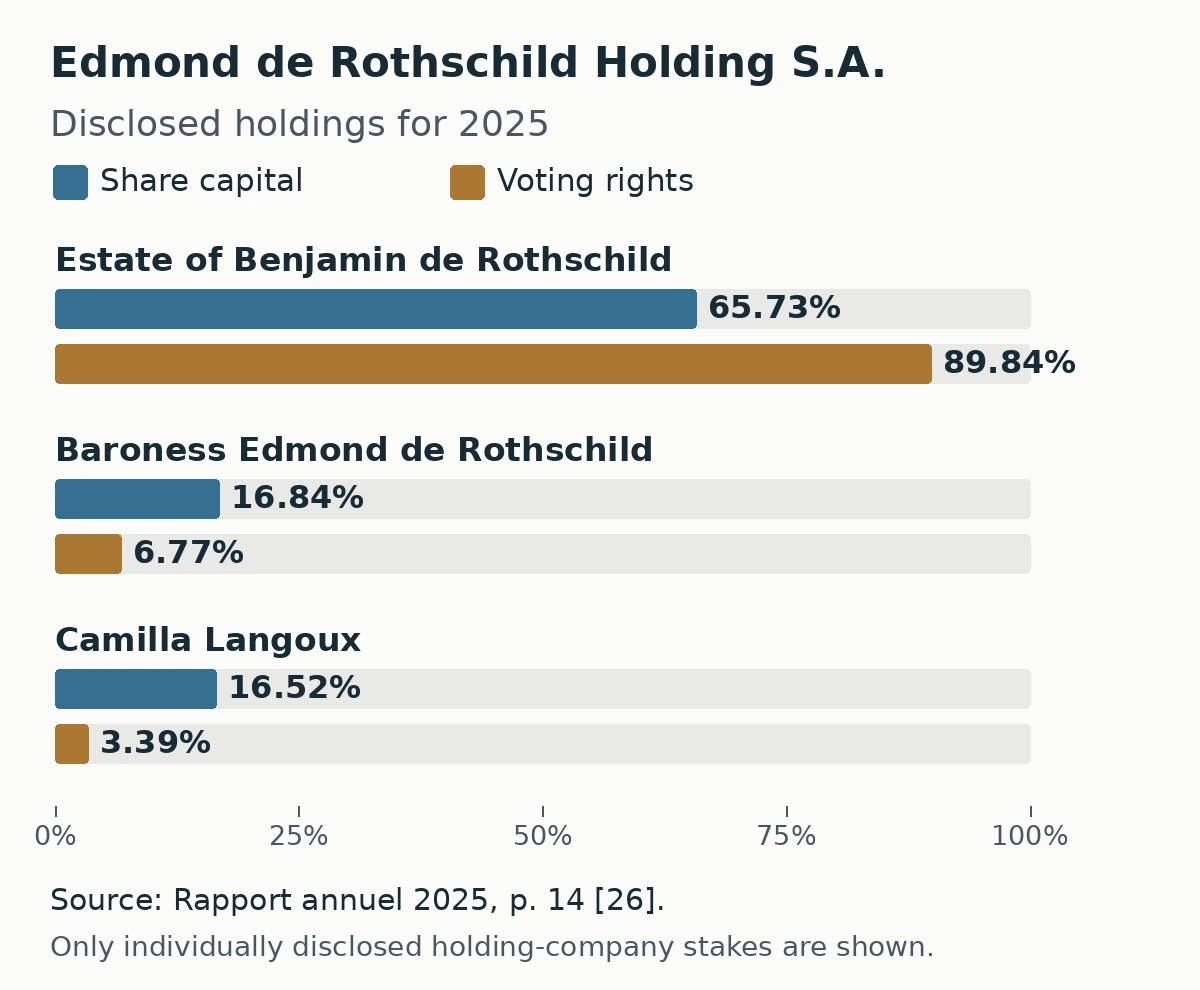
This is an example in which the share of capital and the share of voting rights are not equal. According to the disclosure, the largest shareholder’s voting power is considerably greater than its share of the capital. To understand fully how this power is exercised in specific decisions, we would also need to know the powers of the governing bodies, the holding company's statutory rules and any other agreements between shareholders.
How much power do the Rothschilds have today?
The two modern financial groups operate on a substantial scale. As at 30 June 2026, Rothschild & Co reported €150 billion in assets under management in its Wealth and Asset Management business and €34 billion in its Five Arrows business. Edmond de Rothschild reported CHF 198 billion in assets under management at the end of 2025. These figures represent different business scopes, currencies and reporting dates. They cannot be used to estimate the family’s personal wealth. [26] [28] [29]
When interpreting these figures, it is essential to understand that asset management also involves the assets of clients and investors. Depending on the mandate and type of service, a financial institution may make or recommend investment decisions within the scope of its authority. Such allocation of capital is an important form of economic influence, but it does not mean that all these assets belong to the institution itself or to the family that owns it.
The consolidated balance sheet of Rothschild & Co at the end of 2025 showed approximately €19.989 billion in assets, €4.101 billion in total equity (including non-controlling interests) and €13.191 billion in customer deposits. Customer deposits are liabilities of the group, not its equity. A separate regulatory disclosure reports €2.776 billion in Common Equity Tier 1 (CET1) capital, a measure of regulatory capital distinct from equity reported on the balance sheet. Neither the company's accounting equity nor its regulatory capital provides a direct estimate of the market value of individual owners' holdings. [19] [30]
In addition to asset management, financial advisory services can have considerable economic significance. For 2025, Rothschild & Co reported involvement in 694 transactions through its Global Advisory business, with a combined value of US$673 billion. The value of transactions in which an adviser was involved is neither the adviser’s revenue nor its own assets. It does, however, illustrate the scale of transactions in which expertise, access to information and financial connections can influence the options available to clients. [29]
Publicly available disclosures therefore allow us to identify some concrete sources of the Rothschilds’ economic power: control over certain financial companies, voting rights, financial advisory services and capital management. They do not, however, allow us to compile a complete inventory of the personal wealth of every branch of the family, nor do they in themselves establish unified control over global finance. Unresolved research questions concerning individual private investments or connections require further specific evidence, rather than conclusions drawn from a surname.
In the next article, we will turn to the Warburgs, another historically significant banking family, and examine its role in the development of the American financial system and the establishment of the Federal Reserve. We will again distinguish between institutional influence, formal powers and actual ownership.
Sources and further reading
- The Rothschild Archive, A family Partnership; agreement of 27 September 1810; archival description and accessible excerpts from the English transcription. Source
- Landesgeschichtliches Informationssystem Hessen (LAGIS), Gesellschaftervertrag von Mayer Amschel Rothschild mit seinen Söhnen, 27 September 1810. Historical description, accessible indexed excerpt. Source
- The Rothschild Archive, The Business. Source
- Rainer Liedtke, Agents for the Rothschilds: A Nineteenth-Century Information Network. In: Sarah Panter (ed.), Mobility and Biography, De Gruyter Oldenbourg, 2016, pp. 33–46. DOI 10.1515/9783110415162-003; public excerpts consulted. Source
- The Rothschild Archive, Subscription ledger for the Prussian Government loan, 1818, Archivist’s Choice, March 2018, RAL VI/10/5. Archival description (indexed text; not the complete document). Source
- UK Parliament, Supply—The Suez Canal Shares, 14 February 1876. Source
- UK Parliament, The Suez Canal (Shares) Act 1876, 39 & 40 Vict. c. 67, 15 August 1876. Source 1 Source 2
- Foreign Relations of the United States, 1876, No. 322, Beardsley to Fish, 13 December 1875. Source
- UK Parliament, Supply—£4,080,000 Suez Canal Shares, 21 February 1876. Source
- The Rothschild Archive, March 2015: Suez Canal loan receipts, 1876. Source
- Bank of England Archive, Government shareholdings: Suez Canal Company, C40/491. Source
- UK Parliament, The Suez Canal—English Representatives, 21 February 1876. Source
- UK Parliament, Commons Chamber, Suez Canal—The Management, 5 May 1876. Source
- Ali Coşkun Tunçer, Foreign Debt and Colonization in Egypt and Tunisia (1862–82). In: Sovereign Debt Diplomacies, Oxford University Press, 2021, pp. 73–93. DOI 10.1093/oso/9780198866350.003.0004. Source
- IMF Working Paper, Public Debt Through the Ages (2019). Source
- Suez Canal Authority, Canal History. Source
- Suez Canal Authority, Nationalization Decree, 26 July 1956. Source
- FRUS 1955–1957, vol. XVI, Editorial Note 1. Source
- Rothschild & Co, Consolidated accounts December 2025, pp. 7 and 11. Source
- Rothschild & Co, Group governance and leadership. Source
- Rothschild & Co Concordia, Result of the simplified tender offer, 12 September 2023, pp. 1–2. Source
- Euronext, Rothschild & Co, ISIN FR0000031684. Source
- Peugeot Invest, Rothschild & Co. Source
- Rothschild & Co and Edmond de Rothschild, signing of an overall agreement, 29 June 2018. Source
- Rothschild & Co, Completion of cross-shareholdings transactions, 6 August 2018. Source
- Edmond de Rothschild (Suisse) S.A., Rapport annuel 2025, printed pp. 14–15, PDF p. 8; 2025. Source
- Edmond de Rothschild (Suisse) S.A., Rapport annuel 2024. Source
- Edmond de Rothschild, Strong momentum with CHF 10 billion net inflows in 2025 taking assets under management to a record high close to CHF 200 billion, 20 March 2026. Source
- Rothschild & Co, independent financial services, homepage, stated AUM reporting date 30 June 2026; accessed 16 November 2026. Source
- Rothschild & Co, Pillar 3 Disclosures December 2025, table CC1, p. 13. Source