Private Equity and Private Credit: Who Buys Companies and Who Finances Them?
Distinguishes private equity from private credit and examines how financing affects companies and their owners.

An artistic allegory of ownership and creditor rights in a corporate acquisition; not a documentary depiction of the PowerSchool acquisition.
When an investment fund acquires a company, the name most often reported is that of a major asset manager. Yet behind the acquisition there may be pension funds, sovereign wealth funds, insurance companies, acquisition vehicles and numerous lenders. Some provide equity capital, others lend money, and still others decide how it is used. To understand the economic power of such a system, it is not enough to identify who bought the company. We must also investigate who made the purchase possible and what rights they acquired in the process.
From institutional investor to private fund
In the previous two parts, we examined pension funds and sovereign wealth funds. These may also allocate some of their assets to private investments. Rather than buying a company directly, they can commit capital to a specialist fund that seeks investment opportunities and manages a portfolio in accordance with an agreed strategy. The US Securities and Exchange Commission (SEC) explains that private equity funds generally obtain capital commitments from investors first and then call capital as needed to make investments. [1][2]
One legal structure used by private funds in the United States is the limited partnership, a partnership with a general partner and limited partners. Investors acting as limited partners (LPs) provide capital, while the general partner (GP) has management powers defined by contract. Investment advice and investment management may be provided by a separate company affiliated with the fund’s sponsor. These roles are not necessarily combined in a single legal entity. Investors’ rights, managers’ responsibilities and exit conditions depend on the documentation of the particular fund. [1]
When a pension fund invests in such a structure, its members do not thereby acquire direct voting rights in every acquired company. Their indirect economic exposure passes through several layers of institutions and contracts, and the ability to withdraw an investment from a private fund is often limited. [2] In analysing ownership, we must therefore distinguish between the source of capital, the legal holder of the investment and the party making investment decisions.
Private equity and corporate acquisitions
For the purposes of this article, private equity (PE) means equity investments made through specialist funds, primarily in companies that are not publicly listed. A fund may buy a controlling stake, make a minority investment or participate in taking a publicly listed company private. The usual objective is to generate a return over several years. The manager may help reshape the company’s strategy, operations or capital structure and later sell the investment when conditions are appropriate. [1][2]
In a leveraged buyout (LBO), the purchase is financed through a combination of equity contributions and loans. Debt may be incurred by the acquisition structure, while the target company may become part of an arrangement involving borrowers, guarantors and collateral. The precise arrangement depends on the transaction. If the company’s value rises, leverage can increase the return on equity; if its business deteriorates, leverage can amplify losses and make debt repayment more difficult. Not every private equity acquisition is an LBO, and not every investment confers control over a company.
Private credit and the power of creditors
Private credit often refers to debt financing outside conventional bank lending and public markets for debt securities. Precise definitions and statistical coverage vary. Specialist funds and other non-bank institutions can provide companies with direct loans tailored to their needs. This does not mean that banks are absent from the system: among other things, they may finance the credit funds themselves or offer companies additional credit lines. [3][4]
In a publication dated 6 May 2026, the Financial Stability Board (FSB) estimated the value of assets in the private credit market at the end of 2024 at US$1.5 trillion to US$2 trillion. Data collected from FSB member jurisdictions also covered approximately $220 billion in drawn and undrawn bank credit lines to private credit funds. This amount is not limited to funds already drawn, nor does it cover all direct and indirect connections with banks. [4]
A creditor does not generally acquire shareholder voting rights simply by lending money to a company. However, the creditor acquires a claim and may also obtain security and contractual rights. A credit agreement may restrict additional borrowing or certain transfers of assets and specify the consequences of breaches. If repayment difficulties arise, such rights may affect the options available to management and owners. Their actual scope must be established from the particular agreement, not merely from the size of the loan.
Blackstone, KKR and HPS
Major asset managers often operate in more than one area. In its annual report for 2025, Blackstone stated that it had US$1,274.9 billion in assets under management as of 31 December. Of this amount, its private equity business segment accounted for $416.4 billion and its credit and insurance segment for $443 billion. The former also includes infrastructure and other strategies, while the latter is not limited to private credit alone. [5]

Similarly, KKR combines several investment areas. According to its official results release for the final quarter of 2025, it had $743.9 billion in assets under management at the end of that year, including $229.4 billion in its private equity business line and $322 billion in credit and liquid strategies. [6] These figures illustrate the diversity of the two managers’ activities rather than providing a direct comparison of their private credit portfolios. Assets under management (AUM) are also not the same as the manager’s own assets and may include uncalled capital commitments from investors. Definitions of AUM and the classification of investments by segment also vary between managers. [5][6]
An important connection with earlier parts of the series is HPS Investment Partners. On 1 July 2025, BlackRock completed its acquisition of the company and announced the combination of private financing activities within a new platform, Private Financing Solutions. [7] The acquisition illustrates how activities in public and private capital markets can be brought together under the same asset manager. When investigating specific transactions, however, we must take into account when the ownership relationship was established.
PowerSchool: Anatomy of a specific acquisition
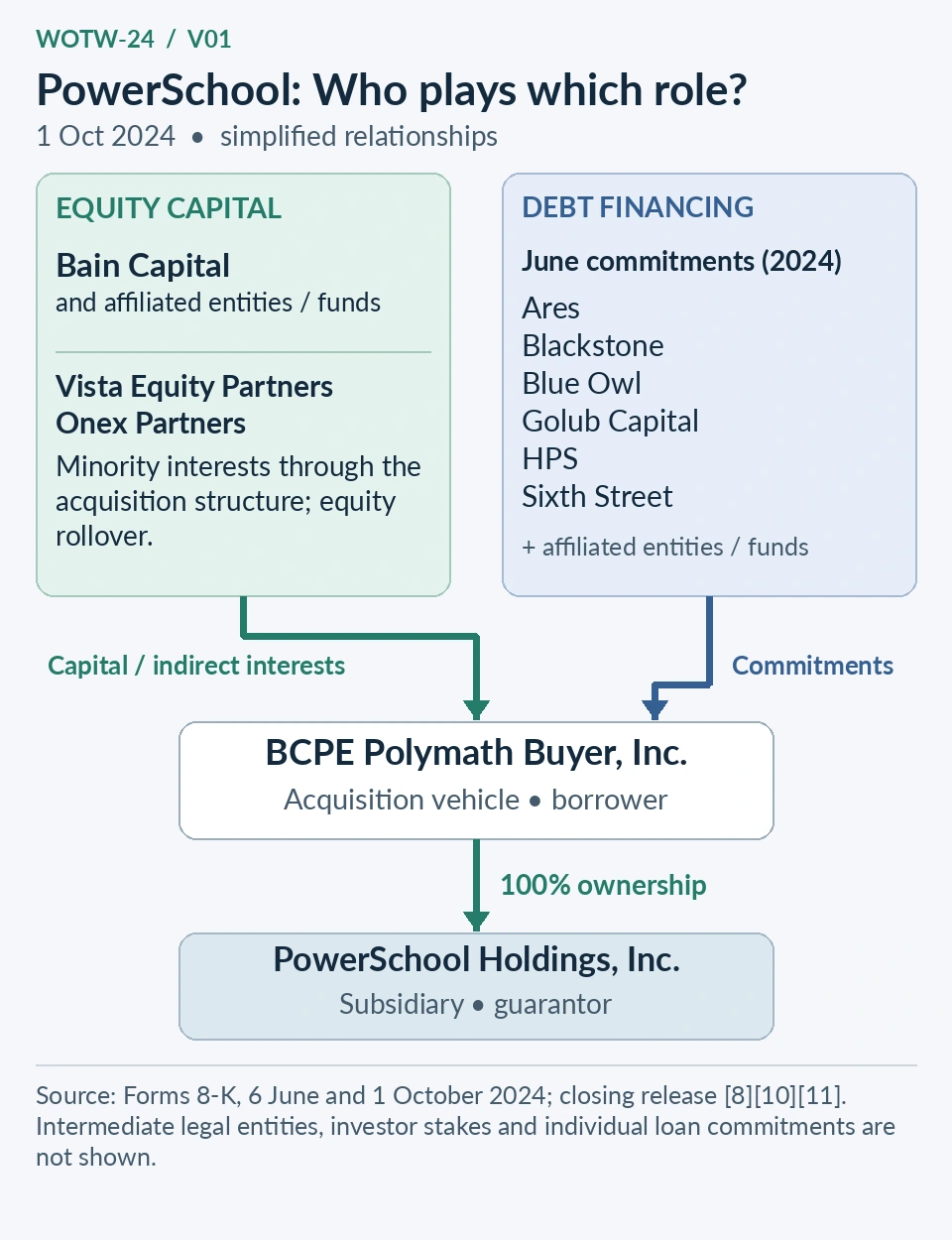
PowerSchool is a US provider of educational software. On 6 June 2024, it entered into a merger agreement with BCPE Polymath Buyer, Inc. and BCPE Polymath Merger Sub, Inc., companies associated with investment funds advised by Bain Capital Private Equity. The former was the acquisition parent company; the latter was its subsidiary established to effect the merger. Funds advised by Bain conditionally committed to provide $1,748,566,902 in equity capital. [8]
In June 2024, the following groups, together with affiliated companies or funds, committed to provide debt financing: Ares Capital Management, Blackstone Alternative Credit Advisors, Blue Owl Credit Advisors, Golub Capital, HPS Investment Partners and Sixth Street Partners. The June commitments provided for three forms of financing: a $2.375 billion term loan, a $500 million delayed-draw term loan and a $300 million revolving credit facility. These commitments totalled $3.175 billion, but this was not an amount that had to be drawn in full at closing. [8][9]
The acquisition was completed on 1 October 2024. PowerSchool became a wholly owned subsidiary of BCPE Polymath Buyer and ceased to be publicly listed. At closing, the existing members of its board of directors resigned and were replaced by the directors of the merger subsidiary. PowerSchool’s existing executive officers remained in their positions. [10] The announced acquisition price was $22.80 per Class A share eligible for cash payment, subject to the exceptions in the agreement. The announced enterprise value was approximately $5.6 billion. Vista Equity Partners and Onex Partners retained minority ownership interests through the acquisition structure. According to the closing Form 8-K, existing shares and equity interests exchanged for equity interests in BCPE Polymath Topco, LP or its subsidiaries were valued at approximately $1.68 billion. [10][11]
Item 5.01 of the closing Form 8-K makes it possible to distinguish between announced and actual financing. Approximately $3.01 billion was paid for the purchase of shares (excluding treasury shares or shares already held, as well as rolled-over interests, as defined in the filing). To complete the acquisition and related transactions, the acquisition vehicle received approximately $1.75 billion in equity contributions from Bain Capital or its affiliates and approximately $2.38 billion in proceeds from the term loan. [10]
PowerSchool – closing acquisition report, 1 October 2024
The same Form 8-K also discloses that a credit agreement was executed at closing: BCPE Polymath Buyer was the borrower, PowerSchool was a guarantor, and Ares Capital Corporation was the administrative agent and collateral agent. The agreement provided credit facilities in the same three nominal amounts as the June commitments. According to the filing, the obligations were secured by a first-priority security interest in substantially all of the assets of the borrower and guarantors, subject to certain exceptions. [10] This illustrates creditors’ contractual power; it does not mean they automatically own the company.
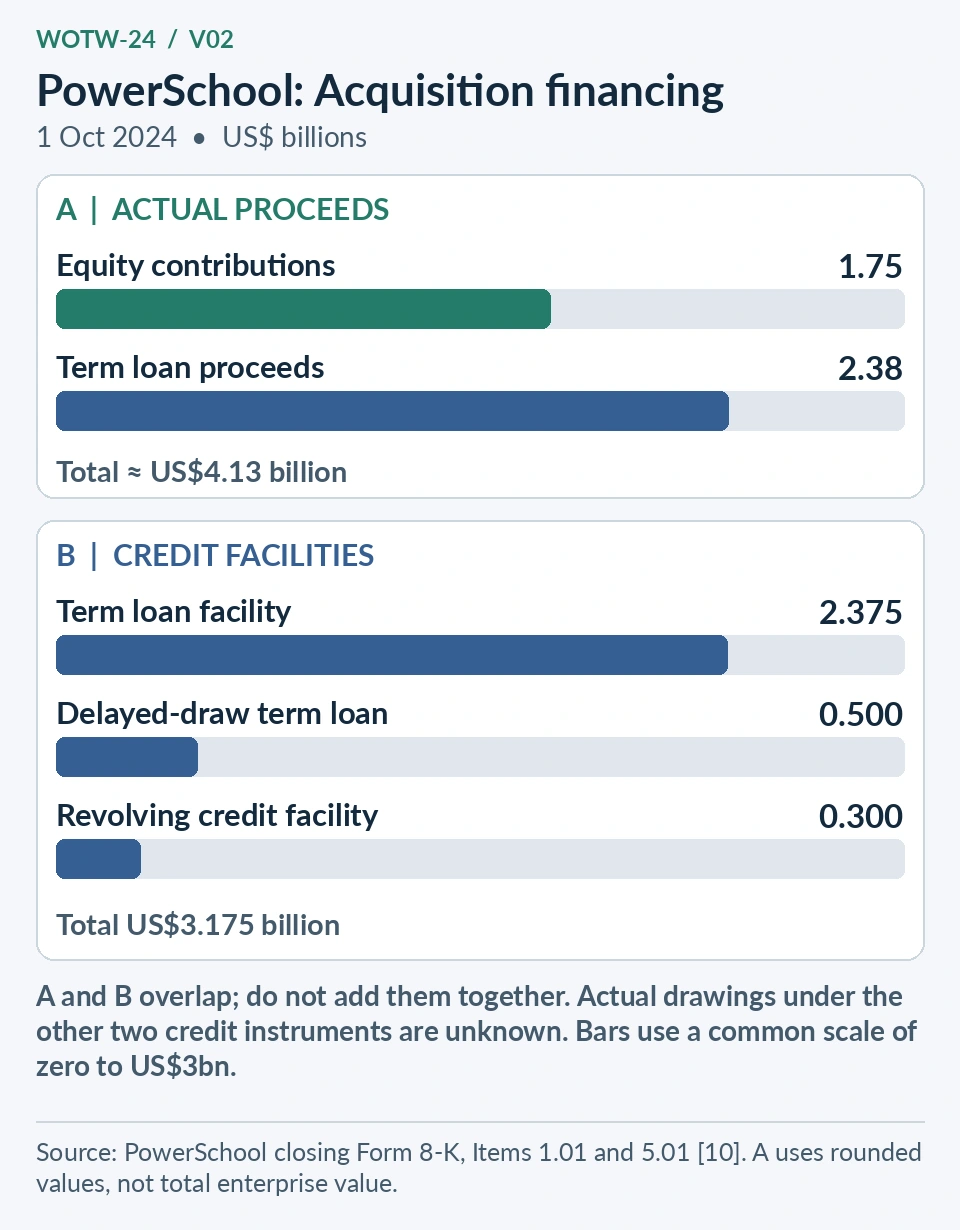
These documents do not establish the final breakdown of ownership interests among ultimate investors, the contribution of each lender or the exact amounts drawn under the other two credit instruments. The announced enterprise value is not the same as the purchase price of the shares or the sum of credit facilities and equity contributions. Nor does the rollover of existing equity interests constitute a new cash contribution. HPS participated in the acquisition in 2024, before BlackRock completed its acquisition of HPS. We must therefore not attribute that financing retrospectively to BlackRock. [7][8][10]
Who receives the returns and who bears the risk?
Investors in a private equity fund may receive distributions from the operations or sale of investments. The manager generally receives contractually agreed fees, while the general partner or another entitled party may share in the profits through a contractually defined share of the profits (carried interest). The precise distribution depends on the fund’s rules. [1] Lenders, meanwhile, expect repayment of principal and interest in accordance with the agreement. Different forms of compensation can also create conflicts of interest, as the SEC warns. [2]
Private equity can provide a company with funding for development, specialist support and assistance with restructuring. Private loans may provide financing that a company would have greater difficulty obtaining in other markets. High indebtedness, however, reduces room for manoeuvre if revenues fall or financing costs rise. In such circumstances, the consequences may be borne by equity investors and creditors as well as employees. The business or social effects of a particular acquisition cannot be assessed from its financial structure alone.
A study published in 2025 in Management Science illustrates this variation using US buyouts from 1980 to 2013. Compared with control firms, the authors found that employment fell by an average of 12 per cent over the two years following buyouts of publicly listed companies, but rose by 15 per cent after buyouts of privately held companies. They also reported average improvements in productivity and differences depending on credit conditions. [12][13] These findings describe a historical US pattern; they do not establish the effects of the PowerSchool acquisition or those of future buyouts in general.
The FSB and the International Monetary Fund warn of private credit risks associated with limited transparency in valuation, liquidity, leverage and links between funds, banks and insurance companies. [3][4] Different institutions may be exposed to the same company or economic sector through different contracts. This may increase the potential for financial difficulties to spread, but it does not in itself establish that a systemic crisis will occur.
Ownership and debt as distinct forms of economic power
The PowerSchool case reveals that asking who owns a company tells only part of a broader story. The acquisition vehicle holds an ownership position, investors in funds participate through their exposure to equity, and lenders have contractual claims and security interests. Asset managers and corporate management exercise different powers. Their influence is not necessarily proportional to the value of assets or the size of financial contributions alone; it also depends on the rights they have acquired.
In the modern economy, control over a company and the financing of its operations may thus lie in the hands of different, interconnected institutions. We must not equate these connections with evidence of unified direction or coordination. We must investigate the specific ownership chain, the terms of the debt and the responsibilities of those making decisions. Only then can we assess whose capital stands behind a company and who actually has the ability to influence it.
In the next part, we will investigate the ownership and control of infrastructure, from airports and ports to energy systems and concessions.
Sources and further reading
- SEC (12 June 2024). Starting a Private Fund, sections on capital provision, legal structure and management. Source
- SEC / Investor.gov. Private Equity Funds, sections on investors, investments, costs and conflicts of interest. Source
- IMF (2024). Global Financial Stability Report: The Last Mile: Financial Vulnerabilities and Risks, online summary of Chapter 2. Source
- Financial Stability Board (6 May 2026). FSB warns on private credit vulnerabilities. Source
- Blackstone Inc. (2026). Form 10-K for the fiscal year ended December 31, 2025, MD&A, Total Assets Under Management. Source
- KKR & Co. Inc. (5 February 2026). KKR Reports Fourth Quarter 2025 Financial Results, Assets Under Management Rollforward, p. 22. Source
- BlackRock (1 July 2025). BlackRock Completes Acquisition of HPS Investment Partners. Source
- PowerSchool Holdings, Inc. (6 June 2024, event date). Form 8-K, Item 1.01, Merger Agreement, Financing Commitments, Support and Rollover Agreements. Source
- PowerSchool Holdings, Inc. (2024). Definitive Information Statement (Schedule 14C), Financing of the Merger. Source
- PowerSchool Holdings, Inc. (1 October 2024, event date). Form 8-K, Items 1.01, 2.01, 3.01, 5.01 and 5.02. Source
- PowerSchool Holdings, Inc. (1 October 2024). Bain Capital Completes Acquisition of PowerSchool, Exhibit 99.1. Source
- Davis, S. J., Haltiwanger, J., Handley, K., Lipsius, B., Lerner, J., and Miranda, J. (2025). The (Heterogeneous) Economic Effects of Private Equity Buyouts. Management Science, 71(11), 9569–9587, public abstract. Source
- Davis, S. J., Haltiwanger, J. C., Handley, K., Lipsius, B., Lerner, J., and Miranda, J. (2019, revised April 2024). The (Heterogenous) Economic Effects of Private Equity Buyouts. NBER Working Paper 26371, abstract, DOI 10.3386/w26371. Source