Airports, Ports, Energy and Concessions: Who Controls Infrastructure?
Examines ownership, management and concession rights in airports, ports, energy and other infrastructure.

Editorial allegory of concession and operating rights; it does not depict an actual location or event.
When a port receives a cargo ship, an airport opens a runway or an electricity system provides power, these services depend on a network of physical assets, contracts and institutions. The owner of the land is not necessarily the owner of the company operating on it. An investment fund manager may influence an operator’s business strategy without owning the land or exercising public powers. To understand economic power over infrastructure, we must therefore establish who holds which rights, who sets the conditions for exercising them and to whom they are accountable.
What does control over infrastructure mean?
In infrastructure, we can distinguish between ownership of land, facilities and equipment, ownership of shares in a company, and the right to use and manage these assets. A concession agreement may grant a business entity the right to carry out an activity or make commercial use of infrastructure for a specified period, while imposing obligations on that entity. Among the port models described by the World Bank is the landlord port, in which a public entity retains ownership of the land and basic infrastructure, while private operators may manage terminals and provide their own equipment. This is one possible model, not a general rule for all ports. [1]
These rights also intersect in financing. As we saw in the previous part of the series, investors may gain indirect equity exposure through funds, while lenders acquire contractual claims and security interests. In an infrastructure investment, it is also necessary to establish whether the state or a regulator sets conditions for access to services, safety requirements and investment obligations. An ownership stake in a company does not in itself reveal who may change prices, restrict access or decide to expand a facility. The following five cases illustrate different allocations of these powers.
Gatwick: investment funds and airport ownership
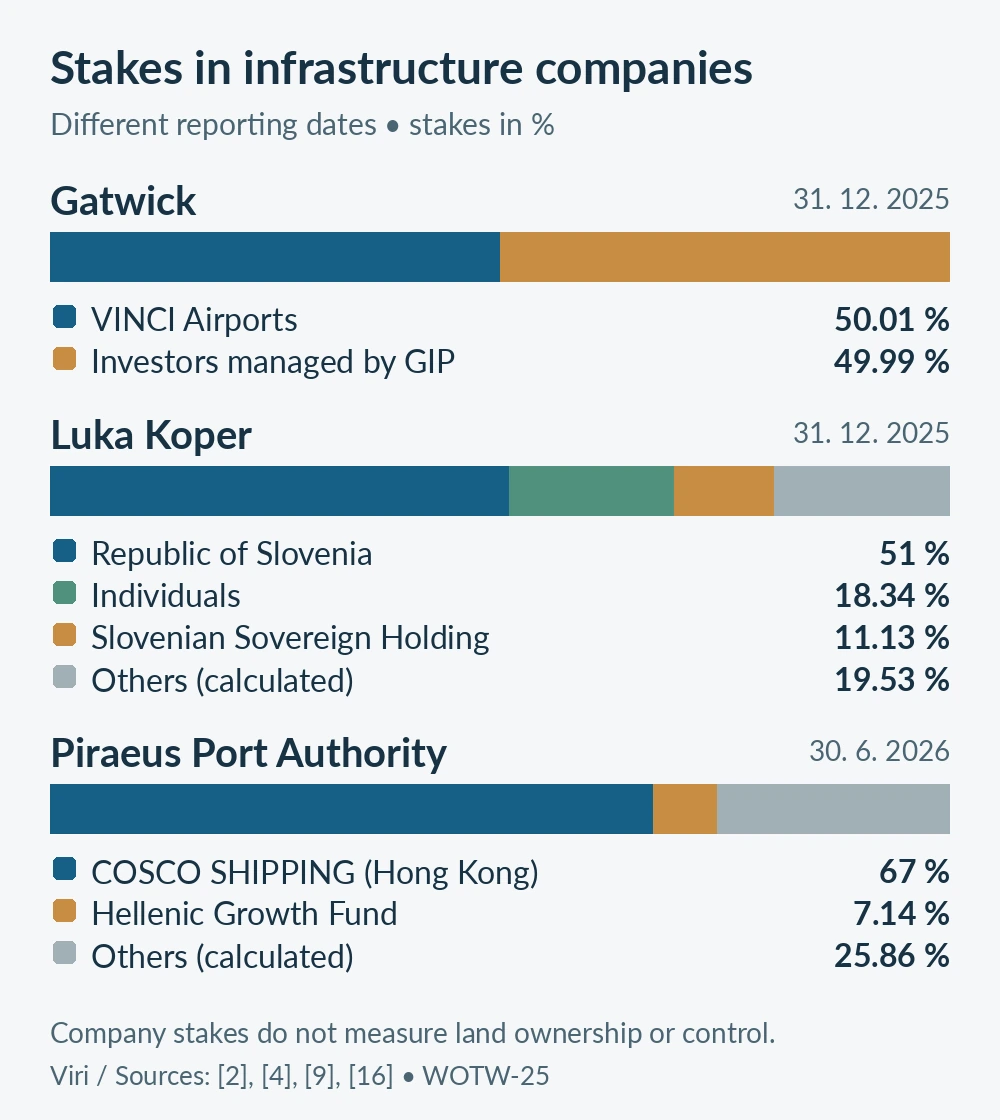
London Gatwick Airport states on its official website that VINCI Airports holds a 50.01 per cent stake, while the remaining 49.99 per cent belongs to a group of investors whose investments are managed by Global Infrastructure Partners (GIP). VINCI has been the majority shareholder since May 2019, while GIP has managed investors’ interests in Gatwick since 2009. The licensed operator is Gatwick Airport Limited. [2][3]

However, the relationship between majority and minority shareholders is not determined by their stakes alone. In its Universal Registration Document for 2025, VINCI confirms a 49.99 per cent non-controlling interest as at 31 December 2025 and explains that VINCI Airports and GIP, acting on behalf of the non-controlling shareholders, have entered into shareholders’ agreements for Gatwick and Edinburgh. Among other things, the agreements govern the composition of boards of directors, the appointment of certain executives and the procedures for approving business plans and annual budgets. [4] The public disclosure does not contain all the contractual provisions, so we cannot derive from it the precise distribution of votes on individual decisions or the extent of any veto rights.
In addition to ownership and contractual arrangements, public regulation also applies. In 2014, the UK Civil Aviation Authority (CAA) granted Gatwick Airport Limited an economic licence under the Civil Aviation Act 2012. The licence sets out the operator’s obligations and may be amended in accordance with prescribed procedures. [5] Shareholders therefore have an economic interest and governance rights, while the regulator has powers that do not arise from share ownership. The precise price constraints currently in force and other specific licence provisions require a separate review.
The case is also important for understanding BlackRock’s role. On 1 October 2024, BlackRock completed its acquisition of GIP and stated at the time that the combined infrastructure platform had approximately US$170 billion in assets under management. [6] The amount refers to assets under management at the closing of the transaction, not to the value of infrastructure directly owned by BlackRock. Nor can we retrospectively attribute GIP’s investment activities in 2009 to BlackRock. The acquisition of the asset manager reveals a link in the decision-making chain, not a transfer of ownership of all its investors’ assets to the buyer.
Luka Koper: the state, shareholders and the concession
In Slovenia, the difference between ownership and management is clearly illustrated by the cargo port of Koper. The government website describes port infrastructure in general as state property managed by the joint-stock company Luka Koper in accordance with regulations. [7] The company conducts business activities, and its shareholders hold equity interests in the company that do not give them a direct co-ownership interest in each port property.

On 8 September 2008, the Republic of Slovenia and Luka Koper signed a concession agreement for a term of 35 years. According to the company’s announcement, the agreement governs the provision of port services, infrastructure development and maintenance, investments, and the rights and obligations of the contracting parties upon termination of the concession. [8] The company’s annual report for 2025 states that the concession fee amounts to 3.5 per cent of operating sales revenue, less revenue from port dues. The annual report describes the fee as payable to the state, which allocates part of the funds to the City Municipality of Koper and the Municipality of Ankaran. [9]
Article 4 of the original 2008 regulation designates the Republic of Slovenia as the body responsible for port management and allows the concession grantor to delegate certain non-administrative tasks to the concessionaire. [10] A further legal detail is important when considering the distribution of the fee. Article 15 of the same regulation stipulates at least 3.5 per cent of a specified revenue base, deals separately with fees for the use of the maritime public domain, and provides for the remainder to be divided between the body responsible for port management and the municipal level in a ratio of 50:50. [10] The 2018 amendment, applicable in this respect from 1 January 2019, sets out the criteria for distributing the municipal share: the area of the land-based part of the port within each municipality (50 per cent), the municipality’s area (25 per cent) and its population (25 per cent). It also provides for the funds to be earmarked for municipal infrastructure and public services. [11] This does not establish the actual annual calculation of the fee or provide a comprehensive review of the agreement currently in force. The concession fee is not the same as a dividend or the total public revenue derived from port activities.
According to the annual report for 2025, on 31 December 2025 the Republic of Slovenia directly owned 51 per cent of the company’s shares, individuals held 18.34 per cent, and Slovenian Sovereign Holding held 11.13 per cent. These are shareholder categories according to the company’s records, not a complete disclosure of all ultimate beneficial owners. [9] The state thus acts in several capacities: as the company’s direct majority shareholder and as the contracting party that granted the concession, in addition to its position in relation to port infrastructure. When assessing a particular decision, it is important to establish which power it derives from and to whom the holder of that power is accountable.
The official description of state ownership of port infrastructure is not, however, a land register inventory of all properties. The original 2008 regulation already envisaged, in connection with the planned construction of the third pier, the possibility of ownership of structures on the basis of a building right (stavbna pravica). [10] This does not establish that the construction was carried out or that such a right currently exists on a particular plot. In the explanatory notes to the final accounts of the 2024 state budget, the Ministry of Infrastructure states that some land within the port area or its planned spatial development area was still owned by other individuals and legal entities, and that land acquisition procedures were under way. [12] This highlights the difference between the institutional description of the port and the ownership status of individual plots. From these sources, we cannot establish the precise current ownership status of all properties or any amendments to the concession agreement.
Piraeus: strategic infrastructure and foreign capital
The Greek port of Piraeus offers a different example. Greece’s public asset management fund, Growth Fund, states that COSCO Shipping (Hong Kong) acquired 51 per cent of the shares in Piraeus Port Authority (PPA) in 2016. The second phase was completed on 6 October 2021 with the transfer of a further 16 per cent of the shares. According to this source, the total purchase price for the 67 per cent stake was EUR 368.5 million. [13] In 2021, PPA also published an official notification of the increase in COSCO’s voting rights from 51 to 67 per cent. [14]

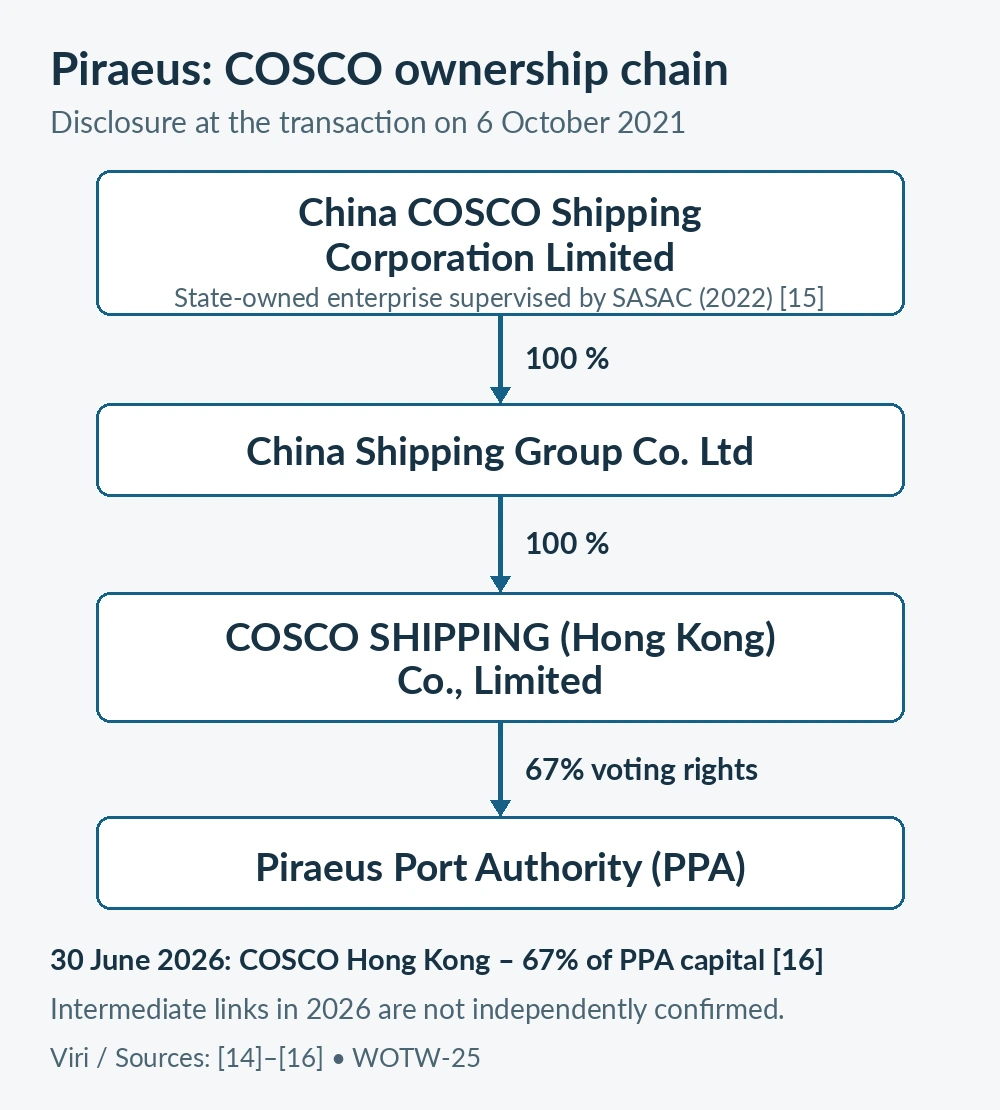
The notification also reveals the ownership chain at the time of the transaction: COSCO SHIPPING (Hong Kong) Co., Limited was wholly owned by China Shipping Group Co. Ltd, which was in turn wholly owned by China COSCO Shipping Corporation Limited. The latter thus indirectly held 67 per cent of the voting rights in PPA. [14] Another company in the group, COSCO SHIPPING International (Singapore), identified the ultimate parent company in its annual report for 2022 as a Chinese state-owned enterprise under the supervision of the state authority SASAC. [15] This is therefore an investment through companies linked to foreign state capital, not a direct transfer of territory to another state. PPA’s interim report for 2026 states that on 30 June 2026 COSCO SHIPPING (Hong Kong) still held 67 per cent of the share capital, while Hellenic Growth Fund held 7.14 per cent. [16] This snapshot does not establish that every intermediate company in the ownership chain remained unchanged.
What was actually acquired? The sale concerned shares in a company entitled to use and commercially exploit certain port assets. PPA’s annual report for 2021 describes the original concession, concluded on 13 February 2002 for forty years, and its ten-year extension in 2008. It also describes a subsequent amendment to the agreement associated with privatisation in 2016. [17] Growth Fund states that the right of use and development lasts until 2052 and specifies, for the amended 2016 agreement, a variable annual fee of 3.5 per cent of consolidated revenue, with a minimum annual fee of EUR 3.5 million. [13] PPA’s 2021 notification confirms that a further amendment to the concession agreement was ratified before the second phase of the sale (Law 4838/2021). [14] The date of the original agreement in the fund’s online summary is inconsistent with the annual report, so we rely on PPA’s report for the historical account without claiming to have examined the entire original agreement and all its amendments.
A majority stake in the operator of an important port allows the shareholder to influence its business direction, but it does not mean acquiring 67 per cent of Greek port territory or state sovereignty. In such a transaction, it is also important to establish which investments the operator must undertake, what services it must provide and which rights the state has reserved for itself. Without examining the specific contractual provisions and the results of implementing the concession, we cannot reliably assess all the consequences of the acquisition for the Greek economy and the public interest.
Energy: grid ownership and system operation
In the electricity sector, economic power may also arise from coordinating the system without the operator owning all the physical infrastructure. The UK’s Department for Energy Security and Net Zero (DESNZ) states in its annual report for 2025–2026 that it acquired the National Energy System Operator (NESO) from National Grid on 1 October 2024. [18] The system operator thereby passed into state ownership, which is not the same as nationalising all electricity networks.
In its description of its activities, NESO explains that its national control centre coordinates electricity generation and consumption in Great Britain in real time and works with network operators. The physical transmission infrastructure is owned and maintained by transmission owners (Transmission Owners), while separate organisations operate distribution networks. NESO performs its duties under a licence issued by the regulator Ofgem. [19] This division shows that a system operator may play a key role in ensuring electricity supply even though it does not own the power lines and other transmission assets.
When assessing the public interest in the energy sector, we must therefore distinguish between decisions about system operation, ownership of generation and transmission facilities, investment financing and regulation. A public system operator is likewise subject to constraints: it must operate within defined rules and cooperate with other participants. We cannot infer from the change in NESO’s ownership alone that the reform reduced electricity prices or improved security of supply; such an assessment would require evidence of outcomes.
Norway: who owns a natural resource and who may exploit it?
The Norwegian petroleum system further illustrates the distinction between ownership of a natural resource and the right to exploit it commercially. The official Norwegian Petroleum website explains that subsea oil and gas deposits on the Norwegian continental shelf belong to the state. A production licence grants its holders exclusive rights to exploration, exploration drilling and production of oil and gas in the licensed area, subject to prescribed conditions. A licensee becomes the owner of the oil and gas produced in proportion to its share in the licence. [20] The right to extract resources and ownership of the resources already extracted are therefore not the same as ownership of the subsea deposit.
Norway also participates directly in the petroleum industry. The state-owned company Petoro manages the State’s Direct Financial Interest (SDFI), while Gassco, also a state-owned company, operates the gas transport system on behalf of its owners. [21] These institutions have different functions and must not be equated with the sovereign wealth fund GPFG, which we examined in an earlier part of the series. The legal framework through which the state derives revenue from natural resources is distinct from the subsequent management of financial assets accumulated in part from that revenue.
Who sets the conditions and who is accountable?
The cases of Gatwick, Koper, Piraeus, the British electricity system and Norway’s natural resources show that economic power may rest on different rights. An investor may influence a company’s strategic decisions, a concessionaire the conduct of an activity, a system operator the coordination of a network, and the state the legal framework within which these rights exist. There is no single form of control or universal ownership chain.
Private financing can enable the development of infrastructure requiring substantial long-term investment, but it can also create tension between the pursuit of profitability and public needs. Public ownership can allow for different development priorities, but it does not in itself guarantee efficient management or responsible conduct. In both models, it is therefore necessary to investigate conditions of access, tariffs, the allocation of risks, maintenance obligations, oversight of contractual compliance and actual outcomes. We must not infer misconduct or the quality of services solely from the nationality or legal form of the owner.
The question of who controls infrastructure thus leads to a more precise one: who can make a particular decision, on what legal or contractual basis, and with what accountability to users and the public? Only when we understand these relationships can we understand the economic power that arises from managing the assets on which everyday life depends.
In the next part, we will examine stock market indices and their role in directing passive capital.
Sources and further reading
- World Bank, PPP Resource Center. Public Private Partnerships in Ports, model of port infrastructure and operators. Source
- London Gatwick Airport. About Us, Management section. Source
- London Gatwick Airport. Our Owners and Management, Our management section. Source
- VINCI (2026). 2025 Universal Registration Document, p. 381, note 23.5, London Gatwick and Edinburgh airports. Source
- Civil Aviation Authority. Gatwick licence and monitoring, introduction and licence amendments. Source
- BlackRock (1 October 2024). BlackRock Completes Acquisition of Global Infrastructure Partners. Source
- Republic of Slovenia, GOV.SI. Koprsko tovorno pristanišče, section Vloga pristanišča (role of the port). Source
- Luka Koper, d. d. (2008). Luka Koper Gets The Concession, announcement of the signing on 8 September. Source
- Luka Koper, d. d. (2026). Letno poročilo 2025 Skupina Luka Koper in družba Luka Koper, d. d., pp. 40 and 59, sections 7.4.1 and 14 (ownership structure). ; English edition of the same publication: Source 1 Source 2
- Government of the Republic of Slovenia (2008). Uredba o upravljanju koprskega tovornega pristanišča, opravljanju pristaniške dejavnosti, podelitvi koncesije za upravljanje, vodenje, razvoj in redno vzdrževanje pristaniške infrastrukture v tem pristanišču, Official Gazette of the Republic of Slovenia, No. 71/08, Articles 4, 15 and 44, original text. Source
- Government of the Republic of Slovenia (2018). Uredba o spremembah in dopolnitvah Uredbe o upravljanju koprskega tovornega pristanišča, opravljanju pristaniške dejavnosti, podelitvi koncesije za upravljanje, vodenje, razvoj in redno vzdrževanje pristaniške infrastrukture v tem pristanišču, Official Gazette of the Republic of Slovenia, No. 41/18, Articles 4 and 7. Source
- Republic of Slovenia, Ministry of Infrastructure. Obrazložitve zaključnega računa proračuna RS za leto 2024, p. 39, C0567. Source
- Growth Fund. Piraeus Port Authority S.A. (PPA), summary of the share sale and concession arrangements. Source
- Piraeus Port Authority S.A. (2021). Notification of significant change of voting rights pursuant to Law 3556/2007, transaction of 6 October 2021. Source
- COSCO SHIPPING International (Singapore) Co., Ltd. (2023). Annual Report 2022, pp. 56–57, Corporate Governance, Interested Person Transactions. Source
- Piraeus Port Authority S.A. (2026). Six-month Financial Report for the period ended June 30, 2026, pp. 24–25, Shareholder Structure. Source
- Piraeus Port Authority S.A. (2022). Annual Financial Report for the year ended December 31, 2021, p. 34, A1, Evolution of Piraeus Port Authority S.A. ; alternative official link to the same publication: Source 1 Source 2
- Department for Energy Security and Net Zero (2026). DESNZ annual report 2025 to 2026: Financial statements, section on the department's capital investments. Source
- National Energy System Operator. What does the Electricity National Control Centre do?, description of activities and the distinction between network roles. Source
- Norwegian Ministry of Energy / Norwegian Offshore Directorate. The Petroleum Act and the licensing system, resource ownership and licences. Source
- Norwegian Ministry of Energy / Norwegian Offshore Directorate (2025). State organisation of petroleum activites, state participation, Petoro and Gassco. Source