Chevron–Hess: Who Had Potentially Decisive Voting Power in the Acquisition?
Analyzes potential voting influence in the Chevron–Hess acquisition using shareholder filings.

Artistic allegory of a corporate acquisition and narrow approval threshold; not a documentary depiction of Chevron or Hess.
When Chevron announced its acquisition of rival energy company Hess in October 2023, it raised the question of who can actually decide whether such a large company passes into new corporate ownership. At the special meeting in May 2024, the transaction was approved by just over half of all shares entitled to vote. The case is particularly interesting because major institutional investors held investments in both companies. How much influence did they have, and what can we really establish from publicly available documents?
An acquisition paid for in shares
On October 23, 2023, Chevron announced that it would acquire all outstanding shares of Hess. At the time of the announcement, the value of the stock consideration was approximately $53 billion, while the total enterprise value of the transaction was approximately $60 billion, including net debt and the book value of noncontrolling interest. Each Hess share was to be exchanged for 1.025 Chevron shares. Because the transaction involved a share exchange ratio rather than a fixed cash purchase price, the economic value of the consideration also depended on share prices. [1]
Chevron justified the acquisition by pointing to access to promising oil reserves, particularly Hess's position in the Stabroek project off the coast of Guyana, as well as the potential to increase cash flows and reduce costs. These were the company's arguments for the transaction, not results that had already been achieved. The boards of directors of both companies unanimously supported the agreement, but completion required, among other things, approval by Hess shareholders. [1] [2]
A majority of all shares, not just those represented at the meeting
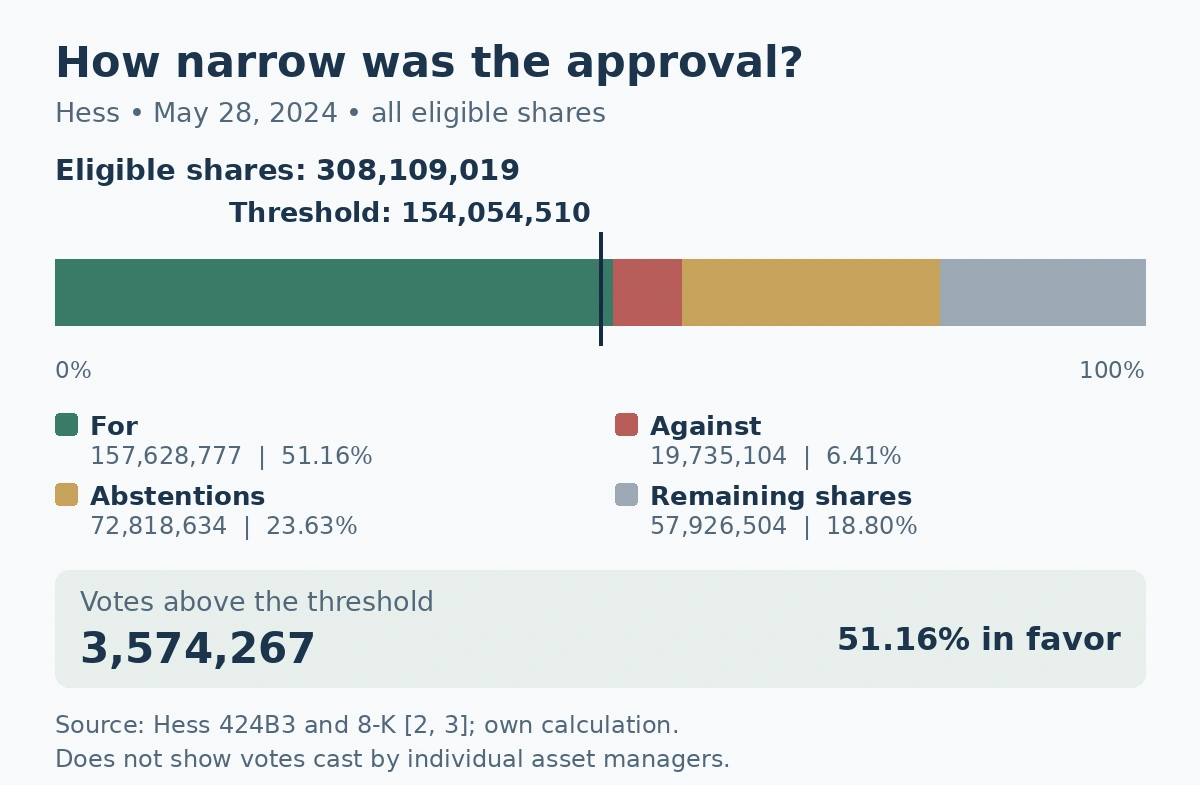
On the record date of April 12, 2024, 308,109,019 Hess common shares were entitled to vote. Each carried one vote. Adoption of the agreement required a majority of all eligible shares, not merely a majority of those voting for or against at the meeting. Absence and abstention therefore had the same effect as a vote against when it came to reaching that threshold, even though they did not necessarily express the same position. [2]
Definitive proxy statement/prospectus (April 26, 2024)
The special meeting took place on May 28, 2024. Three days later, Hess published the official results in a Form 8-K filing. [3]
| Voting outcome | Number of shares | Share of all eligible shares |
|---|---|---|
| For | 157,628,777 | 51.16% |
| Against | 19,735,104 | 6.41% |
| Abstentions | 72,818,634 | 23.63% |
| Remaining shares not accounted for in the results | 57,926,504 | 18.80% |
Sources: [2] [3]. The last row and percentages are our own calculations. Across all three reported voting categories, support was 63.01%; among votes for and against, excluding abstentions, it was 88.87%. Neither of these alternative denominators determined whether the acquisition was approved.
Official special meeting results (May 31, 2024)
The minimum number of votes required for approval was 154,054,510. The actual number of affirmative votes exceeded that threshold by 3,574,267. If 3,574,268 affirmative votes had been removed, with the number of eligible shares and all other votes unchanged, the proposal would not have reached the required threshold at that meeting. This is our own conditional calculation, not a reconstruction of the historical vote.
Who held the shares and who had voting power?
The definitive prospectus and proxy materials issued in April 2024 include a list of major beneficial owners as defined under US reporting rules. The table refers to holdings as of March 27, 2024, and to earlier filings by individual investors; it is not a register of shares on the meeting date. Major asset managers included Vanguard, BlackRock, and State Street. [2]
| Asset manager | Reported shares | Published ownership percentage | Reported voting power |
|---|---|---|---|
| Vanguard | 31,832,380 | 10.36% | 350,049 (shared) |
| BlackRock | 21,615,092 | 7.00% | 19,801,029 (sole) |
| State Street | 17,003,073 | 5.54% | 12,580,779 (shared) |
Sources: [2] [4] [5]. The figures for Vanguard and State Street are also supported by their original Schedule 13G/A filings (for the former, through an accessible text extract). Reported beneficial ownership may arise from voting rights or the power to dispose of shares, so it is not the same as an asset manager's own wealth or the number of votes it cast. The distinction is especially apparent in Vanguard's case: its reported shares substantially exceeded the voting power disclosed in that filing. This does not mean that funds under its management had no voting rights of their own.
The influence of Hess management and affiliated holders was also significant. On the record date, directors, executive officers, and their affiliates collectively held 30,166,193 shares entitled to vote, approximately 9.8% of the total. Under a separate, publicly disclosed agreement, John B. Hess committed to voting in favor of the acquisition with the shares covered by that agreement. This establishes a contractual commitment, not a separate record of the votes he actually cast. Some reported holdings of executives overlap and therefore cannot simply be added together. [2]
How did the major asset managers decide?
In its voting report for 2023–2024, BlackRock describes discussions with the management of both companies and confirms that it voted in support of the acquisition. It explains the decision in terms of its assessment of long-term financial benefits for its clients. Vanguard's 2024 investment stewardship review likewise confirms support from the funds covered by its program. Among the reasons it cites are the scale of the combined business, expected shareholder benefits, and its assessment of the exchange terms. Neither of the reports reviewed specifies the total number of affirmative votes cast at this meeting. [6] [7]
Legal scholars Marcel Kahan and Edward B. Rock published additional data in a study on common ownership. Using Proxy Analytics data, they included estimated voting power and the voting direction of selected institutions in their table for Chevron and Hess. [8]
| Institution | Estimated voting power at Hess | Vote according to the study |
|---|---|---|
| Vanguard | 32,126,526 | For |
| BlackRock | 21,106,032 | For |
| State Street Global Advisors | 12,494,474 | For |
Source: [8], Table 6. These are secondary estimates, not official individual records of votes cast. The figures are not directly comparable with the preceding table: they are based on a different data source and on estimated voting power; we have not established equivalence in timing or methodology. Particularly in Vanguard's case, the estimated voting power must not be equated with the parent company's filing or taken to mean that it cast exactly that many votes.
Common ownership study, Table 6 (2025)
The estimated voting power of each of the three institutions in the study exceeds the 3,574,268 votes that, all else being equal, would have been sufficient to cause the proposal to fall short of the required majority. The historical disclosures for BlackRock and State Street also indicate that potential, whereas Vanguard's parent-company filing alone does not. Establishing that any one institution was individually decisive in arithmetic terms would require reliably confirmed numbers of affirmative votes cast by each asset manager or by appropriately delineated funds. We do not have those figures in this review. Nor can we infer an agreement between the asset managers simply because they voted in the same direction.
Common ownership and differing economic interests
A shareholder invested only in Hess may assess the acquisition differently from an investor who also owns Chevron shares. The former has a direct interest in the consideration received for its holding in the target company; the latter may evaluate the transaction's effect on both investments. These interests may coincide, but they are not necessarily always the same. This is one of the central questions in Kahan and Rock's study. Their analysis also includes investors who voted against the acquisition, such as Fidelity and TIAA-CREF. The sample covers selected institutions invested in both companies and is not an exhaustive list of shareholders. [8]
There was therefore no consensus even among the major institutions. Reuters reported that the proxy advisory firm ISS recommended abstaining because of uncertainty before the transaction closed and concerns about benefits Hess shareholders would forgo while waiting. [9] This is a recommendation reported by a secondary source, not a record of its clients' votes. In addition, a separate, nonbinding vote on executive compensation related to the acquisition failed: 112,970,138 votes for, 109,888,516 against, and 27,323,861 abstentions. Approval of the compensation was not a condition of the acquisition. [3]
Common ownership therefore provides good reason to ask whose economic interests a particular voting decision represents. The academic debate over whether only the votes of economically disinterested investors should count in certain legal circumstances is not a judicial finding that the Hess vote was invalid. Likewise, the economic reasons publicly stated by asset managers are not independent evidence that the outcome was optimal for every individual investor.
From approval to the actual transfer of ownership
The vote itself did not complete the acquisition. Important outstanding conditions included regulatory proceedings and arbitration relating to the contractual rights of partners in the Guyana oil project. In January 2025, the US Federal Trade Commission (FTC) finalized a restriction that, among other things, prevented John B. Hess from being appointed to Chevron's board of directors. On July 17, 2025, the commission set aside that order. The following day, after a favorable arbitration outcome, Chevron announced that the acquisition had been completed. Its Form 8-K confirms that Hess became a direct, wholly owned subsidiary of Chevron. [10] [11] [12]
Official filing confirming completion (July 18, 2025)
The ownership structure did not remain unchanged thereafter. On October 6, 2026, Chevron announced agreements to divest its interests and general partner position in Hess Midstream, along with certain infrastructure assets, in exchange for revised long-term commercial terms and $200 million. In its report dated November 5, 2026, it still expected the transaction to close by year-end. As of our research cutoff of November 16, 2026, we had found no confirmation of completion. This is a separate, subsequent transaction, not a reversal of the Hess Corporation acquisition. [13] [14]
What does this case reveal about economic power?
The Chevron–Hess case shows how a narrow margin above the legally required majority can give significant weight to individual blocks of institutional shareholders' votes. Their ability to participate in corporate decision-making depends not only on the size of reported holdings but also on the allocation of voting power, actual participation, voting rules, and other holders of capital. In this case, we have documented support from BlackRock and Vanguard's funds, secondary evidence of State Street's support, and estimates suggesting that each could have had enough votes to be decisive in arithmetic terms. We do not, however, have a complete and verified tally of their individual affirmative votes.
This is not evidence that the three asset managers own all the assets in their portfolios or that they alone control the outcome of every acquisition. It is a concrete example of how concentrated investments and voting rights can influence decisions about the transfer of major economic assets. In the next article, we will turn to another side of such transactions: who makes them financially possible, who advises on their execution, and who earns fees from them.
Sources and further reading
- Chevron Corporation. Chevron Announces Agreement to Acquire Hess, October 23, 2023, Transaction Details; official text extract, direct access unsuccessful. Source
- Chevron Corporation and Hess Corporation. Definitive proxy statement/prospectus, Form 424B3, April 26, 2024, pp. 3–4, 26–27, 76–78, 124, 128 and Annex B. Source
- Hess Corporation. Form 8-K, May 31, 2024, Item 5.07, Proposal 1–2. Source
- The Vanguard Group. Schedule 13G amendment no. 10, Hess Corp, 2024-02-13, rows 5–11, as of December 29, 2023. Source
- State Street Corporation. Schedule 13G amended filing, Hess Corp, 2024-01-25, p. 2, rows 5–11; as of December 31, 2023. Source
- BlackRock Investment Stewardship. 2024 Global Voting Spotlight, 2024, p. 39, Consolidation in the U.S. energy sector. Source
- Vanguard. Investment Stewardship 2024 Annual Report, 2024 (reporting period), pp. 3, 39, Merger transaction at Hess Corporation. Source
- Marcel Kahan; Edward B. Rock. The Cleansing Effect of Shareholder Approval in a World of Common Ownership, 2025, The Business Lawyer, III.D, Table 6, IV; Proxy Analytics. Source
- Reuters. Hess shareholder vote on Chevron deal easily met majority required -filing, 2024-05-31, report on ISS and investor reservations. Source
- Federal Trade Commission. Order Granting Petition to Reopen and Set Aside, Docket C-4814, July 17, 2025; text of the introduction and conclusion. Source
- Chevron Corporation. Chevron Completes Acquisition of Hess Corporation, July 18, 2025. Source
- Chevron Corporation. Form 8-K, July 18, 2025, Item 8.01. Source
- Chevron Corporation. Chevron to Divest its Ownership Interests in Hess Midstream and DJ Basin Crude Midstream Assets, October 6, 2026, Approvals and Timing. Source
- Chevron Corporation. Form 10-Q, quarter ended September 30, 2026, November 5, 2026, Note 19; accessible text extract. Source