Who Finances Major Acquisitions and Who Profits from Them?
Who finances and advises major acquisitions, and how fees, authority and risk are allocated.

Artistic allegory of corporate acquisition financing; not a documentary depiction of a specific transaction.
When a large corporation acquires another company, headlines usually focus on billions of dollars and the new owner. Behind those figures, however, lies a less visible financial infrastructure: advisors who value companies, banks that arrange financing, and investors who assume part of the debt risk. A comparison of the Chevron–Hess and Broadcom–VMware acquisitions shows that the transfer of ownership is not simply a question of equity stakes. It is also a question of who can make the transaction possible, on what terms, and for what compensation.
Who is involved in an acquisition?
An acquirer can pay the target company's shareholders in cash, issue its own shares to them, or use a combination of the two. It can obtain cash from its own resources, by borrowing from banks, or by issuing debt securities. Financial advisors do not necessarily act as lenders as well. Their role may include assisting with negotiations, valuation, transaction structuring, and raising capital. Lenders, by contrast, provide funds under contractual terms and expect repayment of principal and interest.
In larger transactions, these roles may overlap. A bank that helps structure an acquisition may also participate in arranging loans or issuing bonds. This position gives it an important role in the transfer of economic assets, but does not confer ownership of the acquired company. A creditor has a financial claim, a shareholder holds an equity stake, and an advisor has a contractual mandate. All three forms of influence matter, but they are not equivalent.
Chevron–Hess: an acquisition paid for in shares
On October 23, 2023, Chevron announced an agreement to acquire Hess. Under the proposed terms, Chevron would issue 1.025 of its own shares for each Hess share. At the time of the announcement, the stock consideration was valued at approximately USD 53 billion, while the estimated enterprise value of the transaction was approximately USD 60 billion, including net debt and the book value of the noncontrolling interest. [1] [2]
Unlike in a cash acquisition, Chevron therefore did not need a bank loan equal to the entire stock consideration. Through the exchange of shares, former Hess shareholders became Chevron shareholders. The value of the consideration could fluctuate with Chevron's share price. When the acquisition closed on July 18, 2025, Chevron issued 301.25 million shares for the acquisition. Its 2025 report states a total purchase price of approximately USD 48 billion, which also includes 15.38 million Hess shares previously purchased on the open market during the first quarter of 2025. As part of the transaction, Chevron also assumed existing debt with a principal amount of USD 8.8 billion. [3]
These are different categories. The purchase price at closing is not the same as the enterprise value at announcement, and the existing debt assumed is not a new bank loan taken out to pay the purchase price. These figures therefore do not automatically tell us how much new debt Chevron incurred specifically for its earlier share purchases or other acquisition expenses.
Chevron's lead financial advisor was Morgan Stanley, with Evercore also providing advice. On the Hess side, Goldman Sachs took the leading advisory role, with J.P. Morgan also involved. Financial advisors thus played a role even in a transaction where most of the consideration was not paid in cash. [1]
How much is advisory work worth in a multibillion-dollar transaction?
The Hess acquisition prospectus discloses a contractual fee of USD 80 million for Goldman Sachs. Four million became payable upon announcement, while the remaining 76 million was contingent on completion of the acquisition. This means that 95% of the contractual fee depended on successful closing. The agreement also provided for reimbursement of certain expenses. [2]
Chevron–Hess definitive prospectus (April 26, 2024)
The VMware acquisition prospectus discloses similar contractual incentives. Goldman Sachs's estimated fee was approximately USD 45 million, entirely contingent on completion of the transaction. J.P. Morgan was also expected to receive an estimated USD 45 million; five million of that amount was earned upon delivery of its financial opinion, while the full fee, according to the prospectus, was payable at closing. [4]
Broadcom–VMware definitive prospectus (2022)
| Transaction and advisor | Disclosed fee (USD million) | Contractual condition |
|---|---|---|
| Chevron–Hess: Goldman Sachs | 80 | 4 at announcement; 76 at closing |
| Broadcom–VMware: Goldman Sachs | Approximately 45 | Entirely contingent on closing |
| Broadcom–VMware: J.P. Morgan | Approximately 45 | Payable at closing; 5 earned upon delivery of the opinion |
Source: [2] [4]. The three contractual or estimated fees total approximately USD 170 million; this is neither a complete list of costs for the two transactions nor an audited confirmation of payment.
Such arrangements raise a question about conflicts of interest: how independently can an advisor assess a transaction if a substantial portion of its compensation depends on completion? A fairness opinion is a limited professional assessment based on specified assumptions, data, and valuation methods. It is neither a guarantee that the best possible deal was negotiated nor a recommendation to shareholders on how to vote. The Hess prospectus also discloses Goldman Sachs's previous business relationships with both parties: during the two years through October 22, 2023, the bank recognized approximately USD 3.35 million from relevant advisory and other investment banking services for Hess or its affiliates, and approximately USD 13.2 million for Chevron or its affiliates. [2]
Such disclosures allow for a critical assessment of incentives and relationships. At the same time, advisors undertake complex analyses and bear the costs and risks associated with transactions that may fail. Contingent compensation alone does not establish that an opinion was biased, that fraud occurred, or that anyone acted unlawfully. Disclosure, however, is not a reason to overlook a potential conflict of interest.
Broadcom–VMware: when a loan syndicate is needed
On May 26, 2022, Broadcom announced the acquisition of VMware using a combination of cash and stock. Its estimated value at the time was USD 61 billion, and Broadcom also expected to assume approximately eight billion USD in net debt. The proposed consideration for each VMware share was USD 142.50 or 0.2520 Broadcom shares, subject to a proration mechanism. [5] [6]
To secure financing, Broadcom obtained a conditional USD 32 billion bridge loan commitment from financial institutions at the time of the announcement. This did not mean that the money had already been borrowed. In August 2023, the original commitment was replaced by a credit agreement making USD 28.390625 billion in longer-term loans available for borrowing, divided into three tranches. The agreement permitted an increase in the aggregate amount of up to two billion USD within a specified period extending to fifteen business days after the initial borrowing. [7] [8]
Bank of America was the administrative agent, while Barclays Bank and Citibank were co-syndication agents. The lead arrangers and bookrunners included BofA Securities, Barclays Bank, BNP Paribas Securities, Citibank, HSBC Securities (USA), TD Securities (USA), and Wells Fargo Securities. [9]
Broadcom credit agreement (August 15, 2023)
In a loan syndicate, several financial institutions participate in providing loans, allowing the risk and the amount of capital required to be distributed among them. The agent handles contractual administration, while the arrangers help assemble and allocate the financing. Their appearance on the cover of the agreement does not mean that each provided an equal amount or that the agent was the sole lender. The agreement refers to a separate administrative fee arrangement, but I could not verify its fee schedule or the complete allocation of loans among lenders in the public documents reviewed. [9]
From financing commitments to actual borrowing
The acquisition closed on November 22, 2023. In its official Form 8-K for that date, Broadcom reported an initial borrowing of the entire available amount of USD 28,390,625,000. The credit served several purposes, not just payments to shareholders: it also covered refinancing VMware's debt, providing working capital, and transaction expenses. [10]
The annual reports for fiscal years 2023 and 2024 disclose a larger aggregate amount of acquisition loans, USD 30.390 billion, consistent with an increase within the permitted contractual framework. The following table uses millions of dollars; the initial tranche amounts are expressed more precisely than the figures in the annual report. [8] [11] [12]
| Tranche | Initial agreement (USD million) | Amount reported later (USD million) |
|---|---|---|
| A-2 | 10,695.3125 | 11,195 |
| A-3 | 10,695.3125 | 11,195 |
| A-5 | 7,000 | 8,000 |
| Total | 28,390.625 | 30,390 |
Source: [8] [11] [12]. These are not separate loans that can be added together to produce a larger purchase price. The data reviewed do not disclose the exact date of the additional borrowing or the identities of the individual additional lenders with sufficient certainty.
The structure of the purchase itself also differs from the initial estimate. Approximately half of VMware's shares were exchanged for cash, and the other half for Broadcom shares. Because the market value of the shares changed, this did not mean that the two categories were equal in dollar terms. The accounting purchase consideration reported in Broadcom's 2024 annual report is shown in the following table. [6] [12]
| Component | USD million |
|---|---|
| Fair value of shares issued in exchange for VMware shares | 53,398 |
| Cash paid in exchange for VMware shares | 30,788 |
| Repayment of VMware's loan | 1,257 |
| Other components of purchase consideration | 847 |
| Total purchase consideration | 86,290 |
| Cash acquired (deduction) | −6,642 |
| Purchase consideration net of cash acquired | 79,648 |
Source: [12], Note 4. Other components include equity awards and the settlement of preexisting relationships. This is an accounting measurement, not a cash payment of USD 86.290 billion. Broadcom also assumed USD 8.250 billion in existing VMware unsecured notes. [11] [12]
Who earns financial revenue, and what happens to the debt?
In a 2025 disclosure of pro forma financial information, Broadcom stated that approximately USD 398 million in discounts and financing costs had been incurred in connection with the acquisition financing. This amount belongs to a different category from the advisory fees described above. Nor is it disclosed as the net profit of individual banks or as a list of recipients. [13]
Broadcom pro forma financial information (2025)
The loans carried variable interest rates tied to the SOFR benchmark rate, plus a contractual spread. In fiscal 2024, Broadcom repaid USD 11.195 billion of the A-2 tranche and USD 5.600 billion of the A-3 tranche. It identified proceeds from new bond issuances, the sale of the EUC business unit, and cash on hand as sources of repayment. Broadcom repaid the remaining obligations under these acquisition loans on July 11, 2025, when it also terminated the credit agreement. [12] [13]
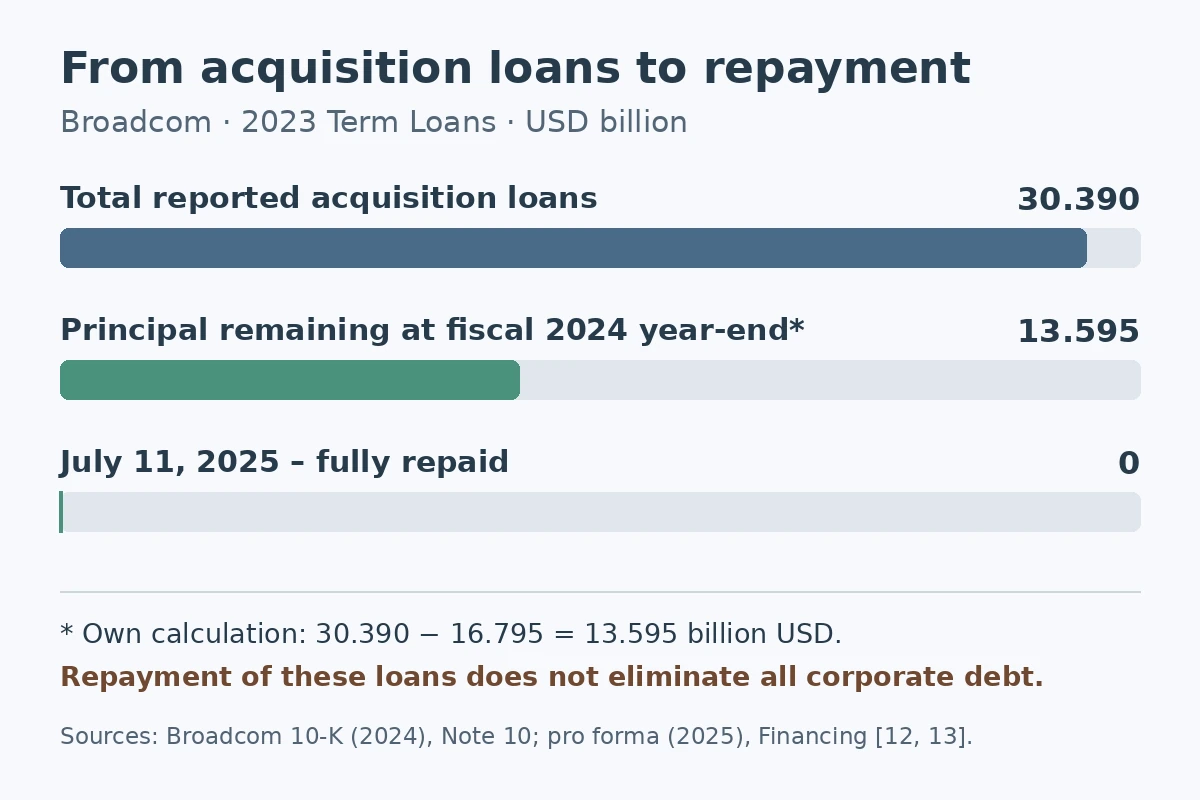
Repaying a bank loan does not necessarily mean that the debt has disappeared. If a company issues bonds and uses the proceeds to repay banks, the form of financing changes, and the group of creditors may change as well. Interest income then accrues to the holders of the relevant debt claims or securities. Arrangers can earn revenue through fees and distribution; lenders can earn interest and other contractual compensation, but also bear funding, capital, and risk costs. The amounts disclosed by the acquirer are therefore not the same as the net profit of an individual financial institution. Without reliable information about actual payments, the allocation of claims, and the costs incurred by each bank, its profit cannot be calculated.
The power of those who make the transfer of ownership possible
A comparison of the two acquisitions reveals different mechanisms of economic concentration. Chevron provided most of the consideration in its own shares; Broadcom combined stock and cash consideration with a large loan syndicate. In both cases, financial advisors helped structure the transaction and had contractually defined economic interests. Their role is documented, but their individual net financial gains and actual influence over each decision are not fully ascertainable from public documents.
Throughout this section of the series, we have seen that economic power is not a single mechanism. In the Federal Reserve's crisis purchases, contractual infrastructure mattered; in the coal industry, the question was the potential influence of common investors; at ExxonMobil, influence was exercised in board elections; and in Chevron–Hess, the narrow margin by which shareholders approved the acquisition was central. The financing of acquisitions adds lending and advisory services to this picture. Ownership, voting, access to capital, and money management can operate together, but their overlap does not establish that all participants act under unified direction. This is a distinction the investigation must preserve even when it uncovers very large financial interests.
Once we understand who makes transfers of ownership possible and who earns revenue from them, another question arises: who influences the rules under which these transactions take place in the first place? The next section, on financial power and political influence, addresses that question.
Sources and further reading
- Chevron Corporation / Hess Corporation. Chevron Announces Agreement to Acquire Hess, October 23, 2023, Transaction Details; Advisors. Source
- Chevron Corporation / Hess Corporation. Definitive Proxy Statement/Prospectus, Form 424B3, April 26, 2024, The Merger—Opinion of Hess’ Financial Advisor; Annex C. Source
- Chevron Corporation. Form 10-K for the Year Ended December 31, 2025, February 24, 2026, Note 29, Acquisition of Hess Corporation. Source
- VMware, Inc. / Broadcom Inc. Definitive Proxy Statement/Prospectus (DEFM14A), 2022, Opinion of Goldman Sachs; Opinion of J.P. Morgan. Source
- Broadcom Inc. / VMware, Inc. Broadcom to Acquire VMware for Approximately $61 Billion in Cash and Stock, May 26, 2022. Source
- VMware, LLC. Form 8-K, November 22, 2023, Item 2.01. Source
- Broadcom Inc. Form 10-Q, Quarter Ended July 30, 2023, Pending Acquisition of VMware; 2023 Term Loans. Source
- Broadcom Inc. Form 8-K, August 16, 2023, Item 1.01. Source
- Broadcom Inc. / Bank of America, N.A. / participating lenders. Credit Agreement, August 15, 2023, Exhibit 10.1, cover page, tranche definitions, § 2.09 and § 2.17. Source
- Broadcom Inc. Form 8-K, November 22, 2023, Item 2.03. Source
- Broadcom Inc. Form 10-K, Fiscal Year Ended October 29, 2023, Note 15, Subsequent Events. Source
- Broadcom Inc. Form 10-K, Fiscal Year Ended November 3, 2024, Note 4, Business Combinations; Note 10, Borrowings. Source
- Broadcom Inc. Unaudited Pro Forma Condensed Combined Financial Information, Exhibit 99.1, 2025, Financing. Source