ExxonMobil: How Can Institutional Shareholders Change the Composition of a Board of Directors?
Examines institutional voting and board changes in the ExxonMobil proxy contest.

Artistic illustration of shareholder voting power; it does not depict the actual virtual annual meeting in 2021.
In the spring of 2021, one of the world's largest oil companies faced an unusual challenge. A small investment manager, Engine No. 1, launched a shareholder campaign that resulted in the election of three of its nominees to ExxonMobil's twelve-member board of directors. How could an investor with such a tiny stake bring about a change of this magnitude? The answer lies not only in share ownership but also in the ability to secure the support of other shareholders and in how voting power is exercised in large publicly traded corporations.
A small investor and a large corporation
As of March 12, 2021, Engine No. 1 LLC reported holdings of 917,400 ExxonMobil shares, representing approximately 0.02 percent of the company. All participants in its campaign collectively reported 944,044 shares. The latter figure also includes the holdings of two nominees; it does not mean that the same shares attributed to multiple related entities or individuals should be counted again. [1]
Engine No. 1: definitive proxy statement (March 15, 2021)
With such a small stake, the activist investor did not have enough votes of its own to elect even one director in this contested election. It could, however, nominate candidates and persuade other shareholders to support them. This is the crucial distinction between ownership and influence: the former determines the extent of one's own economic interest and rights, while the latter may also depend on the ability to build sufficiently broad support for a particular decision.
A dispute over the future of the oil company
In a letter dated December 7, 2020, Engine No. 1 called for a revitalized board, stricter criteria for capital investment, exploration of new business opportunities in energy, and closer alignment of executive compensation with the company's long-term value. Investment in cleaner energy sources was also among its priorities. In January 2021, it formally announced the nomination of four candidates. [1]
ExxonMobil defended its business strategy. In its shareholder materials, it emphasized cost adjustments during the pandemic, the preservation of its dividend, and the experience of its existing board. It also highlighted the appointment of three new independent directors in early 2021. [2] In its May response, Engine No. 1 rejected the suggestion that its strategy would require abandoning the core business or jeopardize dividend payments. [3] Both sides presented their programs as the better path to long-term shareholder value; their campaign materials are not neutral evidence of which strategy would have been more successful.
The dispute therefore involved financial and strategic questions as well as the energy transition. Supporting a candidate who advocates a different approach to long-term risks is not the same as demanding the immediate closure of oil facilities. Similarly, management's claim that its strategy protects shareholders does not in itself establish that the strategy is optimal. Deciding on the board's composition was one way for shareholders to influence this debate.
Concentration of shareholdings and voting power
ExxonMobil's materials for its 2021 annual meeting identify three institutional managers with reported stakes exceeding five percent as of December 31, 2020. The data from their SEC filings also reveal the distinction between shares attributable to them for beneficial ownership reporting purposes and their reported voting power. [4]
| Manager | Reported shares | Stake | Reported voting power |
|---|---|---|---|
| Vanguard | 344,393,240 | 8.2% | 6,708,316 (shared) |
| BlackRock | 283,311,239 | 6.7% | 253,019,946 (sole) |
| State Street | 241,604,130 | 5.7% | 228,735,714 (shared) |
Source: ExxonMobil, 2021 Proxy Statement, p. 35 and notes 1–4. The sum of the reported rounded stakes is 20.6 percent. This is not the total number of votes cast at the annual meeting. [4]
ExxonMobil: notice of annual meeting and proxy statement (March 16, 2021)
For fund managers, the shares covered by a filing are not necessarily their own economic assets. The power to dispose of shares is not necessarily equivalent to voting power either. The voting power reported in these filings describe the position at the end of 2020, not the votes actually cast in May 2021; Vanguard's particularly low reported figure does not by itself mean that its funds could cast only that many votes at the meeting.
Nevertheless, the concentration of investments matters. When the same manager represents numerous investment portfolios, its voting policy can affect many companies. The question is not simply how many shares it manages, but also who decides how to exercise the rights attached to them, in whose interest, and subject to what restrictions.
How did the vote take place?
The annual meeting was held on May 26, 2021. Sixteen candidates competed for twelve seats. Because of the competing nominations, the rule was that the twelve people receiving the most votes in favor would be elected. The company used a blue proxy card, while Engine No. 1 used a white one; a later valid proxy could revoke an earlier one. [4] Withholding support from a candidate did not automatically mean casting a vote for a rival. These arrangements describe the 2021 election, not necessarily the rules applicable at all subsequent meetings.
The official final results, published on June 21, 2021, in an amended Form 8-K/A following certification by the independent inspector of election, report 4,233,538,767 shares entitled to vote as of the March 29, 2021, record date. At least 3,047,661,428 shares were voted in person or by proxy at the meeting, representing 72.0 percent of the eligible shares. [5]
| Engine No. 1 nominee | Votes for | Votes withheld | Elected |
|---|---|---|---|
| Kaisa Hietala | 1,510,819,249 | 154,384,137 | Yes |
| Gregory J. Goff | 1,425,523,196 | 239,680,189 | Yes |
| Alexander A. Karsner | 1,218,032,919 | 447,170,467 | Yes |
| Anders Runevad | 295,055,259 | 1,370,148,126 | No |
Source: final certified results, Form 8-K/A, Item 5.07, Proposal 1. [5]
ExxonMobil: final certified voting results (June 21, 2021)
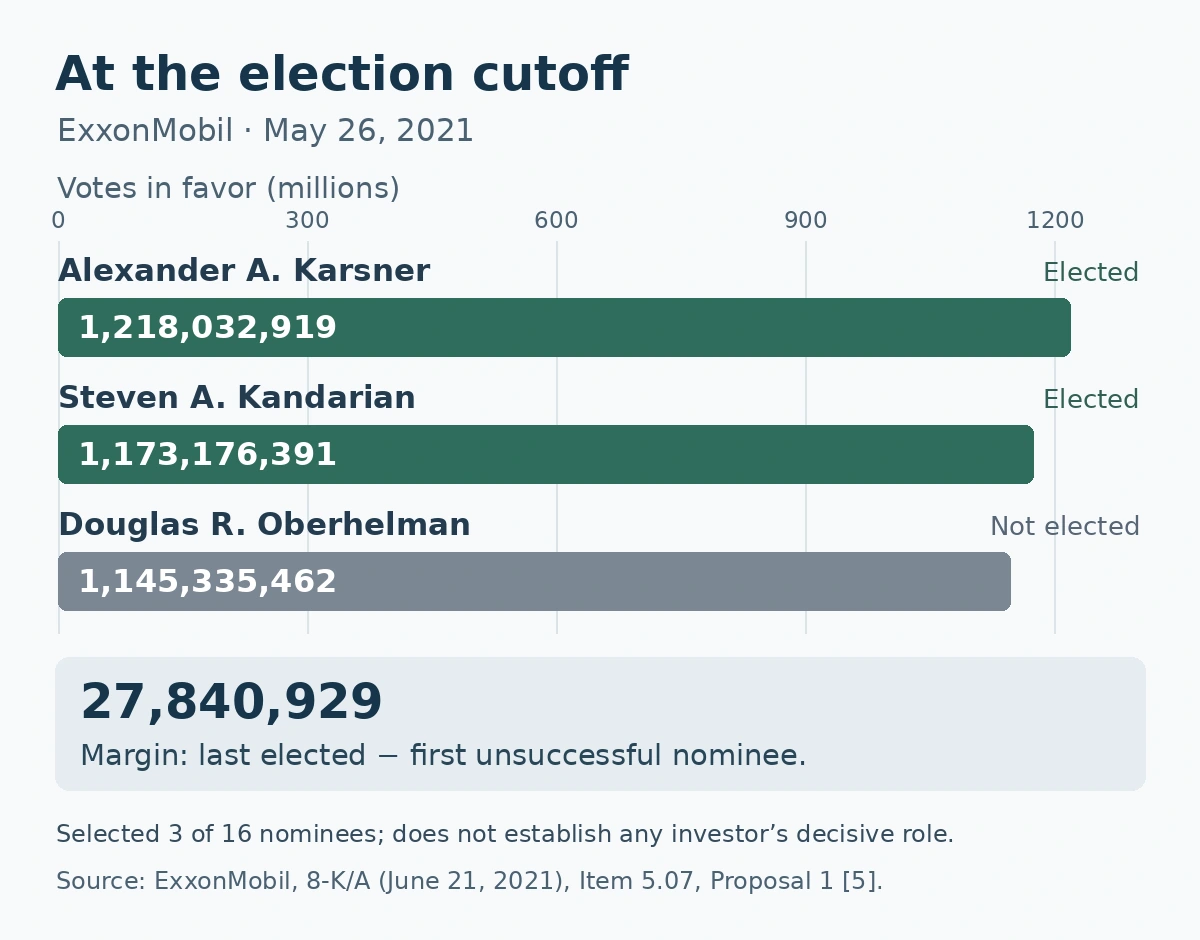
Three Engine No. 1 nominees thus secured a quarter of the seats. The elected candidate with the fewest votes was ExxonMobil's nominee Steven A. Kandarian (1,173,176,391), while the unsuccessful candidate with the most votes was Douglas R. Oberhelman (1,145,335,462). The margin was 27,840,929 votes. Karsner received 72,697,457 more votes than Oberhelman. These margins illustrate why support from major investors matters in closer elections; they do not reveal which individual investor was necessarily decisive.
How did institutional investors decide?
In its May 2021 explanation, Vanguard stated that its funds supported Goff and Hietala, but not Karsner or Runevad. It emphasized the combination of knowledge of the traditional energy industry and its transformation, and the need for better oversight of strategy. The report also mentions discussions with company management, candidates, and other interested parties. [6]
Vanguard: voting insights (May 2021)
State Street Global Advisors identified Hietala and Karsner as the candidates best suited to strengthen oversight of capital investment and the energy transition. [7] An analysis by the advisory firm Alliance Advisors, published on the Harvard Law School Forum, reports that BlackRock supported Goff, Hietala, and Karsner. [8] BlackRock's original voting report could not be retrieved again for this research, so its support is identified in the following table as documented by a secondary source.
| Candidate | BlackRock* | Vanguard | State Street Global Advisors |
|---|---|---|---|
| Gregory J. Goff | Yes | Yes | No |
| Kaisa Hietala | Yes | Yes | Yes |
| Alexander A. Karsner | Yes | No | Yes |
| Anders Runevad | No | No | No |
*BlackRock: secondary source. The table shows reported support, not vote totals or a comprehensive review of individual fund records. [6] [7] [8]
Support was not limited to the Big Three. In a document dated May 19, the California State Teachers' Retirement System (CalSTRS) publicly urged shareholders to support all four nominees. This is documented public support, not independent evidence of the votes cast by CalSTRS. [9] By contrast, the annual voting record of the New York State pension fund explicitly records votes in favor of all four nominees. [10]
The differences among the managers' positions show that their choices were not identical. This does not rule out discussions among investors or similar strategic interests, but the available data do not establish the existence of a unified, binding voting bloc. Nor can the entire outcome be attributed solely to the Big Three while ignoring other participants.
What changed, and what can we not prove?
The election of three new directors changed the composition of the body responsible for overseeing the company's operations and strategic direction. This was more than a nonbinding expression of dissatisfaction, since the new directors gained an actual role in corporate governance. However, their election did not transfer ownership to the activist investor, give it a majority on the board, or entitle Engine No. 1 to determine ExxonMobil's business policy on its own thereafter. Directors serve as members of the company's governing body, not as additional shareholder votes for the manager that supported their nomination.
Determining each manager’s contribution to the electoral outcome would require reliable data on the votes actually cast by individual funds and under individual mandates. The available meeting results are aggregated, and it was not possible in this research to conduct an exhaustive comparison of all Form N-PX filings. Subtracting reported shareholdings from the final vote totals would therefore create an illusion of precision. Nor can the effect of the new directors on subsequent investment, production, emissions, or company profitability be calculated from the election results alone.
What does the ExxonMobil case reveal about economic power?
The 2021 case shows that economic power can be exercised even without majority ownership. A small activist investor proposed an alternative to the existing board composition, and institutional and other shareholders made its partial realization possible through their votes. Dispersed economic ownership therefore does not guarantee equally dispersed decision-making. What matters is who is entrusted with voting power, how much discretion they have in exercising it, and how transparently they report their decisions.
Such power can be understood as a mechanism for holding management accountable to investors, but also as a reason to question the concentration of influence among financial intermediaries. Both aspects can coexist. The ExxonMobil story is not proof that major asset managers control the oil industry on their own. It is, however, a documented case in which institutional investor support was part of a process that changed the composition of a major corporation's governing body.
In the next part of the series, we will examine the same issue through Chevron's acquisition of Hess: when the decision is no longer just about board seats, but about combining entire companies.
Sources and further reading
- Engine No. 1 LLC and other participants. Definitive Proxy Statement (DEFC14A), March 15, 2021. Background of This Proxy Solicitation, Proposal 1, Additional Participant Information. Source
- Exxon Mobil Corporation. Shareholder materials (DEFA14A), March 16, 2021. Description of strategy, dividend, and board composition. Source
- Engine No. 1. Engine No. 1 Issues Message to ExxonMobil Shareholders, May 19, 2021, DFAN14A. Source
- Exxon Mobil Corporation. Notice of 2021 Annual Meeting and Proxy Statement, March 16, 2021, pp. 6–9 and 35. Source
- Exxon Mobil Corporation. Form 8-K/A, June 21, 2021, Item 5.07, Proposal 1. Source
- Vanguard. Voting insights: A proxy contest and shareholder proposals related to material risk oversight at ExxonMobil, May 2021, pp. 1–2. Source
- State Street Global Advisors. 2021 Proxy Contest: Exxon Mobil Corporation (XOM), May 27, 2021. Explanation of nominee selection; text extract, direct PDF unavailable on reopening. Source
- Thomas Ball, James Miller and Shirley Westcott (Alliance Advisors). Was the Exxon Fight a Bellwether? Harvard Law School Forum on Corporate Governance, July 24, 2021. Secondary analysis, section on voting and table of institutional support. Source
- California State Teachers’ Retirement System (CalSTRS). Notice of Exempt Solicitation (PX14A6G), letter dated May 19, 2021. Source
- New York State Common Retirement Fund. Proxy Voting Report, January 1–December 31, 2021, p. 527, Exxon Mobil Corp., May 26, 2021, annual meeting, dissident proxy card. Source