Major Funds and the Coal Industry: What Do the Lawsuits Actually Prove?
What large fund managers’ coal-industry investments and ownership records do—and do not—establish.

Artistic illustration of overlapping investment exposure; it does not depict a specific mine or a proven agreement.
Can asset managers influence how much coal competing companies produce if they manage large stakes in several such companies at the same time? The US litigation against BlackRock, Vanguard, and State Street brings this question to the center of the debate over economic power. The issue is not simply the size of their assets, but the distinction between economic ownership, voting authority, and the actual exercise of influence.
Two Different Transactions in the Coal Industry
In 2020, Peabody Energy and Arch Coal planned to combine some of their mining operations in the southern Powder River Basin in Wyoming. The US Federal Trade Commission (FTC) opposed the proposed joint venture on the grounds that it would restrict competition in the local market for thermal coal. A federal court issued a preliminary injunction on September 29, 2020, and the companies abandoned the transaction. [1]
Five years later, a different transaction took place. On January 14, 2025, CONSOL Energy completed its merger with Arch Resources and changed its name to Core Natural Resources. Arch became its subsidiary. This was not the completion of the previously blocked Peabody–Arch transaction. [2]
The first case illustrates conventional antitrust oversight of business combinations. The second shows how the structure of an industry changes over time. Neither, on its own, proves that major asset managers planned or coordinated restrictions on production.
North Antelope Rochelle and Black Thunder mines from space (September 11, 2005)
What Does Common Ownership of Competitors Mean?
Under common ownership, the same investors or investment managers hold stakes in multiple competing companies. From a risk-diversification perspective, this is understandable: an index fund can cover an entire industry without choosing which producer will outperform the others. From a competition perspective, however, it raises the question of whether an institution exposed to the performance of several competitors might encourage policies that benefit its portfolio as a whole, even though one company could gain market share at another’s expense by increasing production.
A large stake does not imply an equivalent degree of voting authority. In its 2025 proxy materials, Peabody reported the following figures for managers classified as beneficial owners under US reporting rules. The term encompasses voting or investment authority; it does not mean that the entire reported investment belongs to the asset manager itself. [3]
| Manager | Reported shares | Percentage of class | Sole voting power | Shared voting power |
|---|---|---|---|---|
| BlackRock | 19,112,130 | 15.7% | 19,055,735 | 0 |
| Vanguard | 14,693,078 | 12.1% | 0 | 117,467 |
| State Street | 7,631,707 | 6.3% | 0 | 7,467,342 |
Source: Peabody, Proxy Statement 2025, pp. 72–73, footnotes 4–7. The percentages are based on the number of shares outstanding on March 13, 2025, and the managers’ figures on filings from October and November 2024. [3]
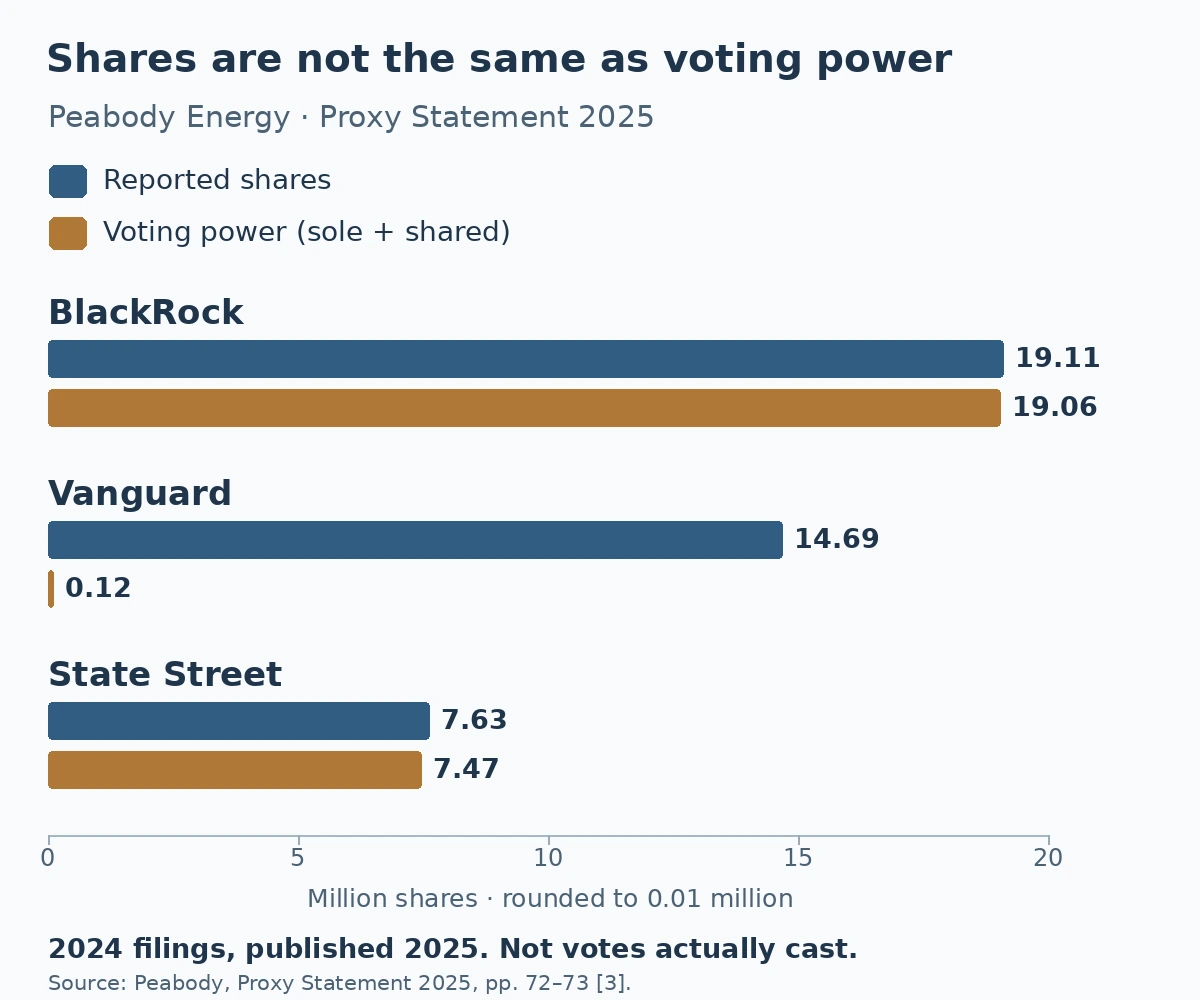
The sum of the published, already rounded percentages is 34.1%. This illustrates the concentration of reported investment positions; it does not establish a unified voting bloc. Vanguard’s figures, in particular, show why investment authority cannot be equated directly with voting authority. Nor do reported voting powers constitute a record of the votes actually cast by individual funds. Assessing their influence would require linking specific funds, their authorized representatives, voting records, and the outcomes of shareholder meetings.
What Do the States Allege Against the Asset Managers?
The states, led by Texas, filed their lawsuit on November 27, 2024. They allege that the major asset managers used overlapping shareholdings and coordinated activities to encourage producers to reduce the supply of coal, thereby raising prices and improving the financial performance of their investments. The allegations also concern activities conducted through climate initiatives and the exercise of shareholder influence. The lawsuit includes federal and state antitrust claims, as well as separate consumer protection allegations. [4]
In the proceedings, the defendants challenged both the asserted legal basis and the sufficiency of the allegations of an agreement and harm to competition. In its public response in May 2025, BlackRock rejected the plaintiffs’ interpretation and warned that forced divestment would make it harder for coal companies to raise capital. Meanwhile, the FTC and the US Department of Justice filed their legal position on the application of competition law to common ownership. [4] [5] [6]
These are conflicting positions on specific conduct and the application of the law. Responsible investment stewardship and environmentally oriented voting do not, by themselves, establish an anticompetitive agreement. Likewise, calling a fund passive does not answer the question of how its voting authority is exercised in practice. The specific conduct, legal standard, and consequences for competition must be assessed.
What Has the Court Decided?
On August 1, 2025, the US District Court for the Eastern District of Texas denied the motions to dismiss most of the claims, but dismissed three claims. In assessing the legal sufficiency of a complaint under Rule 12(b)(6), a court proceeds on the basis of properly pleaded facts without thereby determining that they are true. The decision therefore allowed most of the litigation to proceed; it did not establish the defendants’ liability. [4]
Order on motions to dismiss (August 1, 2025, Doc. 113)
Following the second amended complaint in January 2026 and Vanguard’s settlement, on October 30, 2026, the court partially granted BlackRock and State Street’s joint motion for judgment on the pleadings. Iowa and Nebraska retained the ability to pursue certain claims on behalf of electricity purchasers under their respective state laws. Other indirect-purchaser claims, certain claims for damages on behalf of coal purchasers under federal law, Iowa’s claim for civil antitrust penalties, and Counts XVIII–XX were dismissed. [7] [8]
This is not a final judgment on the alleged cartel agreement. The public docket also lists further filings on November 4 and 5, 2026, whose contents were not accessible during the preparation of this article. [9]
Vanguard’s Settlement: Specific Limits on Influence
On February 25, 2026, Vanguard reached a settlement with the attorneys general of thirteen states, providing for a payment of $29.5 million. The following day, the claims against Vanguard were dismissed with prejudice. The agreement expressly contains no admission of liability or unlawful conduct; actual completion of the payment was not independently verified in this research. [7] [10]
The settlement is particularly significant for its prospective obligations. With respect to US equity investments of certain Vanguard-managed funds, it restricts involvement in companies’ business strategies and production decisions, the nomination of directors, certain forms of coordination with externally managed funds, and using the sale of securities to impose conditions on business decisions. However, it permits voting and engagement with company management on corporate governance matters aimed at long-term shareholder value. The commitments concerning the separation of certain functions and passivity are limited to five years. Vanguard must also make commercially reasonable efforts to offer voting choice by the end of June 2027 to investors in funds accounting for at least half of the relevant US equity investments; the option must be available until at least the end of June 2032. [10]
The settlement thus establishes concrete boundaries for certain forms of shareholder influence. It is not, however, proof that Vanguard previously violated each of these boundaries, nor does it impose the same obligations on BlackRock and State Street.
Do the Coal Figures Support the Allegations?
Statistics from the US Energy Information Administration (EIA) provide an overview of the broader energy environment. The table below combines total US production of all types of coal with average fuel costs for electricity producers. Quantities are expressed in millions of US short tons (one short ton is approximately 907 kg), and costs in current US dollars per million British thermal units (MMBtu). [11] [12]
| Year | Coal production (million short tons) | Coal (USD/MMBtu) | Natural gas (USD/MMBtu) |
|---|---|---|---|
| 2020 | 535.434 | 1.92 | 2.40 |
| 2021 | 577.431 | 1.98 | 5.20 |
| 2022 | 594.155 | 2.36 | 7.21 |
| 2023 | 577.954 | 2.51 | 3.36 |
| 2024 | 512.540 | 2.47 | 2.76 |
Production increased in 2021 and 2022, then declined. At the same time, natural gas costs fluctuated considerably. For 2025, the EIA reports approximately 528 million short tons of coal, representing renewed growth compared with 2024. [11] [12]
These figures neither establish nor refute the alleged restriction of production. Production could rise and still be lower than it would have been under unrestricted competition. It could also decline entirely independently of asset managers’ conduct, owing to changes in demand, the prices of other fuels, mining costs, transportation constraints, or power plant closures. A national aggregate covering all types of coal is not the same as a particular regional thermal coal market; fuel costs are not the same as the price of electricity on a household bill.
A reliable assessment would require comparing competing companies’ production and investment decisions, voting records matched by date, documented contacts between asset managers and executives, regional prices, and independent supply and demand factors. On that basis, production in the absence of the alleged conduct would need to be estimated. This article does not undertake such a causal analysis.
What Do We Actually Know?
The US coal industry case shows that overlapping large institutional investment positions are more than an abstract issue. They are the subject of litigation that has already resulted in specific contractual restrictions for one of the world’s largest asset managers. What remains open is the extent and actual exercise of the remaining defendants’ influence, and its causal connection to the alleged economic harm.
Economic power must not be measured solely by the number of shares held. It matters who has the authority to make decisions, how that authority is exercised, and whether there is accountability for the effects of those decisions. Nor should we confuse a legitimate question about the concentration of power with an already proven abuse of that power. The next installment of the series will examine ExxonMobil, a case in which institutional influence can be studied through actual board elections.
Evidence cutoff: November 16, 2026. This research is based on accessible court decisions, the settlement, public statements, filings, and statistics. The full second amended complaint (Doc. 145), the two answers (Docs. 149–150), the complete court record, and systematic voting records for individual funds were unavailable or were not fully verified. The most recent decision was verified in part through a text extract and independent legal reporting.
Sources and further reading
- Federal Trade Commission. Peabody Energy/Arch Coal, In the Matter of (2020), Case Summary. Source
- Core Natural Resources, Inc. Form 8-K (January 2025), Introductory Note. Source
- Notice of 2025 Annual Meeting of Stockholders and Proxy Statement — Peabody Energy Corporation (2025), pp. 72–73. Source
- U.S. District Court, E.D. Texas. Memorandum Opinion and Order on Motions to Dismiss, Doc. 113 (August 1, 2025). Source
- U.S. Department of Justice. Justice Department and Federal Trade Commission File Statement of Interest on Anticompetitive Uses of Common Shareholdings to Discourage Coal Production (May 22, 2025). Source
- BlackRock. BlackRock’s response to DOJ and FTC filing supporting the multi-state AG lawsuit against asset managers (May 2025). Source
- U.S. District Court, E.D. Texas. Memorandum Opinion and Order on Motion for Partial Judgment on the Pleadings, Doc. 183 (October 30, 2026), pp. 1, 10–11. Source
- Ryan Autullo / Bloomberg Law. BlackRock, State Street to Face Purchaser Claims in Collusion Suit (November 2, 2026). Source
- CaseMagic. Public docket entries in case 6:24-cv-00437 (entries 184–185, November 4–5, 2026). Source
- The Vanguard Group, Inc. and the attorneys general of thirteen states. Settlement Agreement (February 25, 2026), §§ 1.12, 2–7, 15. Source
- U.S. Energy Information Administration. Quarterly Coal Report, April–June 2026, Table 1. Source
- U.S. Energy Information Administration. Electric Power Annual, Table 1.2, Average Costs. Source