BlackRock and the Federal Reserve: Crisis Purchases, iShares and Conflicts of Interest
Documented BlackRock–Federal Reserve relationships in crisis programs, including mandates and conflict-of-interest concerns.

Artistic allegory of contracted execution of a public financial intervention; it does not depict actual transactions.
When the US corporate bond market was hit by a crisis in the spring of 2020, the Federal Reserve intervened with extraordinary measures. Yet it did not carry out all the tasks required to implement those measures itself. The Federal Reserve Bank of New York hired BlackRock, one of the world's largest private asset managers, to manage investments.
This case matters because it allows us to observe economic power where it is often hidden: in contracts, delegated authority and financial infrastructure. Who set the rules of the intervention, who executed the purchases, who owned the assets and who benefited?
When the corporate debt market needs support
Companies do not finance themselves solely by selling shares or taking out bank loans. They can also borrow by issuing bonds that investors buy. When investors suddenly demand higher yields or seek to sell bonds on a large scale, new borrowing can become more expensive for companies. Financial market difficulties can thus spill over into production, employment and business operations.
On March 23, 2020, the Federal Reserve announced two emergency programs. The Primary Market Corporate Credit Facility (PMCCF) was designed to support new corporate bond issues and certain loans, while the Secondary Market Corporate Credit Facility (SMCCF) was intended to purchase existing corporate bonds and exchange-traded funds (ETFs) that invest in corporate debt. Both relied on emergency powers under Section 13(3) of the Federal Reserve Act and the approval of the US Treasury Secretary. [1] [2] [9]
Together, the expanded facilities could support up to $750 billion in purchases. This figure represented the anticipated maximum capacity, not actual expenditure or the acquisition cost of the portfolio. [7]
Who was responsible for what?
To implement the programs, the New York Fed established a special-purpose entity, Corporate Credit Facilities LLC (CCF LLC). The US Treasury provided an equity cushion, while the New York Fed managed the entity and extended secured loans to it. The Treasury's actual equity contribution amounted to $37.5 billion, although $75 billion had originally been envisaged. [4] [6] [7] [9]
On March 24, 2020, the New York Fed hired BlackRock Financial Markets Advisory (FMA) as an external investment manager. The SMCCF agreement is dated May 11, 2020, and the PMCCF agreement June 29, 2020. State Street Bank & Trust Company took on custody and administrative services. [1] [2] [3] [4]
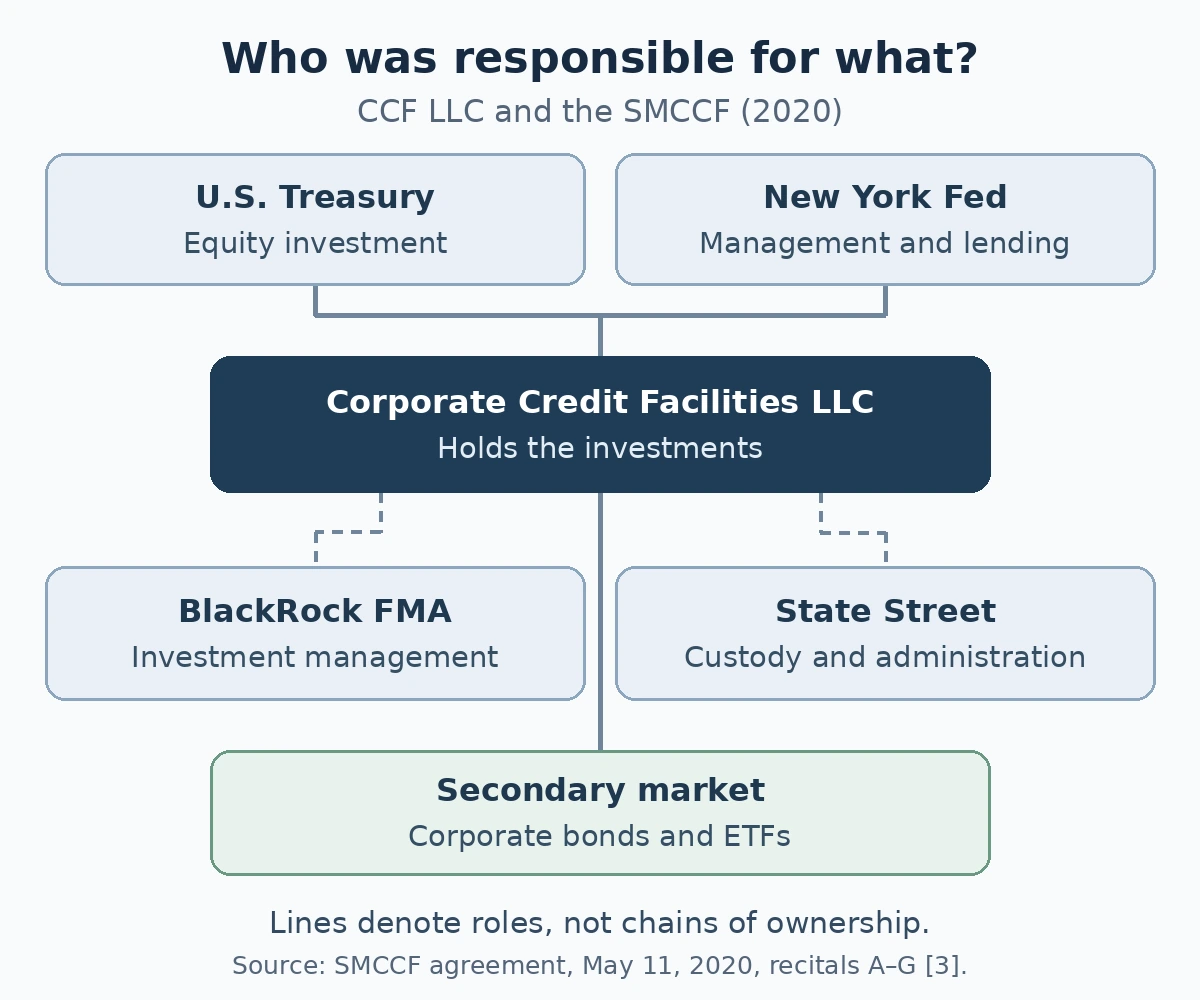
The division of responsibilities is crucial. Within its contractual mandate, BlackRock could execute transactions and provide advice on investment strategy, portfolio construction and risk analysis. It did not, however, own the assets of CCF LLC. The agreement bound BlackRock to the client's guidelines and instructions and, among other things, prohibited it from exercising any voting rights CCF LLC might have arising from its eligible investments. [3] The agreement thus establishes genuine operational and advisory authority for a private asset manager, not a transfer of authority over the central bank.
Almost half of the ETF portfolio in iShares funds
The SMCCF began buying ETFs on May 12, 2020, and individual corporate bonds on June 16. Using ETFs provided relatively quick access to a broader range of bonds. By purchasing a share in such a fund, CCF LLC did not acquire shares in every company represented in the fund. Rather, it acquired an investment in a fund with exposure to corporate debt. [1] [9] [10]
On July 20, 2020, the US Congressional Oversight Commission published a review of sixteen ETFs held in the SMCCF portfolio. Grouping the market values of those positions as of June 29 by the asset managers' fund brands produces the following breakdown. [7]
| ETF family | Market value in USD | Share |
|---|---|---|
| BlackRock – iShares | 3,942,053,773 | 49.17% |
| Vanguard | 2,731,538,663 | 34.07% |
| State Street – SPDR | 1,247,799,761 | 15.56% |
| Xtrackers | 66,412,957 | 0.83% |
| VanEck | 29,918,618 | 0.37% |
| Total | 8,017,723,772 | 100.00% |
Author's calculations based on 16 positions in the Third Report of the Congressional Oversight Commission, pp. 21–22. Percentages are rounded.
The three largest fund families thus accounted for 98.80 percent of the value of this portfolio. This is neither the share of all Federal Reserve crisis purchases nor the share of all SMCCF purchases over the course of its operations. It is a snapshot of ETF holdings on a single day. [7]
The concentration is significant, but more than a percentage is needed to establish whether iShares funds received unwarranted preferential treatment. The selection would need to be compared with the universe of eligible ETFs, their size, liquidity and composition, and the actual decisions made in selecting them. These were the kinds of characteristics included in the published selection criteria. [9]
Third report of the Congressional Oversight Commission (July 20, 2020, pp. 21–22)
When an asset manager also buys its own products
What made this arrangement distinctive was BlackRock's dual economic role: its FMA unit carried out the investment mandate while the BlackRock group also managed the iShares funds included in the purchases. This created a potential conflict of interest. The question is not simply whether the contractor complied with the rules, but also how those rules were designed to limit incentives to favor its own products.
The SMCCF investment management agreement provided for the mitigation of conflicts of interest, disclosure of potential conflicts and separation of sensitive information from other BlackRock activities. A specific financial mechanism, supplemented in December 2020, stipulated that specified revenues from BlackRock funds held by the SMCCF would be offset against certain fees for administering the program. It also accounted for securities lending agent revenues and provided for the return of any unused excess at the end of the agreement. [3]
The official record of vendor costs, reported as of June 30, 2023, makes it possible to calculate the cost of BlackRock's services under both programs. [5]
| Item | USD |
|---|---|
| SMCCF – management and advisory services | 8,172,327 |
| SMCCF – ETF revenue offset | −6,544,399 |
| SMCCF – net cost | 1,627,928 |
| PMCCF – management and advisory services | 5,739,469 |
| Total net cost | 7,367,397 |
Author's calculations using the cumulative “Life to Date” entries in the New York Fed report.
This is not BlackRock's net profit, nor is it a measure of all possible indirect benefits. The financial offset reduces a specific incentive associated with ETF revenues, but does not in itself answer questions about reputation, competitive position and a public institution's reliance on its contractor.
Was the intervention successful?
First, the announced size of the program must be distinguished from its actual scale. After purchase authority expired on December 31, 2020, the next weekly report showed approximately $14.2 billion in eligible SMCCF assets, while on the last day of the year CCF LLC held no eligible PMCCF assets. [2] [10]
Research by Nina Boyarchenko, Anna Kovner and Or Shachar finds that primary market conditions improved as early as the announcement of the programs. The authors also report a more pronounced effect from direct bond purchases than from purchases through ETFs. This offers an economic explanation for why final asset holdings are not necessarily a measure of the intervention's overall effect. [11]
When CCF LLC was dissolved on December 17, 2021, the Treasury's equity contribution had been returned in full, and the New York Fed loan had already been repaid on September 13, 2021. The audited financial statements show the distribution of the entity's cumulative net income of $531.668 million: $480.215 million to the Treasury and $51.453 million to the New York Fed. [6]
In accounting terms, then, the program generated positive net income. This does not, however, allow us to calculate all social benefits and costs or determine who benefited most from the intervention in the long run.
What did the oversight body find?
On April 17, 2023, the Office of Inspector General of the Federal Reserve's Board of Governors published an evaluation of the procedures for selecting and overseeing external contractors for emergency facilities. It covered seventeen contracts, ten of which had been awarded through direct negotiations. Both BlackRock agreements were among the contracts reviewed. [8]
The oversight body found that the New York Fed had largely followed established processes and that oversight mechanisms had helped mitigate risks. It also found that contractor selection procedures for emergency lending facilities had not been defined clearly enough. In January 2023, the New York Fed updated its selection policy to clarify its application and encourage greater use of competitive procedures. [8]
The scope of the review matters: it was an assessment of procedures and oversight, not a forensic reconstruction of every individual SMCCF transaction. Its findings therefore do not establish that misconduct occurred, nor do they provide a blanket assurance that all risks were eliminated.
Economic power derived from the capacity to execute
The BlackRock case does not establish that BlackRock owns the Federal Reserve or that the private asset manager determined US monetary policy as a whole. It does establish that the largest private financial institutions can become important contractors in public interventions.
This raises a question that goes beyond any individual agreement. When only a limited number of firms possess the infrastructure, specialist teams, data and operational capacity to implement complex public financial measures, such concentration can be a source of structural economic power. Formal decision-making authority remains with the public institution, but its practical capacity to carry out those decisions may depend in part on the private sector.
It is therefore not enough to track the ultimate owners of shares or the amount of assets under management. We must also examine contracts, the division of authority, financial incentives, oversight and the practical ability to replace contractors. In the next part of the series, we turn to a different case: whether large funds can influence the operation of the coal industry through their positions in competing companies, and what court documents can tell us about that question.
Sources and further reading
- Federal Reserve Bank of New York. Secondary Market Corporate Credit Facility. 2020–2021. Source
- Federal Reserve Bank of New York. Primary Market Corporate Credit Facility. 2020–2021. Source
- Corporate Credit Facilities LLC; BlackRock Financial Management, Inc. Investment Management Agreement (Secondary Market Corporate Credit Facility). 2020-05-11; amendments 2020–2021. Source
- Corporate Credit Facilities LLC; BlackRock Financial Management, Inc. Investment Management Agreement (Primary Market Corporate Credit Facility). 2020-06-29. Source
- Federal Reserve Bank of New York. FRBNY Quarterly 13(3) Facilities Vendor Costs. 2023-06-30. Source
- Corporate Credit Facilities LLC; KPMG LLP. Financial Statements: Corporate Credit Facilities LLC and Independent Auditors’ Report. 2022-03-10. Source
- Congressional Oversight Commission. The Third Report of the Congressional Oversight Commission. 2020-07-20. Source
- Office of Inspector General, Board of Governors of the Federal Reserve System. Following Established Processes Helped FRB New York and the Board Reduce Risks Associated With Lending Facility Contracts (2023-FMIC-B-005). 2023-04-17. Source
- Federal Reserve Bank of New York. FAQs: Primary Market Corporate Credit Facility and Secondary Market Corporate Credit Facility. 2020-05-26. Source
- Federal Reserve Bank of New York. FAQs: Secondary Market Corporate Credit Facility. 2021. Source
- Nina Boyarchenko; Anna Kovner; Or Shachar. It’s What You Say and What You Buy: A Holistic Evaluation of the Corporate Credit Facilities. 2020-07; rev. 2022-01. Source