The Invisible Infrastructure of Capital
The clearing houses, depositaries and other institutions that enable capital transfers and settlement.

Editorial illustration of the technical layers on which financial institutions depend; not a depiction of any actual location or company.
THY-REALITY · Who Owns the World? · WOTW-28 · Section V — Institutional Capital and Financial Infrastructure C4/v1 · 17 November 2026 · EN_DRAFT_COMPLETE · NOT_USER_APPROVED
When we think about the owners of the world's capital, we usually picture shareholders, banks, fund managers and wealthy families. Yet modern finance does not function solely on the basis of who owns shares or who receives interest. It also depends on databases, risk models, software, electronic messages and systems in which obligations are netted and trades are settled. Much of this daily work is almost invisible to the wider public. Nevertheless, the infrastructure itself can shape how quickly information spreads, who can compare it, where costs arise and how vulnerable an institution becomes when it depends heavily on a particular service. [1][2][15][16]
Who, then, owns this infrastructure, and what does ownership actually enable them to do? This investigation covers two kinds of systems that are often mistakenly treated as one: private data and analytics platforms such as BlackRock Aladdin, Bloomberg Terminal, LSEG Workspace and FactSet; and the infrastructure for financial messaging, clearing, depository services and settlement, represented by Swift and the companies within the DTCC group. These organisations do not perform the same tasks, are not organised in the same way and do not hold the same rights. Their influence can be understood only if we distinguish ownership of a company, its technical role, its contractual relationship with a client and the actual authority to make decisions about investments or assets. [2][4][7][10][11][13]
What, exactly, is “invisible” in the financial system?
Imagine a pension fund planning to buy bonds. Before its managers place an order, they need information about the issuer, must check prices, assess interest-rate and credit risk, and determine whether the purchase complies with the fund's rules. The order must be transmitted to a broker; once the trade has been executed, confirmations, calculation of obligations, delivery of securities and payment follow. At different stages, the fund may use data, software and services supplied by different companies. Each service requires a degree of trust, but relying on one service does not mean handing its provider responsibility for managing the fund's entire portfolio. [2][4][7][13][15]
It is useful to divide this chain into six layers. First come data and access rights: prices, quotations, issuers' reports, news and licensed data feeds. Second are models and analytics, through which users turn data into risk assessments. Third are workflows and orders, linking analysts, portfolio managers, compliance officers and trading desks. Fourth are standardised messages between financial institutions. Fifth are clearing, custody and settlement. Sixth is the oversight and security layer, which establishes requirements for resilience, risk management and transparency. These are not names for a single global central computer, but different functions in which public and private governance can intersect. [11][13][15][16][19]
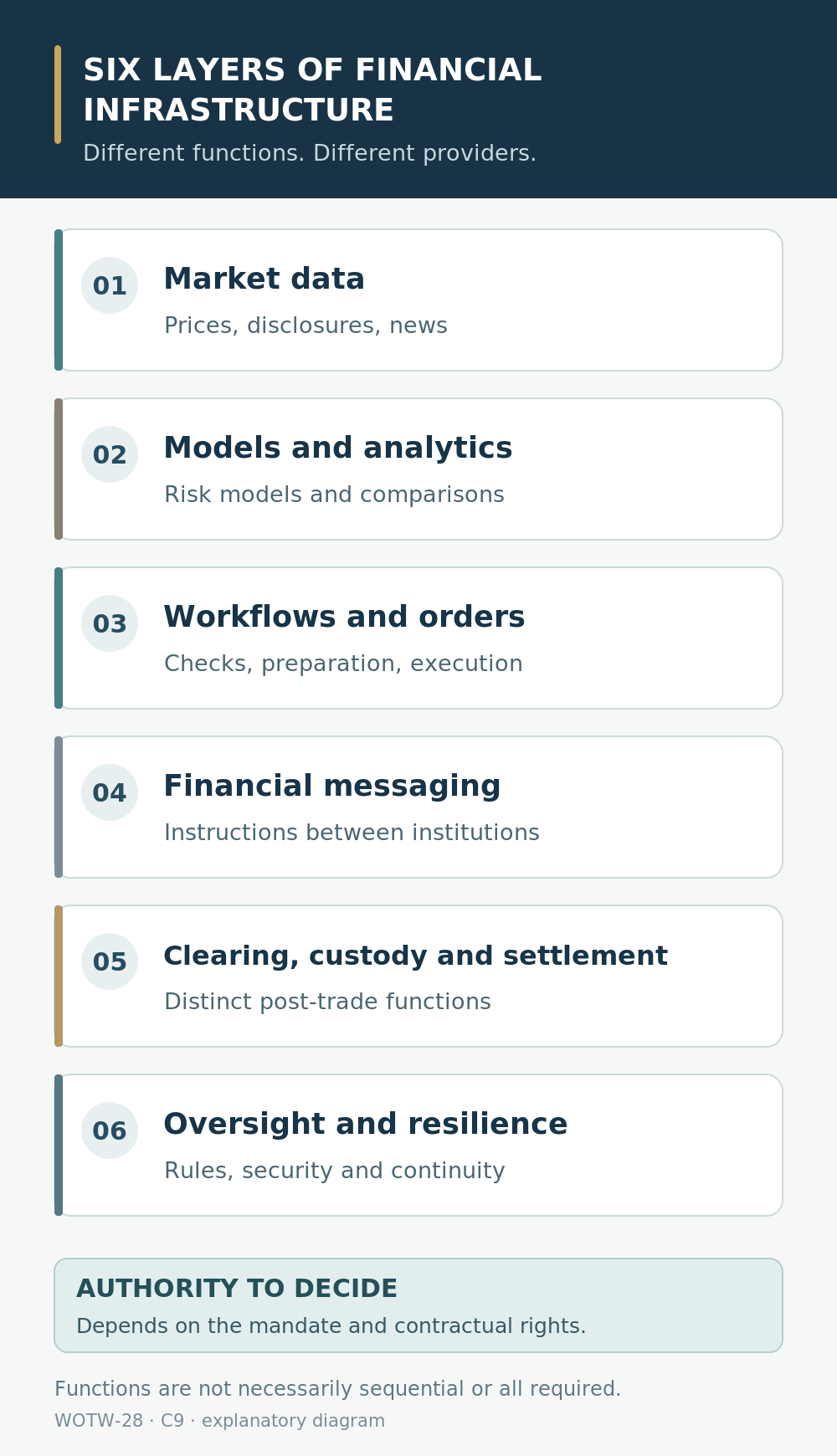
This distinction reveals the central question of power. An information provider may gain an advantage through the quality or reach of its data; a model designer may influence the assumptions selected; an operator of a settlement system may set technical and membership conditions within a supervised framework. Yet none of those observations, by itself, proves that these providers also become the beneficial owners of their clients' securities or make all their investment decisions. Such a conclusion would require specific contracts, mandates and evidence relating to individual transactions.
Aladdin: when risk, trading and oversight come together in one system
Aladdin is a particularly revealing example because it is developed by BlackRock, a group that is also a major asset manager. In its report for the third quarter of 2026, BlackRock expressly lists Aladdin, Aladdin Wealth, eFront and Preqin among its technology and subscription services. The group also offers software services to other institutional clients, not just to its own investment teams. According to BlackRock's description, Aladdin brings together portfolio management, trading, compliance checks, operational processes and risk oversight, allowing different departments to work with coordinated data and procedures. [1][2]
That integration offers a significant organisational advantage: when analysts, managers and risk teams use consistent data, they can reduce duplication, spot discrepancies more easily and understand a portfolio's position more quickly. But the same integration raises another question. How much of an institution's daily activity gradually comes to depend on one supplier, its models, software versions and data connections? Moving to another system may require the institution to realign numerous workflows. Power can therefore take the form of operational dependence, even where no change in asset ownership has been established. [2][16]
In its public terms, BlackRock specifically states that Aladdin users themselves are responsible for investment and other decisions made in connection with the technology's calculations, as well as for regulatory compliance. The same disclaimer says the tool should not be treated as an automatic investment recommendation. This is an important statement by the provider, but it is not a review of every individual contract. A particular service might include an advisory mandate, delegated execution or another contractually defined authority. It would therefore be wrong either to claim that BlackRock necessarily makes decisions on behalf of every Aladdin client or to suggest that using a software platform, by itself, rules out every possible influence on a client's work. [3]
BlackRock Solutions, according to the group's own account, operates as a separate business unit focused on technology and analytics services. The research question is not merely whether this organisational distinction exists on paper, but what access rights, data segregation, contracts and safeguards provide in practice. The documents examined for this article do not support the conclusion that a provider can inspect all clients' data or manage every portfolio that uses its models without authorisation. This remains an important question, but one that requires its own evidence. [2][3]
Bloomberg, LSEG and FactSet: the commercial power of data and the working environment
Bloomberg Terminal combines financial data, news, research functions, analytics, communications and tools used in trading workflows. In a single environment, a user can monitor market movements, retrieve information about an instrument and communicate with other participants. The value of such a system lies not merely in the computer screen, but in the network of data rights, historical databases, work habits and users surrounding it. Through the quality and scope of its service, a company can build a strong subscription relationship; that is not the same as acquiring legal title to the shares or bonds that its users analyse on screen. [4]

Bloomberg L.P. is organised differently from publicly traded providers, as indicated by the company's own materials. Michael Bloomberg's official biography describes him as the company's founder and majority owner. The UK's Register of Overseas Entities lists Michael Rubens Bloomberg as a beneficial owner of Bloomberg L.P., with “significant influence or control as a member of the entity”; the entry identifies the nature of control, not a percentage equity stake. These are meaningful traces of ownership, but the UK filing is not a complete table of every equity interest in the US partnership. They do not justify inventing an exact ownership percentage for 2026 or attributing individual corporate decisions directly to the founder's personal wishes. [5][6]
LSEG Workspace illustrates how financial data and workflows can be connected to a wider market-infrastructure group. LSEG describes itself as providing data, news, analytics and tools for different financial professions. An important historical milestone was the completion of its acquisition of Refinitiv on 29 January 2021, which expanded the data and analytics side of LSEG's business. But the ownership interests and voting rights disclosed in connection with that transaction are not automatically the shareholders' current holdings. Assessing LSEG's actual ownership structure requires examining up-to-date reports and major-shareholding disclosures, rather than freezing the ownership picture on the date of the acquisition. [7][8][9]
FactSet is a publicly traded US company that sells financial professionals data, analytics, software and related subscription solutions. In its annual report for the financial year ended 31 August 2026, it reported 9,258 clients and 260,671 professional users. For this measure, it defines a client as a subscriber with an annual subscription value of at least $10,000. These figures illustrate the scale of its commercial reach; they do not show what proportion of the world's financial assets FactSet controls. Nor can they be directly compared with the user count of another platform, or with market share in an entirely different service category, without a common denominator. [10]
Bloomberg, LSEG and FactSet may overlap in certain functions, while their products, customers and business models differ in others. Their relative importance must be assessed within a defined segment: market data, terminals, analytics, trading connections or enterprise services. The documents examined so far do not provide a single methodologically sound ranking of who “controls what percentage of global finance”. Such a percentage would appear precise while actually combining incomparable phenomena. [4][7][10]
Swift: an international financial message is not a transfer of money
While analytics platforms help prepare decisions, Swift performs a different function: it provides standardised, secure communication between financial institutions. International payments often involve several banks, identifiers, instructions and data that must be transmitted accurately among participants. Swift itself explains that it is not a bank and does not directly move money; it enables the transmission of messages or payment instructions, while banks and other relevant systems carry out the movements of funds. It would therefore be inaccurate to say that “all the world's transactions sit in a Swift account”. [11]
Swift is organised as a cooperative under Belgian law and emphasises the role of its members or shareholders in its description of governance. This legal form matters because it differs from that of an ordinary privately held technology company or a publicly listed data vendor. Yet the word “cooperative” alone tells us neither the full voting rules nor the precise holdings or decision-making powers of any particular member. Establishing those details would require the applicable statutes, membership records, governance rights and the history of actual decisions. [11][12]
The power of a messaging network may lie in its international reach, standards and the ability of banks to communicate with one another. Disruptions or restrictions can have major operational consequences, but the technical step must be distinguished from a decision made under public law. If a state or group of states imposes a sanction, it is not justified, without further evidence, to attribute the political decision to the messaging system itself. Conversely, the infrastructure's significance does not disappear simply because its operator did not impose the sanctions. Access rules, network governance and the availability of alternative connections remain legitimate subjects of scrutiny. [11][12][16]
DTCC: clearing, depository services and settlement are not ultimate ownership
For securities, the next layer of systems is even less visible. A buyer and seller agree on a trade, but the process does not end there: obligations must be determined, the risk of non-performance reduced, and final delivery of securities against payment arranged. In the United States, The Depository Trust & Clearing Corporation (DTCC) plays an important role in this process. Its audited 2025 financial statements distinguish the functions of affiliated entities, including DTC, NSCC and FICC. They operate in different parts of the depository, clearing and settlement system, so it is misleading to describe them as a single undifferentiated “bank holding all shares”. [13]
DTC provides central securities depository infrastructure for the safekeeping and book-entry transfer of securities. NSCC carries out clearing and related functions, including acting as a central counterparty in certain markets. FICC focuses on clearing and risk management for certain fixed-income transactions. This is not a merely academic distinction. In clearing, a central counterparty can interpose itself between trading counterparties; depository functions concern records, safekeeping and book-entry transfers. The respective rights and obligations differ. [13][15]
Several layers of holding often arise in such a system: the issuer; the registered holder or its nominee; a depository participant or intermediary; and the end investor, whose entitlements arise from the relationship with that intermediary. In the documented example of securities held through DTC, its nominee, Cede & Co., may be listed as the registered holder; that does not automatically identify the ultimate economic beneficiary. The name of an infrastructure provider or custodian appearing in a record can therefore create a false impression that the operator is the economic owner of all the assets in its network. A documented custodial or book-entry role is not equivalent to entitlement to all dividends, returns or votes. Any specific ownership claim must trace the chain of registration, contractual rights and ultimate beneficial interest, rather than stopping at the first legal entity listed. [14][15]
That does not mean shared infrastructure lacks economic power. Membership rules, required collateral, links with other systems and procedures in the event of default all affect how participants operate. But the scope of these powers is established through a combination of rules, contracts and supervision, not an assumption that the infrastructure's management can dispose at will of any security. DTCC's audited statements and supervisory materials provide a basis for examining its functions; a complete account of members, voting rights and ultimate ownership interests would require further documentation. [13][14]
Who holds the data, who owns the software and who has the right to decide?
The most important distinction in this article concerns five kinds of rights. First is ownership of the technology provider. Second are shareholding and voting rights within that company. Third is contractual power over a software service, including pricing, access and changes to functionality. Fourth is the authority of an asset manager who actually makes and executes investment decisions for a client. Fifth are the ultimate beneficiary's rights to assets or returns. Some of these rights may overlap in a particular business relationship, but they cannot automatically be collapsed into a single claim of control. [3][6][10][14]
Consider two examples. An insurance company may license analytical software while its own investment committee continues to make decisions and bear responsibility under the applicable mandate. Another institution may, in addition to using software, separately engage an external manager with specified authority to execute trades. Both might be described as “clients of the same financial platform”, but their legal positions differ. The claim that the software provider manages every client's assets would be false in the first case; in the second, it would be necessary to establish precisely which entity holds the mandate and how far its authority extends. [2][3]
A further issue is access to data. An infrastructure provider may process the data needed to deliver its service and may develop its own analytical models. It does not follow that it is entitled to inspect all clients' trade secrets or combine competitors' data without an appropriate basis. Assessing the possibility of an informational advantage or a conflict of interest requires examining data-processing agreements, security controls, segregation of client environments, independent audits and actual incident disclosures. The research material available to us does not contain that evidence for all the platforms discussed. Information asymmetry is therefore a legitimate research hypothesis, not an already established finding of abuse. [2][4][7][16]
Efficiency and dependence: two sides of the same system
Shared infrastructure also exists because it solves genuine problems. Comparable data definitions facilitate analysis; standardised messages reduce misunderstandings; netting reduces numerous gross obligations; and integrated models can help identify risks across large portfolios. If every bank or fund had to build all these functions independently, costs and operational interruptions could increase and communication become more difficult. These benefits form part of a fair assessment; they do not excuse a lack of oversight. [11][13][15]
When many institutions depend heavily on the same service, however, concentration risk arises. An outage at a provider, the loss of a key data source, a software defect or a difficult migration can affect multiple participants at once. In its toolkit of December 2023, the Financial Stability Board (FSB) specifically addressed risks associated with third-party service providers and the potential for wider financial-stability effects if those risks are not managed. This is a general supervisory framework, not a finding that any particular named provider has already caused a systemic crisis. [16]
A second, harder-to-prove possibility is similarity of decisions arising from shared models. If several investors use similar input data or stress scenarios, they may react in similar ways during a severe market shock. This is a plausible hypothesis, not an established description of how every user of Aladdin, Bloomberg or FactSet behaves. Demonstrating it would require access to the models used, how individual clients configure them, actual time series of trades and comparisons with other causes of simultaneous reactions. A subscription to the same service is not sufficient evidence of a common trading command. [2][16]
The assessment of power therefore cannot end with the number of institutions using a given program. What also matters is how quickly they can replace the service, whether they can export their data, whether they can verify key calculations and who is accountable if a result is wrong. Resilience requires reasonable alternative arrangements and the ability to continue operating during a disruption. These are central questions in contemporary oversight of outsourced technology services. [16]
The state, regulators and rules for access to financial information
The international CPMI–IOSCO Principles for Financial Market Infrastructures (PFMI), issued in 2012, establish a framework for payment systems, central securities depositories, securities settlement systems, central counterparties and trade repositories. They set out principles for governance, risk and infrastructure safety. The standard is not, by itself, a certificate that every operator performs flawlessly; such an assessment requires examination of applicable law, supervision, audits and actual events. [15]
Through the Digital Operational Resilience Act (DORA), the European Union strengthened the financial sector's framework for digital operational resilience. On 18 November 2025, the European Supervisory Authorities published a list of critical ICT third-party providers designated under a procedure that considers the importance of their services to financial institutions, their support for critical functions and the possibility of replacing them. The label “critical provider” means that a provider is relevant to operational-resilience oversight; it is neither a criminal designation nor evidence that the provider unlawfully influenced its clients' investment decisions. Nor should the same regulatory status automatically be ascribed to every financial software product without checking the current list and the provider's legal identity. [18][19]
With market data, there is also the question of whether institutions can obtain a more integrated view of trading without depending entirely on a single commercial database. The EU framework for a consolidated tape provides for consolidated tape providers (CTPs), which combine data from trading venues and approved publication arrangements. On 27 July 2026, ESMA authorised EuroCTP as a consolidated tape provider for shares and ETFs; according to its public record, EuroCTP began providing that service on 14 September 2026. This is a concrete example of developing common data infrastructure within a public regulatory framework, not evidence that EuroCTP controls every kind of financial information or every transaction. ESMA describes a framework organised by instrument class, with separate providers following different selection and authorisation procedures. [17]
It is equally important to distinguish among types of regulated data reporting service providers. An ARM is a mechanism for regulatory transaction reporting; an APA publishes prescribed trade information; and a CTP consolidates data. These terms describe functions under financial regulation. They are not generic labels for every commercial terminal, portfolio-management program or financial data company. Talk of “a single source of all data” therefore obscures the system's actual composition and the varied powers of its supervisors. [20]
Who ultimately holds power?
The “owner of financial infrastructure” is not a single person with one key to every account. With Aladdin, BlackRock's technology business can be documented, but it does not follow without further evidence that BlackRock manages all the assets of the program's users. Bloomberg has an identifiable majority-ownership link, but this does not tell us who made a particular bank's investment decision at a given moment. LSEG and FactSet sell widely used data and analytics services, yet their subscriptions are not registers of ultimate ownership of their clients' securities. Swift transmits messages; it does not settle every payment on behalf of banks. DTCC performs key depository and clearing functions, which is not equivalent to a universal entitlement to assets moving through intermediated holding records. [1][3][4][5][7][10][11][13][14]
These distinctions do not mean infrastructure is powerless. Power can be exercised through access prices, data standards, modelling assumptions, workflows, connection conditions and the difficulty of replacing critical services. These factors may create switching costs and informational differences between large and small participants. This is precisely why we must ask who sets the rules, who supervises their application and how users can verify the functioning of systems on which they depend. That is a verifiable direction for investigating economic power—not a claim that a single secret centre controlling the world's capital has been proved to exist. [15][16][18]
The most important open question therefore remains the evidentiary chain from the owner of infrastructure to a specific decision. We would need valid contracts, access rights, actual asset-management mandates, supervisory decisions and reliable evidence of consequences. Until we have those materials, we can describe the scale of technical dependence and possible mechanisms of influence, but cannot present hypothetical coordination as fact. This conclusion does not diminish the importance of asking who controls infrastructure; it makes that question investigable without conflating informational influence, legal rights and actual ownership.
This brings the section on institutional capital and financial infrastructure to a close. The wider series now turns to how documented economic capabilities interact with legislation, public decisions and institutional accountability. Establishing such links requires a separate investigation of each mechanism, not an automatic assumption that every organisation discussed operates as a single network.
Sources and further reading
- BlackRock, Inc. Form 10-Q, quarter ended 30 September 2026, particularly Overview and Technology and Subscription Services. SEC, 2026. Source
- BlackRock. Aladdin: Frequently Asked Questions, particularly How is Aladdin used?, Who uses Aladdin? and BlackRock Solutions. Accessed 17 November 2026. Source
- BlackRock. Aladdin — official overview and user-responsibility disclaimers. Accessed 17 November 2026. Source
- Bloomberg Professional Services. Bloomberg Terminal — overview of data, analytics and trading functions. Accessed 17 November 2026. Source
- Bloomberg. Michael R. Bloomberg — Founder, official biography identifying him as majority owner of Bloomberg L.P. Accessed 17 November 2026. Source
- UK Companies House. Bloomberg L.P., OE018811 — Register of Overseas Entities, beneficial owners; description of the nature of Michael R. Bloomberg's control. Public register; accessed 17 November 2026. Source
- London Stock Exchange Group (LSEG). LSEG Workspace — official overview of data and analytics. Accessed 17 November 2026. Source
- LSEG. Annual Reports — 2025, the group's annual report and description of its activities. 2026. Source
- LSEG. LSEG All-Share Acquisition of Refinitiv: Transaction Completion and Admission to Trading, announcement, 29 January 2021. Source
- FactSet Research Systems Inc. Form 10-K, financial year ended 31 August 2026, Item 1 — Business; FactSet Clients and Users. SEC, 20 October 2026. Source
- Swift. Who We Are, overview of the cooperative and the distinction between messages and actual transfers of funds. Accessed 17 November 2026. Source
- Swift. Organisation and Governance, structure, membership and governance. Accessed 17 November 2026. Source
- The Depository Trust & Clearing Corporation (DTCC). Consolidated Financial Statements, 2025, audited 19 March 2026, Note 1 Business and Ownership, printed p. 8. Source
- Essential Properties, L.P. Prospectus Supplement: 5.375% Senior Notes due 2036, 4 June 2026; Book-Entry, Delivery and Form and the discussion of DTC, participants and ultimate beneficial owners. Issuer's prospectus published through SEC EDGAR (not a document authored by the SEC). Source
- BIS, Committee on Payment and Settlement Systems (now CPMI), and IOSCO. Principles for Financial Market Infrastructures, 16 April 2012. Source
- Financial Stability Board. Final Report on Enhancing Third-party Risk Management and Oversight: A Toolkit for Financial Institutions and Financial Authorities, 4 December 2023. Source
- European Securities and Markets Authority (ESMA). Consolidated Tape Providers, regulatory overview including EuroCTP's authorisation and start of operations in 2026. Accessed 17 November 2026. Source
- European Supervisory Authorities (EBA, ESMA, EIOPA). The European Supervisory Authorities Designate Critical ICT Third-party Providers under DORA, 18 November 2025. Source
- European Banking Authority (EBA). DORA Oversight, overview of oversight of critical ICT third-party providers. Accessed 17 November 2026. Source
- ESMA. Data Reporting Services Providers, distinction between ARM, APA and CTP. Accessed 17 November 2026. Source