Credit Rating Agencies: Who Assesses the Financial Risk of States and Companies?
The ownership, financing and influence of credit rating agencies in assessing sovereign and corporate risk.

Symbolic editorial artwork about credit rating; not an actual rating device or an agency's real procedure.
THY-REALITY · Who Owns the World? · WOTW-27 · Section V — Institutional Capital and Financial Infrastructure C4/v1 · 17 November 2026 · EN_DRAFT_NOT_APPROVED · Translation of SL C3/v1 (approved with limits)
When a state borrows money by issuing bonds, or a company needs capital to expand, the decision appears at first to rest between borrower and investor. Yet a third participant often stands between them: a credit rating agency. Its rating does not set a bond's price by legal decree, but it can influence how investors, banks, asset managers and central banks understand risk. In certain procedures, the rating is even incorporated directly into the rules governing which assets are eligible for use and under what conditions.
Who, then, assesses the creditworthiness of states and companies? The answer is not simply a list of three globally familiar brands. Agency ownership, how agencies are paid, their methodologies, market concentration, and the relationship between private expert opinion and public financial rules all matter. We must, however, distinguish the potential to exert influence from an actual established violation, and both from proof that a particular rating caused a specific economic consequence. [1][2][3]
What a Credit Rating Tells Us — and What It Does Not
A credit rating is an expert, forward-looking opinion about the relative creditworthiness of an issuer or a particular debt obligation. For a sovereign borrower, it may assess both the ability and willingness to repay debt, public finances, the institutional environment and exposure to economic shocks. For a company, relevant information includes revenues, cash flows, existing debt, financing terms, industry position and business risks. An issuer rating is not the same as a rating of an individual bond: repayment of a particular instrument also depends on collateral, creditor seniority and contractual terms. [1][4]
Grades ranging from high ratings such as AAA or Aaa to lower, speculative categories make quick comparisons possible, but they offer no mathematical guarantee. The agency itself characterizes a rating as an opinion, not a recommendation to buy or sell, nor a precise, unconditional probability of default. Nor are different agencies' rating symbols necessarily fully equivalent without a verified mapping between their scales. It is therefore dangerous to reduce a complex analysis to a single letter without examining the methodology, rating date and reasons for a change. [1][4]
A credit rating can be useful without being perfect. It gathers and standardizes information that not every investor can process equally quickly. Its social value comes from making comparisons possible; its weakness lies in the risk that the opinions of a few major intermediaries become a substitute for independent judgment. The critical question is therefore not whether credit ratings should exist at all, but who produces them, what incentives they face, and where their use shifts from information to a decisive institutional rule.
The Big Three: Measurable Concentration, Not Proof of a Single Owner
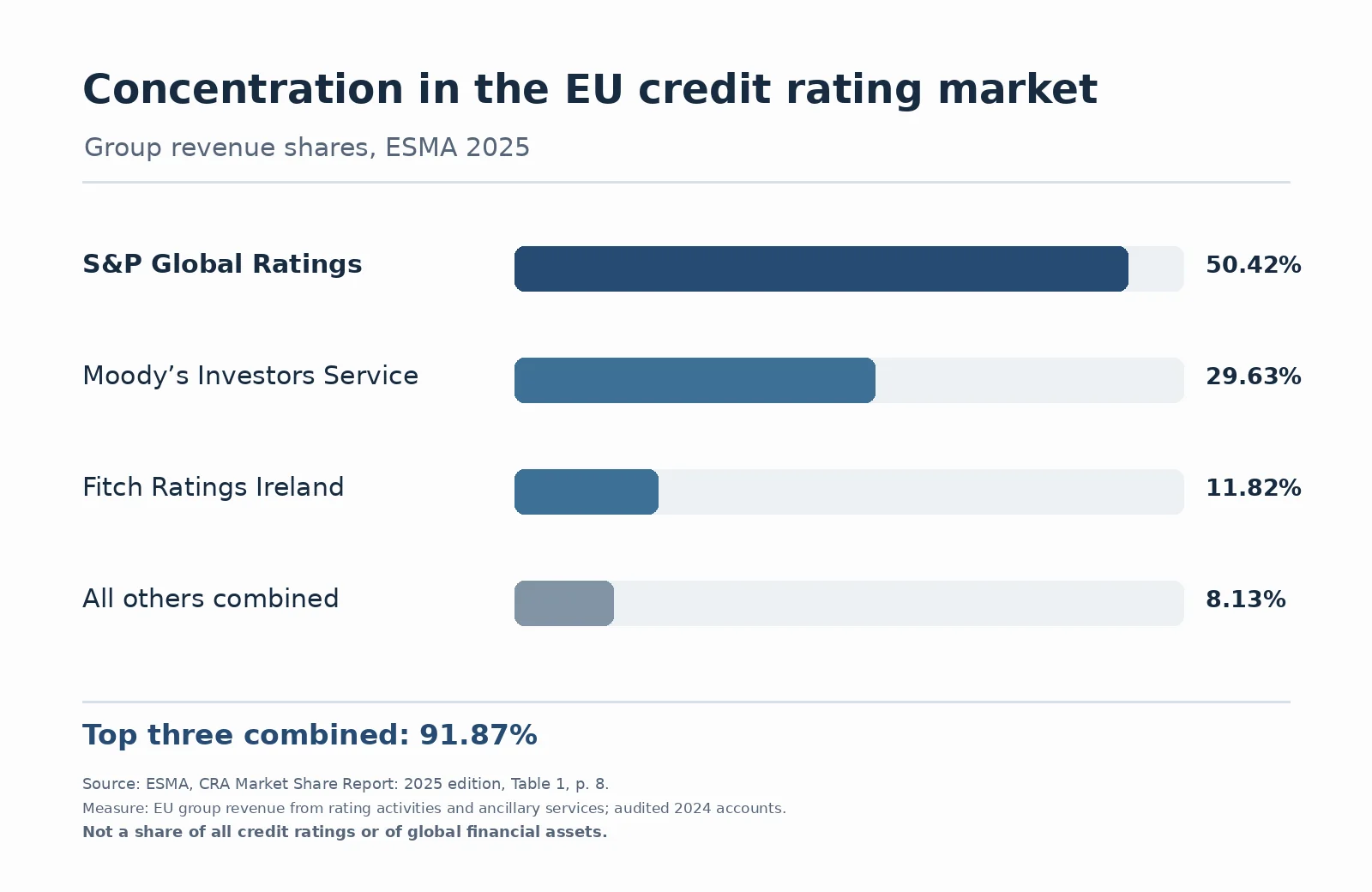
The international credit rating market is highly concentrated around S&P Global Ratings, Moody's and Fitch Ratings. In its CRA Market Share Report: 2025 edition (published on 18 December 2025), the European regulator ESMA calculated market shares from audited 2024 financial statements of 50.42% for S&P Global Ratings Europe, 29.63% for Moody's Investors Service and 11.82% for Fitch Ratings Ireland. Together, these amount to 91.87%. This is an EU group-level measure of revenues from credit rating activities and ancillary services; it does not directly mean that the three account for 91.87% of all ratings worldwide, all bonds or total global financial assets. [2]
For comparison, the US Securities and Exchange Commission (SEC) reported ten registered NRSROs and a total of 2,192,543 outstanding credit ratings at the end of 2025 under the methodology used in its statistical overview. S&P, Moody's and Fitch were among the largest by number of ratings. Yet the US figure measures the number of outstanding ratings, whereas the European figure measures revenue; comparing the percentages would be methodologically incorrect. The agencies also differ in their presence across sovereign bonds, companies, insurers and structured financial products. [3]
High concentration clearly demonstrates the dominance of a small number of providers, but does not in itself measure every aspect of price and quality competition. Established scales and broad international coverage enable comparability and economies of scale, while also potentially making entry more difficult for smaller providers. Market share alone does not establish that the three companies coordinate every rating or share a single hidden owner. Such a claim would require direct evidence of control, agreements or specific influence over decisions; an aggregate percentage proves none of these things.
Who Owns the Agencies?
The ownership question should begin with legal entities and documented ownership chains, not lists of alleged dynasties. S&P Global Ratings operates within S&P Global Inc., whose parent company files reports with the US SEC and whose shares are publicly traded. Moody's Investors Service belongs to Moody's Corporation; its list of subsidiaries in its 2025 SEC filing includes Moody's Investors Service, Inc. In publicly traded companies, we must further distinguish an individual shareholder's stake, voting rights, board composition and actual influence over an analytical decision. [5][6]
Fitch has a different ownership structure. Its European transparency report, published in March 2026, states that Fitch Ratings Ireland Limited is owned by Fitch Ratings Ltd (99.37%) and Fitch Ratings, Inc. (0.63%); Fitch Ratings, Inc. is wholly owned by Fitch Group, which is indirectly wholly owned by the privately held Hearst Corporation. The report states that Hearst holds its interest in Fitch Group through Hearst Ratings II, Inc. This is a verifiable corporate chain, not evidence that Hearst or any particular individual ordered a specific change to a country's rating. That is precisely why the investigation must distinguish ownership from operational decision-making. [7]

An investor who holds shares in a parent company may have an economic interest and perhaps voting rights; that does not yet demonstrate an ability to instruct an analyst to assign a particular rating. Conversely, it would be equally unjustified to dismiss all potential conflicts: European law specifically regulates the influence of shareholders, managers and connected persons on the independence of the rating process. A single ownership chart cannot settle the question. It requires scrutiny of rights, rules, actual contacts and any findings by supervisors. [8]
Who Pays for a Rating, and What Incentives Does That Create?
Much of the credit rating industry operates on an issuer-pays model: the debt issuer or a related party commissions and pays for the rating. ESMA expressly described this as the most common model in its 2015 analysis of competition and conflicts of interest; S&P Global Ratings also states on its website that it uses this model. A business model is not in itself proof that a rating is too high, but it raises an obvious question: might the desire to retain a client influence the assessment of its risk? If an issuer looks among several agencies for one that will assign it a more favorable grade, another risk arises — rating shopping. [9]
An alternative is investor-pays, under which investors or data subscribers pay. This reduces direct dependence on the issuer but raises other issues: who can afford research data, whether ratings are used to gain a private advantage, and whether the provider has sufficient revenue to cover the market well. ESMA also highlighted opposing incentives: a large investor might prefer a lower initial rating to secure a higher yield, while a regulated investor might prefer a higher rating because of capital requirements. Different hybrid models involve different incentives. It is therefore not enough to identify who transfers the fee; the business structure, potential sale of additional services, separation of sales from analytical work, and actual conflict-management mechanisms must also be examined. [9][8]
Regulatory rules recognize these risks. Article 6 of the European Credit Rating Agencies Regulation requires measures to ensure that ratings are not affected by conflicts of interest or business relationships; Annex I governs organizational separation, disclosures, related holdings and the position of rating analysts. The legal standard does not mean that every conflict automatically changes a rating. It means that the independence of the process is subject to evidence and supervision, not merely to the reputation of a brand. [8]
Methodology: Data, Judgment and Decisions That Cannot Be Reduced to a Formula
A rating agency publishes methodologies, uses data and expert judgment, and reaches decisions on significant ratings through internal procedures. Economic analysis involves numbers, but may also assess governance, political institutions, financial flexibility, exposure to shocks and future developments. The same current debt level therefore does not necessarily produce the same rating: much depends on the structure of debt, currency, maturity, refinancing capacity and other circumstances. [1][10]
This is where a subtler form of power emerges. The choice of weights, scenarios and qualitative assumptions helps determine what counts as a significant risk. This does not demonstrate malicious intent. It means that methodologies and possible departures from them are legitimate subjects of inquiry: did the agency apply previously published criteria, how did it justify a change, and did it treat comparable cases comparably? Article 8 of the European regulation requires disclosure of methodologies, models and key assumptions, as well as appropriate data quality. [10]
For sovereigns, this expert judgment touches democratically sensitive areas. A rating analysis may consider tax policy, public expenditure or the state's ability to make decisions during a crisis. The agency is not an elected public authority and does not adopt the budget. Nevertheless, its opinion may feed into assessments of debt yields and the contractual or regulatory conduct of other actors. The distinction between analyzing fiscal risk and prescribing policy is therefore important; a claim of specific political pressure requires evidence of an identifiable act, its chronology and other possible causes.
How a Rating Affects the Price of Money
An investor may demand a higher yield after a downgrade because they believe the risk of default has increased. But a bond's yield is a market price shaped by many factors: interest rates, liquidity, inflation expectations, fiscal data, global capital flows and specific demand. A rating may summarize information already known, introduce a new signal, or trigger rules used by investment funds. Mere proximity in time between a rating change and a movement in yields is therefore insufficient to establish that the rating decision was the sole or decisive cause. [11]
The mechanism becomes especially clear when ratings form part of institutional criteria. An asset manager's mandate may restrict holdings of lower-rated bonds; a loan agreement may, in some cases, tie its terms to a specified rating category; a central bank may use ratings to assess eligible collateral. In such cases, we must examine the rule adopted by the user of the rating, not only the process by which the agency issued it. The agency does not necessarily write the rule that an investor follows, but its output may become one of the input conditions that activate that rule. [12]
Within its Eurosystem credit assessment framework (ECAF), the European Central Bank uses several types of credit assessment sources, not only private external rating agencies: these include central banks' internal credit assessment systems and certain counterparties' internal models. The ECB announced a change in the selection of external ratings for 30 November 2026, covering certain private-sector collateral, non-euro-area public-sector collateral and some other issuer groups. Where at least two eligible ratings from two different recognized external institutions are available, the second-best rating will generally be used. If only one eligible rating is available, it will be reduced by one credit-quality notch in certain cases. For a defined group of euro-area public-sector issuers, the use of the best rating will be retained; additional specific rules apply to certain other instruments. As this implementation date is still in the future at the time of writing, we do not describe the changes as already operational. The ECB explains that it aims to reduce reliance on the most favorable rating and incentives for rating shopping. [12][13]
Do Agencies Create Crises, or Merely Detect Them?
A common criticism is that a downgrade triggers more expensive borrowing and can worsen the position of an already weakened debtor. This mechanism is economically possible, especially if predetermined portfolio or collateral conditions are activated. At the same time, the reverse explanation may apply: an agency downgrades the borrower because economic data, expectations and market conditions have already deteriorated. Research must therefore distinguish reactions to news from causality. [11]
An analysis by Helmut Reisen and Julia von Maltzan, published by the OECD in 1999 using a historical sample of emerging markets, examined spread reactions to rating changes as well as the interrelationship between yields and rating decisions. Studies of European bond markets likewise report reactions to announcements of rating changes and feedback effects between markets and ratings. Their findings are not a universal rule that every downgrade causes a crisis, but an argument for carefully examining the feedback loop in each specific case. [11][14]
This distinction protects the investigation from two oversimplifications. The first would attribute every deterioration in market conditions to rating agencies and ignore actual fiscal or business risks. The second would claim that agencies have no power because they merely express opinions. In reality, the same opinion can become influential when investors and institutions use it on a large scale. Yet the magnitude of its effect must be established through events, portfolio exposures, contractual rules and comparison with other causes.
Documented Violations: The Slovenian Case and Wider Supervisory Action
In 2016, ESMA fined Fitch Ratings Limited €1.38 million for several negligent breaches of the Credit Rating Agencies Regulation. Among its findings was that, when downgrading Slovenia in 2012, Fitch had not provided the then-required 12 hours for the state to review and respond. ESMA also found deficient internal controls and the disclosure of information about certain planned sovereign rating changes to some senior individuals at Fitch's parent company before public announcement. These are specifically documented procedural and supervisory failings. The decision itself, however, does not establish that the downgrade of Slovenia was economically unfounded, nor that it constituted a coordinated attack on the country. [15]
The US supervisor also took action. In January 2015, the SEC announced proceedings against S&P Ratings Services relating to ratings of certain commercial mortgage-backed securities. S&P agreed to settlements with the SEC totaling more than $58 million and separate settlements with the states of New York and Massachusetts totaling a further $19 million. In one of the proceedings, it admitted some findings; in others, the settlement terms differed. The case is significant as a concrete supervisory intervention concerning methodological and business practices, but it relates to specified securities and periods, not to every sovereign or corporate rating issued by the agency. Regulatory allegations, agreed settlements and final proof of any broader claim must be kept distinct. [16]
Supervisory action conveys two lessons: the notion that major agencies are completely untouchable is mistaken, but a single established violation does not mean every rating they issue is invalid. The most useful approach for a serious investigation is therefore a precise evidentiary trail: which legal entity, which rated instrument, what date, what provision and which supervisory decision? Only then does it make sense to assess economic consequences and the limits of responsibility.
Who Supervises Private Rating Agencies?
In the European Union, ESMA directly supervises registered credit rating agencies in respect of obligations within its remit; responsibility for supervising the specific duty under Article 8d to consider appointing a smaller agency rests with the competent national sectoral authorities. The framework introduced by Regulation (EC) No 1060/2009 and subsequent amendments requires registration, conflict management, methodological transparency, organizational safeguards and public accountability. The US SEC registers and examines NRSROs; its reporting addresses methodological rules, internal controls, complaints and conflicts of interest. The mere existence of supervision does not establish its complete effectiveness, but supervisory powers, public registers and decisions provide a basis for verifiable claims. [3][8][17]
The European framework also seeks to limit concentration through a specific obligation. When an issuer or a related third party intends to appoint at least two agencies, it must consider appointing at least one agency with a market share of no more than 10%, provided that agency is available and capable of rating the relevant instrument or entity. If it does not appoint such an agency, the issuer must document its decision; supervision of this particular duty belongs to the competent national authorities. This is not a general requirement that a smaller agency must always be selected. ESMA publishes market shares precisely so that this procedure can be applied. The figure of 91.87% concentration is therefore both a description of the market and a starting point for asking whether measures designed to promote competition are sufficient. [2][18]
Regulation has limits. A supervisor can review disclosures, methods, conflicts and procedures, but it cannot make the economic future certain. Independence also requires that the legal accountability of an agency not be confused with an automatic right of a state or issuer to a favorable rating. A better system therefore needs more high-quality sources of information, a clear distinction between roles, and less blind reliance on a single rating symbol. Although European and US bodies exercise supervision, users of ratings must still assess their reliability and suitability for their own decisions.
Who Actually Holds Power — and Where Are the Limits of the Evidence?
The question posed in the title has answers at several levels. Market power rests with a small number of major agencies, as revenue and statistical data demonstrate. Ownership power belongs to the legal and natural persons who own parent companies through documented chains, but ownership is not automatically evidence that they issue instructions to rating analysts. Methodological power lies with the expert teams that turn data and assumptions into credit opinions. Institutional power also belongs to those who decide that ratings will be incorporated into investment mandates, contractual terms or central-bank collateral rules. [2][5][6][7][12]
It is this final layer that shows why "who provides the rating?" is not quite the same question as "who makes the decision?" An agency issues a rating, while an investor, bank or regulator decides what to do with it. Influence arises from the relationship between the two. There are real conflicts of interest and procedural violations documented in official decisions, but the documents presented here do not support a generalized assumption of a single hidden command center. It would be equally mistaken to let the absence of such evidence obscure the possibility of verifiable improper influence in individual cases.
To understand who holds economic power, following the owner of a rating agency is not enough. We must trace the whole sequence: data → methodology → rating decision → market and regulatory use → measurable consequence. Each arrow is a distinct research question. This approach relies neither on the authority of a ratings brand nor on an assumption of its all-encompassing power, but on documents capable of showing when a private opinion becomes actual economic power.
Sources and further reading
- S&P Global Ratings, Understanding Credit Ratings — explanation of ratings as forward-looking expert opinions, rating scales and limitations. Source
- European Securities and Markets Authority (ESMA), CRA Market Share Report: 2025 edition, 18 December 2025, cover identifier ESMA84-2037069784-2228, sections 5 and 7, table on p. 8 (PDF page 8); calculation based on audited 2024 financial statements. ESMA links to the document on its website as “CRA Market Share Calculation 2025.” Source
- U.S. Securities and Exchange Commission (SEC), Nationally Recognized Statistical Rating Organizations (NRSROs): Statistics, comparison for 31 December 2024 and 2025, methodological notes. Source
- S&P Global Ratings, Credit Ratings: Issuer and Issue Credit Ratings — distinction between issuer ratings and issue ratings. Source
- S&P Global Inc., Annual Report on Form 10-K for the year ended December 31, 2025 (SEC filing). Source
- Moody's Corporation, Exhibit 21: Subsidiaries of Moody's Corporation as of December 31, 2025 (SEC filing). Source
- Fitch Ratings, European Union Transparency Report, March 2026, chapter 1, Legal Structure and Ownership, p. 6. Source
- Regulation (EC) No 1060/2009 on credit rating agencies, as amended, notably Article 6 and Annex I; ESMA, Article 6: Independence and avoidance of conflicts of interest. Source
- ESMA, Technical Advice: Competition, choice and conflicts of interest in the credit rating industry, ESMA/2015/1472, 30 September 2015, particularly section 4.2, paragraphs 191–199 (printed pp. 59–61), on issuer-pays and investor-pays models. Source
- ESMA, Article 8: Methodologies, models and key rating assumptions, interactive presentation of Regulation 1060/2009. Source
- Reisen, Helmut, and Julia von Maltzan, Boom and Bust and Sovereign Ratings, OECD Development Centre Working Papers, No. 148, 1999. Source
- European Central Bank (ECB), Eurosystem credit assessment framework (ECAF) — sources of credit assessments, collateral eligibility and rating scales. Source
- ECB, FAQs on the use of external ratings in the Eurosystem collateral framework, updated 29 September 2026, planned implementation of changes on 30 November 2026. Source
- Afonso, António, Davide Furceri and Pedro Gomes, Sovereign credit ratings and financial markets linkages: Application to European data, Journal of International Money and Finance 31(3), 2012, pp. 606–638. Source
- ESMA, ESMA fines Fitch Ratings Limited €1.38 million, press release dated 21 July 2016; related official decisions and public notice. Source
- SEC, SEC Announces Charges Against Standard & Poor's for Fraudulent Ratings Misconduct, 21 January 2015, Release 2015-10. Source
- SEC, Office of Credit Ratings, description of supervision and current annual reports, 2026. Source
- ESMA, Credit Rating Agencies, overview of Article 8d obligations and the annual calculation of market shares. Source