American Interests: Arms, Minerals and the Future of Ukraine
An examination of American military assistance, the defence industry and investment in Ukrainian minerals, distinguishing public commitments from actual payments.
AI-generated symbolic illustration; it does not depict an actual geological map, military shipment or agreement.
Russia's large-scale military operation in Ukraine, which began in February 2022, also raised the enduring question of how to finance Ukraine's defence and reconstruction. [3] The war is not merely a struggle over territory and the country's political future. It is also a question of who supplies weapons, who pays for them, who makes investment decisions and who will receive the revenues from economic activities that will continue to develop long after the fighting ends. The United States occupies a distinctive position in these relationships: as a military power, a producer of defence equipment and a partner in pursuing Ukraine's future economic opportunities.
In 2026, two distinct mechanisms of American involvement became particularly apparent. The first enables allied funds to finance American weapons, while the second establishes a long-term US–Ukrainian investment partnership. The relationship between them raises a question that goes beyond the usual debate over military assistance: how does security dependence intersect with economic power? Answering it requires a distinction between political promises, contractual rights, actual payments and anticipated benefits. The cut-off date for this analysis is 25 November 2026.
US Policy towards Ukraine under the Trump Administration
Assistance to a country at war can be understood as an expression of solidarity, an instrument of foreign policy or a means of strengthening one's own security. These explanations are not mutually exclusive. Under Donald Trump's administration, another prominent demand is that European allies should shoulder a greater share of the financial burden and that cooperation should benefit the American economy. A White House document dated 8 July 2026 presents allied defence investment as an achievement of US policy and a stimulus to domestic industry. [1]
This matters because economic benefit is not merely a critical interpretation offered by the administration's opponents; it is part of the administration's own public policy argument. Such a statement does not, however, establish that economic benefit is the sole or primary reason for US policy towards Ukraine. Washington may simultaneously have strategic interests in limiting Russian military power, maintaining its influence in Europe and strengthening its own industrial base; Ukraine, meanwhile, has immediate security needs of its own.
A second dimension is the United States–Ukraine Reconstruction Investment Fund (URIF). The U.S. International Development Finance Corporation (DFC) linked its establishment to Ukraine's reconstruction, the strengthening of American natural-resource supply chains and new business opportunities for both countries. [2] An institutional framework for American participation in Ukraine's future economy is thus emerging alongside military cooperation. This does not mean that all previous assistance was conditional on economic concessions or that American funding has ceased altogether.
From Direct Military Assistance to the PURL Programme
Under direct assistance arrangements, the US government can supply equipment from its own stockpiles or finance its procurement. The PURL programme (Prioritised Ukraine Requirements List) allows allied funds to support the delivery of priority equipment from the United States. What changes, above all, is the relationship between the purchaser, the funder and the supplier. The military need is Ukrainian, the financial burden may fall on the allies, and part of the industrial impact occurs in the United States. This does not necessarily replace all other forms of assistance.
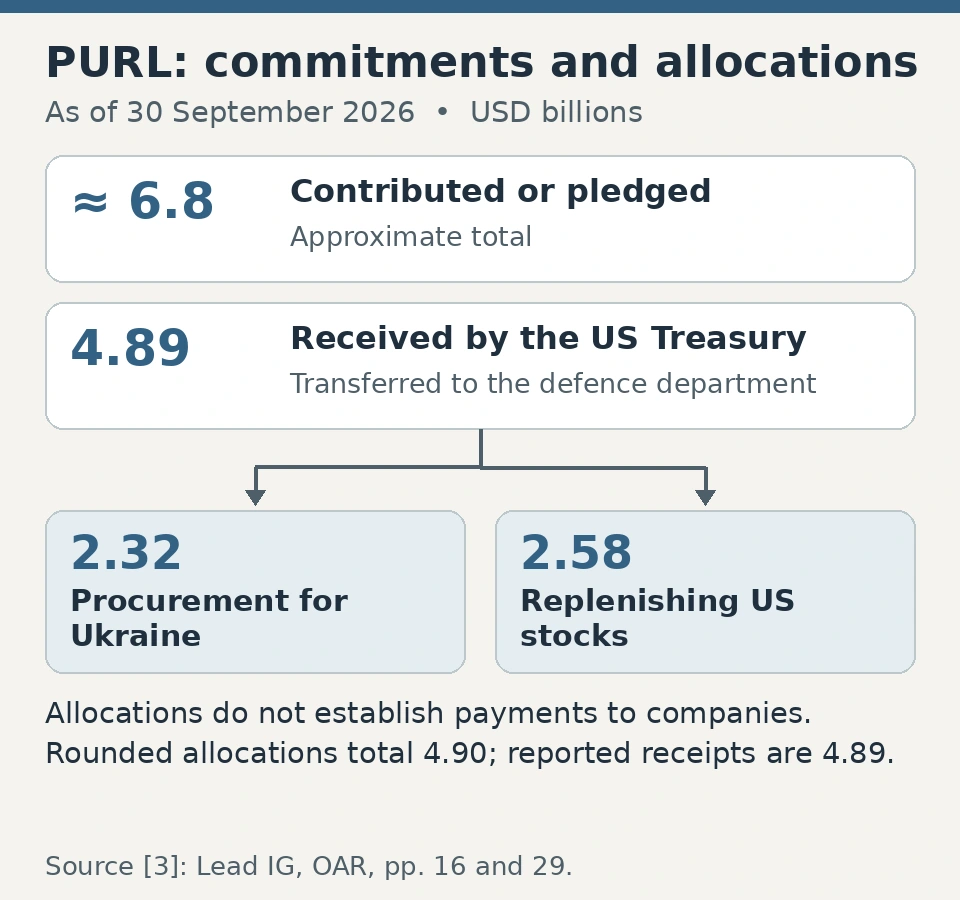
The US interagency oversight report on Operation Atlantic Resolve for July–September 2026 provides a more precise account of the programme's financial scale. As at 30 September 2026, announced or already contributed amounts totalled approximately US$6.8 billion. By that date, the US Treasury had received $4.89 billion, which had been transferred to the US Department of Defense. According to the report, $2.32 billion of this was allocated to procurement for Ukraine and $2.58 billion to replenishing US stockpiles. The difference between the sum of the rounded figures and the stated total is $0.01 billion. [3]
These figures are not interchangeable. A commitment is a promise of funding; funds received represent an actual cash flow; an allocation specifies the purpose of the funds; and a manufacturer's revenue arises under the rules of the particular commercial arrangement. Replenishing American stockpiles may benefit domestic production, but the aggregate allocation does not establish how much money any individual company had received by a particular date. The White House's July statement that more than $5 billion had been spent through PURL also remains unreconciled with the September oversight figure of $4.89 billion received. [1][3] Without reconciling the accounting categories and the scope of reporting, this discrepancy can neither fairly be treated as evidence of wrongdoing nor regarded as resolved.
On 18 November 2026, the Ukrainian Ministry of Defence announced that the government had approved the signing of a framework agreement that would allow European loan funds to be used to purchase American weapons through PURL. Under this description, NATO acts as a financial intermediary rather than a seller or guarantor; the funds remain Ukrainian until the implementation of a specific package is confirmed, quarterly reporting is envisaged, and unused funds may be returned or redirected. [4] Authorisation to sign does not itself establish that the agreement has been signed, that the money has already passed into American hands or that the equipment has been delivered.
European Financing of American Defence Products
When a European country pays for American defence equipment, the same decision may support Ukraine's defence and generate demand in American industry. The security effect and the economic effect are distinct aspects of the same transaction. European funding, however, is not a single uniform category: countries may allocate funds to American products, domestic production or direct Ukrainian orders, so total assistance cannot be equated with purchases from the United States.
On 18 June 2026, the Dutch government announced a package worth €500 million. It allocated half to Dutch-manufactured drones and the other half to PURL. [5] The Dutch Ministry of Defence also emphasised the benefits to its own industry and security. This example shows that economic benefit to the supplier country is not unique to American policy. [5] An announced package is not yet a report of payments made.
Slovenia also participates in this mechanism. On 8 July 2026, during the NATO summit in Ankara, the Ministry of Foreign and European Affairs announced an additional commitment of $50 million to PURL, which would bring Slovenia's total contribution to $100 million. [6] This establishes the existence of the additional commitment, but not when or whether the funds were transferred. The Slovenian public is therefore entitled to ask which budget lines finance such obligations, what their purpose is and how their implementation is verified. Answering these questions requires documentation of payments and orders, not merely political announcements.
The possible use of European loan funds for PURL raises a further question about the relationship between the funder, the debtor and the manufacturer. A European financial instrument may support Ukrainian procurement in which the economic recipient is an American company. [4] It does not automatically follow that all European contributions are loans, that the entire amount of European assistance is destined for the United States or that Europe derives no security benefit from the cooperation. Assessing Europe's burden requires an understanding of the legal nature of each instrument and the actual flows of funds.
RTX, Raytheon, Lockheed Martin and General Dynamics
The total revenues of major arms manufacturers are not a measure of business attributable exclusively to the war in Ukraine. Corporate reports offer a more precise, albeit still incomplete, picture. The distinction between the value of new orders, sales revenue and profit after costs is particularly useful.
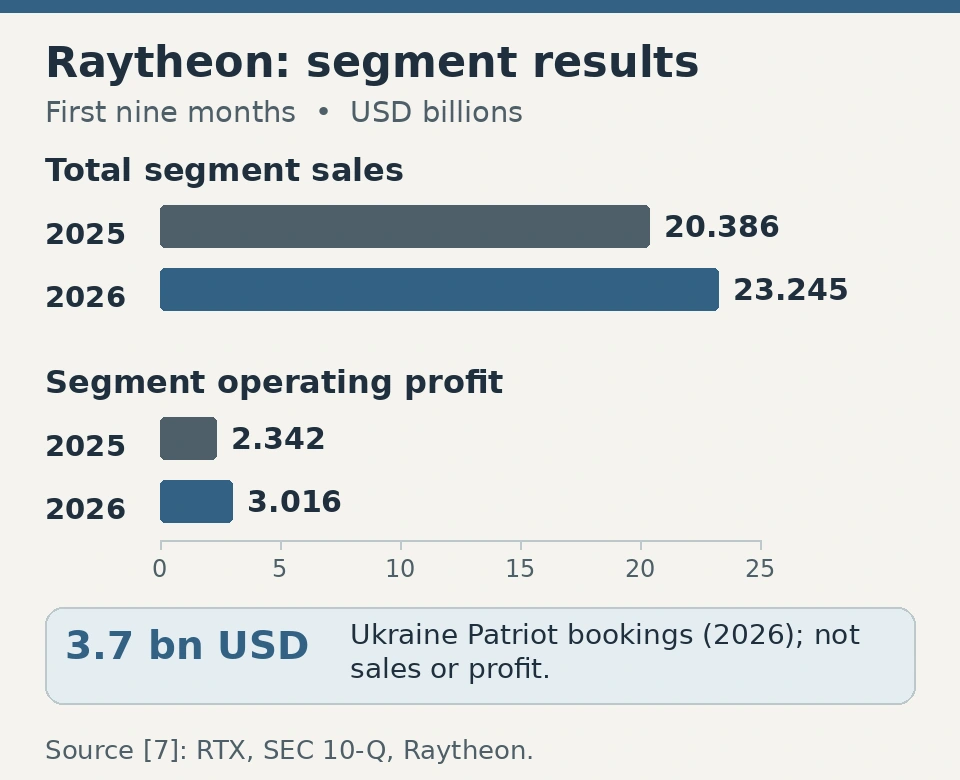
Raytheon is a business segment of RTX, not an additional separate group whose results can be added to RTX's consolidated results. RTX's quarterly report for the period ending 30 September 2026 records orders for Patriot system interceptors for Ukraine worth $3.7 billion in the first nine months of the year. Sales across the Raytheon segment totalled $23.245 billion in the same period, compared with $20.386 billion in the corresponding period of 2025. The segment's operating profit was $3.016 billion, compared with $2.342 billion a year earlier. [7]
This is a documented economic connection between Ukrainian needs and orders placed with an American manufacturer. However, $3.7 billion in orders is not the same as $3.7 billion in payments, still less an equivalent amount of net profit. Growth in sales and operating profit across the segment also reflects other business activities. The report does not make it possible to attribute this amount to PURL or calculate the profit generated exclusively by the war in Ukraine.
The situation is similar at Lockheed Martin. Its report for the period ending 27 September 2026 describes growth in production alongside adverse profit adjustments on certain programmes. [8] Greater demand may mean more orders, but costs, production capacity, contractual obligations and risks affect the ultimate financial outcome. General Dynamics reported company-wide revenue of $14.6 billion and operating earnings of $1.5 billion for the third quarter of 2026. [9] These figures cannot be presented as an account of the company's Ukraine-related business.
The defence industry's economic interest in maintaining orders is understandable in light of its business activities. It does not follow that every company influenced a particular political decision to continue the war. Such a conclusion would require evidence of specific lobbying activity, its connection to decision-makers and its demonstrable effect on the decision. Commercial success alone is not evidence of political or moral responsibility for the duration of the fighting.
The US–Ukrainian Reconstruction Investment Fund (URIF)
Whereas military orders address present needs, URIF is designed for a longer period. In September 2025, DFC announced a US capital commitment of $75 million, to be matched by an equal Ukrainian commitment. [2] The combined $150 million is the sum of those commitments, not necessarily cash already paid in.
DFC's annual management report for fiscal year 2026 provides a more precise picture of the American side: DFC contributed $5 million to the fund during that year, and the carrying amount of its investment on 30 September was $3.6 million. [10] The carrying amount is an accounting figure that does not, on its own, establish that the difference was paid to other persons or represents a final realised loss. The report also states that the federal government does not guarantee the partnership's obligations and has no obligation to cover losses beyond the committed capital.
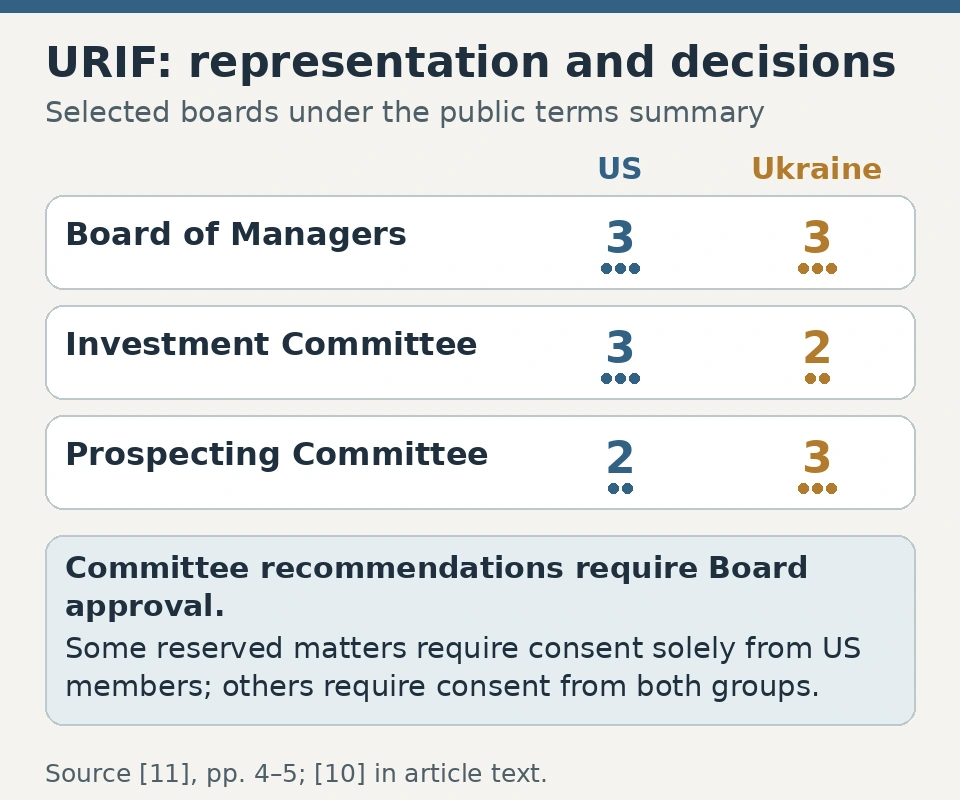
The distinction between ownership of the partnership and management of the fund is important. According to its report, DFC holds the entire economic interest in the general partner company (DFC Ukraine Subsoil, LLC). This is not 100 per cent ownership of the entire fund. The board of managers of the general partner company consists of three American and three Ukrainian representatives. The public summary of the partnership agreement, however, shows that equal representation does not mean a completely equal position in every type of decision. The investment committee has three American and two Ukrainian members, while the Prospecting Committee has two American and three Ukrainian members. The committees' recommendations are submitted to the main board for approval. Some reserved matters require only the consent of the American members, while others require the unanimous consent of both groups of members. [10][11]
On 25 March 2026, the fund announced its first approved investment, in the Ukrainian company Sine Engineering, which operates in the field of dual-use unmanned systems technology. [12] The public announcement does not confirm the amount of the individual disbursement. The first approved project also demonstrates that the fund is not limited to mining. Its scope includes economic activities related to security and technological development.
The Minerals Agreement: Actual Contractual Rights and Obligations
The intergovernmental agreement establishing the fund was concluded on 30 April 2025. The Ukrainian parliament adopted ratification law No. 4417-IX on 8 May, and the law bearing the president's signature was returned on 12 May 2025. [13][14] When interpreting the economic consequences, it is necessary to distinguish the intergovernmental agreement from the more detailed partnership agreement. A public summary of the latter is available, but its complete text has not been verified in this research.
Photograph of the agreement signing, Washington, 30 April 2025 (Wikimedia Commons)
One of the most important provisions concerns 50 per cent of specified government receipts from royalties (charges for the use of natural resources), licence fees and payments under production-sharing agreements. It applies to new licences and certain older licences that, under the contractual definition, were not being industrially exploited when the agreement entered into force. Existing income-producing licences are generally excluded, but the public summary identifies exceptions where less than one per cent of balance reserves have been extracted in the preceding ten years, or where breaches of an approved work programme have persisted for more than five years. The public summary identifies 23 May 2025 as the relevant starting date. [11][13] This does not mean that the United States becomes the owner of half of Ukraine's minerals, half of its territory or half of all Ukrainian budget revenues. It is an irrevocable right of the partnership to those receipts for the duration of its existence. The agreement preserves Ukraine's right to decide which areas will be opened for exploration and resource extraction. [11][13]
Article VI.5 of the intergovernmental agreement stipulates that the assessed value of new military assistance delivered by the US government to the Ukrainian government after entry into force is added to the US partner's capital contribution under the rules of the partnership agreement. According to the public summary, the general partner determines the value if the partners cannot agree. [11][13] This mechanism connects defence assistance with future economic rights. It does not, however, justify the conclusion that every delivery of American weapons paid for by European countries is automatically recorded as a US capital contribution. Such an assessment would require knowledge of the actual funding and valuation rules for each transaction.
The partnership's long-term position is also shaped by information and negotiation rights regarding investments, as well as a time-limited restriction on offering materially more favourable terms to third parties for comparable transactions. When buyers are sought for raw materials, DFC or its designee has the right to make an offer to purchase on market terms, not the right to receive supplies free of charge. The agreement includes special tax and currency provisions, together with exceptions and consultation procedures. [11][13] Such provisions may affect Ukraine's room for manoeuvre in choosing economic partners, although they do not in themselves amount to a transfer of ownership of all deposits or of state sovereignty as a whole.
The timeframe also matters. The public summary of the partnership agreement distinguishes between mandatory reinvestment of revenue from the right to government receipts, the option of reinvesting up to 100 per cent of project earnings, operating expenses and distributions to the partners. Distributions to the partners from project earnings are not permitted before 23 May 2035. [11] It is therefore inaccurate to say that all profits must necessarily be reinvested for ten years regardless of the revenue category and costs. Nor is it possible to predict the amount of future payments. These will depend on actual projects, economic performance and contractual rules, the complete text of which remains beyond the reach of this research.
Lithium, Strategic Raw Materials and the Dobra Project
Lithium is an important raw material in battery production, so investment in its extraction is also linked to energy and industrial policy. In the case of Ukrainian deposits, the distinction between geological potential, confirmed commercially exploitable reserves, the right to develop a project and actual commercial production is crucial. The existence of a deposit does not by itself guarantee an economically viable mine.
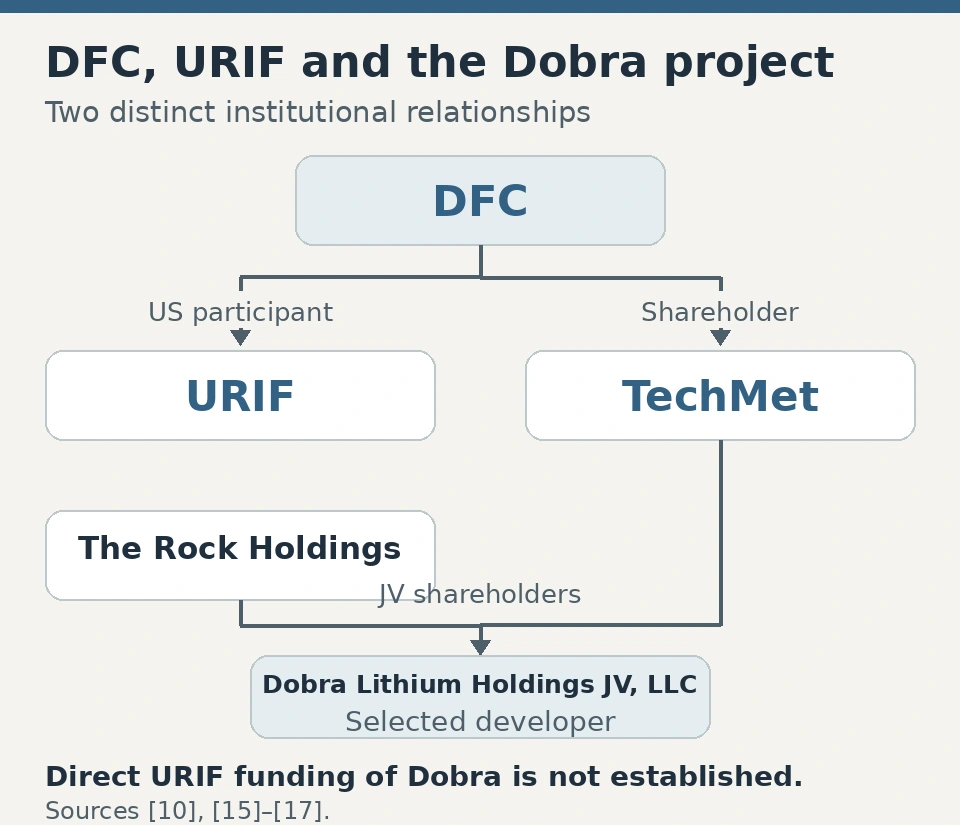
On 12 January 2026, the Ukrainian government announced the selection of Dobra Lithium Holdings JV, LLC to develop the Dobra deposit under a production-sharing agreement mechanism. The company brings together TechMet and The Rock Holdings. The minimum envisaged investment is $179 million, of which $12 million is intended for geological exploration and an international audit of reserves, and $167 million for ore extraction and beneficiation, conditional on confirmation of commercially exploitable reserves. [15] This is a planned commitment under the stated conditions, not evidence that this amount has already been spent or that the mine has begun production.
TechMet's ownership link to the US government is also significant. In August 2024, Qatar's sovereign wealth fund, QIA, announced a $180 million investment in TechMet and, in the same announcement, cited DFC's then total capital commitment of $105 million. On its corporate information page, TechMet lists DFC among its significant shareholders. [16][17] These data establish an institutional connection, but not the complete current ownership structure or the amount of personal benefits received by individual owners. Regarding the Dobra project, the Ukrainian government emphasised integration into the supply chains of strategic partners while retaining ownership of the deposit in the hands of the Ukrainian people. [15]
DFC thus acts in two distinct capacities: as the US participant in URIF and as an investor in a company involved in the Dobra project. This is grounds for careful scrutiny of selection procedures, contractual terms and potential conflicts of interest. It is not, however, evidence that URIF directly financed Dobra, that the selection of the winning bidder was manipulated or that an improper transfer of funds took place. Such an assessment would require the complete documentation of the procedure, the final production-sharing agreement and the actual financial flows. [10][15][16][17]
In October 2026, the US Treasury separately announced approval of the establishment of a joint URIF platform with BGV Group Management for investment in early-stage mineral projects. [18] That approval cannot be counted as already confirmed financing for Dobra. Together, however, the two examples show why long-term economic interests in strategic raw materials need to be monitored at the level of individual projects rather than solely through political announcements.
Energy, Infrastructure and Post-war Reconstruction
Reconstruction is not necessarily an activity that begins only after a peace agreement. Energy systems, production capacity and public services require investment even during war. In these circumstances, benefits for civilians and business opportunities can coexist. In the energy sector, the immediate public interest is a more reliable supply for the population, while investors must assess anticipated revenue, costs and risks.
On 2 October 2026, the US Treasury announced approval of a URIF equity investment in a distributed combined heat and power platform and of debt financing related to a DTEK battery energy storage facility. [18] Equity investment and lending are distinct instruments: the former generally provides participation in a company's economic performance, while the latter creates a contractual claim. The announcement of approvals does not establish individual disbursements or final returns.
The financial risk of these projects is particularly important. Following URIF's June board meeting, the US Treasury reported on a framework for cooperation between DFC and the Multilateral Investment Guarantee Agency (MIGA) in political risk insurance. [19] Such a framework can help manage risks that private capital alone may struggle to accept, but it is not evidence that a specific policy was issued for every project or that an insurance payout was made.
It is precisely here that the question of how risks and benefits are distributed arises. If public institutions help reduce investment risks, it matters which losses public funders may bear, who is entitled to potential returns and what obligations private partners have. Aggregate announcements of investment packages are not sufficient to answer these questions. Actual contractual terms and implementation reports are needed, taking into account the benefits these projects may bring to the Ukrainian population.
State, Corporate and Personal Financial Interests
The connections between American government institutions, defence manufacturers and investment projects do not mean that they all pursue the same objectives or that all the money ends up with the same recipients. A state may pursue strategic influence and security objectives; a company, commercial results; an investment fund, returns and development objectives; and a political office-holder, political interests of their own. These roles may complement or conflict with one another. Their intersection is a legitimate subject of public scrutiny. American policy must therefore be judged not only by the declared purposes of assistance, but also by the contractual rights, distribution of benefits and political obligations it creates.
The documents reviewed for this analysis establish specific orders placed with the defence industry to meet Ukraine's needs, capital commitments by public institutions, rights under the intergovernmental agreement and individual approved investments. [2][7][10][11][12][13][18] None of the documents reviewed establishes that Donald Trump personally received any profit from URIF in 2026. DFC's economic interest in the general partner company is an institutional stake, not Trump's personal property. Nor do the provisions concerning the earliest date for distributions of returns to the partners establish personal financial flows or rule out all other possible forms of financial interest outside the fund.
Establishing a specific conflict of interest requires identifying the recipient, their ownership or contractual position, the related public decision and its actual or potential economic effect. Establishing that an individual received funds also requires a traceable record of a specific payment. An allegation of improper influence over political decisions requires further evidence of the connection between the influence and the decision, as well as a basis for judging that the influence was improper. The absence of such evidence does not mean that public scrutiny is unnecessary; it means that an accusation cannot be presented as an established fact.
Who Has an Economic Interest in War, and Who in Peace?
The defence industry has an economic interest in orders. A prolonged war may increase demand for weapons, ammunition, maintenance and the replenishment of depleted stockpiles. At the same time, it creates costs, production risks and constraints. [3][7][8][9] An end to the war would therefore not necessarily mean an end to defence orders: stockpile replenishment, long-term deterrence and the maintenance of military capabilities can sustain demand even in peacetime. A commercial interest in orders cannot, without further evidence, be taken as an interest in endless war. That is precisely why decisions about peace must not be subordinated to the interests of arms suppliers.
For the development of mines, energy systems and infrastructure, the relationship is often different. Investors need a predictable legal environment, access to capital and the ability to operate over the long term. War may create reconstruction needs, but it also makes projects harder to implement and increases the risk of investment losses. [11][15][18][19] More stable conditions may improve the prospects for such investments, although they do not by themselves guarantee success. The US government, too, may therefore have different economic interests that do not necessarily align over time.
For Ukraine, the essential question is whether international cooperation will enable it to preserve its security, rebuild its economy and retain genuine freedom to make its own decisions. Contracts may bring capital, technology and access to markets while imposing long-term limits on certain economic choices. For European countries, the question remains how much financial responsibility they are assuming and what security and economic effects these obligations have. For American institutions and companies, what matters is that they can connect their participation in Ukraine's defence and reconstruction with their own strategic and commercial objectives. The principal test of economic cooperation should be whether the Ukrainian population can make its own long-term decisions about its country's development, not merely whether foreign investors' objectives are fulfilled.
The war cannot be explained solely by the financial interests of its economic participants. Nor should political decisions be exempt from scrutiny because they are justified in the name of security or solidarity. The true value of a future peace will be measured not only by the scale of new investment, but also by how much security, dignity and freedom to make their own decisions it brings to the people who will live in Ukraine long after the signatories of today's agreements have left their positions.
Sources and further reading
- White House, 8 July 2026. Official presentation of NATO allies’ defence investments and benefits for American industry. Source Source
- DFC, 17 September 2025. DFC Kickstarts US-Ukraine Reconstruction Investment Fund with $75 Million Seed Capital Equity Investment. Source Source
- Lead Inspector General, November 2026. Operation Atlantic Resolve, Report to Congress, July 1–September 30, 2026, pp. 8, 16, 29. Official copy at State OIG; copy at USAID OIG. Source 1 Source 2
- Ministry of Defence of Ukraine, 18 November 2026. Ukraine will be able to pay for U.S. weapons through PURL with EU loan funds. Source Source
- Government of the Netherlands, 18 June 2026. Announcement of a new €500 million assistance package for Ukraine. Source Source
- Ministry of Foreign and European Affairs of the Republic of Slovenia, 8 July 2026. Minister Kajzer na vrhu zveze NATO v Ankari [Minister Kajzer at the NATO summit in Ankara]. Source Source
- RTX, 20 October 2026. SEC Form 10-Q, period ending 30 September 2026, Raytheon section. Source Source
- Lockheed Martin, 22 October 2026. SEC Form 10-Q, period ending 27 September 2026. Source Source
- General Dynamics, 30 October 2026. Report on third-quarter 2026 financial results. Source Source
- DFC, November 2026. FY 2026 Annual Management Report, note 19, p. 67. Source Source
- Ukraine Public-Private Partnership Agency, 2025. Summary of Terms of Partnership, public summary of the partnership agreement dated 23 May 2025, pp. 2–5. Source Source
- DFC, 25 March 2026. URIF Announces First Investment, Strengthening Ukraine’s Security and Unlocking New Emerging Technology for the United States and Allies. Source Source
- Government of Ukraine and Government of the United States, 30 April 2025. Agreement between the Government of Ukraine and the Government of the United States of America on the Establishment of a United States-Ukraine Reconstruction Investment Fund. PA-X transcription, University of Edinburgh, Articles II, IV–VIII and Annex A. Source Source
- Verkhovna Rada, May 2025. Law No. 4417-IX on ratification of the agreement, legislative record 0309. Source Source
- Government of Ukraine, 12 January 2026. Announcement of the selection of the developer of the Dobra lithium deposit under a production-sharing agreement. Source Source
- Qatar Investment Authority, 7 August 2024. QIA to Invest $180 Million in TechMet. Source Source
- TechMet. About us, section on US government support. No publication date. Source Source
- U.S. Treasury, 2 October 2026. URIF Approves Additional Investments and Partnerships in Energy and Critical Minerals. Source Source
- U.S. Treasury, 30 June 2026. URIF Holds Fourth Board Meeting at Ukraine Recovery Conference. Source Source