Europe Pays: War, Debt and the Defence Industry
How European loans, public debt and defence procurement shape the financing of the war in Ukraine and raise questions about economic benefits and accountability.
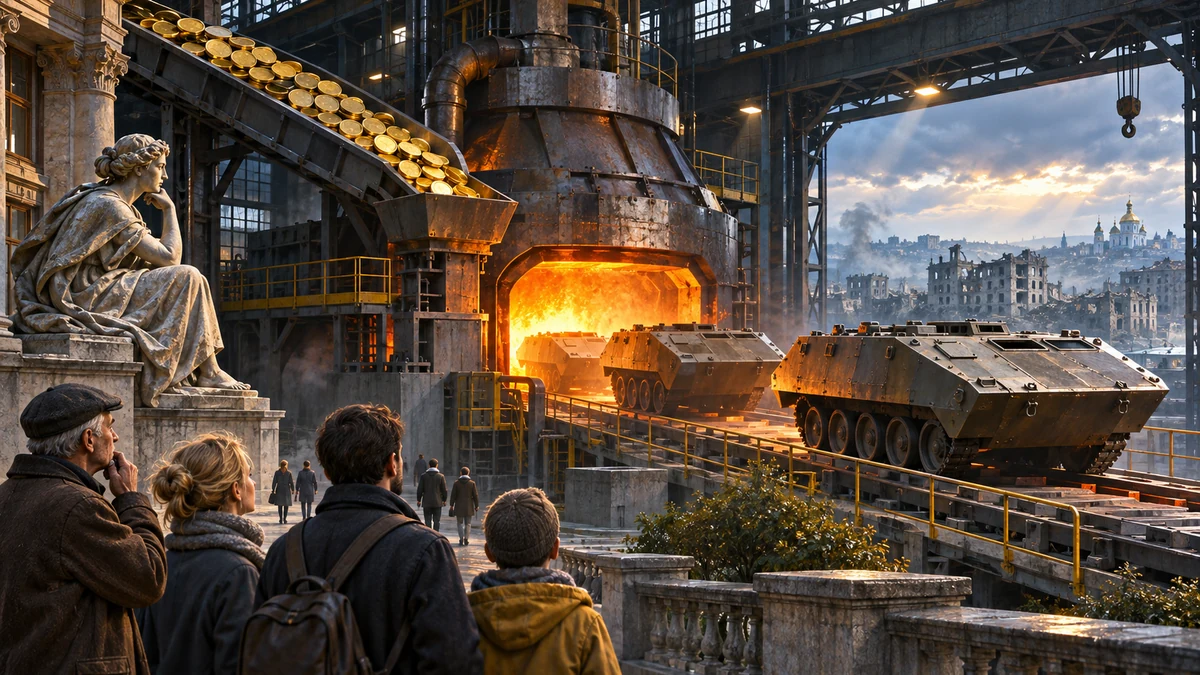
AI-generated symbolic editorial illustration of public financing, the defence industry and the consequences of war; not a documentary image.
Decisions on the battlefield alone do not determine the course of a war. Its duration and a country's ability to defend itself also depend on who is willing to finance its expenditure, who produces the necessary equipment, and who assumes the risk if anticipated sources of future funding fail to materialise. European support for Ukraine is therefore a question of solidarity, security, public finance and industrial policy all at once. These dimensions also raise questions of responsibility towards the people the aid is intended to benefit and those on whose behalf financial commitments are made.
In assessing European policy up to 25 November 2026, it is essential to distinguish between money that has been promised, money that has been legally authorised and money that has actually been disbursed. The same applies to companies: the value of an order is not necessarily revenue already earned; revenue is not profit; and profit alone does not establish political influence. Only by making these distinctions can we meaningfully ask who finances the war, who benefits economically from it and who bears its long-term cost.
From Financial Aid to a Long-Term War Economy
Following the start of Russia's large-scale military operation in Ukraine, European governments made decisions about supporting the country under attack and protecting their own security. Their choice of the extent and form of support warrants independent political scrutiny. Support involves more than the supply of military equipment. It also concerns the operation of public administration and public services, and the Ukrainian state's ability to maintain financial stability under wartime conditions. The prolonged nature of the war is changing the character of that assistance: occasional spending decisions are evolving into multi-year financing and production plans.
On 4 February 2026, the Council of the EU cited a preliminary International Monetary Fund estimate putting Ukraine's remaining financing needs for 2026 and 2027 at €135.7 billion, on the assumption that the war would end in 2026. This figure was a conditional projection, not a forecast with a guaranteed outcome. In November, the Commission presented an estimate of an additional financing gap of approximately €70 billion for 2027. [1] [2]
The comparison does not establish that the two estimates were calculated using the same method or that the difference between them represents the direct cost of an additional year of war. It does, however, illustrate why financial commitments cannot be assessed independently of assumptions about the duration of the conflict. Preparing funding in case the war continues may be a precautionary security measure. At the same time, it creates economic expectations and institutions whose operations will need to be reassessed if circumstances change.
Europe's €90 Billion Loan and Additional Financing Proposals
The legal framework for the Ukraine Support Loan (hereafter USL) was finalised on 23 April 2026. The envisaged total for 2026 and 2027 is up to €90 billion, with an indicative allocation of €60 billion for defence capabilities and €30 billion for budgetary support. A total of 24 member states participate in the enhanced cooperation arrangement. Funding is raised through EU borrowing on capital markets, backed by the EU budget. [3]
Up to €45 billion was available for 2026: €8.35 billion for macro-financial assistance, an equal amount through the Ukraine Facility and €28.3 billion for defence industrial capabilities. For 2027, the Council adopted Implementing Decision (EU) 2026/2623 on 23 November, published on 25 November. According to the accessible text of Article 2a, it allocated the remaining sum of up to €45 billion within the same loan as follows: up to €6.65 billion through the Ukraine Facility, up to €6.65 billion in macro-financial assistance and up to €31.7 billion for defence capabilities. [3] [4]
Separately, on 18 November the Commission proposed a new loan of up to €45 billion for 2027, comprising up to €25 billion in military assistance and up to €20 billion in general budgetary support. The proposal envisaged new EU borrowing and a budgetary guarantee; in the Commission's announcement, adoption of the legislation remained the next step. [2]
The remaining €45 billion of the original loan and the additional proposal cannot therefore be treated as two disbursements that have already taken place. They are at different legal stages. Nor is the combined nominal value of the financial instruments the same as their ultimate cost to European public finances: determining that cost requires knowledge of the amounts drawn down, financing terms and actual course of repayments.
The financial architecture of EU support for Ukraine
| Category | Total amount | Defence | Budget support | Note |
|---|---|---|---|---|
| USL 2026–2027 (overall legal framework) | up to €90bn | €60bn (indicative) | €30bn (indicative) | legal framework finalised 23 April 2026 [3] |
| Remaining amount within the same USL for 2027 | up to €45bn | up to €31.7bn | up to €13.3bn | allocation within the same loan [4] |
| Additional Commission proposal of 18 November 2026 | up to €45bn | up to €25bn | up to €20bn | separate new legislative proposal [2] |
The table distinguishes the legally adopted overall framework, its 2027 allocation and the separate new Commission proposal; these categories are not cumulative sums already paid out.
From Political Pledges to Actual Disbursements
Macro-financial assistance and the Ukraine Facility are different channels of budgetary support. Some USL funds are disbursed through the existing Ukraine Facility instrument, so published amounts may overlap. Adding the entire disbursement under that instrument to the USL-funded portion of the same disbursement would count the same money twice.
On 25 June 2026, the Commission disbursed €3.2 billion in macro-financial assistance. The Ukraine Facility disbursement of €2.9 billion on 2 October included €800 million from the USL. On 5 November, the Commission disbursed a further €4.36 billion under the USL: €3.7 billion in macro-financial assistance and €658 million for defence; the published total is rounded. [5]
A defence disbursement of €1.71 billion followed on 16 November. According to the accessible excerpt of the EU delegation's announcement, cumulative defence disbursements under this loan had then reached €18.1 billion. [6] On 5 November, the Commission had reported €16.4 billion in such disbursements. [5] Both figures are cumulative and already include previous defence disbursements. On 20 November, according to an officially published excerpt, the Commission reported a disbursement of approximately €7.9 billion through the Ukraine Facility, of which €5.1 billion came from the USL. [7]
These examples do not provide a complete account of all European funding. They illustrate the distinction between instruments and stages of decision-making. To establish precisely how much funding had been drawn down by the cut-off date, each disbursement would need to be reconciled with its legal basis and inclusion in the official cumulative figures. Authorising a tranche does not constitute an additional disbursement on top of the subsequent transfer of that same tranche.
European Debt, Interest, Reparations and Taxpayers
The loan creates two distinct financial relationships. The first is between the Union and its lenders, who must be repaid in accordance with the borrowing terms. The second is between the Union and Ukraine, where special conditions govern when the principal becomes due. A budgetary guarantee makes financing possible, but does not mean that the entire authorised principal has already become a loss to taxpayers.
Article 20 of Regulation (EU) 2026/467 links repayment to specified triggers, including Russian reparations or other settlements for damage. It also establishes triggers relating to a breach of the fundamental precondition and to established fraud, corruption or other illegal activities connected with the management of the loan. A breach of the fundamental precondition concerns the entire outstanding amount; an established irregularity concerns the amount involved in that irregularity. Reparations are taken into account in the prescribed proportion relative to other eligible outstanding loans. [8]
Article 22 permits a borrowing cost subsidy upon an annual request and within the authorised budgetary appropriations. The costs include funding, liquidity management and administrative expenses. This is neither a predetermined interest rate nor a guarantee of an identical annual subsidy. Under Article 4(4), non-participating member states are entitled to an adjustment in respect of expenditure resulting from enhanced cooperation, with the exception of the institutions' administrative costs. [8] If anticipated reparations fail to materialise or repayment takes longer, the question arises of how long the Union's financial exposure will last. The precise final cost cannot be calculated from the nominal value of the loan alone.
For European citizens, the key question is therefore how actual financing costs and potential budgetary consequences will be reported under different scenarios. Without information on the terms of individual debt issues, the agreement with Ukraine, future budgetary decisions and repayments, it would be misleading either to declare the entire amount a certain loss or to promise that Europe will incur no cost at all.
Where Does European Money Go?
Defence assistance is not necessarily directed exclusively to companies in the European Union. The rules also provide for Ukrainian manufacturers, certain other European countries and third countries subject to prescribed conditions; derogations are possible in cases of urgent need. [3] The €60 billion framework for defence capabilities is therefore not equivalent to the sales value of European arms manufacturers.
The Commission stated that most of the €658 million defence component of the 5 November disbursement was intended for procurement from Ukrainian companies. [5] For the subsequent defence disbursement on 16 November, accessible excerpts of official announcements indicated that approximately 40 per cent of the €1.71 billion was earmarked for contracts with manufacturers established in the EU. [6] [9] That amounts to approximately €684 million intended for contracts, not proof that individual companies have already received the money. The proportion in a single tranche does not represent all European defence disbursements.
Under Articles 21 and 23 of the regulation, a request for defence financing may include signed contracts or their final drafts. Following a positive assessment, a disbursement linked to the value of the relevant contracts is authorised. [8] This is another reason to distinguish between supplier eligibility, contract value, disbursement to Ukraine, payment to the supplier and actual delivery. Knowing only one of these does not necessarily tell us the others.
Industrial benefits are not confined to the final assembler: some of the money may cover components, labour, investment, development, production financing and other costs. Establishing the precise distribution requires documentation of the specific transactions. Protecting commercially and militarily sensitive information does not remove the need for institutional oversight, although it limits the detail available to the public. [8]
Rheinmetall, BAE Systems, Leonardo, Thales, Saab and KNDS
Manufacturers' financial results show that increased demand for defence equipment creates economic opportunities. They do not, however, automatically reveal how much European aid to Ukraine has flowed to each group. Companies operate in different markets, enter into multi-year contracts and report in different currencies and using different accounting measures.
On 5 November, Germany's Rheinmetall announced that sales in the first nine months of 2026 had increased from €6.057 billion to €8.376 billion, while its operating result had risen from €795 million to €1.339 billion. Deliveries to Ukraine were among the factors contributing to sales, alongside customers in other European countries and business expansion. Operating free cash flow was negative, with the company citing an increase in inventories. [10] Growth in profitability and available cash flow are therefore distinct measures of performance.
On 12 November, Britain's BAE Systems reported £33 billion in orders secured in 2026 up to the date of its announcement. Its operations span multiple markets and major government programmes, not Ukraine alone. [11] On 5 November, Italy's Leonardo reported an order backlog worth €60.4 billion, which was also affected by the incorporation of the acquired company IDV. [12] Comparing growth without accounting for changes in the group's scope may overstate growth attributable to new orders.
France's Thales reported sales of approximately €16.4 billion in the first nine months of 2026. Growth was 7.6 per cent on a reported basis, or 8.1 per cent at constant exchange rates and scope. [13] Sweden's Saab reported an order for Ukraine worth SEK 24.6 billion in the third quarter, included in total quarterly order bookings of SEK 65.825 billion. Its quarterly earnings before interest and tax (EBIT) amounted to SEK 1.945 billion. [14] The value of the Ukrainian order is neither revenue already recognised from that order nor evidence of the source of its entire financing.
In June 2026, France and Germany announced an agreement on the strategy and governance of the KNDS group. Its objectives include expanding industrial capacity and strengthening European defence sovereignty; the agreement also opens up the possibility of a stock exchange listing. [15] This is an important example of the interplay between state industrial policy and corporate strategy. It provides no figure for the amount KNDS has received from the USL. For all six groups, separate contractual and financial records would be needed before a specific share of the European loan could be attributed to them.
Defence companies and the meaning of the figures cited
| Company | Figure cited | What it represents | Caution |
|---|---|---|---|
| Rheinmetall | €8.376bn | sales Jan–Sep 2026 | not profit; not exclusively Ukraine [10] |
| BAE Systems | £33bn | orders secured in 2026 up to the November announcement | not revenue [11] |
| Leonardo | €60.4bn | order backlog at end of Sep 2026 | not annual revenue; includes IDV [12] |
| Thales | approximately €16.4bn | sales Jan–Sep 2026 | includes wider operations [13] |
| Saab / KNDS | see the cited statements in Section 6 | different business or strategic information | limited comparability [14] [15] |
The cited business figures are not directly comparable because they do not measure the same category and do not necessarily refer exclusively to Ukraine-related business.
Defence Industry Ownership and Shareholder Benefits
Business growth can benefit shareholders through dividends, share buybacks and increases in the market value of their investments. A shareholder, however, is not the direct recipient of every government payment to a company. Nor are an investment asset manager, a legal owner and an ultimate economic beneficiary necessarily the same person. Without these distinctions, an examination of ownership quickly becomes a list of names with no evidentiary value.
In November, BAE Systems expected to return approximately £1.6 billion to shareholders in 2026, including dividends and share buybacks. This was a forecast of the total annual amount, not confirmation that all the money had already been paid or that it came from business with Ukraine. [11]
Ownership structures vary. Leonardo's governance report states that on 10 March 2026 the Italian Ministry of Economy and Finance held 30.204 per cent of the company's ordinary share capital and voting rights. [16] In its own overview of the group, Dassault Aviation reports a 27 per cent stake in Thales. [17] At Saab, a Class A share carries ten votes and a Class B share carries one; all Class A shares are held by Investor AB. [18] A share of the capital is therefore not necessarily equivalent to a share of the voting rights.
A state can simultaneously be a customer, a rule-maker and a shareholder in a defence company. This does not in itself establish abuse, but it increases the importance of clearly distinguishing roles and responsibilities. It must be possible to assess the public interest in security independently of the financial interests of a company or its owner. State ownership must not become a reason for subjecting defence procurement to less stringent oversight.
Lobbying and the Interplay Between Industry and Political Institutions
Dialogue with government institutions carries particular weight in the defence industry because public decisions on budgets and procurement shape a substantial part of the market. Industry can provide authorities with expert information about production capacity, while also having an interest in decisions that increase demand for its products. The question is not merely whether companies represent their interests, but also how transparently they do so and what influence that representation has.
For the 2025 financial year, the German Lobbying Register records expenditure on interest representation of between €820,001 and €830,000 for Rheinmetall AG (R002018). For KNDS N.V. (R002952), it records a range of €400,001 to €410,000. [19] [20] These figures concern interest representation within the scope of the German register, not total lobbying activity across the EU or worldwide. Neither range measures the effectiveness of lobbying.
These figures cannot establish that a particular vote resulted from lobbying or that any of the companies deliberately prolonged the war. Such an assessment would require a traceable connection between a specific proposal put forward by an interest group, contacts with decision-makers, a change in regulation, a potential conflict of interest and the consequences of the decision. Without that connection, we can reasonably demand transparency, but we cannot derive an accusation from financial interest alone.
Between Security Needs and Economic Interests
Advocates of European support for Ukraine's defence emphasise preventing further aggression, helping a country under attack and reducing risks to their own security. Defence production can contribute to deterrence, more reliable supply chains and employment. These benefits are not necessarily at odds with the pursuit of lasting peace.
At the same time, financial flows create economic interests that do not always coincide with every objective of public policy. A company may have an interest in predictable demand and long-term utilisation of its production capacity. A government must also make decisions about taxation, public debt, social needs, security risks and diplomatic options. That is precisely why the benefits to manufacturers cannot replace an independent assessment of whether a defence decision is necessary and proportionate to its objective.
European institutions cannot evade accountability for their wartime policies by invoking Russia's responsibility for the invasion. European decisions on financing, armament and diplomacy must be judged by their own consequences. The critical question is whether financing mechanisms can also adapt to declining needs, whether recipients and outcomes are adequately monitored, and whether economic interests are kept separate from political decisions on war and peace. Article 4(3) of Regulation 2026/467 provides for the possibility of reducing or cancelling the undisbursed amount if Ukraine's needs decrease significantly. [8]
The Long-Term Cost of European War Policy
The war has several possible consequences for European public finances. If defence needs diminish, future financial commitments may also decline, but debt already incurred and financing costs do not automatically disappear as a result. If the war continues, new requests for assistance and further borrowing may arise. If reparations or other legally permissible settlements actually become available, part of the loan may be repaid. None of these scenarios alone establishes what the final bill will be.
Taxpayers have the right to understand how funds were authorised, what liabilities were incurred, what deliveries were made and how their effectiveness is assessed. This also includes the question of alternative uses of public money. Comparing defence expenditure with spending on healthcare, housing, education or infrastructure requires actual budgetary data; simply declaring every nominal loan amount to be money taken directly from those areas is not enough.
Europe's war economy reveals a dual responsibility. Europe must make decisions about its security and assistance to Ukraine while explaining the cost and conditions of those decisions. Although certain business effects and financial instruments are documented, the full trail from European borrowing to ultimate suppliers and shareholders is not yet apparent from the material reviewed. That limitation is precisely why better public oversight is needed; it is not a licence to invent missing data. Political success cannot be measured solely by the volume of funds authorised; what also matters is whether decisions contribute to people's security and prospects for peace.
The question does not end with the European market. The next article in the series examines American economic and strategic interests, where it is equally important to distinguish between public policy, commercial contracts, investments and the actual recipients of benefits.
Note on sources: For the implementing decision on 2027 financing and the November disbursement announcements [4], [6], [7], [9], official textual excerpts were accessible during preparation; the complete documents could not be reopened. The precision of the statements is limited to the portions available.
Sources and further reading
- Council of the EU. Council agrees position on legal framework to provide €90 billion in financial support to Ukraine. 4 February 2026. source Source
- European Commission. Commission proposes €45 billion in additional financial support for Ukraine in 2027. 18 November 2026. source Source
- Council of the EU. Council finalises €90 billion support loan to Ukraine. 23 April 2026. source Source
- Council of the EU. Implementing Decision (EU) 2026/2623, 23 November 2026, Official Journal of the EU 25 November 2026, Article 2a. source Source
- European Commission. Commission disburses €4.36 billion to Ukraine under the €90 billion Ukraine Support Loan. 5 November 2026. source Source
- EU Delegation to Ukraine (EEAS). Commission disburses another €1.71 billion to Ukraine for drones, ammunition and air defence systems. 17 November 2026, concerning the disbursement of 16 November. source Source
- European Commission. Commission disburses €7.9 billion to strengthen Ukraine's financial stability and advance reform efforts. 20 November 2026. source Source
- European Parliament and Council of the EU. Regulation (EU) 2026/467, 24 February 2026, in particular Articles 4, 20–25. source Source
- European Commission. Press release IP/26/2452 concerning the €1.71 billion defence disbursement, 16 November 2026. source Source
- Rheinmetall AG. Rheinmetall in the first nine months of 2026: Record growth and a high level of profitability – Operating result in excess of €1.3 billion. 5 November 2026. source Source
- BAE Systems plc. Market update. 12 November 2026. source Source
- Leonardo S.p.A. Board of Directors approves 9M2026 results. 5 November 2026. Regulatory announcement, published via FinancialFilings. source Source
- Thales. Thales reports its order intake and sales as of September 30, 2026. 22 October 2026. Regulatory announcement, published via WebDisclosure. source Source
- Saab AB. Saab Q3 results 2026: Positioned to capture growing demand. 23 October 2026. source Source
- Presidency of the French Republic. France and Germany have reached an agreement on the strategy and governance of KNDS. 22 June 2026. source Source
- Leonardo S.p.A. Corporate Governance Report – Financial Year 2025, Table 1, p. 85, as of 10 March 2026. source Source
- Dassault Aviation. Shareholding Structure and Organization Chart. source Source
- Saab AB. The share. source Source
- Deutscher Bundestag. Lobbyregister: Rheinmetall AG, R002018, financial year 2025. source Source
- Deutscher Bundestag. Lobbyregister: KNDS N.V., R002952, financial year 2025. source Source