The Revolving Door: Personnel Movements Between Financial Institutions and Regulators
Reviews revolving-door career moves between finance and regulators and safeguards against conflicts of interest.

Symbolic editorial illustration generated with AI.
When we speak of financial power, we usually think of bank ownership, shares, investment funds and money. Yet people who understand how financial markets and the institutions that regulate them operate are also highly valuable. Former bankers become senior officials in public bodies, while former regulators take up positions of responsibility in the financial industry. This movement of personnel, known as the revolving door, reveals a connection between private capital and public authority that cannot be explained by ownership stakes alone. How can we distinguish the beneficial exchange of expertise from the danger of private interests taking precedence over the public interest?
What Is the Revolving Door?
The phenomenon operates in two main directions. A specialist from a bank, fund or financial trade association may take on a role in policymaking or supervision. Conversely, after leaving public service, an official may find employment with a company or association affected by decisions made by their former institution. Some careers involve several such moves. Such moves do not necessarily involve lobbyists or direct financial compensation for a particular decision.
A former regulator's value to the financial industry may derive from their familiarity with procedures, technical issues, contacts and institutional ways of thinking. Conversely, a banker may bring a public body knowledge of the markets and financial instruments it must understand in order to regulate them effectively. The danger arises when confidential information, expectations of future employment or previous business relationships threaten impartiality. The mere possibility of such a conflict of interest warrants safeguards, but it does not prove that anyone has actually exploited their position for personal benefit.
The Farkas Case: When Safeguards Were Insufficient
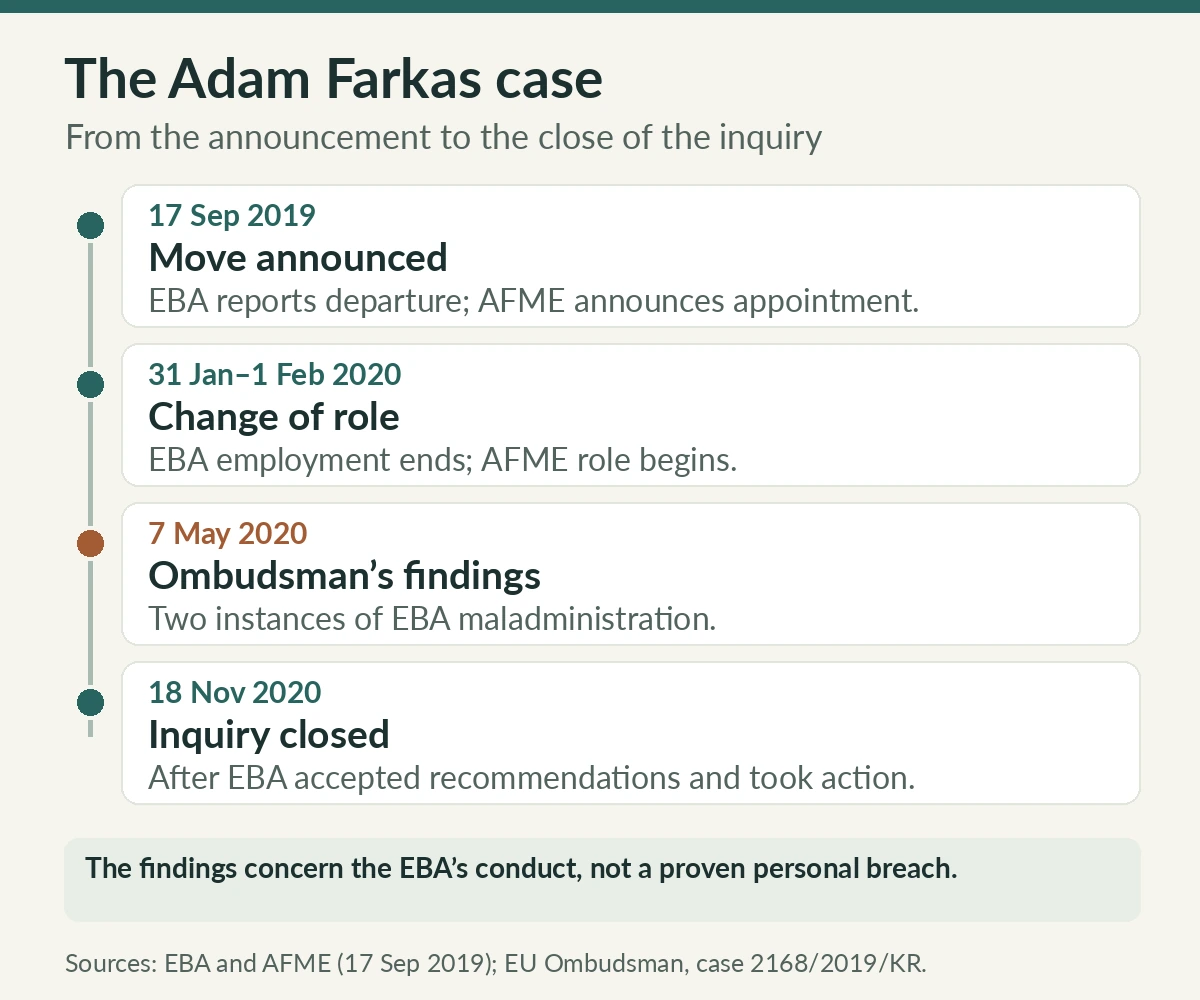
In September 2019, the European Banking Authority (EBA) and the Association for Financial Markets in Europe (AFME) announced that Adam Farkas, then Executive Director of the EBA, would take over as head of the association. His employment at the EBA ended on 31 January 2020, and he started his new job the following day. AFME represents the interests of the financial industry, whereas the EBA helps develop banking rules and coordinate supervisory practices. The move therefore linked two institutionally distinct roles within the same field. [1] [2]
The EBA recognised the risk. It imposed a 24-month restriction on lobbying the EBA and on professional contacts with its staff, as well as an 18-month restriction on providing advice on matters directly related to Farkas's work during his final three years of service. It also restricted his duties before his departure. The inquiry timeline shows that the Board of Supervisors adopted the restrictions on 12 September 2019, while technical restrictions on access to information began on 23 September. He was on paid leave from November until the end of January. [1] [3]
Following a complaint, European Ombudsman Emily O’Reilly investigated the EBA's handling of the matter. She identified two instances of maladministration: given the risks, the EBA should have prohibited the move to the new job, and it had failed to restrict access to confidential information immediately. In her final decision of 18 November 2020, she stated that the EBA had accepted the recommendations and taken steps to implement them. These included criteria for future time-limited employment prohibitions and procedures for safeguarding information. [4]
This case goes beyond merely listing career histories. There is an official finding that the safeguards chosen were insufficient. However, the findings concern the EBA's responsibility in handling the move. We cannot infer from them that Farkas disclosed confidential information, breached the restrictions or secured a particular legislative change for the financial industry. Such claims would require separate evidence. [4]
Campa and Barroso: Two Different Directions of Movement
Before becoming Chairperson of the EBA, José Manuel Campa headed global regulatory affairs at Santander. He took up his EBA position on 1 May 2019, following confirmation of his nomination by the European Parliament. His career illustrates a move from a position in which a private bank deals with financial rules to a senior post in a body that helps formulate them. [5] The fact that Campa previously worked for a bank does not, in itself, tell us how he made decisions in particular cases or whether the bank obtained any special advantage.
José Manuel Barroso's case illustrates the opposite direction. After two terms as President of the European Commission between 2004 and 2014, he became Non-Executive Chairman of Goldman Sachs International and an adviser to Goldman Sachs in July 2016. [6] His appointment prompted debate about the duties of former senior European Union officials. According to the Ombudsman's October 2016 summary, the ethics committee at the time considered that Barroso had not breached the code of conduct, although it acknowledged damage to the institutions' reputation. [7]
In March 2018, the Ombudsman called for a fresh ethical assessment. This followed a meeting between Barroso and a Vice-President of the Commission that had been recorded as a meeting with Goldman Sachs. Both participants subsequently described it as a private meeting. The Ombudsman also drew attention to the absence of a formal Commission decision on his employment. According to the official register, the joint inquiry concluded in July 2018 with a finding of maladministration on the part of the Commission. [8] [9] We were unable to access the full text of the final decision directly during this research, so our assessment is limited to the official publication of the recommendation and the recorded outcome. This is not a judicial finding of personal misconduct by Barroso.
American Career Paths: Dudley, Gensler, Mnuchin and Deese
In the United States, too, there is no entirely impermeable barrier between senior positions in financial and public institutions. In January 2007, William C. Dudley moved from Goldman Sachs to the Federal Reserve Bank of New York, where he initially headed the Markets Group. He had previously served, among other roles, as Goldman Sachs's chief US economist. He had also worked as an economist at the Federal Reserve Board of Governors in the early 1980s. On 27 January 2009, he became President of the New York Fed and, in that capacity, Vice-Chairman of the Federal Open Market Committee (FOMC), which sets monetary policy. [10] [11]
Gary Gensler was a partner at Goldman Sachs before holding senior positions at the US Treasury between 1997 and 2001 and later chairing the Commodity Futures Trading Commission (CFTC). Between his public appointments, he also worked in academia. From 17 April 2021 to 20 January 2025, he chaired the Securities and Exchange Commission (SEC). [12] His career does not represent a direct move from Goldman Sachs to the SEC, as there were numerous other jobs and appointments in between.
Before becoming US Secretary of the Treasury in February 2017, Steven Mnuchin worked at Goldman Sachs and subsequently in the private investment sector, including at Dune Capital Management, and led OneWest Bank. According to material published by the Senate policy committee, he held a leadership position at OneWest between 2009 and 2015. [13] [14] The Treasury is an executive branch department with broad responsibilities for financial policy, not merely a specialist supervisory institution. From a revolving-door perspective, the important point is that its head brought into public service experience from activities that could be affected by the department's decisions.
Brian Deese worked in public economic policy during Barack Obama's administration and then served as global head of sustainable investing at BlackRock between 2017 and 2020. Between 2021 and 2023, he headed the National Economic Council (NEC) at the White House. [15] [16] The NEC is an economic policy advisory and coordinating body, not a regulator in the strict sense. Deese thus illustrates a move from public policy into asset management and back into an environment where economic policy is formulated.
In all four cases, the career moves are documented. This provides a useful starting point for investigating potential conflicts of interest, but it is insufficient to establish that a particular person acted on the instructions of a former employer while in public service. To make such a claim, we would need to know the specific decisions involved, the person's responsibilities, any recusals from proceedings and the evidence of business or political influence.
How Can We Measure Influence and Distinguish Risk from a Breach?
Research into the revolving door must not end with a diagram connecting names and institutions. In each specific case, we need to ask when a potential conflict of interest arose, what information the individual had access to, whether they participated in the relevant decision and who benefited from it. It is also important to compare how other companies were treated in similar circumstances. Without this, even an accurate career history can create a misleading impression of causality.
There are several possible explanations for the same phenomenon. A public institution's employee may anticipate future employment in the industry and adjust their conduct accordingly. Alternatively, the industry may wish to recruit them precisely because they have been an effective and demanding regulator. A 2014 study by David Lucca, Amit Seru and Francesco Trebbi, based on publicly available career histories of US bank regulators, found relationships between employment flows, the economic cycle and the intensity of supervisory enforcement. In their abstract, the authors interpreted their results as more consistent with the acquisition of expertise while working for a regulator than with a simple explanation based on favours in exchange for future employment. [17]
Such a finding does not rule out instances of improper influence. The study examines employment patterns in US banking supervision, not all political appointments or decisions in global financial markets. Its full methodology would need to be examined separately before using its findings to draw broader causal conclusions. Nevertheless, it is important to consider explanations that do not presuppose corruption.
Ethical and Legal Safeguards in the EU and the US
The European Union imposes certain restrictions on officials after their employment ends. Article 16 of the Staff Regulations, in the 2024 consolidated text, requires, among other things, notification of intended occupational activities within two years of leaving service. If an activity is related to work carried out during the final three years of service and could conflict with the legitimate interests of the institution, the competent authority may prohibit it or approve it subject to conditions. As a rule, former senior officials are also subject to a 12-month restriction on lobbying their former institution on matters for which they were responsible during their final three years of service. [18]
A separate code of conduct applies to Members of the European Commission. The version that entered into force in February 2018 introduced a two-year period for assessing new occupational activities undertaken by former Commissioners and a three-year period for former Commission Presidents. Where activities relate to a former area of responsibility, consultation with the Independent Ethical Committee is required before approval. [19] These rules cannot automatically be applied retrospectively to Barroso's appointment in 2016. Nor is the assessment period a general prohibition on all employment.
In the United States, 18 U.S.C. § 207 imposes various restrictions on certain former public officeholders. Among other things, it restricts representation of others in particular matters involving specific parties in which an official participated personally and substantially, and imposes a two-year restriction in relation to certain matters involving specific parties that fell within their official responsibility during their final year of service. For certain senior and very senior officials, it imposes additional one-year or two-year restrictions on communications intended to exert influence. The law also contains exceptions. [20] A legal assessment of any individual case must therefore establish which provision applied at the relevant time, to the particular office and conduct, rather than merely considering the names of the former and new employers.
Expertise, the Public Interest and Institutional Independence
A complete ban on personnel movements could make it difficult for regulators to recruit specialists from financial markets. The right to work is important, but it must be balanced against responsibility to the public. Where serious risks arise, public bodies should have clear rules for disclosing interests, recusal from decision-making, timely restriction of access to confidential information and, where necessary, time-limited restrictions on new employment. Equally important is checking whether these safeguards are observed in practice.
The central question of the Who Owns the World? series is therefore not confined to who owns capital. We must also ask who shapes the rules of the financial system, who defines the criteria according to which votes are cast in companies, and how expertise and institutional influence are transferred between the private and public spheres. These are distinct mechanisms of power that can overlap, without their mere existence proving that there is a single centre of control. In the final article of the series, we will bring these mechanisms together and assess what they actually tell us about the distribution of economic power in the world.
Sources and further reading
- European Banking Authority. Adam Farkas steps down as EBA Executive Director (2019-09-17). Source
- AFME. AFME appoints Adam Farkas as new CEO (2019-09-17). Source
- European Ombudsman. Recommendation in case 2168/2019/KR (2020-05-07). Source
- European Ombudsman. Decision in case 2168/2019/KR on the European Banking Authority’s decision to approve the request from its Executive Director to become CEO of a financial lobby group (2020-11-18). Source
- European Banking Authority. José Manuel Campa takes up his position as Chairperson of the EBA (2019-05-03). Source
- Goldman Sachs. José Manuel Barroso Appointed Non-Executive Chairman of Goldman Sachs International and Advisor to Goldman Sachs (2016-07-08). Source
- European Ombudsman. Ombudsman reacts to opinion of Ethical Committee on Barroso (2016-10-31). Source
- European Ombudsman. Ombudsman asks Commission to reassess Barroso appointment (2018-03-15). Source
- European Ombudsman. The Commission’s alleged insufficient action with respect to its former President’s compliance with Treaty obligations (2018). Source
- Federal Reserve Bank of New York. William C. Dudley (2018-06). Source
- Federal Reserve Bank of New York. New York Fed Names William Dudley Executive Vice President (2006-11-29). Source
- SEC. Gary Gensler (2025-04-22). Source
- U.S. Department of the Treasury. Steven T. Mnuchin Sworn in as Secretary of the Treasury (2017-02-13). Source
- U.S. Senate Republican Policy Committee. Steven Mnuchin to be Secretary of the Treasury (2017-02-02). Source
- MIT Office of the Provost. MIT welcomes Brian Deese as its next Institute Innovation Fellow (2023-07-11). Source
- Aspen Institute Economic Strategy Group. Brian Deese (brez datuma). Source
- David Lucca, Amit Seru, Francesco Trebbi. The Revolving Door and Worker Flows in Banking Regulation, Staff Report No. 678 (2014-06). Source
- European Union. Staff Regulations of Officials of the European Union (consolidated text) (2024-01-01). Source
- European Commission. Code of Conduct for the Members of the European Commission (2018-02-01 (veljavnost opisane izdaje)). Source
- U.S. Congress. 18 U.S.C. § 207: Restrictions on former officers, employees, and elected officials of the executive and legislative branches (2026-10-07 (presek zbirke)). Source