ISS and Glass Lewis: Who Shapes Voting Recommendations?
How proxy advisers ISS and Glass Lewis develop recommendations and influence shareholder voting.

Symbolic editorial illustration generated with AI.
The ownership structures of large companies often feature the same asset managers. Yet between the shareholder and the vote at a general meeting lies another important layer of the financial system: firms that analyse proposals and advise investors on how to vote. Institutional Shareholder Services (ISS) and Glass Lewis occupy a particularly prominent position among them. Their power does not necessarily derive from owning shares, but from their ability to provide large numbers of investors with the criteria, information and technical infrastructure needed to make decisions.
A voting recommendation is not a voting right
At general meetings, shareholders decide on matters such as the election of directors, executive remuneration and certain acquisitions. Pension funds and investment funds may hold shares in thousands of companies. For each meeting, they must examine the proposals and decide how to exercise voting rights, where those rights belong to them or have been entrusted to them. Proxy advisors provide analyses and recommendations, often alongside software tools for casting votes. In 2016, the US Government Accountability Office (GAO) drew attention to the growing importance of these services, while also finding considerable disagreement about the extent of their influence. [1]
It is important here to distinguish between economic ownership, legal entitlement to vote, an asset manager's mandate and an advisor's recommendation. An advisor may also participate in the execution of votes under a mandate, but this does not give it economic ownership of the shares. Even if an investor frequently follows recommendations, this does not mean that it has transferred all its rights to the advisor or that all investors make the same decisions.
In a 2025 report, the OECD cited an estimate that ISS and Glass Lewis together account for approximately 90 per cent of the proxy advisory market. This is an estimate of market concentration in services, not a share of global wealth, shares or voting rights. [2] The important question is what such concentration means for the diversity of information on which investors base their decisions.
ISS: from voting recommendations to financial market infrastructure
ISS is part of the ISS STOXX group, which provides data, analytics and stock market indices alongside corporate governance services. On 11 February 2026, German exchange group Deutsche Börse announced an agreement to acquire the remaining minority stake held by General Atlantic. In its quarterly statement for the first quarter of 2026, it reported that the transaction had been completed at the end of March. It paid €1.15 billion for the remaining 19.69 per cent of ISS STOXX GmbH, thereby acquiring the outstanding minority stake. [3] [4]
The combination of an exchange group, index services, financial data and voting analytics is important to understanding economic infrastructure. Ownership alone, however, does not prove that Deutsche Börse determines ISS's recommendation at a particular general meeting. Such a conclusion would require evidence of a specific instruction, intervention or other mechanism of influence.
According to ISS, its general voting policies are developed through research and feedback from investors, issuers and other market participants. Before finalising decisions, it publishes proposed changes for public comment. Individual analyses are then produced using general, thematic or client-specific criteria. ISS announced its updates for 2026 on 25 November 2025, with general application scheduled for meetings held from 1 February 2026 onwards. [5] [6] This process is the company's publicly described model, not an independent audit of each of its recommendations.
Glass Lewis: ownership, analytics and artificial intelligence
Glass Lewis moved from ownership by two Canadian institutional investors into a private investment structure. On 16 March 2021, Peloton Capital Management announced that it and Stephen Smith had acquired Glass Lewis from the Ontario Teachers’ Pension Plan Board and the Alberta Investment Management Corporation (AIMCo). [7]
Another significant change followed in September 2026. According to a public announcement by Glass Lewis dated 24 September, the company joined forces with Clarity AI, a provider of data and analytical solutions for assessing sustainability and other factors. The announcement stated that the merger had been completed the previous day, 23 September. Financial terms were not disclosed; a publication by legal adviser Torys also corroborates the announcement of the combination. [8] [9] Public announcements are insufficient to reconstruct the precise ownership stakes and voting rights in the new ownership structure. The owners from 2021 therefore cannot automatically be presented as an unchanged current ownership group.
In its US guidelines for 2026, Glass Lewis presents its standard voting policy as one of several offerings. Its criteria address board independence, management performance and other aspects of corporate governance. Its Viewpoint platform also enables the execution of a selected voting policy and the recording of votes. [10] The merger with a data provider may increase the significance of a shared technological environment, but the announcement of the combination does not prove that artificial intelligence independently determines voting outcomes.
Who sets the criteria: the advisor or the investor?
The way investors use recommendations can vary considerably. Some commission research and make their own decisions; others use a predefined policy, while still others commission an advisor to develop or put their own criteria into practice. Larger asset managers may also have their own analytical teams, so using the same provider does not necessarily result in identical votes. In 2016, the GAO found that some large institutional investors in particular depended less on external recommendations. [1]
A specific example is BlackRock Voting Choice, introduced in 2022. BlackRock describes options through which eligible investors, subject to certain conditions, can select their own or an external voting policy, or leave voting to BlackRock. External policy providers include ISS, Glass Lewis and Egan-Jones. [11] Such a system may expand client participation in voting, while shifting some decisions about the content of the criteria to the provider of the selected policy. This is not a transfer of ownership, nor is it evidence that all users of the same platform vote according to instructions from BlackRock or a single advisor.
Influence can therefore arise at several points: the selection of a provider, the establishment of criteria, the analysis of a specific proposal and the technical execution of voting. If many investors use the same default model, that model can acquire considerable practical significance. Who uses it and whether it has changed the outcome, however, must be demonstrated in each individual case.
Two concrete examples of voting
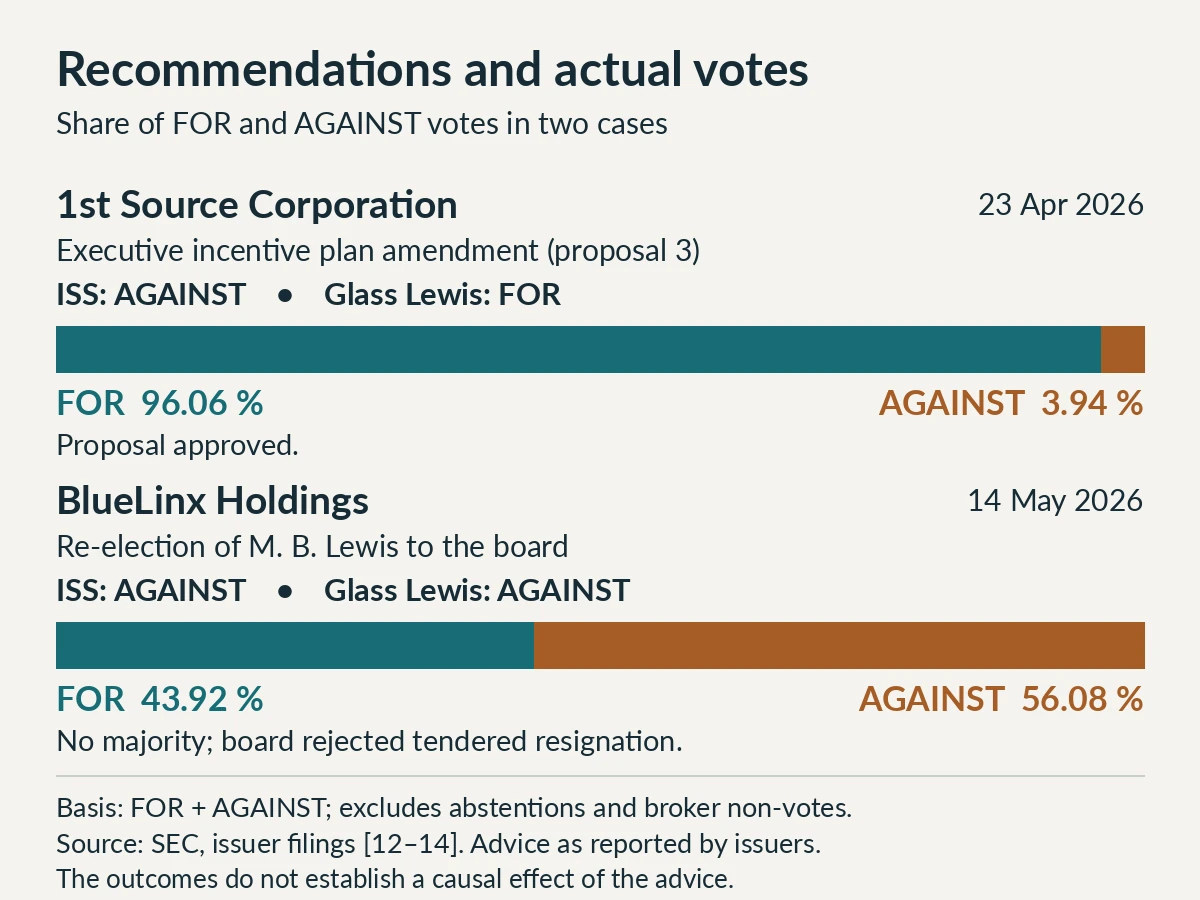
On 9 April 2026, US financial company 1st Source Corporation published a supplement to its general meeting materials. It stated that ISS opposed the third proposal, an amendment to the 1982 Executive Incentive Plan, while Glass Lewis supported all the proposed plans. Management expressed disagreement with ISS's methodology. This is the company's position, not an independent finding that the calculation was incorrect. [12]
At the general meeting on 23 April 2026, the third proposal was approved: 19,334,730 votes for, 792,753 against, 47,359 abstentions and 3,170,891 shares recorded as broker non-votes (votes that a broker did not cast on this proposal because instructions were missing and its discretionary voting authority was limited). [13] The case illustrates that the two advisors can issue opposing recommendations and that a negative ISS recommendation does not necessarily lead to a proposal being rejected.
BlueLinx Holdings provides a contrasting example. According to the company's official report dated 19 May 2026, ISS and Glass Lewis recommended voting against the re-election of former chief executive Mitchell B. Lewis to the board before the general meeting on 14 May. According to the company, the reason was his role on the nominating committee and an independence criterion that differed from the one used by the company. He received 2,604,527 votes for and 3,325,567 against, with 5,057 abstentions and 1,198,409 broker non-votes. He failed to receive majority support and tendered his resignation, but the board rejected it. Lewis stepped down from the nominating committee but remained on the board. [14]
Both examples are based on materials that the companies filed with the SEC. We do not have the advisors' original research reports supplied to clients. The voting results therefore enable us to verify the outcome, but not to establish which investor changed a vote because of a particular recommendation. The BlueLinx case also shows that the consequences of a vote are determined by the applicable company rules, not by the advisor itself.
How much influence do recommendations actually have?
If investors and an advisor oppose a poor proposal for the same reasons, the alignment of their votes does not itself prove that the advisor caused the rejection. When measuring the advisor's actual influence, it is therefore important to distinguish between correlation and causation.
In a study published in 2016, researchers Nadya Malenko and Yao Shen examined US votes on executive remuneration (say-on-pay) from 2010 and 2011. They used a regression discontinuity approach: they compared companies close to thresholds that, under ISS's methodology at the time, affected the likelihood of a negative recommendation. They estimated that a negative ISS recommendation reduced support for such proposals by approximately 25 percentage points. [15] [16] This is important empirical evidence of influence in a defined setting, but it is by no means a universal rule that ISS controls a quarter of the votes at all general meetings or that the estimate remains applicable in 2026.
Form N-PX filings are important for investigating individual events in the United States. In 2022, the SEC adopted amendments to improve the comparability of voting data reported by registered funds and required additional reporting by institutional investment managers on executive remuneration votes. The expanded disclosures also include the number of shares voted and shares loaned but not recalled in time. [17] Even such records do not generally reveal the reason for a vote. Establishing causation would require further documentation concerning the specific recommendations, selected policy or investor's decision.
Conflicts of interest and regulation
Advising investors while also offering other services to companies that the advisor evaluates may create conflicts of interest. The risk is not limited to the advisor's owners: it may also arise from business relationships, commercial incentives and affiliated companies. It is therefore not sufficient for a provider to declare its independence; separation of functions, disclosures, scrutiny of procedures and the ability to correct inaccurate information also matter.
A June 2026 supplement to the Principal Funds prospectus includes a description of the procedures of investment adviser Federated, which provide, among other things, for reviewing Glass Lewis's internal controls and checking a sample of certain ISS reports. When a Glass Lewis conflict is disclosed, the procedures provide in certain cases for obtaining a comparative ISS analysis and an independent assessment by the responsible person. [18] Such documentation shows that institutions recognise the risk, but does not in itself establish that the measures described are effective.
In the European Union, Article 3j of the Shareholder Rights Directive, added by Directive (EU) 2017/828, requires transparency about codes of conduct, methodologies and procedures, and the disclosure of actual or potential conflicts of interest to clients. [19] In the United States, the scope of the regulator's authority has also been the subject of litigation. On 1 July 2025, the Court of Appeals for the District of Columbia Circuit upheld the lower court's finding that proxy voting advice, where the advisor has no interest of its own in the outcome, is not a solicitation within the meaning of Section 14(a) of the Securities Exchange Act. [20] The ruling concerns a specific statutory basis, not a general exemption from all forms of financial oversight.
US Executive Order 14366 of 11 December 2025 directed the relevant authorities to review the rules and consider additional transparency and competition in the industry. [21] On 5 August 2026, the Antitrust Division of the US Department of Justice withdrew a 1987 letter concerning its intention at the time not to bring antitrust action against ISS's original business model. The Department justified the withdrawal on the basis of changes to the business model and expressed concern about market concentration. [22] This is a specific regulatory action, not a final judicial finding of collusion or unlawful influence over a particular vote.
The power to determine the criteria
ISS and Glass Lewis matter because they not only affect the flow of information, but can also shape the criteria by which corporate conduct is assessed. Corporate power does not arise exclusively among the holders of capital. Some of it may already take shape in the creation of the rules, data and recommendations that those holders use.
Such concentration calls for transparency, but it must not be mistaken for proof of a single centre of control. A serious investigation of economic power must establish who holds the shares and the voting mandate, who prepares the recommendation, who can change the vote and who makes the final decision. In the next article, we will move from institutional rules and advisory services to another connection between the financial and political worlds: the movement of people between financial institutions and public regulators.
Sources and further reading
- U.S. GAO. Corporate Shareholder Meetings: Proxy Advisory Firms’ Role in Voting and Corporate Governance Practices (GAO-17-47) (2016-11-15). Source
- OECD. Institutional Investor Engagement and Stewardship: Regulatory frameworks (2025). Source
- Deutsche Börse Group. Deutsche Börse Group to Acquire General Atlantic’s Minority Stake in ISS STOXX (2026-02-11). Source
- Deutsche Börse Group. Quarterly statement Q1/2026 (2026-Q1). Source
- ISS STOXX. Policy Development & Application (brez datuma). Source
- ISS STOXX. ISS Governance Announces 2026 Benchmark Policy Updates (2025-11-25). Source
- Peloton Capital Management. Peloton Capital Management and Stephen Smith Acquire Glass Lewis (2021-03-16). Source
- Glass Lewis. Glass Lewis and Clarity AI Join Forces to Integrate Sustainability, Governance and Stewardship (2026-09-24). Source
- Torys. Glass Lewis and Clarity AI join forces (2026-09-24). Source
- Glass Lewis. 2026 Benchmark Policy Guidelines — United States (2025 (za 2026)). Source
- BlackRock. BlackRock Voting Choice (brez datuma). Source
- 1st Source Corporation. Supplement to the 2026 Proxy Statement (DEFA14A) (2026-04-09). Source
- 1st Source Corporation. Form 8-K, 2026 shareholder voting results (2026-04-24). Source
- BlueLinx Holdings Inc.. Form 8-K, 2026 annual meeting voting results and director resignation (2026-05-19). Source
- Nadya Malenko; Yao Shen. The Role of Proxy Advisory Firms: Evidence from a Regression-Discontinuity Design, Review of Financial Studies 29(12), 3394–3427 (2016). Source
- Nadya Malenko; Yao Shen. Letter to SEC, File No. 4-725, with attached research article (2018-10-12). Source
- SEC. SEC Adopts Rules to Enhance Proxy Voting Disclosure by Registered Investment Funds and Require Disclosure of “Say-on-Pay” Votes for Institutional Investment Managers (2022-11-02). Source
- Principal Funds, Inc.. Principal Funds, Inc. Supplement to the Prospectus and Statement of Additional Information (2026-06-15). Source
- European Parliament and Council. Directive (EU) 2017/828 amending Directive 2007/36/EC (2017-05-17). Source
- U.S. Court of Appeals for the D.C. Circuit. Institutional Shareholder Services, Inc. v. SEC, No. 24-5105 (2025-07-01). Source
- The White House. Executive Order 14366: Protecting American Investors from Foreign-Owned and Politically-Motivated Proxy Advisors (2025-12-11). Source
- U.S. Department of Justice. Justice Department Withdraws Business Review Letter Issued to Proxy Advisory Firm (2026-08-05). Source