
Solipsism: Can We Prove That a World Exists Outside Our Mind?
Solipsism asks an extreme question: if we always access the world through experience, how do we justify belief in an external world and other minds independent of us?
Read articleShorter entry points into the questions explored across THY-REALITY. Browse by field or search directly by title and description.
Solipsism asks an extreme question: if we always access the world through experience, how do we justify belief in an external world and other minds independent of us?
Read article
The simulation hypothesis, digital physics, and informational descriptions of nature are not the same claim. Bostrom’s argument, physical tests, and new constraints show what can be tested — and what cannot yet be established.
Read article
Placebo and nocebo show how expectation, learning and treatment context can modify pain, the perception of adverse effects and some measurable physiological responses — without equating those effects with removal of the underlying disease.
Read article
David Icke links his “phantom self” to identity, perception, fear, media and consciousness. The article separates researched psychological phenomena from his wider metaphysical model.
Read article
Steiner’s cosmos links physical, etheric, astral, and spiritual levels with planetary incarnations, Lemuria and Atlantis, karma, spiritual hierarchies, and Christ, Lucifer, and Ahriman.
Read article
From Plato’s cave, Descartes and brains in vats to Baudrillard, Gnosticism, algorithms and synthetic media: what did The Matrix actually draw from philosophy, and why does its metaphor feel even stronger today?
Read article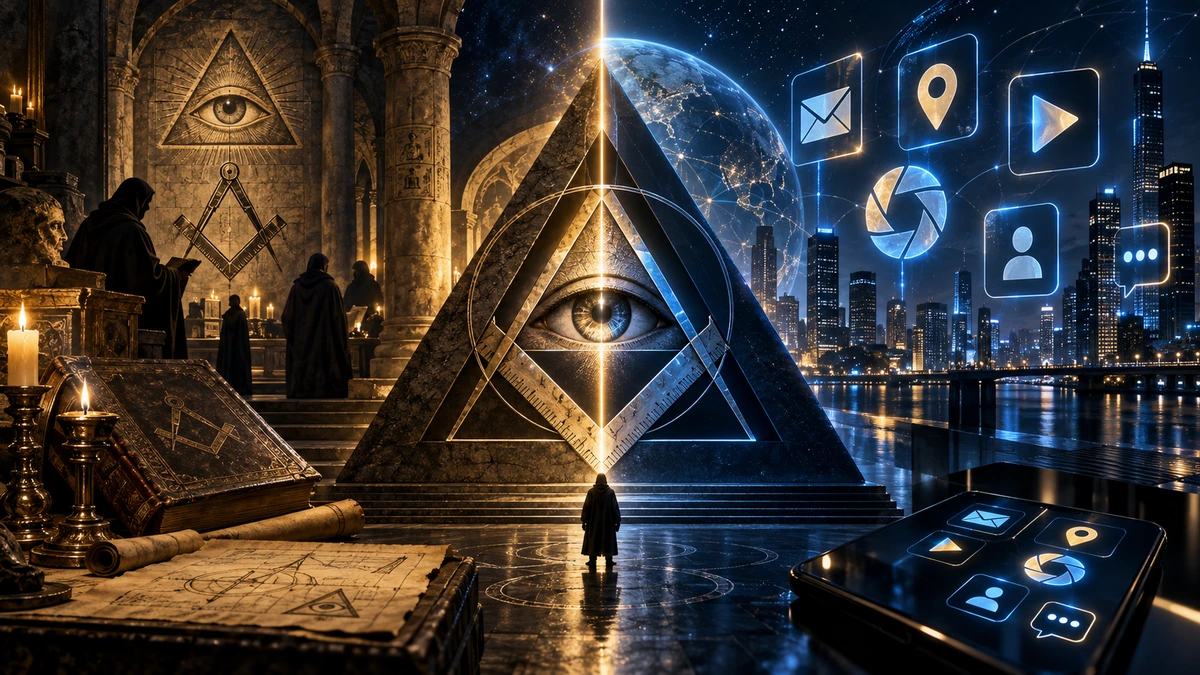
Some modern logos and older ritual emblems are not merely vaguely similar: they share strikingly close silhouettes or internal geometry.
Read article
Science methodologically seeks natural, testable explanations. But does its success prove physicalism as an ontology? A distinction between method, data, model, and metaphysics.
Read article
A foundational map of reality distinguishes world, experience, model and description, and shows why empirical fact, philosophical interpretation and speculation are not the same level of claim.
Read article
We measure time by using change, but it does not follow that time is nothing but change. This article separates clocks, relativity, the entropy arrow, subjective time, and the still-open metaphysics of temporal passage.
Read article
Perception is our first point of contact with reality, but not a perfect copy of it. How can we separate perception, interpretation, and what we can verify?
Read article
Perception is not a passive photograph of the world. This article shows how the senses transduce and select signals while the brain combines them with context, attention, prior experience and expectations into a usable perceptual model.
Read article
Admitting “I don’t know” is not the end of thinking. It is the beginning of more precise inquiry, intellectual humility, and better verification.
Read article
A true piece of information can still produce a false picture when we mistake one part for the whole. Learn how context and multiple perspectives improve understanding.
Read article
The same reality can require multiple maps and models. Explore the difference between territory and representation, the role of purpose and idealization, and why model plurality is not relativism.
Read article
Discovering that we were wrong does not mean that we have corrected the error. What changes when new understanding is carried into decisions, acknowledgment, and action?
Read article
We observe an event and almost immediately assign it meaning. How can we separate what we know from what we infer, test, or merely imagine for now?
Read article
An open mind does not mean accepting every claim, and skepticism does not mean rejecting everything in advance. How can we apply the same standards in both directions?
Read article
Measurement helps us see patterns, but indicators can also reshape behavior, allocate power and determine what counts as reality. This article shows how to measure without mistaking the map for the territory.
Read articleNo article matches your search.