Placebo and Nocebo: When Expectation Changes Experience, Symptoms and Treatment
Placebo and nocebo show how expectation, learning and treatment context can modify pain, the perception of adverse effects and some measurable physiological responses — without equating those effects with removal of the underlying disease.
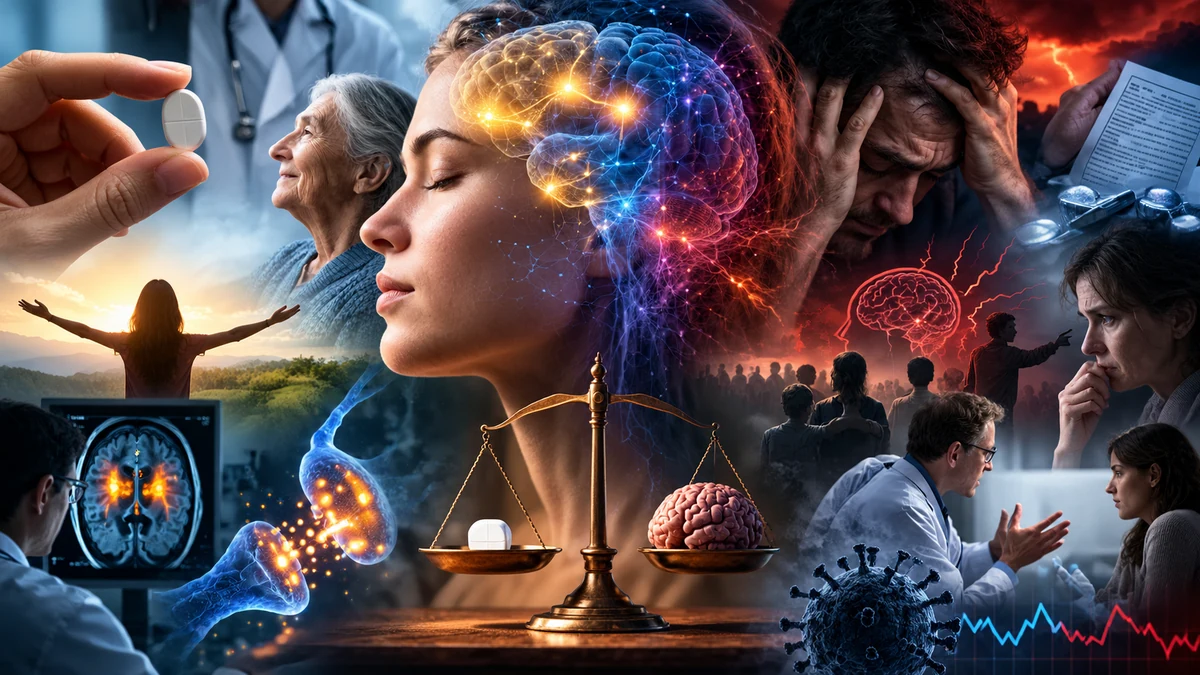
When a person takes a pill, they do not receive only a chemical substance. They also receive information. They know that they have taken something. They may believe it will help. They may fear side effects. They see the doctor, the hospital, the packaging and the name of the medicine. They remember previous experiences, read the patient information leaflet and hear stories from other people. All of this accompanies the pharmacological substance.
Research into placebo and nocebo effects examines precisely this additional layer of treatment: what happens when expectation, learning, meaning and treatment context begin to influence what a person actually experiences — and, under some circumstances, measurable physiological processes as well. Placebo can influence pain, expectation can participate in responses of brain systems, and negative expectations can intensify symptoms or make them more noticeable.[1][8][13]
The subject is often oversimplified. Placebo does not necessarily mean that a person merely imagines improvement, and nocebo is not another name for an imaginary side effect. If the nervous system changes the experience of pain or another symptom, the change in experience can be real even when the underlying pathology remains unchanged.
That is why the boundary matters: expectation can modify a symptom and part of a physiological response; it does not follow that expectation alone can remove an infection, tumour, fracture or other underlying pathology. The article therefore keeps subjective symptoms, objective function, physiological response and underlying disease separate throughout the article.[4][6]
Placebo Response Is Not the Same as Placebo Effect
If a patient receives a placebo and feels better one week later, we do not yet know why. The illness may have improved naturally, symptoms may fluctuate, the patient may have sought help when the condition was at its worst, and part of the change may also come from measurement, behaviour or other care.
The total improvement observed after placebo administration is often described as the placebo response. The placebo effect, in the narrower sense, refers to the part of that change associated with psychological and psychobiological mechanisms such as expectation, learning and conditioning. Benedetti and Shaibani describe the distinction directly: placebo response also includes spontaneous remission, regression to the mean and various biases, while placebo effect denotes the narrower psychological component.[1]
One of the most famous papers in the history of the field was Henry K. Beecher's 1955 article The Powerful Placebo. He estimated that roughly one third of patients responded to placebo, strongly shaping later ideas about its power.[2] Later methodological analysis argued that much of the improvement Beecher attributed to placebo could also be explained by natural history, regression toward the mean and other factors.[3]
Modern research therefore tries, where possible, to compare placebo with a no-treatment condition as well. A large Cochrane review of 202 randomised trials across 60 clinical conditions did not find major general health benefits from placebo interventions, although some patient-reported outcomes — especially pain — showed a measurable average effect with substantial variability between studies.[4] Placebo is therefore not a magical treatment — and it is also not nothing.
Pain, Context and Hidden Drug Administration
Pain is one of the best-studied examples of placebo effects. It is not simply a direct meter of tissue damage but an experience produced through nervous-system processing that can be influenced by attention, previous experience, perceived threat, emotion and expectation. This does not mean that pain is unreal; it means that the real experience of pain is generated through the nervous system.
In chronic low-back pain, reviews have found measurable placebo-related changes, but estimates of their size and clinical importance differ. Some results suggest moderate effects on subjective pain and self-reported functioning, while other comparisons of placebo with no intervention have found smaller short-term effects.[5]
It also matters what is being measured. A newer meta-analysis of open-label placebo in chronic musculoskeletal pain found small to moderate effects on self-reported pain and function, while finding no clear effect on objective physical-function tests.[6] Subjective improvement in a symptom and objective improvement in physical capacity are therefore not necessarily the same phenomenon.
Particularly revealing are studies of open-hidden drug administration. In open administration the patient knows that medication has been given; in hidden administration the same active substance can be delivered without a clear signal of the moment of administration. With several analgesics, hidden administration has produced a smaller effect than the same medication given openly.[7] The pharmacological substance was the same; the information was different. Ordinary clinical care can therefore combine the pharmacological action of a drug and the context in which it is administered.
Parkinson's Disease and Dopamine
One of the best-known physiological demonstrations of a placebo mechanism comes from Parkinson's disease. In 2001, PET imaging showed that placebo administration in patients with Parkinson's disease was associated with measurable endogenous dopamine release in the striatum.[8] The patient's subjective report was therefore not the only observed phenomenon; a neurochemical signal changed in a way that could be monitored through brain imaging.
A later study told patients that they had different probabilities of receiving active treatment when they actually received placebo. Significant dopamine release was observed in the condition where the stated probability of active medication was 75%, and the results showed that the strength of expectation can participate in placebo-related dopaminergic responses.[9]
This does not show that expectation cures Parkinson's disease. It shows something more specific: therapeutic expectation can, in a particular context, participate in a measurable neurochemical response. A measurable physiological response is not the same thing as stopping the underlying neurodegenerative disease.
What If the Patient Knows the Pill Is a Placebo?
For a long time it seemed almost self-evident that placebo had to involve deception. Research into open-label placebo complicated that assumption: patients are explicitly told that the tablet contains no active drug, and researchers then observe whether anything still changes.
In a randomised trial of chronic low-back pain, patients who received openly labelled placebo in addition to usual care reported greater improvements in pain and disability than patients receiving usual care alone.[10] A later meta-analysis of four open-label placebo studies in chronic low-back pain, however, presents a more modest picture: the average reduction in pain was about 0.62 points on a numerical rating scale, and the GRADE certainty of evidence was rated very low.[11]
An experiment with naloxone added another interesting detail. 59.4% of participants did not respond to the open-label placebo; among the 40.6% who did respond, naloxone, an opioid-receptor antagonist, reduced placebo analgesia. This suggests involvement of the endogenous opioid system in at least some responders.[12]
Open-label placebo therefore does not show that belief in a 'real drug' is always necessary. Treatment ritual, previous learning, expectations about the process and the meaning of the therapeutic act may all matter. But the effect is not universal, average changes are often modest, and its clinical usefulness has not been established conclusively.[6][11][12]
Nocebo: When Expectation Works in the Other Direction
Placebo has a mirror image: nocebo. If positive expectation can sometimes reduce a symptom, negative expectation can sometimes intensify it or increase the likelihood that a bodily change will be noticed and attributed to treatment.
A meta-analysis of 130 independent studies involving 8,219 participants found an average nocebo effect of moderate size, with substantial heterogeneity depending on the health outcome and the way negative expectations were induced.[13] Nocebo is therefore not one uniform reaction but a family of context-dependent effects.
Nocebo can arise from bad previous experiences, verbal warnings or heightened attention to bodily sensations. Observing other people can matter too: meta-analytic evidence on social learning indicates that seeing another person experience symptoms can increase one's own nocebo response.[14]
If the person then develops a headache, the headache is real. The question is what caused or amplified it. Nocebo is therefore not another name for an imaginary symptom, and it is not an explanation for every adverse drug effect.
Statins and the Unusual SAMSON Experiment
The SAMSON trial is a useful example of how difficult it can be to separate pharmacological adverse effects from nocebo effects within an individual. It enrolled people who had previously stopped statins because of symptoms. Over a year, each participant received randomly arranged months with 20 mg atorvastatin, placebo tablets and no tablets, while recording symptom intensity every day.[15]
| Period | Mean symptom score |
|---|---|
| No tablets | 8.0 |
| Atorvastatin | 16.3 |
| Placebo | 15.4 |
There was no statistically significant difference in mean symptom intensity between statin and placebo months; the calculated nocebo ratio was 0.90. Six months after the trial, 30 of the 60 randomised participants were taking statins again.[15]
SAMSON did not show that statins have no pharmacological adverse effects. It studied a selected population that had already stopped statins because of symptoms. Within that group, most of the additional symptom burden observed during statin months was also reproduced during placebo months. The timing of a symptom after taking a tablet is therefore not, by itself, reliable proof that the active ingredient caused it.[15]
COVID-19 Vaccine Trials and Symptoms After Placebo
Nocebo effects received particular attention during the COVID-19 pandemic. A meta-analysis of twelve clinical trials examined adverse events among 45,380 participants, including 22,578 people who received placebo.[16]
After the first placebo dose, 35.2% reported at least one systemic adverse event; after the second, 31.8% did. Headache and fatigue were among the most common symptoms. From the ratio of events in placebo and active groups, the authors estimated that nocebo responses at the population level could account for about 76.0% of systemic events after the first and 51.8% after the second dose.[16]
Those percentages should not be read as a diagnosis of an individual symptom. They do not mean that 76% of a particular vaccinated person's symptoms were psychological. They are population-level comparisons of event frequencies between groups.
Participants receiving active vaccine also reported more adverse events than placebo groups, particularly after the second dose.[16] The study therefore did not show that vaccine side effects were 'only nocebo'. It showed that some symptoms intuitively attributed to the active substance also occur among people who did not receive it.
A Doctor's Words Can Be Part of the Treatment Context
Nocebo research raises an ethical problem. Patients have a right to know about possible adverse effects, but information about a side effect can itself increase expectation, attention and the likelihood that a person will notice or attribute that symptom to treatment. This does not mean doctors should hide risks.
The statements '30% of people experience a headache' and '70% of people do not experience a headache' are mathematically equivalent, but their psychological framing may not be. A review of positive framing found only a small number of studies and therefore calls for caution, but it suggests that the way risk is presented can affect expectations or reported adverse effects.[17]
A newer 2026 review examined 38 studies of communication strategies. It found that nocebo education, risk framing, empathy and contextualisation more consistently influenced expectations, perceived threat and symptom attribution than the actual intensity or frequency of symptoms.[18]
Informed consent is therefore not only a question of how much information is provided, but also how it is communicated without concealing anything material. Communication can become part of the therapeutic context, but it cannot replace truthful information.[18]
If the Brain Influences a Symptom, the Symptom Is Not Imaginary
In ordinary language, the word 'psychological' is often treated as if it meant 'not real'. The nervous system does not respect that distinction. Fear can accelerate heart rate, thoughts can trigger sweating, stress can change pain, and expectation can participate in opioid or dopaminergic responses under certain conditions.[8][9][12]
If a symptom is modulated through the brain, it is still a symptom. A person experiencing a nocebo-related headache does not merely 'imagine' it because the initiating mechanism differs from direct pharmacological toxicity. The same applies in the opposite direction: a person whose pain decreases after placebo does not necessarily pretend that the pain has decreased.
This distinction prevents two opposite errors. The first is dismissing the patient's experience: 'if it is placebo or nocebo, it is not real'. The second is the overextended conclusion: 'if the brain can change a symptom, thought can remove any disease'. The evidence supports neither simplification.[4]
The Body Has Limits That Expectation Does Not Erase
Because placebo effects are interesting, it is easy to take the next step too far. From the finding that expectation can influence pain it does not follow that a person can cure anything through sufficiently strong belief. The Cochrane review did not find a large general healing effect of placebo interventions across clinical conditions.[4]
Placebo may change the experience of pain. That does not mean a broken bone has healed. It may change nausea. That does not mean the cause of nausea has disappeared. It can affect subjective well-being and some physiological responses. That does not mean it can independently eliminate a bacterial infection, remove a malignant tumour or restore destroyed tissue.
Open-label placebo illustrates the same boundary. Meta-analyses suggest changes mainly in self-reported outcomes, while objective physical-function measures may remain unchanged and certainty of evidence can be low or very low for some conditions.[6][11]
A useful formulation is therefore: placebo and nocebo are best understood as modulation of the organism's response to treatment, not as evidence that thought can arbitrarily rewrite pathology. Reduced pain is not the same as healing an injury; a dopaminergic response is not the same as stopping neurodegeneration.
Placebo Does Not Exist Only in a Placebo Pill
One of the most interesting consequences of this research is that placebo effects are not limited to placebo treatments. When a patient receives a real medicine, expectation can still contribute to the total outcome. The drug has a pharmacological action, while the way it is administered, previous experience, the relationship with healthcare staff and the meaning of treatment can influence the overall clinical response.[7]
Open-hidden studies therefore show why it can be misleading to divide treatment into 'the real drug effect' and 'the fake placebo effect'. In ordinary care, both processes can operate simultaneously: pharmacology through the molecule, context through the organism that knows it is being treated.[7]
This does not suggest that medicine should replace effective treatments with sugar pills. If treatment context contributes to outcome, it makes sense to use it alongside effective treatment, not instead of it. Clear explanations, realistic positive expectations, reduction of unnecessary fear and trustworthy communication can affect the treatment experience while accurate information and informed consent remain intact.[18]
Conclusion: Between the Molecule and Expectation
Placebo and nocebo are fascinating because they disrupt a simple boundary between the 'psychological' and the 'physical'. Expectation is a psychological phenomenon, but it is generated by the brain, which is a biological organ. Its signals participate in regulating pain, movement, stress, autonomic function and many other bodily processes.
Research also places clear limits around the phenomenon. Placebo does not have one large universal effect across diseases. Responses vary greatly between people and conditions. Some of the clearest findings concern particular symptoms, especially pain. Open-label placebo is scientifically interesting but evidentially limited. Nocebo is real but does not explain every adverse effect.[4][6][13]
When a person receives treatment, the body therefore receives more than a chemical substance. It also receives expectation, meaning, memory, fear, hope, information and the relationship with the person providing treatment. Sometimes the pharmacological molecule dominates the outcome, sometimes context mainly changes the experience of the symptom, and often both operate at the same time.
And it is precisely there — between the molecule and expectation — that placebo and nocebo research begins.
Sources and further reading
- Fabrizio Benedetti & Aziz Shaibani — Placebo Response and Placebo Effect: What Is the Difference?, Neurologic Clinics, 2026 Source
- Henry K. Beecher — The Powerful Placebo, JAMA, 1955 Source
- Kienle & Kiene — The powerful placebo effect: fact or fiction?, Journal of Clinical Epidemiology, 1997 Source
- Hróbjartsson & Gøtzsche — Placebo interventions for all clinical conditions, Cochrane Database of Systematic Reviews Source
- van Lennep et al. — Placebo effects in low back pain: A systematic review and meta-analysis of the literature, European Journal of Pain, 2021 Source
- Systematic review and meta-analysis of open-label placebo effects in chronic musculoskeletal pain, 2025 Source
- Benedetti, Carlino & Pollo — Hidden administration of drugs, Clinical Pharmacology & Therapeutics, 2011 Source
- de la Fuente-Fernández et al. — Expectation and dopamine release: mechanism of the placebo effect in Parkinson disease, Science, 2001 Source
- Lidstone et al. — Effects of expectation on placebo-induced dopamine release in Parkinson disease, Archives of General Psychiatry, 2010 Source
- Carvalho et al. — Open-label placebo treatment in chronic low back pain: a randomized controlled trial, Pain, 2016 Source
- Flávio-Reis et al. — Open label placebo for chronic low back pain: a systematic review and meta-analysis of randomized controlled trials, Pain Management, 2025 Source
- Benedetti et al. — Open-label nondeceptive placebo analgesia is blocked by the opioid antagonist naloxone, Pain, 2023 Source
- Rooney et al. — The nocebo effect across health outcomes: A systematic review and meta-analysis, Health Psychology, 2024 Source
- Meta-analysis of socially induced nocebo effects / observational learning, 2024 Source
- Wood et al. — Side Effect Patterns in a Crossover Trial of Statin, Placebo, and No Treatment (SAMSON), Journal of the American College of Cardiology, 2021 Source
- Haas et al. — Frequency of Adverse Events in the Placebo Arms of COVID-19 Vaccine Trials, JAMA Network Open, 2022 Source
- Barnes et al. — Can positive framing reduce nocebo side effects? Current evidence and recommendation for future research, Frontiers in Pharmacology / review, 2019 Source
- Peng et al. — Shaping expectations in care: communication strategies to reduce the nocebo effect, Patient Education and Counseling, 2026 Source