The Constitution of the World According to Rudolf Steiner: Anthroposophical Cosmology
Steiner’s cosmos links physical, etheric, astral, and spiritual levels with planetary incarnations, Lemuria and Atlantis, karma, spiritual hierarchies, and Christ, Lucifer, and Ahriman. This article reconstructs how these ideas form a unified anthroposophical map of the human being and the world.
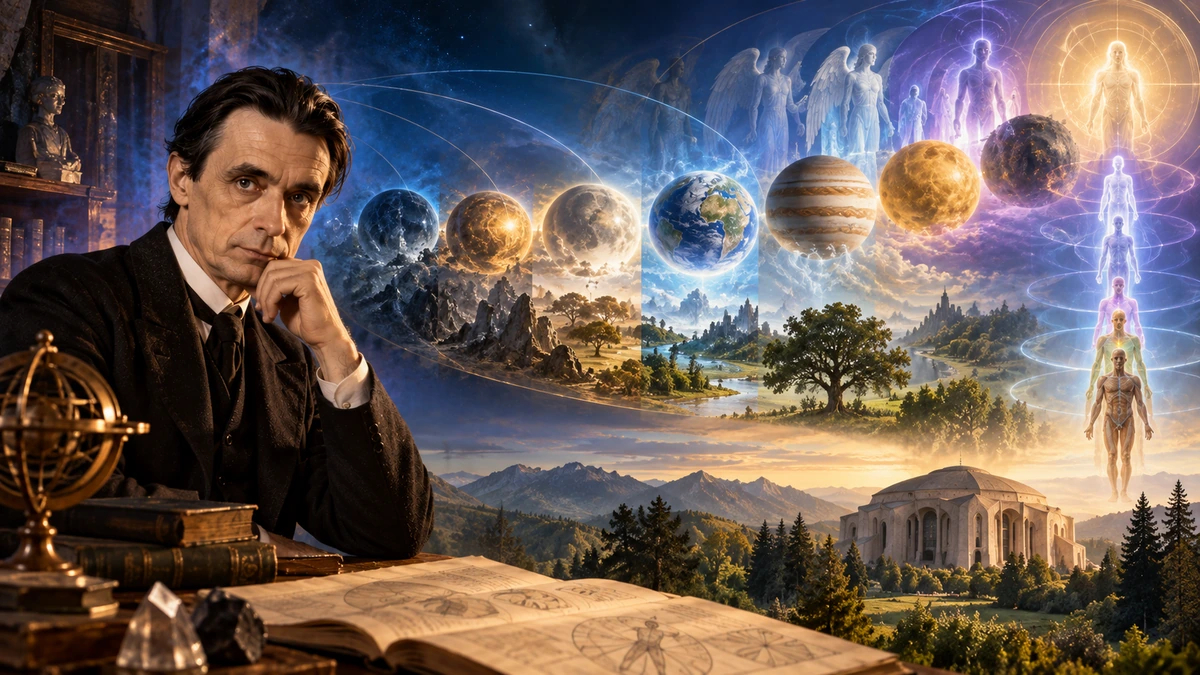
When Rudolf Steiner speaks about the “constitution of the world,” he is not speaking only about astronomy or the physical universe. His anthroposophical cosmology connects the human being, nature, birth and death, reincarnation, spiritual beings, the development of Earth, and humanity’s future within a single layered system.
The core of this map is set out especially in Theosophy (1904), From the Akashic Record / Cosmic Memory (1904–1908), and Occult Science — An Outline (1910). In these works Steiner describes the physical, etheric, and astral bodies together with the I, three worlds, reincarnation and karma, spiritual hierarchies, and the great sequence Old Saturn–Old Sun–Old Moon–Earth–Jupiter–Venus–Vulcan.
These terms need to be read in Steiner’s own sense. “Old Saturn,” “Old Sun,” and “Old Moon” are not simply the present planets of those names but, in his account, earlier stages of world evolution. Likewise, “etheric” and “astral” designate particular levels of the human being and nature within the anthroposophical system.
The purpose of this article is therefore to reconstruct Steiner’s model from within: what its central concepts mean, how they relate to one another, and what place is given to the human being, Earth, spiritual hierarchies, karma, Christ, Lucifer, and Ahriman. It does not attempt to prove or disprove these teachings, but to present them as precisely as possible in the language and relationships of Steiner’s own system.
Foundations of the cosmology: key texts and spiritual anatomy
In anthroposophy, the world is not conceived only as a collection of material bodies in space. Steiner describes it as an interweaving of physical, soul, and spiritual orders, with different levels of reality penetrating one another. The human being occupies a distinctive place in this picture because Steiner treats human constitution as a microcosm of a larger cosmic structure.
For this reason, the “constitution of the world” means more than cosmography in Steiner. It includes the levels that make up the human being, their relationship to nature, the role of spiritual beings, and the way all of these develop through long cosmic periods. Cosmology is at once anthropology, world history, and a doctrine of spiritual development.
Theosophy establishes the basic anthropology: it divides the human being into body, soul, and spirit and more specifically into physical, etheric, astral, and higher spiritual members. From the Akashic Record extends the model into primordial history through Lemuria, Atlantis, and early humanity. Occult Science then connects these themes within a broader cosmogony of the human being and the world.
The system developed in an environment where Theosophy, Christian esotericism, Goethean organic thought, and Steiner’s own philosophy intersected. He adopted some terms from Theosophical vocabulary but gradually reshaped them and connected them ever more strongly with his interpretation of Christ, freedom, and human spiritual development.
The human being, three worlds and the path of knowledge
The best-known anthroposophical scheme speaks of the physical body, etheric or life body, astral body, and the I. The physical body connects the human being with the mineral world; Steiner associates the etheric body with life, growth, and formative activity; the astral body with sensation, desire, and consciousness; and the I with the individual center of the person.
In Theosophy he further unfolds the same structure into seven- or ninefold schemes. These include the sentient soul, intellectual or mind soul, consciousness soul, spirit self, life spirit, and spirit human. These are not separate systems but different levels of detail within the same basic anthroposophical picture of the human being.
Steiner places the human being within three interconnected domains: the physical or sensory world, the soul world, and the spiritual world. The physical world is the domain of ordinary sensory perception; the soul world is associated with feeling, desire, sympathy, and antipathy; the spiritual world with archetypal and creative forms.
This division becomes especially important in Steiner’s account of life between death and a new birth. After death, the relationship among the human members changes, and in his description the individual passes through different states of the soul and spiritual worlds before entering earthly life again.
Steiner presents anthroposophy not only as a set of teachings but also as a path of knowledge. In Knowledge of the Higher Worlds and The Stages of Higher Knowledge he describes exercises of attention, meditation, inner calm, and observation intended to transform the mode of perception step by step.
Within this path he uses three characteristic stages: imagination, inspiration, and intuition. Imagination means conscious perception of imaginal spiritual content; inspiration is described as perception of relationships and activities behind those images; intuition, in Steiner’s terminology, means direct inward encounter with a spiritual being or process. These words therefore have a more specific meaning in anthroposophy than in ordinary speech.
The Akashic record, planetary incarnations and spiritual hierarchies
In texts later collected as From the Akashic Record, Steiner speaks of the Akashic record as a spiritual memory of the world. In his account, past events can be perceived there not only as outward occurrences but also in their inner spiritual relationships.
Through this concept Steiner explains many details concerning Lemuria, Atlantis, and early periods of humanity. The Akashic record therefore functions within the system as an expanded archive of cosmic and human history, approached through the forms of supersensible knowledge described in his works on spiritual development.
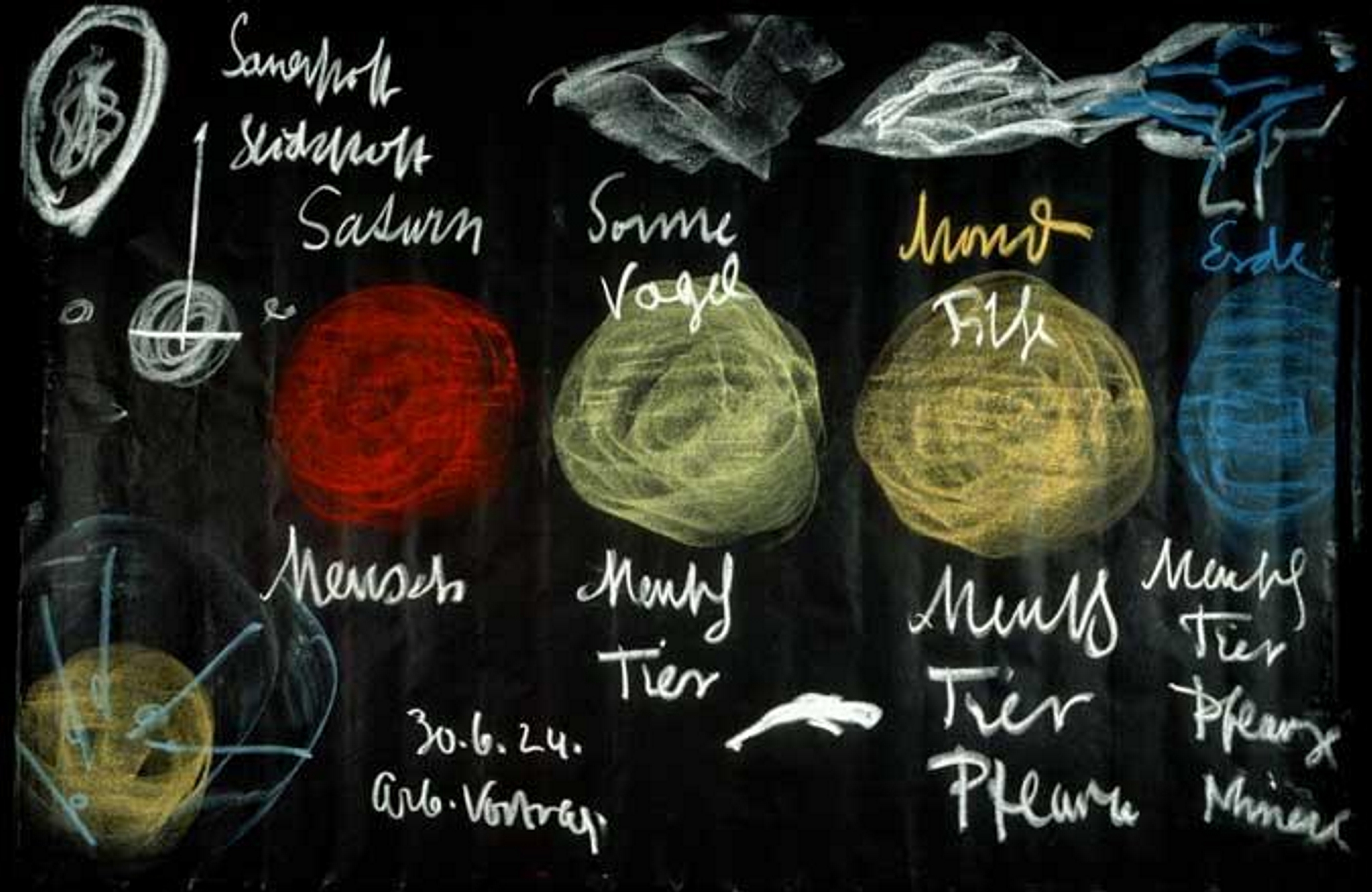
In Occult Science, present Earth is the fourth great stage in the sequence Old Saturn, Old Sun, Old Moon, Earth, followed by future Jupiter, Venus, and Vulcan. In Steiner’s system these names designate large-scale “planetary incarnations” of the development of the whole world.
Each stage has a particular role in the formation of the human being. Steiner places the beginnings of the physical body on Old Saturn, the development of the etheric body on Old Sun, the astral body on Old Moon, while the Earth stage is associated with the development of the I. Later stages continue the transformation of the human being and the relationship to the spiritual world.
Steiner’s cosmos is populated by different orders of spiritual beings. He uses a Christian-esoteric sequence of angels, archangels, and archai, followed by exusiai, dynameis, kyriotetes, thrones, cherubim, and seraphim, and assigns them different tasks within cosmic development.
In his scheme the hierarchies are also connected with the planetary incarnations. Angels are said to have passed through their “human stage” on Old Moon, archangels on Old Sun, and archai on Old Saturn. Humanity is thus placed within a wider succession of beings developing at different levels of cosmic history.
Lemuria, Atlantis and the evolution of consciousness
Steiner’s history of Earth includes Lemuria and Atlantis as major periods preceding the present post-Atlantean development. He associates the Lemurian period with early human formation and the differentiation of the sexes, and the Atlantean period with different forms of consciousness, memory, and relationship to natural forces.
After Atlantis comes a sequence of post-Atlantean cultural periods. Steiner speaks of ancient Indian, ancient Persian, Egyptian-Chaldean, Greco-Roman, and the present fifth post-Atlantean epoch, followed by future cultural stages. Human history is thereby understood as a series of changes in consciousness and in the relationship between humanity and the spiritual world.
Steiner’s system is strongly evolutionary, but evolution is not limited to changes in physical form. In his account, physical forms accompany a deeper development of consciousness and spiritual capacities, so the history of the human being already begins in the pre-Earth planetary stages.
From this perspective, humanity is not only a product of terrestrial development but participates in a long process through which physical embodiment, life forces, consciousness, and the I are gradually formed. Nature, animals, plants, and minerals all have their places in this story, while human development forms the central thread linking the different cosmic phases.
Lucifer, Ahriman and the cosmic role of Christ
Popular summaries sometimes treat Lucifer and Ahriman simply as two evil beings, but Steiner’s picture is more structured. The Luciferic is associated with exaltation, detachment from earthly life, and an excessive emphasis on inward or spiritual experience; the Ahrimanic with hardening, materialization, cold intellect, and excessive attachment to the external world.
Within anthroposophical cosmology both poles have roles in human development. The task is not their complete removal but the establishment of balance. Lucifer and Ahriman thus become part of a wider dynamic of freedom in which the human being develops the capacity for conscious and independent choice between different one-sided tendencies.
In mature anthroposophy the Christ impulse occupies a central place. Steiner describes the “Mystery of Golgotha” not only as an event in Christian history but as a cosmic turning point through which Christ became connected in a particular way with Earth and humanity.
Christ also functions within this structure as a balancing center between the Luciferic and Ahrimanic poles. Steiner thereby connects earthly and human evolution with Christian themes, making Golgotha the central point of a larger process that began before the present Earth and continues into future cosmic stages.
Reincarnation, karma and developmental epochs
In Theosophy and many lectures, a single human life is only one part of a longer sequence of incarnations. The I, in Steiner’s account, carries the individual thread through different lives, while karma connects actions, experiences, relationships, and future life circumstances.
Karma therefore functions not merely as a moral rule but as a mechanism linking personal biography to cosmic evolution as a whole. In each life the individual enters new conditions in which earlier relationships are worked through while new causes are created for future development.
In his earlier Theosophical period Steiner uses expressions such as “root races,” sub-races, Atlanteans, and the “Aryan” root race. These terms belong to the vocabulary of contemporary Theosophy and to his early way of describing long stages of human development.
In later lectures the emphasis increasingly shifts toward cultural epochs, peoples, languages, and changes in consciousness, while Steiner also speaks repeatedly about the declining significance of racial differences in humanity’s further development. Following both phases is useful for understanding how his developmental vocabulary changed over the decades.

When cosmology becomes cultural practice
Anthroposophical cosmology did not remain separate from practical life in Steiner’s work. Ideas concerning stages of human development, rhythms, life forces, and the relationship between the human being and nature entered Waldorf education, biodynamic agriculture, and anthroposophic medicine in different ways.
The connection is not identical in each field. In education, concepts of child development are especially important; in biodynamics, rhythms, life forces, and the relationship of the farm to a wider cosmic environment; in medicine, the multi-membered picture of the human being. Practical institutions therefore became one way in which Steiner’s cosmological concepts acquired cultural and social continuation.
Steiner’s cosmology is built as a network of relationships. The physical, etheric, astral, and I define the constitution of the human being; the three worlds define the wider field of existence; reincarnation and karma connect individual lives; and the hierarchies and planetary incarnations place personal development within the history of the cosmos as a whole.
Lemuria, Atlantis, and the cultural epochs likewise describe transformations of human consciousness within the Earth stage. Lucifer and Ahriman represent opposing developmental tendencies, while the Christ impulse is placed at the center of Earth evolution. Individual concepts in Steiner are therefore rarely fully intelligible in isolation from the rest of the system.
Synthesis: the anthroposophical map of the human being and the world
Steiner’s cosmology is a comprehensive system in which the human being, Earth, and cosmos are not separate levels but different expressions of one developmental process. Physical, etheric, astral, and spiritual; reincarnation and karma; Old Saturn, Old Sun, Old Moon, and Earth; spiritual hierarchies; and Lucifer, Ahriman, and Christ each have distinct functions, yet acquire their full meaning through their relationships to one another.
To understand Steiner’s “constitution of the world” therefore means above all understanding this internal architecture of anthroposophy: how it moves from the constitution of the human being to the structure of the cosmos, how it extends history into prehistoric and future stages, and how it places individual life within a large narrative of the development of consciousness. This article presents that map as a system of concepts and relationships.
Sources and further reading
- Rudolf Steiner Archive. *Theosophy* (GA 9), ‘The Essential Nature of Man’: physical, etheric, astral and spiritual members.
- Rudolf Steiner Archive. *Theosophy* (GA 9), ‘Re-Embodiment of the Spirit and Destiny’: reincarnation, heredity and karma.
- Rudolf Steiner Archive. *Theosophy* (GA 9), ‘The Three Worlds’: sensory, soul and spirit worlds.
- Rudolf Steiner e.Lib. *Theosophy* (GA 9) publication and edition record.
- Rudolf Steiner Archive. *Knowledge of the Higher Worlds* (GA 10): Steiner’s proposed path of supersensible cognition.
- Rudolf Steiner Archive. *The Stages of Higher Knowledge* (GA 12), ‘Inspiration and Intuition’.
- Rudolf Steiner Archive. *From the Akashic Record / Atlantis and Lemuria* (GA 11), ‘From the Akashic Records’.
- Rudolf Steiner Archive. *Atlantis and Lemuria* (GA 11), ‘Our Atlantean Forefathers’.
- Rudolf Steiner Archive. *Atlantis and Lemuria* (GA 11), ‘The Lemurian Era’.
- Rudolf Steiner e.Lib. *From the Akashic Record / Cosmic Memory* (GA 11) publication record.
- Rudolf Steiner Archive. *Occult Science — An Outline* (GA 13), Chapter IV: human and world evolution.
- Rudolf Steiner Archive. *Occult Science — An Outline* (GA 13), Chapter VI: future evolution and Saturn–Sun–Moon–Earth–Jupiter–Venus–Vulcan sequence.
- Rudolf Steiner e.Lib. *Occult Science — An Outline* (GA 13): edition and content record.
- Cambridge University Press. Steiner, *Outline of Occult Science*: publication history and scholarly edition description.
- Cambridge University Press. *Outline of Occult Science*, Chapter IV, ‘The Evolution of the World and Man’.
- Rudolf Steiner Archive. *Spiritual Hierarchies and their Reflection in the Physical World* (GA 110), Lecture III.
- Rudolf Steiner Archive. *Spiritual Hierarchies* (GA 110), Lecture VI: angels, archangels, archai and reincarnation.
- Rudolf Steiner Archive. *The Balance in the World and Man: Lucifer and Ahriman* (GA 158).
- Rudolf Steiner Archive. *Christ in Relation to Lucifer and Ahriman* (GA 159), lecture of 18 May 1915.
- Rudolf Steiner Archive. *Lucifer and Ahriman* (GA 191): balance and historical role in Steiner’s mature cosmology.
- Rudolf Steiner Archive. *Occult Science and Occult Development* (GA 152): Christ and the Mystery of Golgotha as cosmic event.
- Rudolf Steiner Archive. *The Relationship of Anthroposophy to Natural Science* (GA 75): Steiner’s own methodological claims for ‘spiritual science’.
- Rudolf Steiner Archive. *Foundations of Esotericism* (GA 93a), Lecture XXIV: early root-race and Atlantean/Lemurian terminology.
- Rudolf Steiner Archive. *The Mission of the Individual Folk-Souls* (GA 121), Lecture IV: Steiner’s later account of race, heredity and its projected decline.
- Rudolf Steiner Archive. ‘Special Note on Statements about “Races” in the Rudolf Steiner Complete Edition.’
- McDermott, Robert. ‘Rudolf Steiner and Anthroposophy.’ In *The Cambridge Handbook of Western Mysticism and Esotericism* (2016).
- Herford, Maximilian. ‘Evidenz und Ursprungswissen bei Hanns Hörbiger und Rudolf Steiner.’ *Aries* 20(2), 2020: epistemic strategies in Steiner’s cosmogony.
- McKanan, Dan. ‘Seed: Rudolf Steiner’s Holistic Vision.’ In *Eco-Alchemy* (University of California Press, 2017).
- ‘The Modernist Afterlives of Theosophy.’ In *The Edinburgh Companion to Modernism, Myth and Religion*: Steiner’s Christological and Theosophical context.
- Staudenmaier, Peter. ‘Race and Redemption: Racial and Ethnic Evolution in Rudolf Steiner’s Anthroposophy.’ *Nova Religio* 11(3), 2008.
- Strube, Julian. ‘Theosophy, Race, and the Study of Esotericism.’ *Journal of the American Academy of Religion* 89(4), 2021.
- Encyclopedia.com. ‘Steiner, Rudolf (1861–1925)’: historical overview of Steiner’s thought and Theosophical/Goethean context.
- Mortimer, Nick et al. ‘Zealandia: Earth’s Hidden Continent.’ *GSA Today* 27(3), 2017: geological criteria, plate-tectonic history and submergence.
- Te Ara — The Encyclopedia of New Zealand. ‘Zealandia: the New Zealand continent’: continental crust and Gondwana separation history.