Internal Monarchy, External Anarchy: Order Without a Ruler Is Not Chaos
Anarchy does not necessarily mean the absence of order, and internal monarchy does not mean ruling others. What happens when a person first accepts responsibility for governing themselves and then asks how much external rule is actually justified?

The words monarchy and anarchy appear almost perfectly opposed. The first evokes a ruler. The second, the absence of one. So the phrase “internal monarchy, external anarchy” may initially sound contradictory. In reality, it describes two different levels of the same problem.
Internal monarchy means: first learn to govern yourself. External anarchy means: do not assume that someone else must therefore govern you. This does not mean that human beings need no rules, cooperation, experts, organization, contracts, judges, protection, or common procedures. Nor does it mean that every state is necessarily illegitimate or that a complex society can function without any coercion whatsoever. It means something more precise:
The need for order is not yet proof of the need for a ruler.
If we want to determine whether external political authority is morally justified, we must first separate several things that everyday language often collapses into one: order, organization, authority, power, and the right to rule.
Anarchy, chaos, and organization are not the same
Anarchy Is Not the Same as Chaos In ordinary language, anarchy often means disorder, violence, collapse of rules, or a condition in which everyone simply does whatever they want. Political philosophy uses the term more precisely. Anarchism appears in many traditions and forms, but one of its central questions concerns the justification of political or governmental authority. Anarchy in this sense is therefore not simply another word for chaos. It refers to the absence of a ruler, or to the absence of a justified hierarchical authority claiming a general right to command others.
That distinction matters. A city without traffic coordination may become chaotic. An orchestra without coordination may perform badly. A company without organization may fail. But none of these examples proves that all social order must depend upon a person or institution possessing a moral right to rule.
Anarchy in the philosophical sense does not necessarily mean: “no rules.” It can mean: “no ruler.” Those are not the same thing.
Organization Is Not Rule Imagine a group of people building a house. Someone prepares the plans. Someone coordinates the schedule. An electrician determines the correct technical implementation of the wiring.
A structural engineer decides which construction solutions are safe. The client makes certain financial decisions. Workers agree on the sequence of tasks. There is structure.
There is coordination. There are different responsibilities. There may even be moments when it is perfectly reasonable for one person to say: “This has to be done this way.” But it does not follow that this person therefore possesses a general moral right to control the lives of everyone else.
Their authority may be epistemic. It may be functional. It may arise from a contract. It may be voluntarily accepted for a particular purpose. That is different from political authority, which makes a stronger claim:
that an institution has a moral right to issue binding rules even to people who did not personally consent to each individual command, and under certain conditions to enforce those rules coercively.
Perhaps such a right can be justified. But it cannot be established merely by showing that society requires organization. A function is not the same as a monopoly over that function. And organization is not the same as the right to rule.
What internal monarchy means and why it matters
What Does Internal Monarchy Mean? Taken literally, the phrase could sound authoritarian. But internal monarchy does not mean becoming an inner tyrant, suppressing emotion, or declaring oneself the infallible master of personal truth. It means something else. A human being has impulses.
Desires. Fear. Anger. A need for recognition.
A tendency toward self-justification. The capacity to deceive both others and oneself. And the capacity to act honestly even when nobody is watching. The question of internal self-government is: which of these will actually govern my behavior?
A person who refrains from stealing a phone only because they see a security camera behaves differently from someone who leaves it untouched even in complete privacy because they understand the boundary between what is theirs and what belongs to another. Externally, the result is the same. The phone remains where it is. But the mechanism producing order is different. In the first case, order is produced mainly by an external threat.
In the second, an important part of the restraint already exists internally. That is the core of internal monarchy:
not waiting for another person to impose by force a boundary that we are capable of understanding and respecting ourselves.
Self-Government Is Not Self-Will A dangerous misunderstanding appears quickly. If a person governs themselves, does that mean: “I alone decide what is right and wrong”? No. That would be self-will.
Self-government means accepting responsibility for judgment and conduct, not becoming the source of moral truth. If more objective moral boundaries exist, they apply to me as well. If my action unjustifiably harms another person, I cannot morally cleanse it by saying: “That is my personal truth.”
Internal monarchy therefore does not mean: I am the law. It means: I am responsible for whether my conduct survives moral examination. That includes willingness to admit error.
To accept correction. To listen to expertise. To fulfill voluntary obligations. To respect the legitimate boundaries of another person. And to refrain from actions we may be physically capable of performing but have no justified moral claim to perform.
Why Is Self-Government Politically Important? Imagine two societies. In the first, most people refrain from theft only because the police might catch them. They honor contracts only because they fear legal enforcement. They refrain from attacking others only because they fear punishment. When surveillance disappears, restraint disappears with it.
In the second society, people are still imperfect. Fraud, violence, disputes, and mistaken judgments still exist. But many more people respect certain boundaries even without immediate supervision because they regard those boundaries as legitimate. These societies might require very different amounts of external control. This does not mean that the second society automatically needs no institutions.
It means only that the need for external coercion may not be a fixed quantity completely independent of the behavior and moral culture of the people themselves. The less people are capable of governing themselves, the more attractive the solution becomes: someone must govern them. And the more order can be created through self-restraint, responsibility, trust, agreement, and restitution, the more justified the question becomes: how much external rule is actually necessary?
But Who Stops the Person Who Refuses to Govern Themselves? This is one of the strongest objections. Society does not consist only of responsible people. There are violent individuals. Fraudsters.
People who break contracts. People who refuse to respect boundaries. People whom moral argument does not stop. What do we do with them? If the answer to anarchy is simply: “we hope everyone will be good,”
then the answer is not serious enough. A society requires ways to:
- prevent immediate violence,
- defend those who are attacked,
- establish facts,
- resolve disputes,
- enforce legitimate claims,
- provide restitution,
- protect vulnerable people,
- coordinate responses to common dangers.
The question is therefore not whether these functions exist. The question is:
Does the existence of these functions necessarily require one political institution with a general and monopolistic right to rule?
Those are different claims.
Sources of order and the possibility of law without the state
Order Has More Than One Source In real societies, order never comes from a single source. Some comes from law. Some from custom. Some from social norms.
Some from contracts. Some from family. Some from markets. Some from professional rules.
Some from reputation. Some from reciprocity. Some from conscience. Some from voluntary associations.
Some from local institutions. Some from international agreements. And some from the political state. Elinor Ostrom’s work on common resources and polycentric governance showed why the simple choice between “the market or the central state” is often too narrow. Under certain conditions, people can develop multiple levels of rules, local institutions, monitoring, sanctions, and procedures for governing shared resources.
This does not prove anarchism. Ostrom did not demonstrate that the state can or should be eliminated from every complex society. But her work does show something relevant: institutional order can be polycentric. Several centers of decision-making can coexist. A centralized political monopoly therefore cannot simply be assumed to be the only possible form of organized order.
Can Law Exist Without the State? We also tend to automatically associate the word law with the state. Yet researchers of legal order have examined ways in which rules and enforcement can emerge in systems lacking a centralized state enforcer. Gillian Hadfield and Barry Weingast have developed models of decentralized legal order and examined historical cases in which coordination, reputation, group rules, and decentralized enforcement produced some characteristics of legal systems without the conventional centralized state apparatus. Again, caution is necessary. Such research does not prove: “the state is unnecessary.”
Still less does it prove: “every decentralized system is just.” What it does show is that the claim “without a centralized state enforcer, legal order is impossible by definition”
is not self-evident. That changes the debate. Instead of asking: “the state or chaos?” we can ask: “which institutions solve particular problems best, and with what moral justification do they use coercion?”
The strongest arguments for a ruler — and the same test for the state
The Strongest Argument for a Ruler Is Not Foolish If we want to examine the idea of anarchy seriously, we should not caricature arguments for the state. Thomas Hobbes famously emphasized the problem of conflict in the absence of a common authority. If people fear one another, do not know who will honor agreements, and lack a sufficiently strong common mechanism of protection, they may rationally arm themselves and even strike preemptively. The problem is real.
Public goods present another difficulty. Who pays for something from which even non-contributors benefit? How do we prevent free-riding? Who organizes responses to epidemics, floods, or external attack?
How do we prevent a private security organization from becoming stronger than all its competitors? How does someone without money obtain access to justice? How do we prevent a local community from oppressing a minority? These are not trivial objections. Any serious model of order without rulers must address them.
But the State Must Pass the Same Test Symmetry matters here. If an anarchic system can generate a private monopoly of force, that is a problem. But a state system already institutionalizes a major concentration of coercive power. If a local community can oppress a minority, that is a problem. But a democratic majority can also enact laws that unjustifiably violate minorities.
If a private arbitrator can become corrupt, that is a problem. But judges, regulators, police, and political administrations can also become corrupt. This does not mean the risks are equal. It means we should not use two different standards.
We should not reject decentralized institutions merely because they can abuse power while accepting centralized institutions merely because their power is official. Nor should we reject the state merely because it can abuse power when there may be strong reasons why certain forms of centralization solve particular problems better than available alternatives. The correct question is comparative:
Under actual human conditions, which arrangements best constrain unjustified power, protect legitimate rights, resolve conflict, and enable cooperation?
The Problem of the Ruler Who Must Control Other Rulers Suppose human beings require rulers because they cannot be sufficiently trusted to govern themselves. Who then controls the ruler? One answer is: law. But someone must interpret and enforce the law.
Institutions. But institutions are composed of human beings. Elections. But voters are the same imperfect human beings whose limitations motivated the search for external control.
Separation of powers. This is an important answer, but it means the solution is not simply more authority. It is the dispersal of authority, mutual checks, and limits on centers of power. And here an interesting paradox appears.
One of the best ways to protect against abuse of power is often: not to allow a single center to accumulate too much of it. Polycentricity is therefore not necessarily the opposite of institutional order. It can be one of its safeguards.
Democracy Solves an Important Problem — But Not Every Problem Democracy answers a very important question: How should a community make common decisions when people disagree? Elections allow governments to change without civil war. Public debate allows criticism.
Political equality limits the claim that one person is naturally born to rule another. Democratic procedures therefore have important moral and practical value. But it does not automatically follow that: everything a majority approves is morally justified. If 51 people out of 100 vote to deprive the other 49 of a fundamental liberty without further justification, the percentage alone does not explain why the action is just.
Democracy can tell us: who made the decision. Legitimacy still requires us to ask: what gives that decision the moral right to be coercively binding? This is one of the central problems of political philosophy.
There are several serious answers. Consent. Justice. Equal political status.
Reciprocity. Protection of rights. The benefits of a stable common system. The capacity of authority to help people better follow reasons that already apply to them. None of these answers needs to be rejected in advance. But they must be examined.
The Existence of the State Is Not Proof of Its Legitimacy A state can exist. It has police. Courts. Officials.
Laws. A tax system. Borders. Military forces.
Administration. Those are facts. But the fact that an institution exists and can enforce its decisions does not automatically imply that it has a moral right to do so. A robber has the power to take a wallet. That does not give them the right.
A parent has physical power over a small child. That does not create unlimited moral authority. A company may have the power to dismiss an employee. That does not make every dismissal just. The same distinction must be applied to political authority.
The existence of authority is a fact about the world. Its legitimacy is a moral claim.
If the claim is correct, reasons must be available.
External anarchy as the final question, not the first step
External Anarchy Is Therefore Not the First Step, but the Final Question The order of reasoning matters. If we begin with: “No ruler is legitimate,” we have already accepted the conclusion that should first be demonstrated.
A more disciplined path is different. First: What is true? Then: How do we know? Then: Which moral principles can we reasonably defend? Then: Do we apply them symmetrically? Then: How much responsibility does an individual bear for their own actions? Then: Can that person learn to govern themselves?
Only then do we arrive at the question: if the individual is not naturally morally subordinate to another human being, what creates a moral right of political rule? This is the path from epistemology to political philosophy. Not the reverse.
Internal Monarchy Reduces the Excuse “I Was Only Following Orders” Self-government has another consequence. A person cannot simply transfer all moral responsibility upward. “I was ordered to do it.” may explain why they acted.
It does not establish that the action was right. The opposite extreme is equally insufficient: “Nobody has the right to tell me anything.” does not prove moral correctness either.
Internal self-government stands between these two comfortable positions. It says: I will listen to good reasons even when they come from another person. And: I will not turn a bad reason into a good one merely because it comes from a superior. That is more demanding than obedience. And more demanding than rebellion for its own sake.
What would order without a ruler actually require?
What Would Order Without a Ruler Actually Require? A society with very little political rule would require far more than a slogan. It would require people who:
- understand the difference between freedom and self-will;
- respect legitimate property and personal boundaries;
- honor voluntary agreements;
- resolve disputes without automatically resorting to violence;
- accept restitution and responsibility;
- allow their decisions to be questioned;
- understand the value of expertise;
- distinguish authority of knowledge from a right to rule;
- cooperate even without complete agreement;
- build institutions that limit concentration of power;
- protect people from private violence and private domination as well.
This would not be a society without responsibility. It would be a society demanding more responsibility. If people cannot govern themselves, the absence of an external ruler can quickly create a vacuum filled by whoever is strongest. In that sense, internal monarchy is a prerequisite for any serious discussion of external anarchy.
Anarchy Does Not Mean the Absence of Institutions The word institution does not necessarily mean the state. A contract is an institution. Arbitration is an institution. Insurance is an institution.
A professional association is an institution. A local community can be an institution. A cooperative is an institution. A system of shared rules is an institution.
An organization providing protection is an institution. The question is not: institutions or nothing. The question is: which institutions, with what powers, under what conditions, and with what opportunities for exit, oversight, and competition? That is a far more interesting question than the simplistic choice: the state or chaos.
What If Voluntary Action Is Not Enough? This too is a serious objection. If someone attacks a child, we do not wait for the aggressor to voluntarily consent before stopping them. If someone steals property, restitution does not necessarily depend upon the thief’s willingness to cooperate. If someone directly threatens another person, defense may require force.
Order without rulers therefore does not necessarily mean order without all coercion. The more important question is: which coercion is justified? Force used to stop an attack is not morally equivalent to force used to initiate an unjustified attack.
A society could therefore reject a general right to rule while still recognizing legitimate self-defense, defense of others, and mechanisms for enforcing justified claims. But every such mechanism requires limits. Otherwise an organization created for protection may itself become a source of domination.
The Hardest Problem: Who Decides What Is Justified? Here we reach the point where no slogan is sufficient. Two people can sincerely believe that they are right. Both can appeal to Natural Law. Both can claim they are acting defensively.
Both can label the other the aggressor. Self-government without epistemic discipline is therefore not enough. We need procedures. Evidence.
Independent judgment. Possibilities for appeal. Rules regarding conflicts of interest. Reasons that can be publicly examined.
Sometimes the best solution may be highly institutional. Perhaps even centralized. But if we need a judge, it does not follow that the judge requires a general right to rule our lives. If we need firefighters, it does not follow that firefighters should determine our religion. If we need bridge engineers, it does not follow that engineers possess political authority over our speech.
Functional need determines the domain of the function. It does not establish unlimited authority beyond it.
Nine questions for every form of external authority
Whenever a person or institution demands obedience, we can ask:
- What exactly is being demanded of me?
- Which legitimate right or interest is the measure supposed to protect?
- Would an ordinary individual without an institutional title be morally permitted to do the same thing?
- If not, what creates the institution’s special moral permission?
- Does that permission arise from consent, contract, delegation, protection of rights, necessity, democratic procedure, or something else?
- Is the power limited to the purpose for which it was created?
- Is there an effective way to examine, appeal, and correct errors?
- Would we grant the same power to a government or political group we deeply distrust?
- Does the need for a particular function really prove the need for a monopolistic ruler over that function?
These questions do not assume an anarchist answer. They assume only that political authority should not be exempt from the standards of justification we apply elsewhere.
Internal monarchy, external anarchy, and the possibility of order
Internal Monarchy, External Anarchy We can now define the phrase more precisely. Internal monarchy means: I govern myself insofar as I am capable of understanding reasons, controlling my behavior, respecting the legitimate boundaries of others, accepting responsibility, and correcting my mistakes. External anarchy means: I do not attribute to another human being an automatic moral right to rule me merely because they possess a title, a majority, a uniform, a tradition, or superior power.
It does not mean: I never listen. It means: obedience requires a reason. It does not mean: I recognize no authority. It means: I distinguish epistemic and functional authority from a general political right to rule. It does not mean: there are no rules. It means: a rule and a ruler are not the same thing.
It does not mean: there is no organization. It means: organization is not proof of sovereignty over a person.
It does not mean: everyone will be good. It means: institutions must be judged under conditions of actual human imperfection — including institutions that receive a monopoly over coercion.
Is Order Without a Ruler Possible? The most defensible answer is: in some limited forms, clearly yes. People cooperate every day without political command. They make agreements.
Build organizations. Create standards. Govern shared resources. Use arbitration.
Maintain open-source projects. Develop professional norms. Cooperate through multiple overlapping institutions. Can such principles replace every function of the modern state in a large, technologically complex society? That is much harder.
The philosophical and empirical evidence does not settle the question in one sentence. There are serious problems involving security, public goods, externalities, coordination, unequal power, access to justice, and the possible emergence of new private monopolies. THY-REALITY therefore does not need the dogma: “the state is necessarily evil” or: “the state is necessarily good.” It needs a more fundamental question:
Which forms of order can people create without rule, which functions require stronger common institutions, and what gives those institutions the moral right to use coercion?
That question remains open. And that is exactly why it deserves investigation.
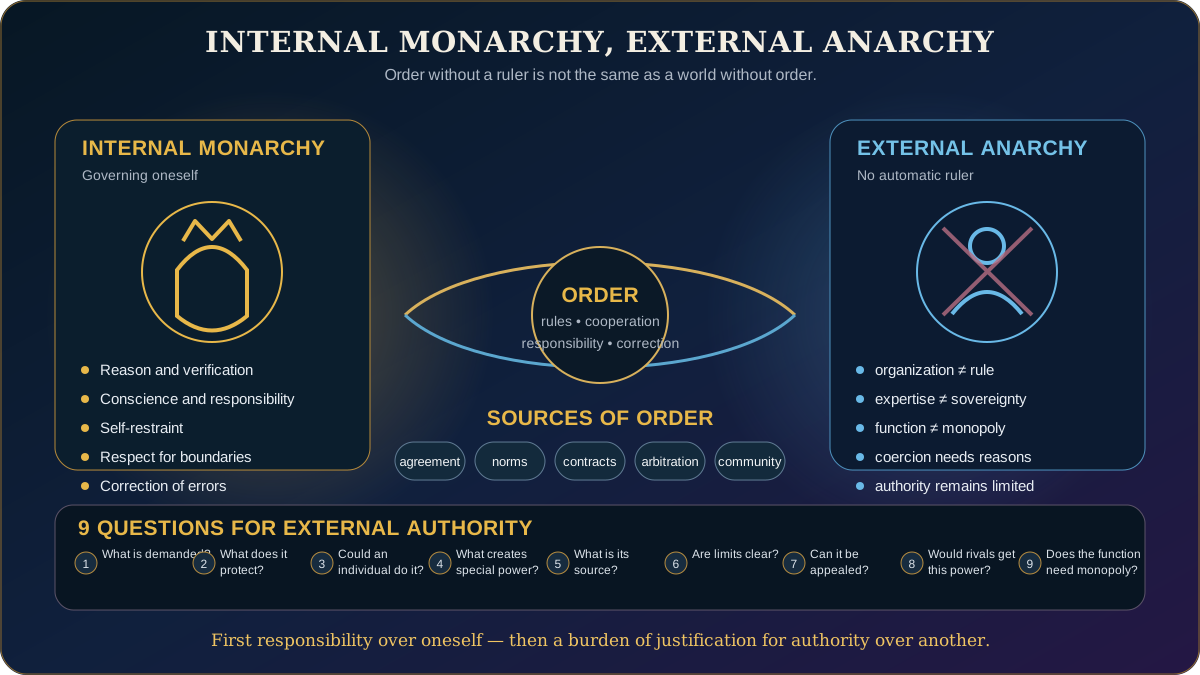
Order without a ruler is not a world without order
Perhaps the largest mistake in the whole debate is hidden inside language itself. If we say: “without the state there would be anarchy” and by anarchy we already mean chaos, then we have built the conclusion into the definition.
The question has been answered before it was even asked. But once anarchy is understood more precisely as the absence of a ruler, the real investigation becomes possible. Can there be: order without a ruler?
law without monopoly? protection without a master? coordination without subordination? responsibility without permanent threat?
institutions without unlimited political sovereignty? We already have partial answers to some of these questions. Others remain unresolved. But first we must allow the question itself to exist.
A person who cannot govern themselves will almost inevitably require increasing amounts of external control. A person who can govern themselves may reasonably ask why another person should become their ruler.
That is the meaning of internal monarchy and external anarchy. Not a promise of chaos. Not a call to blind rebellion. But a demand for a more mature form of order: first responsibility over oneself — then a burden of justification for authority over another.
Sources and further reading
- Stanford Encyclopedia of Philosophy — Anarchism. Source
- Stanford Encyclopedia of Philosophy — Authority. Source
- Stanford Encyclopedia of Philosophy — Political Legitimacy. Source
- Stanford Encyclopedia of Philosophy — Democracy. Source
- Elinor Ostrom — Beyond Markets and States: Polycentric Governance of Complex Economic Systems, Nobel Prize Lecture. Source
- Elinor Ostrom — Governing the Commons: The Evolution of Institutions for Collective Action. Source
- Gillian K. Hadfield & Barry R. Weingast — What Is Law? A Coordination Model of the Characteristics of Legal Order. Source
- Gillian K. Hadfield & Barry R. Weingast — Law without the State: Legal Attributes and the Coordination of Decentralized Collective Punishment. Source
- Thomas Hobbes — Leviathan. Source