Is Morality Objective or Only a Matter of Culture?
People and cultures can disagree profoundly about morality. But disagreement alone does not prove relativism, just as widespread agreement alone does not prove objective morality.

A practice may be accepted in one society and condemned in another. Something that was once lawful and ordinary can later appear morally intolerable. Customs, family structures, punishment, property, sexuality, authority, animals, and the treatment of outsiders have varied greatly across places and periods.
It is tempting to conclude that morality is therefore only a matter of culture. But cultural diversity by itself does not establish that conclusion. People also disagree about history, medicine, and economics without disagreement alone proving that there is no truth in those domains. The reverse is equally important: widespread moral agreement does not by itself prove that we have discovered an objective moral property of the world.
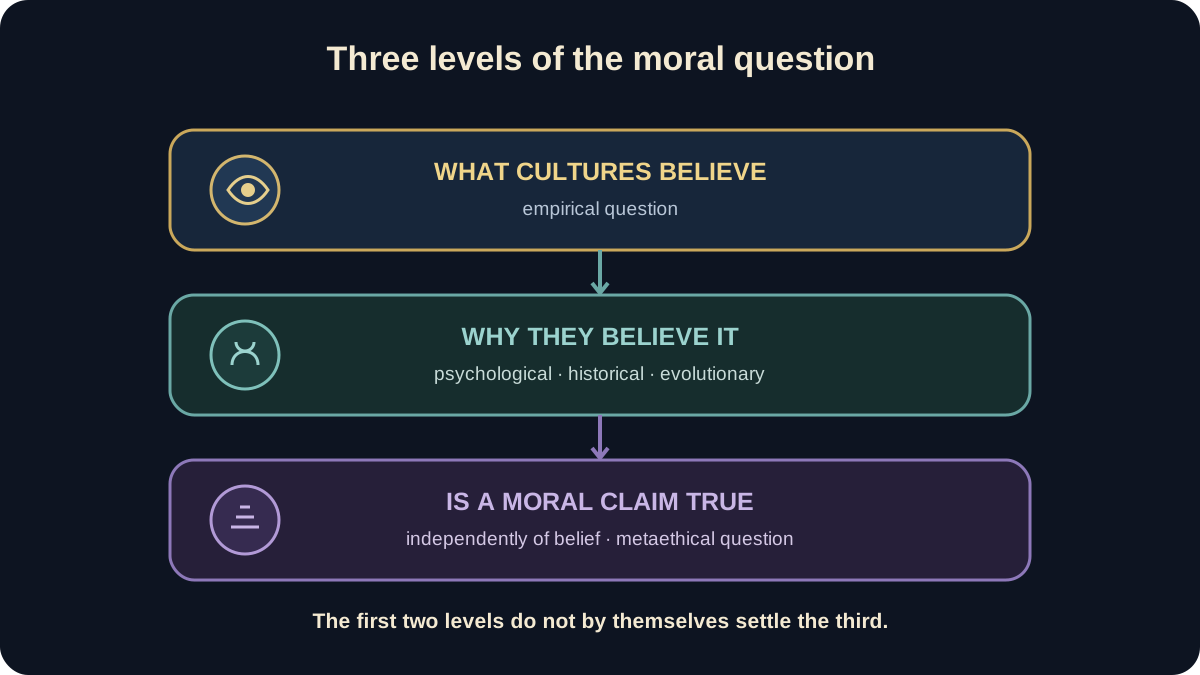
We need to separate three questions: what people morally believe, why they believe it, and whether any moral claim can be true independently of those beliefs.
What do objective morality and relativism mean?
What does “objective morality” mean? The word objective can sound as though a moral truth would need to exist in exactly the same way as the mass of a stone or the temperature of water. Moral realism, however, is not simply the claim that “my morality is correct.” In broad terms, it holds that moral statements can be true or false and that at least some moral statements are in fact true. Many realists add some form of independence from human attitudes, although they disagree sharply about the metaphysics involved.
A realist might therefore argue that deliberately torturing an innocent person purely for pleasure would be wrong even in a society that approved of it. Social approval would not create moral truth; the culture could be morally mistaken. That is a strong thesis, and it immediately raises further questions: what makes such a truth true, and how could we know it?
Moral relativism is more than cultural diversity The descriptive claim that cultures have different moral norms is an anthropological or sociological claim. Metaethical moral relativism goes further. In its various forms, it holds that the truth or justification of moral judgments is importantly relative to a moral framework, culture, group, or other standard, and that a single neutral standard may not be available.
So “culture A permits X” and “X is morally right for culture A” are not the same claim. The first describes a practice or belief. The second already advances a philosophical account of moral validity. We cannot simply infer the second from the first.
Disagreement, agreement, and universality
Disagreement is real — but what does it prove? Moral disagreement is easy to find. People seriously disagree about capital punishment, euthanasia, abortion, the treatment of animals, war, property, and distribution. Disagreement occurs between cultures, within cultures, and among philosophers who share much of the same factual information.
This is a genuine challenge for theories of objective morality: if there is a single moral truth, why is it so difficult to discover? Yet disagreement alone is not a logical refutation of realism. Disagreement also occurs in domains where few people doubt that there are facts. The argument becomes stronger only if we can show that central moral disagreements remain rationally irresolvable even among well-informed, reasonable, and impartial people.
Agreement does not prove objectivity either Now reverse the argument. What if many cultures evaluate similar forms of conduct positively? Curry, Mullins, and Whitehouse examined ethnographic records from 60 societies and studied seven forms of cooperative behavior: helping kin, helping the group, reciprocity, bravery, deference, dividing disputed resources, and respecting prior possession. In their sample these cooperative behaviors were consistently evaluated positively in moral terms.
That is meaningful evidence of cross-cultural similarity. It does not settle metaethics. A realist may see partial convergence on moral truth; an evolutionary or functional account may point to recurring problems of cooperation; a relativist may accept broad common norms while denying mind-independent validity. The empirical finding alone does not choose among these interpretations.
Universal is not the same as objective If every human being preferred the same flavor, the preference would be universal without thereby becoming objectively best in an attitude-independent sense. Likewise, common biology, vulnerability, dependence on cooperation, and recurring social problems can generate widely shared moral intuitions.
The useful boundary is therefore two-sided: culturally universal is not identical to metaethically objective, and culturally variable is not identical to metaethically relative. One level concerns the distribution of beliefs; the other concerns what would make moral claims true or justified.
Culture as a standard — and the problem of moral reform
Is cultural acceptance enough? Imagine a society in which slavery is legally and culturally accepted and its economy is built around it. If moral rightness simply means whatever the society approves, then slavery was morally right there for as long as the culture accepted it. Many people feel the pressure of relativism most strongly here because they want to distinguish “the society approved it” from “the society was right to approve it.”
That intuition still does not by itself prove realism. It mainly shows why we want moral criticism that can exceed current consensus. Sophisticated relativists can reply that cultures are not monolithic, contain competing norms, and change over time. A serious discussion must address the strongest version of a view, not its easiest caricature.
How can a moral reformer criticize their own culture? The problem sharpens when a reformer lives in a society where a practice is normal but argues that it is wrong. If moral rightness means only what the culture accepts, the reformer appears mistaken by definition until enough people agree. Once the culture changes, the same judgment would suddenly become right.
This creates real pressure for simple relativist models. But contemporary relativists often use more complex notions of moral frameworks, rational irresolvability, and cultural plurality. Relativism therefore cannot be reduced to the slogan that the majority is always right.
Objectivism, nature, and anti-realism
Objectivism has no easy route either Saying “there is objective good” is only the beginning. How would we know it? Through reason, moral intuition, human nature, well-being, rights, rational reasons, divine command, or something else? Moral realists disagree widely on these questions and on what moral facts would even consist in.
Objectivism therefore cannot be used as a shortcut for declaring our present morality universal. If objective moral truth exists, it does not follow that we have understood it correctly. The very possibility of objective error means that our own culture can be morally mistaken too.
Can morality simply be derived from nature? Natural-law discussions invite an easy shortcut: human beings need cooperation, therefore they morally ought to cooperate; a behavior is natural, therefore it is good. But a descriptive claim about how the world works does not, without an additional normative premise, tell us how we ought to act. Hume's famous observation about the shift from statements about what is to statements about what ought to be remains an important methodological warning.
Nature contains cooperation, but also predation, disease, competition, and death. “Natural” is therefore not a synonym for “morally right.” The natural-law tradition is far more demanding: it connects human nature with practical rationality, basic goods, and reasons for action. Even within that tradition there are disputes about how goods generate moral obligations.
Moral anti-realism is broader than relativism The alternative to moral realism is not only cultural relativism. Some non-cognitivist approaches treat moral language primarily as the expression of attitudes or practical commitments. Error theory accepts that moral statements purport to describe objective moral facts but argues that no such facts exist. Constructivist approaches connect moral validity to particular procedures of rational justification or construction.
The choice is therefore not simply “objective morality” versus “every culture has its own truth.” The metaethical map contains several serious possibilities that need to be distinguished before arguing for one of them.
Relativism, context, and disputes about facts
Relativism does not automatically imply tolerance A common claim says: “Because every culture has its own morality, we should tolerate all cultures.” But tolerance is itself a normative demand. If moral validity is always relative to culture, why must a culture that values intolerance accept a universal obligation of tolerance? Relativism does not derive tolerance by itself.
The reverse is also true. Objectivism does not imply intolerance. Someone may defend freedom of conscience, equal dignity, and limits on coercion precisely as objective moral requirements. A metaethical position and a political temperament are not the same thing.
Context explains — it does not automatically justify Cultural context matters. A gesture, symbol, or practice can mean very different things in different settings, and moral evaluation should not begin with a false interpretation of what people are actually doing. But understanding why a practice developed is not the same as morally endorsing it.
Context is indispensable to interpretation. Whether it also justifies a practice is a further moral question. If those two levels are collapsed, cultural explanation can accidentally become moral immunity.
Some moral disputes are really disputes about facts Two groups may share the value of protecting people while disagreeing about which policy actually protects them. One society may prohibit a food because it believes the food causes a dangerous disease, while another permits it because it rejects that empirical belief. Correcting the factual disagreement may dissolve much of the apparent moral disagreement.
But not all disagreement works this way. People can accept very similar facts and still disagree about justice, liberty, welfare, or duty. It is therefore useful to ask first whether a moral dispute is primarily about the world, about values, or about both.
Human nature and the meaning of objectivity
Human nature may constrain the moral space without writing the whole manual Human bodies can suffer, are vulnerable, require certain conditions for life, have limited information, and depend heavily on social cooperation. These facts are relevant to theories of harm, well-being, reciprocity, and cooperation and can help explain why some moral concerns recur across very different cultures.
Yet a normative step is still required. Why is well-being morally important? How should well-being be balanced against liberty? What happens when interests conflict? Human nature can be part of a moral argument, but it is not an automatic rulebook.
Objective does not necessarily mean physical If objective moral truths existed, they would not need to resemble physical laws. A statement about gravity and a statement that unjustified torture is wrong may belong to different kinds of discourse, while the second could still be objective in the sense that its truth is not merely a matter of voting or individual preference.
This matters because moral realism can be rejected too quickly if it is required to make moral properties measurable by the same instruments used for temperature. At the same time, the realist still owes an account of what moral facts are and how moral knowledge could be justified.
Practical judgment without false certainty
Seven questions before a major moral conclusion
- What in the dispute is an empirical fact and what is a moral premise?
- Do I apply the same rule to people outside my own group?
- Which consequences for harm, well-being, freedom, and responsibility are relevant?
- Would I accept the same rule if I did not know which side I would occupy?
- Do I have reasons that go beyond “this is how we do things”?
- What would have to be true for me to revise my moral position?
- Am I merely describing cultural difference, or have I actually shown that culture determines moral truth?
These questions do not prove moral realism or refute relativism. They help separate moral argument from custom, identity, interest, and group pressure.
Humility is not the same as relativism The statement “I may be wrong about this moral question” expresses intellectual humility. It is not the same as saying “no answer can be more correct than another.” The first allows for truth and human fallibility; the second already advances a metaethical theory about moral validity.
The mirror-image mistake is absolute certainty. A powerful internal conviction is a psychological fact about a person, not automatic evidence of a moral fact. If objective morality exists, it remains possible to be sincerely and confidently wrong about it.
What can we honestly conclude?
One of the hardest possibilities Perhaps objective moral truths exist but human beings know them imperfectly. Cultures could then make moral progress, while our own culture would retain no special immunity from error. The question would not merely be how people in the past could have been so blind, but which of our present assumptions future generations may recognize as our blind spots.
That is a more demanding consequence of realism than the slogan “we are objectively right.” If truth exceeds the group, it exceeds our group too.
And if morality is not objective? The practical problem still remains. Suffering, conflict, interests, cooperation, power, and consequences do not disappear. People still need procedures for resolving disputes and reasons they can offer to others. Metaethical anti-realism therefore does not mean that conduct becomes irrelevant or that people cannot hold demanding moral commitments.
The question of what moral statements are metaphysically and the question of how human beings should live together are connected, but they are not identical.
What can we actually conclude? Cultural differences are real, but different moral beliefs are not by themselves proof that objective moral truths do not exist. Cross-cultural similarities are real, but a universal or widespread norm is not by itself proof of objective moral truth. Human nature creates shared constraints and recurring problems, but a natural fact does not automatically become a moral command.
The most research-disciplined position is to treat moral objectivity as a serious possibility without automatically treating our present morality as its complete expression.
Natural Law Is Not a Matter of Belief asked whether natural law is something we discover or merely believe. Cause and Effect: Actions Have Consequences showed that causation alone does not generate moral obligation. Is Morality Objective or Merely a Matter of Culture? adds the central metaethical question: can a moral claim be true even when people disagree about it? Counting votes cannot answer that question, but clarity about what would need to be shown is already a major step forward.
From culture and majority rule to self-government
The State Can Be Institutionalized Culture The state does not exist outside culture. Its laws, institutions, values, and permitted forms of conduct arise within a historical society. It can therefore be understood partly as a way in which a culture institutionalizes its norms. Turning a cultural belief into law changes its legal status, but does not automatically change its moral status.
Culture does not become morally infallible merely because it writes its beliefs into law.
Democratic Majority and Legitimacy Democracy is an important method of common decision-making, but we must distinguish “the majority decided” from “the majority possesses a moral right to coercively enforce that decision against the minority.” The first describes a procedure; the second requires a theory of legitimacy.
Democratic agreement may contribute to legitimacy. It cannot automatically prove the moral correctness of the content.
Self-Government Requires More Than Cultural Obedience A person is born into a world of norms they did not choose. Internal self-government requires the ability to ask whether something is justified by a good moral reason or merely treated as normal by culture or required by law.
Self-government begins when a person can distinguish between “this is how things are done” and “there is a good moral reason for this.”
Sources and further reading
- Stanford Encyclopedia of Philosophy. Moral Realism. Substantive revision 2026. Source
- Stanford Encyclopedia of Philosophy. Moral Relativism. Substantive revision 2026. Source
- Stanford Encyclopedia of Philosophy. Moral Disagreement. Substantive revision 2026. Source
- Stanford Encyclopedia of Philosophy. Moral Epistemology. Source
- Stanford Encyclopedia of Philosophy. Moral Skepticism. Source
- Curry, O. S., Mullins, D. A., & Whitehouse, H. (2019). Is It Good to Cooperate? Testing the Theory of Morality-as-Cooperation in 60 Societies. Current Anthropology, 60(1), 47–69. DOI: 10.1086/701478. Source
- Stanford Encyclopedia of Philosophy. The Natural Law Tradition in Ethics. Substantive revision 2025. Source
- Hume, D. (1739–1740). A Treatise of Human Nature, Book III, Part I, Section I. Source