Are All Rights Property Rights?
Self-ownership powerfully explains bodily autonomy and consent, but can property really account for expression, conscience, voting, privacy and fair procedure? Are All Rights Property Rights? tests the limits of the thesis.

Imagine that someone takes your phone without permission. The moral structure seems immediately recognizable: another person has interfered with something to which you have a legitimate claim. Now change the example. Someone forces you to remain silent about your political beliefs. Another person secretly reads your private correspondence. A public authority prevents you from voting without adequate justification. A court imprisons you without a fair procedure. Someone decides that your body may be used against your will.
Can all of these wrongs be understood in the same way as taking your phone? An influential libertarian tradition says that, at a sufficiently fundamental level, they can. Its starting point is self-ownership: the idea that each person has stringent moral rights over their own body and person, including rights of control and rights against non-consensual use. From this starting point, some theories attempt to derive broader rights concerning labor, property, contract, movement, privacy, and freedom. The theory is elegant. That is precisely why it should be tested carefully.
Self-ownership expresses a powerful moral idea: other people do not possess an automatic right to control our bodies and lives. But this does not yet establish that every human right can be reduced to property without losing something important.
What is a right and how far does self-ownership reach?
What does it mean to have a right? Before asking whether every right is a property right, we need a clearer account of what a right is. Ordinary language uses the same word for several different normative relationships. We say that someone has a right to speak, a right not to be assaulted, a right to enter into a contract, a right to vote, a right to a fair hearing, and a right not to have a legal status altered arbitrarily. These are not all structured in the same way.
A highly influential analysis developed by Wesley Hohfeld distinguishes four basic elements that can make up rights: privileges or liberties, claims, powers, and immunities. Complex rights often combine several of them. source A property right in a house, for example, may contain a liberty to use the house, a claim that others refrain from entering without permission, powers to sell or lease it, and protections against certain other people unilaterally changing one's legal position. But the same kinds of normative elements appear outside property.
Freedom of religion can include liberties to practice and immunities against certain forms of governmental compulsion. The right to vote contains a political power to participate in collective decision-making. The right to a fair trial creates claims concerning how institutions must treat the accused. Property therefore contains rights. It does not follow that rights as such are merely property.
Why self-ownership is such an attractive idea Consider the sentence: “My body is not your instrument.” It carries enormous moral force. Another person may not use my body sexually without my consent. They may not remove an organ merely because doing so would benefit someone else. They may not enslave me and treat my labor as a resource at their disposal. Physical strength does not give them moral title over my body.
The language of self-ownership captures these cases with striking clarity. Contemporary philosophical accounts of libertarianism describe self-ownership as giving people very strong rights over their persons, including control over use, claims against non-consensual use, protections against involuntary loss of these rights, and rights connected with consent and enforcement. source This framework is especially effective at explaining why consent matters.
Physical contact during voluntary sport can be permissible while an assault is not. A medical intervention can be legitimate with informed consent and wrongful without it. Sexual activity changes fundamentally in moral character depending on whether genuine consent exists. Self-ownership therefore expresses an important moral boundary:
A human being is not a common resource that other people may use simply because doing so would benefit them.
That insight deserves to remain central to Are All Rights Property Rights?.
But do we own ourselves in the same way that we own a phone? The analogy becomes more difficult when we take it literally. A phone can be sold. A house can be given away. A car can be leased.
Ordinary property rights frequently contain some capacity to transfer rights from one person to another. What would completely analogous ownership of oneself imply? Strong theories of full self-ownership have had to confront exactly this problem. If ownership includes powers to transfer control rights, could a person permanently transfer those rights over themselves and enter a form of voluntary slavery?
The contemporary SEP entry on libertarianism treats this as a genuine internal dispute. Some theories allow such alienation in principle; others argue that self-ownership rights can be waived in limited ways but cannot be permanently transferred, because permanent alienation would conflict with autonomy or with the nature of personal agency. source The dispute reveals something important. The statement
“I have primary moral authority over my own body” may not be identical to “I own my body in precisely the same sense in which I own transferable property.” The first can be grounded in autonomy, agency, bodily integrity, dignity, or the moral separateness of persons.
The second applies a model of ownership. That model may illuminate important features of personal freedom without being a complete description of what a person is. Indeed, the current SEP discussion of property notes that some philosophers question whether the concept of self-ownership is even necessary to explain the inviolability of the human person. source
Slavery is a useful test of the metaphor A common intuition behind self-ownership is expressed through a rhetorical question: “If I do not own myself, who does?” The question is powerful, but it can conceal a false choice. Perhaps a human being does not need to be someone's property at all.
One of the deepest wrongs of slavery was precisely that people were treated as objects over which another person could exercise property-like powers of use, control, transfer, and extraction. Two different philosophical conclusions can therefore be drawn. The first says: Because no other person may own me, I must own myself.
The second says: Because a human person should not be treated as property, ownership may not be the most fundamental category for describing the moral status of persons. Both approaches reject slavery completely. They disagree about the best explanation of why slavery is wrong. THY-REALITY therefore should not present self-ownership as the only logically possible alternative to slavery.
Testing the property account across different rights
Freedom of expression can partly be explained through property The property model performs well in some cases involving speech. If I control my body, my voice, my computer, my printing equipment, and legitimately acquired resources, then preventing me from expressing an opinion may involve interference with things over which I have strong claims. Suppose I write a book using my own equipment, finance its publication myself, and voluntarily exchange copies with willing readers. Much of that relationship can indeed be described through bodily autonomy, contract, and property. But harder cases quickly appear.
What if a government prohibits criticism of itself even on privately owned media? What if authorities seize a publication solely because of its political viewpoint? What if access to information is suppressed without anyone taking a physical object from the reader? What if someone is punished merely for holding or expressing a lawful opinion?
The European Convention on Human Rights treats freedom of expression as a distinct right that includes the ability to hold opinions and to receive and impart information. It is not formulated merely as a consequence of property ownership. source This does not logically prove that no property-based theory of expression could be constructed. It does show that saying “I own my vocal cords” is not yet a complete theory of freedom of expression.
Voting rights are an even harder case Suppose a citizen is arbitrarily prevented from voting. What property has been taken? We sometimes say metaphorically that someone has been “robbed of their vote.” But a political vote is not an object that the citizen possessed in the same manner as money or a phone.
It is a normative power to participate in a system of collective political decision-making. If voting were an ordinary property right, further questions would arise. Could it be sold? Could it be inherited?
Could I permanently transfer my vote to someone else, giving that person two votes while leaving myself with none? Modern democratic institutions generally reject precisely that model. Voting rights attach to political membership and equal citizenship rather than functioning as freely tradable assets.
The current SEP entry on property makes the distinction unusually explicit: even under a broader definition of property that includes alienable intangible rights, rights such as the right to vote and the right to marry do not qualify as property rights. source This creates a serious challenge for the strongest version of Are All Rights Property Rights?.
One can redefine property broadly enough to include political participation, but at some point the word begins to mean little more than “something to which a person has a right.” The theory then risks becoming circular.
The right to a fair trial is not obviously a property right Consider a person accused of a crime. They may have claims to an independent tribunal, an opportunity to defend themselves, access to relevant evidence, procedural equality, and a decision reached according to law. What exactly do they own in this situation? One possible answer is that the procedure ultimately protects their life, liberty, and possessions against unjustified state interference. That explains why the stakes are high.
But it does not fully explain why procedure itself matters. The right to a fair trial is also a constraint on the authority of institutions. It determines how an institution that possesses legal power must exercise that power. This fits naturally within the broader theory of rights. Some rights create claims against others; some create powers; some protect us through immunities against another actor's ability to alter our normative position. source
Property rights contain these structures. They are not the only rights that do.
Privacy also extends beyond ownership of physical space At first, privacy appears easy to translate into property language. My home is mine, so others should not enter without permission. My letter is mine, so others should not open it. My computer is mine, so others should not search it arbitrarily. But contemporary privacy problems quickly exceed physical ownership.
A company may own the server on which information about me is stored. Does its ownership of the hardware give it unlimited moral authority over information concerning my health, relationships, movements, or communications? A government may use its own surveillance equipment to monitor my private life. No physical object belonging to me need be taken. Yet an important personal boundary may still have been crossed.
The European human-rights framework therefore protects private and family life separately from property. In the same system, property, expression, conscience, elections, liberty, and fair trial are treated as distinct rights. source Again, legal classification does not settle philosophy by itself. But it reflects a practical insight: different kinds of rights protect different dimensions of human agency and social status.
Freedom of conscience is especially resistant to property reduction Imagine that a state compels a person to profess a religion they do not believe. What has been taken? We could say metaphorically that “their mind belongs to them.” That formulation captures something important, but it stretches property language into an unusual domain.
Thoughts and convictions are not assets that can be transferred to another person in the same way that a title to land can be transferred. Freedom of conscience protects something closer to a person's normative authorship of their own beliefs and to limits on external authority over their inner convictions.
The Universal Declaration of Human Rights reflects this distinction structurally. Property is protected in Article 17; freedom of thought, conscience, and religion in Article 18; expression in Article 19; and political participation in Article 21. source The Declaration cannot prove that a philosophical reduction to property is impossible. It does, however, show why such a reduction cannot simply be assumed.
Negative and positive rights
The property model is strongest with certain negative rights Where does the original theory work best? It performs especially well where the core principle is: other people may not use me or my legitimately held resources without adequate justification. That includes many cases involving:
- bodily integrity,
- consent,
- protection against slavery,
- protection against assault,
- control over one's labor,
- possession of legitimate property,
- voluntary exchange.
In these areas, property language makes the boundary of permissible control highly visible. This explanatory success is real. The problem arises only when the success of the model in these cases is turned into a universal conclusion: everything that counts as a right must therefore be property. A boundary of authority does not automatically become a property boundary merely because both structures limit what others may do.
What about positive rights? The issue becomes even more difficult with rights to education, healthcare, basic social security, or other goods that require organized institutions and material resources. Strong self-ownership theories have a serious objection here. If every person holds extremely strong control rights over their labor and resources, how can anyone acquire an enforceable claim that requires others to contribute resources for their benefit?
Contemporary philosophical discussions of self-ownership recognize this tension. A very strong self-ownership principle can exclude enforceable duties to assist others because coercively requiring such assistance would interfere with the person's control over their body and actions. source This is a coherent philosophical position. It is not the only theory of rights.
Other traditions argue that rights concern not only protection against interference but also the social and institutional conditions necessary for people to function as free and equal persons. The Universal Declaration itself includes social security, work, adequate living standards, and education alongside civil and political rights. source The disagreement therefore cannot be resolved by declaring positive rights unreal merely because they do not fit a property model. That would define the disputed conclusion into the premise.
Self-ownership, the world, and the limits of property
Self-ownership does not by itself determine ownership of the world Suppose we grant complete self-ownership. Every person possesses strong moral authority over their own body. What follows about land, water, minerals, forests, and other external resources? Not enough to produce a complete property system.
A second theory is required: a theory of legitimate acquisition. Libertarian philosophy itself recognizes this problem. The current SEP discussion distinguishes self-ownership from the question of ownership of external resources and describes major disagreements between right-libertarian and left-libertarian theories about how the external world may legitimately be appropriated and distributed. source The problem can be made vivid.
A person might formally be described as a complete owner of themselves while every usable piece of land and every natural resource is controlled by someone else. What practical freedom would self-ownership then guarantee? The relationship between personal control and access to the external world therefore requires additional principles. “Do Not Steal” as a Concise Principle of Natural Law already exposed this difficulty.
Are All Rights Property Rights? makes its consequences clearer. If all rights are supposed to arise from property, we first need a convincing theory of how legitimate external property rights arise. Self-ownership cannot perform that work by itself.
Property itself is not one simple right Another complication appears when we look more closely at ownership. We often say: “This is my property.” The phrase sounds as if it refers to one indivisible right.
In reality, property frequently contains a complex combination of powers and claims. A person may own an apartment but remain subject to rules protecting neighbors. Land can be burdened by easements. Ownership of a physical copy of a book does not give the owner its copyright.
Owning shares in a company does not mean personally owning every chair in the company's offices. Philosophy and law therefore frequently analyze ownership as a structured collection or bundle of rights, powers, privileges, and restrictions, even though there is disagreement about how unified that bundle must be. source Instead of saying: all rights are property rights we can say: property itself is a particular institutional arrangement composed of several different kinds of rights. That is an important analytical difference.
What property shares with other rights Rejecting the complete reduction does not mean the original intuition was empty. Far from it. Property, bodily autonomy, privacy, expression, conscience, and political rights all answer related questions: Who may decide?
Who may interfere? Whose consent matters? What can a person do without another person's permission? What may others demand?
Which aspects of a person's legal or moral position may institutions alter? All rights establish some kind of normative boundary or normative authority. The general theory of rights captures this better than property alone. Rights distribute liberties, claims, powers, and immunities among persons and institutions. source This allows us to preserve a more precise version of the source insight:
Not every right must be a property right. But every right defines some protected sphere of liberty, claim, power, or immunity. Property is one especially important example of such a protected sphere, not necessarily the universal model for all the others.
The body, personal sovereignty, and the sale test
“My body is mine” remains morally useful The everyday sentence “My body is mine” performs an extremely important moral function. It means that others do not automatically have permission to touch, use, injure, exploit, or medically alter my body.
It means that consent matters. It means that I am not another person's slave. None of that language needs to disappear. We only need to distinguish two possible meanings of the word mine.
In “This chair is mine,” we normally describe a relationship between a person and an external object. In “My body is mine,”
the subject and what is being protected are inseparable in a much deeper way. I am not merely the proprietor of the body through which I act. I am an embodied person. The current SEP discussion of property emphasizes this connection between bodily control and agency while also noting that philosophers disagree over whether the idea of self-ownership is required to explain it. source The metaphor therefore remains useful. It need not become literal metaphysics.
Personal Sovereignty Without Reducing the Person to Property Even if a human being is not understood as a thing that owns itself, the central moral insight can remain: a person possesses primary moral authority over their body, conscience, and legitimate sphere of personal decision-making. We can cautiously call this personal sovereignty.
The word sovereignty normally refers in political philosophy to supreme political authority. Applied to the individual, it should therefore be understood as a moral metaphor, not as a claim that every person is an absolute ruler over the world around them. Personal sovereignty does not mean “I can do whatever I want.” Our actions take place in a world of other persons with equal moral status; autonomy does not create a right to unjustifiably interfere with their bodies, liberty, or legitimate claims.
A person is the primary moral authority concerning themselves, while their sphere of autonomy is limited by the equal moral status of others.
This is close to the idea of internal self-government: governing oneself first rather than automatically claiming authority over another.
The transfer test reveals an important difference A useful thought experiment is to ask: Can I legitimately transfer this right to another person so that I no longer possess it and they do? With a car, often yes. With land, usually yes under established procedures.
With shares, yes. With voting rights, ordinarily no. With the right not to be tortured, no. With basic legal personality, no.
With the right to a fair trial, it would make little sense to say that I sold my right to my neighbor, leaving me without fair-process protection while giving the neighbor two such rights. Transferability is not the only possible criterion of property. But it reveals a significant distinction. Some rights concern assets or positions that can pass from one person to another.
Others attach to a person because of who or what that person is within a moral and legal order. The current SEP discussion of property uses this distinction directly when explaining why even a broad, alienability-based conception of property does not encompass voting and marriage rights. source
How rights protect people and how to test the property argument
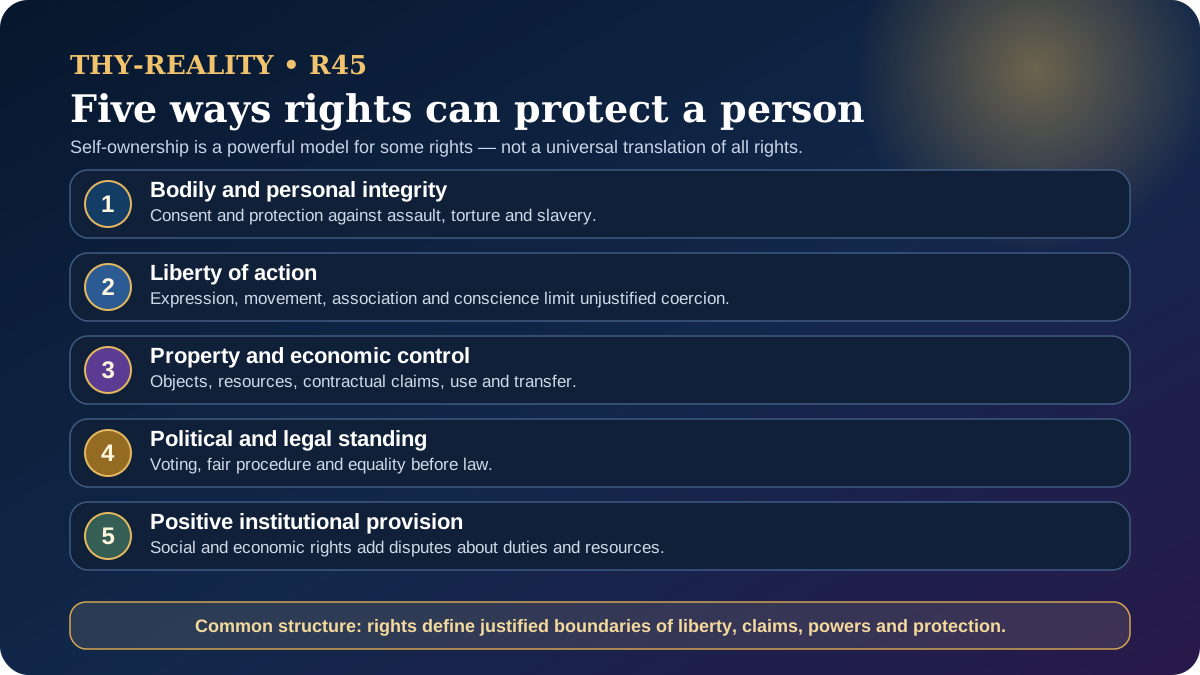
Five ways rights can protect a person Rather than forcing all rights into a single category, we can distinguish several overlapping functions. First: bodily and personal integrity. Protection against assault, torture, slavery, and various non-consensual uses of the body belongs here. Self-ownership is a particularly powerful explanatory model in this domain.
Second: liberty of action. Expression, movement, association, religion, and conscience protect areas in which people may act or decide without unjustified coercion. Third: property and economic control. These are property rights in the more recognizable sense: rights concerning objects, resources, contractual claims, transfer, possession, and exclusion.
Fourth: political and legal standing. Voting rights, equality before law, procedural rights, and fair-trial protections structure a person's relationship with institutions and collective authority. Fifth: rights connected with positive institutional provision. This includes the more philosophically contested field of social and economic rights.
The categories overlap. That is not a defect. Human relationships overlap. The distinction simply prevents the term property from carrying more conceptual weight than it can justify.
Seven questions for testing the claim “this is a property right” A body, physical object, land, information, action, legal status, political power, or something else?
- What is the actual object of the right?
If it can be sold or given away, the analogy with property becomes stronger. If it is inseparable from the person, additional explanation is needed.
- Can the right be transferred?
Non-interference, active assistance, recognition of a decision, or inability to alter the person's status?
- What does the right require from others?
A metaphor is useful only when it clarifies.
- Does property language explain the right better than autonomy, dignity, equality, agency, or political status?
If the moral reason for the right remains fully intelligible, property may not be the foundational concept.
- What remains if we remove the word “property”?
Voting, conscience, fair procedure, privacy, expression, and rights requiring institutional action?
- Can the theory handle difficult cases?
If so, the claim becomes circular: all rights are property because all rights have been renamed property.
- Has “property” been expanded until it simply means “anything to which someone has a right”?
What remains after testing: a better foundational formulation
What remains after the test? A stricter test does not require us to discard the valuable moral core of the argument. Several important conclusions survive. A person has an exceptionally strong moral claim to control their own body. Consent is a fundamental boundary governing many interpersonal actions.
Slavery is a radical violation of personal agency. Property rights can provide essential protection for individual independence. People have strong interests in controlling their own labor, time, and legitimately acquired resources. Violations of legitimate property rights do not become moral merely because the violator is more powerful, belongs to a majority, or acts through an institution.
All of this remains compatible with “Do Not Steal” as a Concise Principle of Natural Law. What does not survive is the unsupported leap: “Self-ownership explains some central rights; therefore every right is a property right.” That conclusion requires much more than the premise provides.
A stronger foundational formulation If we are looking for a common structure connecting bodily integrity, liberty, property, expression, conscience, privacy, and political rights, a broader formulation may be more defensible:
Rights define justified boundaries of liberty, claims, decision-making authority, and power among individuals and institutions. Property rights are an important part of this system, and self-ownership is a powerful model for some personal rights, but neither needs to be the complete explanation of all rights.
This statement is less elegant than: “All rights are property rights.” Reality often resists elegant compression. The task is not to find the shortest possible formula. It is to find the one that survives examination.
From self-ownership to a universal test Natural Law Is Not a Matter of Belief introduced the symmetry test. If I claim bodily integrity for myself, I need a reason before denying comparable protection to someone else. If I demand freedom of conscience, I cannot force another person to adopt my religion merely because I possess political power. If I expect others to respect my legitimate property, I must apply comparable standards to theirs. If I want fair procedure when I am accused, I cannot deny it to an opponent solely because I dislike them.
This reveals a deeper common structure of rights. The deepest principle may not be: “Everyone owns everything that their rights protect.” It may instead be: “Every person is a morally relevant subject whose justified liberties, claims, powers, and protected status may not be arbitrarily subordinated to the interests of another.” That formulation preserves much of what self-ownership was designed to protect. It does so without reducing the human person to an object of ownership.
Collective institutions and the limit of delegation
Can a Collective Institution Acquire a Special Right? Institutions can acquire particular powers through voluntary agreements, contracts, shared property, delegation, and legitimate procedures. We therefore cannot simply assume that a group can never possess a special authority that a random individual lacks. Political authority, however, often claims powers over people who did not directly consent to each law or measure. This is where the separate problem of political legitimacy begins. Perhaps legitimacy arises from consent, democratic equality, fairness within a cooperative system, the need for coordination, the protection of rights, or some combination of these reasons. Political philosophy offers several competing accounts.
A special institutional right requires a special moral reason; an institution does not acquire it merely by existing.
Delegation Cannot Create a Right from Nothing If I authorize someone to sell my car, I give them a power I had a right to delegate. If I have no right to take my neighbor’s car without justification, I cannot obviously create such a right merely by authorizing someone to do it in my name.
Political authority is more complex because it involves shared institutions, public functions, and multilateral relationships. But the question remains: are political powers composed of rights people can legitimately grant, or is there some additional independent source of institutional authority? If there is, it must be explained.
Authorization by itself does not create a moral right from nothing.
One Hundred People Do Not Turn Arbitrariness into a Right Merely by Adding Themselves Together Imagine one hundred people. None of them has the right to take your phone without justification. Do they acquire that right merely by voting to take it? The number alone does not explain the moral transformation. If the phone is instead part of a contractual dispute, a debt, restitution after theft, or a legitimate procedure, the situation may change. The crucial factor is not one hundred people. It is the additional morally relevant reason.
The same applies to political authority: majority support, voting, and institutional status can matter, but they do not by themselves explain why a particular interference is morally justified.
The size of a group is not a moral reason. If a special right exists, we must identify what creates it.
Personal sovereignty as an initial burden of proof
Personal sovereignty alone does not tell us how to organize courts, resolve disputes, govern common resources, or respond to aggression. It does not prove that society needs no institutions. It does change the starting relationship: the person is not treated as naturally subordinate. Their autonomy is morally relevant, and interference with it requires justification.
The question therefore changes from “why are you unwilling to obey?” to two more precise questions: why would it be reasonable to obey, and where does the other party obtain the right to demand obedience?
Personal sovereignty does not eliminate the question of authority. It requires authority to carry its own burden of justification.
Are all rights property rights after all?
The most defensible answer remains: not in the ordinary or contemporary philosophical meaning of property. Property rights form an important family of rights. Self-ownership is a powerful model for bodily autonomy, consent, protection against slavery, and many negative liberties. But voting rights, due process, freedom of conscience, political status, and several other rights cannot simply be transformed into property without additional and controversial assumptions.
A human being is not a thing that owns itself. A human being is a moral subject over whom another person or institution possesses no automatic authority. Interference with their body, liberty, conscience, legitimate property, or protected legal status requires moral justification.
This is not the claim that every form of political authority is unjustified. It is the requirement that a special right to rule cannot prove itself merely through the existence of an institution, a majority, or superior force. If no individual possesses a natural right to arbitrarily rule another person, through what moral process can such a right arise in a group, majority, or state? Perhaps it can arise. But if it can, there must be a reason.
The size of the group is not that reason. The existence of an institution is not that reason. Power is not that reason. And this is why the question of political legitimacy remains open.
Sources and further reading
- Stanford Encyclopedia of Philosophy — Rights. Source
- Stanford Encyclopedia of Philosophy — Property and Ownership. Source
- Stanford Encyclopedia of Philosophy — Libertarianism. Source
- United Nations — Universal Declaration of Human Rights. Source
- Council of Europe — European Convention on Human Rights: Rights and Liberties. Source
- Council of Europe — Freedom of Expression. Source