“Do Not Steal” as a Concise Principle of Natural Law
“Do not steal” is a powerful moral rule, but theft already assumes an answer to what legitimately belongs to whom. “Do Not Steal” as a Concise Principle of Natural Law examines property, necessity, taxation, conscience, and the limits of the concept itself.

A phone is lying on a table. We know it belongs to someone who has stepped away for a few minutes. We could take it. Nobody is watching. The phone would be useful to us, and its owner might not notice that it is missing until later.
Would it be wrong to take it? For most people, the answer comes almost immediately: yes. But why? Not because moving the phone is physically impossible. It plainly is possible. Not because the universe prevents us from putting it into our pocket. And not necessarily because we know which section of the criminal code prohibits theft.
Something else seems to matter: the phone is not ours, and we do not have an adequate justification for taking it as our own. This brings us close to one of the oldest and most concise moral rules: do not steal. We can test a stronger proposal: perhaps theft provides a compact way of understanding a broad class of moral wrongs — taking another person's property, liberty, life, labor, or even their ability to make an informed choice. The proposal is attractive because it looks for a common structure, but it must be tested rather than assumed. That is a powerful idea. But before turning it into a universal law, we have to examine what the word theft already assumes.
“Do not steal” is a strong candidate for a fundamental moral constraint. But before treating it as a complete moral law, we must ask what counts as stealing, what it means for something to belong to someone, and what makes a claim of ownership justified.
Theft, property, and justice in acquisition
Theft is more than physically moving an object If I pick up an abandoned stone from an empty path, we would not normally call that theft. If I take your phone from a table and keep it, we might. The physical action can be remarkably similar: an object moves from one place to another.
The moral difference arises from a network of claims and relationships. Who is entitled to use the object? Who may decide what happens to it? Who may exclude others from it? Who may transfer it?
Modern philosophy therefore treats property not merely as a collection of physical objects but as a normative system of rules governing access to and control over resources and other things of value. Because both the general shape of those rules and their particular applications are disputed, the justification of property is itself a philosophical problem. source This creates an important logical point:
Before we can determine whether an act is theft, we must have some account of whether another person had a justified claim to the thing in question.
The word theft is therefore already partly normative. To say that someone “took what rightfully belonged to another person” is not a neutral description of motion. It already contains a judgment about entitlement. The remaining question is: why was the thing rightfully theirs?
“Mine” and “yours” are not always simple categories With a toothbrush, a coat, or a personal phone, ownership may appear obvious. Other cases are harder. Who owns a river? Who owns land used by one community for generations but later formally registered by another?
Can someone acquire a natural resource merely by reaching it first? What does it mean to own an idea? Who owns the courtyard shared by the residents of an apartment building? Who owns the assets of a corporation with thousands of shareholders?
Who owns a public park? Such cases show that property cannot simply mean “a thing held by one individual.” Even contemporary human-rights language recognizes that property need not be purely individual. Article 17 of the Universal Declaration of Human Rights states that everyone has a right to own property alone as well as in association with others and protects people against arbitrary deprivation of property. source
The important conclusion is not that one particular theory of ownership has already won. It is the opposite: Respect for property does not by itself prove one exclusive theory of property.
Why is stealing so intuitively wrong? Despite disagreements about property theory, the moral attraction of the prohibition on theft is not difficult to understand. People structure their lives around relatively stable expectations. Food, clothing, shelter, tools, savings, personal objects, and productive resources are not merely abstract economic units. They allow people to plan, work, exchange, create, care for others, and maintain some independence from the immediate will of other people. If others may simply take whatever we possess or rely upon whenever they are stronger, long-term planning becomes more difficult.
The harm is not limited to the value of the object lost. Uncertainty itself becomes costly. If I cannot reasonably expect my tools to remain available tomorrow, I have less reason to invest effort in using and maintaining them today. If agreements can be ignored whenever one party becomes powerful enough, exchange requires more protection and more distrust. If people cannot rely on justified claims being respected, more energy has to be spent defending possession instead of creating or cooperating.
Philosophers have defended property systems partly because stable ownership can support independence, responsibility, planning, and freedom. Critics, however, have pointed to exclusion, inequality, unjust acquisition, and the social consequences of allowing property to become concentrated. SEP's current overview presents precisely this continuing dispute rather than treating private property as a philosophically settled fact. source The useful question is therefore not simply: “Property: yes or no?” It is: Which property claims are justified, how do they arise, what limits do they have, and how should they interact with other important human goods?
“Do not steal” already assumes a theory of legitimate acquisition Imagine that someone steals a bicycle and sells it the next day. Does the buyer automatically become the morally legitimate owner simply because they now possess it? Most people would say no. That answer reveals something important.
Possession alone does not establish legitimate ownership. The rule “do not take what belongs to another” can work only if we possess at least some account of how something legitimately becomes mine, yours, ours, or theirs. Possible answers have included labor, first acquisition, voluntary transfer, contract, gift, inheritance, convention, law, collective ownership, or various combinations of these. Philosophers have disagreed about these foundations for centuries.
John Locke famously began with a world initially given in common and tried to explain how individual appropriation could become legitimate through labor. Hume, by contrast, placed much greater emphasis on property as a social convention that stabilizes possession. Other theories defend communal, collective, public, or more restricted forms of ownership. source We therefore cannot reason in a circle:
- theft is wrong;
- theft means taking my property;
- my property is whatever I declare to be mine;
- therefore anyone interfering with anything I call mine is morally wrong.
The problem lies in step three. It requires an independent justification.
“Do not steal” through history and a concrete case
“Do not steal” is not owned by one modern political ideology The commandment “You shall not steal” is especially familiar from the Jewish and Christian Decalogue. But the moral problem of unjustified taking is much wider than one religious tradition or one modern political philosophy. Societies across history have developed rules governing possession, transfer, fraud, trespass, restitution, debts, and prohibited forms of appropriation. At the same time, even classical natural-law traditions have not always treated private ownership as an unlimited absolute.
Thomas Aquinas defended private administration of property as socially useful, yet he also argued that human divisions of property could not override extreme and manifest necessity. In such circumstances, taking what is needed for immediate survival need not count as theft in the strict sense. source That matters because it reveals something often lost in political slogans:
A strong prohibition on theft does not automatically settle every conflict between property, life, necessity, and justice.
A loaf of bread exposes the problem better than an abstract formula Consider two cases. In the first, a person who can easily afford food steals an item from a shop simply because they prefer not to pay. In the second, a person faces an extreme emergency. No reasonable alternative is available, and their child faces immediate serious harm from starvation. They take the food required for survival.
A similar physical event has occurred in both cases: food was taken without the ordinary owner's permission. Must the moral judgment be identical? If the answer is yes, we are defending an extremely strong and largely exceptionless theory of property. If the answer is no, then we have acknowledged that other moral considerations can matter: necessity, life, alternatives, responsibility, and perhaps obligations toward people in severe need. This is exactly why “Do Not Steal” as a Concise Principle of Natural Law cannot stop at a slogan.
“Do not steal” may be a powerful principle. Powerful principles still have to survive difficult cases.
Taxation, law, and the question of a direct victim
Is taxation theft? This is a recognizable political-philosophical position. It is not a neutral definition. If theft is defined from the outset as every transfer of resources made without the direct consent of the individual paying, then compulsory taxation will qualify as theft by definition. But that simply places the disputed conclusion inside the definition.
The real philosophical question is whether a political community can, under some conditions, legitimately require contributions for common institutions, public goods, legal systems, infrastructure, defense, social programs, or other collectively authorized purposes. Different political theories answer that question differently. Even Locke's political philosophy does not support the simple historical claim that taxation necessarily requires unanimous consent from every property holder. SEP's discussion of Locke treats majority rule as an important component of political society, and SEP's democracy entry notes that Locke regards consent to regulation or taxation of property as satisfied through the consent of a majority of representatives of property holders. The exact scope of governmental authority in Locke remains disputed among interpreters. source source
Contemporary European human-rights law also does not treat taxation as conceptually identical to theft. Article 1 of Protocol No. 1 protects the peaceful enjoyment of possessions while expressly allowing states to enforce laws needed to secure payment of taxes and other contributions. Such interference must remain lawful, and the Court's case law examines whether a fair balance has been maintained and whether an excessive burden has been imposed. source
None of this proves that every tax is morally just. It proves something narrower and methodologically important: “Taxation is theft” cannot be used as a definition that ends the argument. The stronger question is: Under what conditions is a compulsory public contribution morally justified, how is it determined, what purposes may justify it, who is accountable for its use, and what limits should apply to the state's power over property? That is a more difficult question. It is also a better one.
Legality does not make every taking just Rejecting the automatic equation “tax = theft” does not require accepting the opposite slogan: “Whatever the state takes is therefore morally legitimate.” That would make the same mistake in reverse. What Is Natural Law? already distinguished legality from morality. A legal system can define formal ownership and authorize transfers, taxation, fines, confiscation, expropriation, or other interventions.
But we can still ask whether those rules are just. The Universal Declaration of Human Rights does not say that public authorities can never interfere with property. It says that no one should be arbitrarily deprived of it. source
The European human-rights framework likewise allows certain interferences while subjecting them to legal requirements and proportionality review. In taxation cases, the European Court examines whether a fair balance has been maintained; an excessive individual burden can fall outside the permitted margin. source This gives us the same symmetry test found throughout the Natural Law series. “An individual may not take whatever they want.” does not entail “An institution may take whatever it wants.” Both need justification.
Does the absence of an obvious victim make an act morally permissible? A stronger proposal is that if there is no victim, the state should not criminalize the act. The intuition deserves examination, but it is not self-validating. There is an important insight behind this. If government punishes private conduct merely because a majority dislikes it, without identifying harm, rights violations, or a serious public reason, coercion requires justification. But the phrase victimless act can hide difficult cases.
Suppose someone drives while severely intoxicated and, by luck, reaches home without hitting anyone. There was no injured pedestrian that night. Does that mean the conduct was morally harmless? Or imagine pollution whose effects are spread among thousands of people and become measurable only over decades.
There may be no single obvious victim standing beside the source of the pollution, yet the cumulative harm can be real. The same difficulty appears with systemic fraud, reckless endangerment, and other behavior that creates substantial risks before a specific injury materializes. A stronger formulation is therefore:
Punishment requires justification in serious harm, violation of rights, or sufficiently grave and unjustified risk — not merely in the fact that an authority disapproves of the behavior.
This preserves the warning against excessive moral policing without turning “no immediate identifiable victim” into an automatic answer to every case.
Conscience, the positive meaning of the rule, and its limits
Conscience can warn us, but it does not determine ownership by itself The argument can also be connected to conscience. A person may feel internal resistance before dishonest behavior or guilt afterward. That experience can matter. But Follow an Order or Follow Your Conscience? already established an important methodological limit: conscience is not an infallible database of moral truth.
People can feel guilty about actions that were not wrong. They can also commit serious wrongs while experiencing very little guilt. Conscience is shaped by empathy, temperament, upbringing, fear, habit, culture, ideology, memory, and the way we interpret what has happened. It is therefore better understood as a signal inviting moral examination, not as final proof. If my conscience troubles me, useful questions include: What did I actually do?
Who was affected? Did I deceive someone? Did I violate an agreement? Did I take or use something without adequate justification?
Can the harm be repaired? But the feeling itself cannot establish who rightfully owns disputed land, whether a particular tax is just, or whether a complex inheritance claim is legitimate. Those questions require evidence and argument.
“Do not steal” contains a positive principle The wording sounds negative: do not do this. But behind the prohibition lies a positive idea: respect the justified boundaries and claims of other people. If an object legitimately belongs to another person, do not simply take it. If someone has entrusted an object to you temporarily, do not convert temporary use into ownership through deception.
If a voluntary agreement establishes legitimate obligations, do not manipulate the other party merely because you possess greater power. The moral importance of “do not steal” lies not merely in objects but in respect for others as agents whose legitimate claims impose limits on what we may do. Yet one word remains essential: legitimate. Respecting property cannot mean respecting every claim merely because someone has attached the word mine to it.
Can every wrong really be understood as theft? Now we reach the strongest possible extension of the principle. If the concept of theft is broadened sufficiently, many serious wrongs can be described as forms of taking. Murder can be described as taking life. Kidnapping as taking liberty.
Fraud as taking away another person's opportunity to make a genuinely informed decision. Slavery as taking control of another person's labor, body, and freedom. This language can reveal an important common structure: someone assumes unjustified control over something that should remain protected in relation to another person. That can be analytically useful.
But there is also a danger. If we redefine theft until it simply means “every form of wrongdoing,” then the proposition “all wrongs are theft” becomes true only because of the definition we selected. We would then obtain a circular result: “All wrongs are theft because we have defined theft to include all wrongs.” That explains very little.
A foundational principle should explain other moral categories. It should not merely rename everything that needs explaining.
This is why broader claims — for example, that all rights are property rights or that all wrongs are forms of theft — require especially careful testing.
What remains of “do not steal” after testing it?
What remains after the test? A great deal. A powerful principle remains: Do not appropriate, deprive, or control without adequate justification what another person has a legitimate claim to. That clearly applies to ordinary theft.
It may also illuminate fraud, coercive appropriation, breach of trust, exploitation, and some abuses of institutional power. The symmetry test from Natural Law Is Not a Matter of Belief remains equally useful: If it would be wrong for another person to take my legitimately held property merely because they are stronger, I require a special justification before allowing myself, my group, a corporation, or a government to do the same. But “Do Not Steal” as a Concise Principle of Natural Law adds a second test: Was the property claim itself justly acquired and legitimately defined? Without that question, “do not steal” can become merely a defense of whatever distribution happens to exist now, regardless of how it came into being.
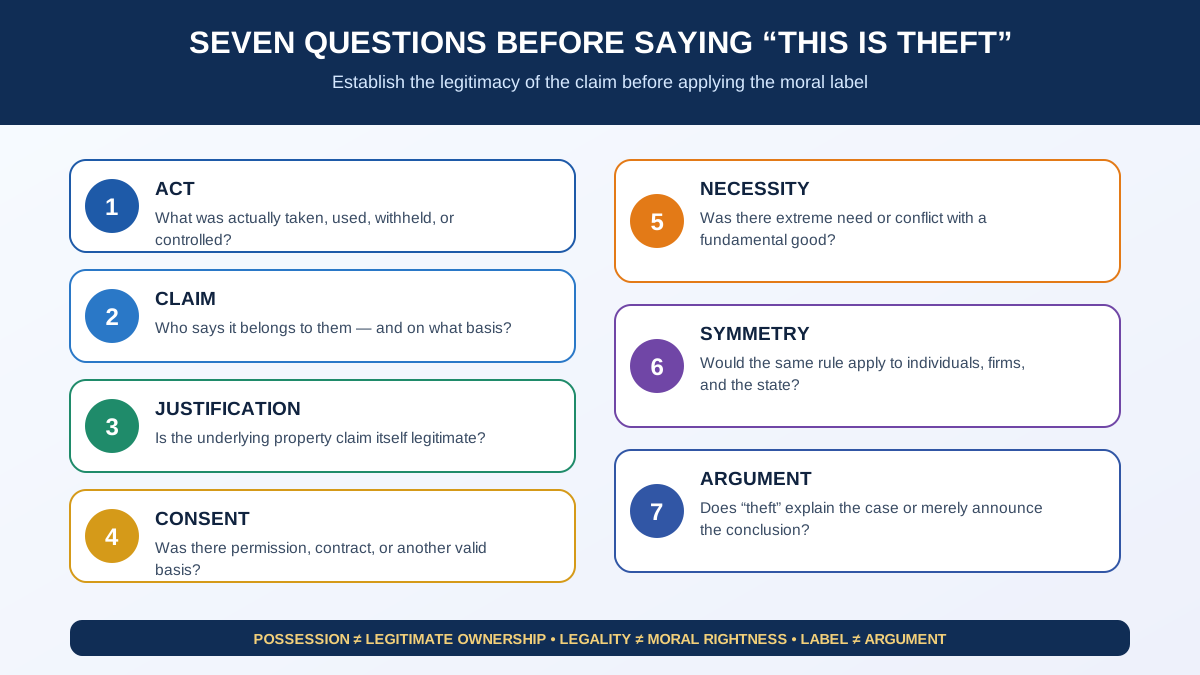
Seven questions before saying “this is theft” Describe the event before applying a political or moral label.
- What was actually taken, used, withheld, or controlled?
Possession, purchase, creation, contract, inheritance, common ownership, law, or something else?
- Who claims that it belongs to them, and on what basis?
Having something in one's possession does not by itself prove legitimate ownership.
- Is the underlying property claim itself justified?
Permission, contract, gift, shared rights, or certain emergency circumstances can change the case.
- Was there consent or another morally relevant basis for use?
Life, urgent basic needs, and other rights can create difficult boundary cases.
- Was there extreme necessity or conflict with another fundamental good?
The meaning of theft should not change simply because the actor changes.
- Would we use the same definition for an individual, corporation, community, and state?
If we must first prove that the taking was unjustified, the label cannot replace that proof.
- Does the word “theft” explain the case, or merely state our conclusion?
“Do not steal” as a candidate principle of Natural Law What Is Natural Law? and Natural Law Is Not a Matter of Belief set a demanding standard for claims about Natural Law. A principle does not become a law of nature merely because it is ancient, intuitive, traditional, religious, or personally compelling. We have to ask: What exactly does it prohibit?
What values does it protect? Does it apply symmetrically? Which difficult cases challenge it? Does it depend on other principles in order to be applied?
“Do not steal” performs quite well under this examination. It protects people's ability to possess, use, exchange, create, cooperate, and plan without being continually exposed to arbitrary deprivation. It identifies obvious cases of unjustified appropriation with considerable clarity. It appears in major historical moral traditions and is compatible with modern human-rights protections against arbitrary deprivation of property. But it does not, by itself, produce a complete theory of property.
It does not automatically determine how the first legitimate ownership claim arose. It does not settle every dispute between individual property and common resources. It does not produce a complete theory of taxation. It does not resolve every emergency case. And if we expand theft until it covers every moral wrong, we risk losing the concept's analytical precision. The strongest version of the source idea is therefore more careful:
“Do not steal” is a strong candidate for a fundamental moral principle when theft means unjustified appropriation or deprivation of something to which another person has a legitimate claim. But precisely because of that, a full theory also requires an account of legitimate claims, just acquisition, necessity, transfer, and the limits of ownership.
That does not weaken the principle. It makes the principle testable.
A simple rule, difficult application, and self-regulation
A simple rule with a difficult application The easiest moral examples are often very clear. Do not take a phone that you know belongs to someone else. Do not acquire another person's money through deception. Do not keep an object that was entrusted to you only for temporary use.
Cases like these explain why “do not steal” is one of humanity's most intuitive moral rules. But serious moral systems are not tested only by easy cases. They are tested by disputed land, historically unjust acquisition, common property, extreme need, taxation, inheritance, natural resources, intellectual property, contractual power, and conflicts between property claims and other fundamental human goods. That is where we discover whether we possess a principle or merely a slogan. This line of reasoning identifies something important: wrongdoing often involves a person assuming control over something to which they lack sufficient moral entitlement.
“Do Not Steal” as a Concise Principle of Natural Law adds the question that must accompany that insight: How do we determine what anyone is legitimately entitled to in the first place? That question leads directly to the article Are All Rights Property Rights? If we want to claim that all rights are ultimately property rights, we will have to test whether life, bodily integrity, freedom of speech, privacy, political participation, freedom of conscience, and other rights can genuinely be explained with sufficient precision through the language of ownership alone — or whether property is one important family of rights among several distinct kinds.
From Legitimate Boundaries to Trust and Self-Regulation The prohibition on theft matters not only because it allows punishment. When people understand and respect legitimate boundaries even without immediate supervision, trust, predictability, and cooperation become possible. Two people may leave someone else’s phone untouched for different reasons: one because of a camera, the other because they understand that the phone is not theirs. The outward result is the same, but only one requires an immediate external threat.
Understanding the boundary → internal self-regulation → trust → less dependence on constant external control.
Taxation: legal classification does not end the moral question
The claim “taxation is theft” is a serious libertarian thesis, not a definition. The opposite slogan — that taxation cannot be theft because the state imposes it — also fails to settle the moral question. We still need to ask which moral reason gives a political community the right to require resources without direct individual consent.
The legality of taxation is a legal fact. Its moral legitimacy requires a further argument.
Internal monarchy and order from within
Internal monarchy means first governing oneself: not taking what is not yours, not lying merely because it is profitable, honoring voluntary agreements when supervision disappears, and refusing to demand exemptions from the standards imposed on others. An external model of order may run: law → police → punishment → obedience → order. An internal model can run: understanding → self-discipline → responsibility → trust → cooperation → order. Real societies use both; the important question is their relationship.
Order without a ruler would be impossible if people could not first learn to rule themselves.
Sources and further reading
- Stanford Encyclopedia of Philosophy — Property and Ownership. Sodobni pregled lastnine kot pravil dostopa in nadzora, utemeljitev zasebne lastnine, zgodovinskih teorij in distribucijske pravičnosti. Source
- Stanford Encyclopedia of Philosophy — Locke's Political Philosophy. Locke o naravnih pravicah, lastnini, politični družbi, večinskem odločanju in davkih. Source
- Stanford Encyclopedia of Philosophy — Democracy. Pregled večinskega odločanja in Lockejevega argumenta o predstavniškem soglasju pri regulaciji in obdavčenju lastnine. Source
- Thomas Aquinas — Summa Theologiae II–II, q. 66. Lastnina, kraja in vprašanje skrajne potrebe. Source
- Universal Declaration of Human Rights — Article 17. Pravica do lastnine samostojno ali skupaj z drugimi in varstvo pred samovoljnim odvzemom. Source
- European Court of Human Rights — Guide on Article 1 of Protocol No. 1. Mirno uživanje premoženja, javni interes, zakonitost, davki, drugi prispevki in načelo pravičnega ravnotežja. Source