Force and Violence Are Not the Same Thing
Physical force can be used to attack or to stop an attack. Force and Violence Are Not the Same Thing separates description from moral judgment and examines necessity, proportionality, purpose, and the boundary between defense and retaliation.

Imagine two scenes. In the first, a person pushes someone to the ground in order to steal their bag. In the second, a bystander pushes an attacker away from the person the attacker is assaulting. Physical force is used in both cases. But if our description ends with the movement of bodies, we have left out almost everything that matters to moral judgment.
Who created the danger? What were they trying to achieve? Was intervention necessary? How much harm did it cause? Was a less harmful way of stopping the danger realistically available? Did the force stop once the danger ended?
This is why it is useful to distinguish between the use of force and the question of whether causing harm was morally justified. But an important qualification is needed from the beginning: the words force and violence do not have one universally accepted definition across philosophy, law, public health, political theory, and ordinary language.
The title “Force and Violence Are Not the Same Thing” expresses a moral and analytical distinction. It does not claim that every dictionary, discipline, or legal system uses these terms in exactly the same way.
What do force and violence mean?
In ordinary speech, violence is often understood as a particularly harmful, aggressive, or unjustified use of force. Other frameworks define it more broadly. The World Health Organization, for example, defines violence in terms of the intentional use of physical force or power, threatened or actual, against oneself, another person, a group, or a community when it results in or has a high likelihood of resulting in injury, death, psychological harm, maldevelopment, or deprivation.
Under that terminology, physical force is not the opposite of violence. It can be one component of violence.
This methodological point matters. When two people use the word violence differently, they may not yet disagree about morality. They may first be working with different conceptual categories.
THY-REALITY will therefore distinguish three levels: what physically happened, what form of force, coercion, or power was used, and whether the action was morally justified. If these levels are collapsed into a single word, the vocabulary itself can silently decide the moral dispute before the argument has even begun.
For the purposes of this article, force can be understood broadly as physical intervention that changes another person's position, movement, or ability to act. That description alone does not tell us why the force was used or whether its use was justified.
A person can be pushed in order to attack them or in order to move them away from an approaching vehicle. Someone can be restrained in order to abduct them or in order to stop an immediate attack on another person. Similar physical movements can therefore have very different moral meanings.
The reverse is also true. Conduct can be profoundly coercive without an immediate physical blow. A threat can narrow another person's choices by intentionally attaching serious consequences to refusal. Philosophical work on coercion therefore distinguishes among coercion, force, violence, threats, punishment, interference, and related forms of power. Their relationships are not captured by one universally accepted definition.
“Was force used?” is primarily a descriptive question. “Was the use of force justified?” is an additional moral question.
Initiation and the limits of self-defense
One of the project's central intuitions is important: there is a meaningful difference between a person who creates an unjustified danger and a person who tries to stop that danger. If one person attacks another, we cannot make the attacker and defender morally equivalent merely because both eventually use physical force.
Yet the rule “only ask who started it” is also too simple. What counts as the beginning? Was the first relevant act a threat, a physical assault, a coercive seizure, an intrusion, or a response to an earlier danger? In prolonged conflicts, each side may describe its most recent action as a response to something that happened before.
More importantly, an initial attack does not make every later response automatically justified. If someone pushes another person, the person who was pushed does not thereby acquire unlimited permission to cause any amount of harm regardless of the danger that remains.
The direction of the conflict therefore matters, but it is not enough. We must also examine the nature of the threat, the necessity of intervention, the amount of force used, the alternatives realistically available, and the purpose of the action.
Philosophical discussions of self-defense commonly examine at least two major constraints: necessity and proportionality. Even where defense is justified in principle, a particular defensive act may still be wrong if an adequately effective and significantly less harmful alternative is genuinely available. Likewise, not every amount of defensive harm is proportionate to the threat being prevented.
Suppose an attacker can be safely stopped by closing and locking a door. If that option reliably ends the danger, deliberately inflicting much greater injury would require additional justification merely because the other person initiated the confrontation.
At the same time, a requirement to use less harmful means cannot reasonably demand an option that is ineffective or only imaginary. Necessity does not mean choosing the symbolically gentlest response. It concerns which realistically available response can adequately avert the threat and what harms those alternatives impose.
This is the essential distinction: defensive force is justified, where it is justified, by the protection of persons and the prevention of harm — not by a general permission to punish someone for having created the danger.
When danger ends and when we defend others
There is a moral boundary between defense and retaliation. If an attack has been stopped and the attacker no longer presents the same immediate danger, the justification for continuing defensive force changes.
Suppose someone strikes us, we push them away, and sufficient distance is created for the attack to end. If we then chase the person only to “give it back,” we are no longer stopping the same immediate threat. We have entered a new stage of the event, and that stage requires its own justification.
This does not mean nothing may happen after an attack. Reporting the incident, securing a dangerous object, lawful detention, investigation, and criminal proceedings can all be relevant responses. The narrower point is that the label self-defense cannot automatically justify everything that happens after the initial threat has ended.
The purpose of defensive force is to stop danger. When that danger ends, that particular justification for force also ends.
The same reasoning appears when force is used not to protect ourselves but to protect another person. If we witness an immediate assault, physical intervention can be morally very different from the assault itself.
But another question now becomes crucial: what do we actually know?
Perhaps we saw only the final five seconds of a conflict. Perhaps the person who currently appears to be using force is restraining someone who attacked a child moments earlier. Perhaps we have misjudged the severity of the threat.
Fact, Interpretation, Hypothesis, and Speculation Are Not the Same already distinguished observation from interpretation, hypothesis, and speculation. In situations involving force, that distinction becomes especially important because a mistaken interpretation can cause serious and difficult-to-reverse harm.
The willingness to protect another person therefore also requires epistemic discipline: act quickly when danger is sufficiently clear and delay strong conclusions when the situation permits further verification. Decisiveness does not turn an assumption into a fact.
Coercion without a physical attack
If we restrict the moral problem to punches and physical injury, we can miss other important forms of power. A person may be threatened in a way that drastically narrows their practical choices without being physically touched at that moment.
Philosophical discussions of coercion often focus precisely on such cases: one person attempts to direct another person's conduct by attaching threatened consequences to refusal. Coercion matters to questions of freedom and responsibility because it can alter what options are realistically available and what costs attach to choosing otherwise.
That does not mean every form of pressure is violence. A request, criticism, the setting of a legitimate boundary, a contractual condition, a lawful sanction, and an unjustified threat are not the same thing.
But it does mean that the absence of direct physical contact does not by itself establish the absence of serious interference with another person's freedom or well-being. WHO's public-health framework likewise uses a broader concept that includes the intentional use of power as well as physical force and recognizes psychological harm and deprivation among possible outcomes.
Lawful force, morality and limits
The distinction between force and unjustified harm becomes particularly important when force is exercised by institutions. Police officers and other authorized agents may have legal powers to use force under particular circumstances. But legal authority does not transform every use of force into a justified one.
International standards for law enforcement therefore impose constraints. United Nations and OHCHR guidance emphasizes principles including legality, necessity, proportionality, precaution, accountability, minimizing harm, and protecting life.
The mere existence of legal authorization is therefore not equivalent to unlimited permission.
This corrects two opposite simplifications. The first says: “Because it was official, it was not violence and cannot be wrong.” The second says: “Because force was used, the action must automatically have been wrongful violence.” Neither statement does the required analysis.
The relevant questions remain: what danger existed, what legitimate objective was being pursued, which alternatives were realistically available, how much force was necessary, how much harm was caused, and whether that harm was proportionate to the justification for acting.
What Is Natural Law? already distinguished positive law from moral judgment. Force and Violence Are Not the Same Thing applies that distinction to the use of force. Something may be legally authorized and still remain open to serious moral criticism. Something else may be prohibited by a particular legal system without the existence of that prohibition alone settling every broader philosophical question about moral justification.
This is not an invitation to disregard law. Law establishes concrete rights, duties, procedures, institutional safeguards, and consequences that moral discussion alone does not replace. Nor is Force and Violence Are Not the Same Thing a legal guide to self-defense. The applicable legal rules differ among jurisdictions and factual circumstances.
The point is narrower: “the law permits force” does not logically entail “this particular use of force was morally right,” just as “the law prohibits it” does not by itself provide a complete moral theory.
The symmetry test developed in Natural Law Is Not a Matter of Belief and reinforced in Is Morality Objective or Merely a Matter of Culture? is especially important here. If we say a use of force is justified merely because it is carried out by our institution, our political side, our nation, or a group we trust, identity has replaced principle.
The same mistake can be made in the opposite direction. If institutional force is automatically condemned while private force is automatically celebrated as legitimate resistance or self-defense, two different moral standards are being applied.
The standard should remain as independent of group identity as possible.
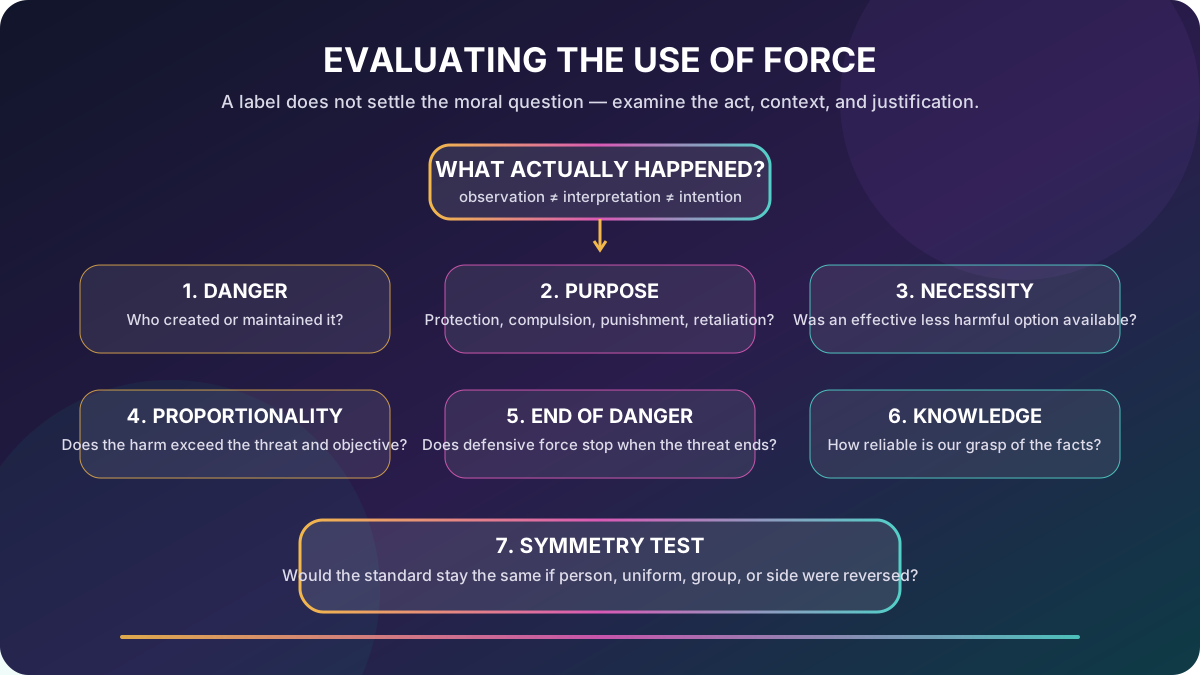
Was the danger real? Was the force directed toward stopping that danger? Was it necessary? Was it proportionate? What alternatives existed? How reliable is our understanding of the facts? Would we accept the same reasoning if the identities of the parties were reversed?
A universal moral principle cannot change its meaning merely because we replace one person, uniform, nation, institution, or political side with another.
Natural Law and the danger of definitional shortcuts
Suppose we adopted the absolute moral rule “every use of physical force is wrong.” Difficult cases would appear immediately. May a person push an attacker away from a child? May someone pull another person back from the edge of a cliff? May a person physically prevent the continuation of an immediate lethal attack?
Such cases show why the physical mechanism alone cannot be the complete moral criterion.
Within the project's inquiry into Natural Law, a more demanding candidate principle is therefore worth testing: intentional interference with another person's body, freedom, or fundamental interests requires moral justification; when force is used to stop an unjustified danger, its permissibility is further constrained by necessity, proportionality, knowledge, and the purpose for which it is used.
Even this formulation is not proven merely because it appears intuitive. It is a candidate moral principle that must be tested against difficult cases, competing moral theories, evidence, and the project's symmetry requirement.
There is a rhetorical temptation to define violence as “every morally wrongful use of force.” We could then easily conclude that violence is always wrong — but much of the conclusion would already have been built into the definition.
The same technique can work politically in the opposite direction. Everything done by a favored authority can be called force, while resistance by opponents is labeled violence. Again, vocabulary would decide the moral status before the reasons had been examined.
THY-REALITY should avoid this trap.
First describe the action: who did what, to whom, by what means, in what circumstances, and with what consequences. Then identify whether the case involved force, coercion, threat, injury, restraint, deprivation, or another form of interference. Only after that should we argue about justification.
A word should not perform moral work that belongs to an argument.
Seven questions before judging the use of force
- What actually happened? Separate direct observation from interpretation, intention, and the story told about the event.
- Who created or maintained the relevant danger? Do not look only at the final physical movement; examine the relevant sequence of actions.
- What was the purpose of the force? Stopping danger, compelling conduct, punishment, retaliation, obtaining a benefit, or something else?
- Was force necessary? Was a comparably safe and effective but significantly less harmful response genuinely available?
- Was the response proportionate? How serious was the harm imposed relative to the threat or legitimate objective?
- When did the danger end? Defensive justification cannot expand indefinitely beyond the danger it was supposed to stop.
- Are we using the same standard for every side? Would our principle remain the same if attacker and defender, private citizen and institution, or our group and an opposing group changed places?
These questions are not an algorithm that mechanically produces one uncontested answer in every case. They do, however, make it harder to replace moral analysis with a single emotionally powerful word such as force, violence, defense, order, or authority.
Force is a means; the moral question is what we do with it
The title of Force and Violence Are Not the Same Thing therefore does not mean that the world can be divided into two perfectly separate physical categories in which force is good and violence is bad. The real boundary is more demanding.
Physical force can be used to attack or to stop an attack. Coercion can occur without an immediate blow. Defense can be morally justified but can also become unnecessary, disproportionate, reckless, or retaliatory. Institutional authority can legally regulate force without eliminating the need for limits and accountability. A private person likewise gains no unlimited moral permission merely by describing themselves as the defender.
The deepest distinction is therefore not between two words. It is between force that requires justification and a justification that must survive examination.
If we want to discuss violence within the framework of Natural Law, it is not enough to say “violence is wrong.” We must first explain which forms of interference we regard as unjustified, why they are morally problematic, when defensive action becomes permissible, and by what criteria defensive force is limited.
Only then does the distinction between force and violence become more than a slogan. It becomes a moral question that can be examined through reasons.
Sources and further reading
- World Health Organization. World Report on Violence and Health — definicija in javnozdravstveni okvir nasilja. Source
- Stanford Encyclopedia of Philosophy. Self-Defense — moralna upravičenost obrambne škode, sorazmernost, nujnost in povezane omejitve. Source
- Stanford Encyclopedia of Philosophy. Coercion — prisila, grožnje, sila, nasilje, svoboda in odgovornost. Source
- United Nations / Office of the High Commissioner for Human Rights. Use of Force in Basic Principles on the Use of Force and Firearms by Law Enforcement Officials. Source