The Right to Self-Defense and the State Monopoly on Force
Self-defense, the state monopoly on legitimate force, and institutional accountability are distinct questions. The Right to Self-Defense and the State Monopoly on Force asks when force can be justified and why authority is never a moral blank cheque.

Imagine a person being attacked in the street. No police officer is standing beside them. There is no time for a court procedure, a debate, or an institution to arrive and stop the danger on their behalf. The question is immediate: may that person defend themselves?
Most people would intuitively answer yes. But this simple example quickly leads to a more difficult question. If an individual may use necessary force to protect themselves or another person, what does the familiar claim that the state possesses a monopoly on the legitimate use of force actually mean?
Are these two ideas incompatible? Not necessarily.
The apparent contradiction often arises because three different questions are merged into one: who is physically capable of using force, who is legally authorized to use it, and when the use of force is morally justified.
Force and Violence Are Not the Same Thing showed why those questions cannot be settled merely by choosing the words force and violence. The Right to Self-Defense and the State Monopoly on Force takes the next step: does the state's institutional monopoly on legitimate physical force eliminate an individual's moral right to self-defense? And does institutional status give the state a special moral permission that ordinary people do not possess?
The question is not merely “Who may use force?” but “Under what conditions is that force justified — regardless of who uses it?”
Self-defense: a right grounded in danger, not status
Self-defense is not the same as taking the law into your own hands When we speak about self-defense, we are speaking about a response to a danger that requires action now. Someone trying to stop an immediate attack is not in the same position as someone who, hours later, decides to find the alleged offender and punish them personally.
That distinction is fundamental. Self-defense is directed toward preventing or stopping danger. Retaliation is directed toward paying someone back. Private punishment goes further still by assuming the authority to determine guilt and impose a sanction.
Philosophical discussions of self-defense therefore do not treat defense as an unlimited right to harm an aggressor. Among its central constraints are necessity and proportionality. Even when defensive action is permissible in principle, not every possible defensive act is thereby justified.
Force and Violence Are Not the Same Thing already established this distinction. The Right to Self-Defense and the State Monopoly on Force preserves it because the defensible claim “a person may protect themselves” must not quietly become the very different claim “a person may decide for themselves whom they are entitled to harm and how much.” The second does not follow from the first.
The justification for defense comes from the danger, not from a title Consider two very similar situations. In the first, a bystander sees someone threatening another person with a knife and intervenes to stop the attack. In the second, a police officer arrives and takes comparable action.
If we are looking only at the basic moral reason for protecting the endangered person, it is difficult to explain why the victim's life would suddenly become worthy of protection only when a uniform appears. There are, of course, important differences between the officer and the bystander. A police officer possesses a specific legal role, training, powers, duties, procedures, equipment, and institutional accountability. We can therefore demand things from an officer that we cannot always demand from a random witness.
But the office itself does not create the fundamental moral value of protecting a person from unjustified harm.
Article 2 of the European Convention on Human Rights illustrates this distinction at the most serious end of the spectrum. In regulating state uses of force that may result in loss of life, it recognizes defense of a person from unlawful violence among the relevant situations, while imposing the demanding requirement that such force be no more than absolutely necessary. This is a human-rights rule governing state responsibility under the Convention, not a general legal code for private self-defense. The narrower point is that institutional identity alone does not settle the justification of the concrete act.
What the state monopoly on force means and why it exists
What does “the state monopoly on force” actually mean? The expression is most famously associated with the German sociologist Max Weber. In his classic formulation, the modern state is a human community that successfully claims the monopoly of the legitimate use of physical force within a particular territory.
The word claims matters. Weber was not proving that every use of state force is morally good. He was giving a sociological account of a distinctive feature of political authority. His formulation describes the state's claim to determine the legitimate institutional use of physical coercion within its territory; it is not a moral certificate attached to every act performed by state agents.
The monopoly also does not mean that only government employees ever physically use force. A person may defend themselves under the conditions recognized by the relevant legal system. Security personnel may exercise limited powers. States may authorize various actors to exercise particular forms of coercive power.
The more precise institutional idea is therefore this: the modern state generally claims ultimate authority within its legal order to determine which uses of physical coercion are legally permitted, by whom, under what conditions, and with what consequences. That is considerably more precise than saying, “Only the state may use force.”
Sociological legitimacy is not the same as moral correctness The word legitimate can also mislead us. If a government, institution, or legal system is regarded as legitimate, we have said something about political or social authority. We have not demonstrated that every individual act performed by that authority is morally correct.
Weber's political sociology analyzes forms of domination and legitimacy without defining the modern state as morally good by virtue of being a state. Is Morality Objective or Merely a Matter of Culture? made a structurally similar distinction about morality and culture: a society's approval of an action does not by itself establish that the action is objectively morally right.
The same applies here. Institutional recognition can establish authority within a system. It cannot eliminate the need to evaluate what that authority actually does.
Modern human-rights standards make the point concrete. The UN Human Rights Office states that law-enforcement use of force must be lawful, necessary, and proportionate and must operate within systems of training and accountability. If official status by itself made every use of force legitimate, such restrictions would be unnecessary.
Authority tells us who has been empowered to act. It does not tell us that every particular act was justified.
Why would a society centralize coercive power in the first place? Criticism of concentrated state power can be so intuitive that another part of the problem is sometimes overlooked: there are serious reasons societies developed public systems for regulating coercion.
Imagine a society in which every person independently decides who has wronged them, determines guilt, chooses the punishment, and carries it out. Two people disagree over who began a conflict. Each regards themselves as the victim. Each family protects its own member. Retaliation generates further retaliation.
The problem of private coercion is therefore not only that people may act immorally. It is also epistemic and institutional. Human beings can be biased, mistaken, poorly informed, emotionally involved, and personally invested in disputes they wish to judge.
Public institutions can, at least in principle, separate roles. Police respond to threats and investigate. Prosecutors argue a case. Defendants can contest it. Courts assess evidence. Procedures impose rules on how guilt and punishment may be established. No institutional system is infallible, but the reason for separating those roles is substantial: a person who believes they have been wronged is not necessarily the most impartial judge of their own case.
Philosophical discussions of coercion similarly recognize arguments for publicly organized coercion as a means of restraining private violence and making peaceful cooperation possible. Centralization can therefore solve a real problem. It can also create another one.
A monopoly reduces one danger and creates another When organized coercive power is dispersed among private individuals and competing groups, the risks include retaliation, private warfare, vigilantism, and domination by whoever possesses greater physical power. When coercive capacity is concentrated within the state, a different danger appears: the institution with the greatest organized capacity for lawful coercion can misuse that power.
This is not an argument that every state inevitably becomes tyrannical. It is a structural problem of concentrated power. That is why modern legal systems do not consist only of grants of authority. They also contain restrictions on authority: legislation, courts, constitutional guarantees, human-rights protections, oversight bodies, disciplinary procedures, criminal responsibility, public scrutiny, and other mechanisms intended to constrain abuse.
Current OHCHR guidance states that law-enforcement force must comply with legality, necessity, proportionality, and accountability, with non-violent means used where they can effectively achieve the legitimate objective. At the most serious level, European human-rights law applies the stricter requirement of “absolute necessity” to uses of state force falling within Article 2 and subjects potentially lethal operations to close scrutiny.
A monopoly on legitimate force is not a monopoly on moral truth. Greater institutional power requires stronger mechanisms for controlling how that power is used.
Due process, timeliness, and the boundary of vigilantism
The state may not punish simply because it possesses force A police officer may, under appropriate circumstances, use force to stop a threat, carry out a lawful arrest, or achieve another legitimate law-enforcement objective. That does not make personal retaliation one of those objectives.
Even a person suspected or convicted of a serious crime does not become an object upon whom individual officers may impose whatever physical punishment they personally consider deserved. This brings institutional force back to a distinction already established for private self-defense: purpose matters.
Once an immediate threat has ended, the justification for defensive force changes. Investigation, arrest, evidence, judicial procedure, and lawful sanctions belong to different institutional stages. This distinction becomes especially important for public authorities because their power is not merely physical. Behind the individual officer stand law, organization, resources, detention powers, and the wider coercive capacity of the state.
OHCHR guidance therefore makes clear that intimidation or punishment cannot itself constitute a legitimate policing objective for the use of force. The state monopoly on coercion is therefore not properly understood as permission for officials to do whatever they wish. In principle, coercive power is supposed to be tied to defined purposes, procedures, limitations, and accountability.
But institutions cannot always arrive in time Centralized protection has an unavoidable practical limitation. The state is not physically present beside every person at every moment. An assault can begin and end in seconds. Police, emergency services, or other authorities require time to receive information and reach the scene.
That creates an important distinction between the claims “society has good reasons to regulate coercion and prohibit private punishment” and “a person facing an immediate threat has no moral right to protect themselves or another person until the state arrives.” The second claim is much more difficult to defend.
When danger is immediate and effective institutional protection is not available in time, the problem of self-defense cannot simply be delegated away. But Force and Violence Are Not the Same Thing already showed that this does not create unlimited permission. We must still ask whether the threat was real, whether intervention was necessary, whether the response was proportionate, whether an effective but less harmful option existed, and whether force stopped when the danger stopped.
The right to self-defense therefore does not amount to a rejection of public institutions. It recognizes that circumstances can arise in which an endangered person must act before an institution can effectively protect them.
Self-defense and vigilantism are not the same thing This is one of the most important boundaries in the discussion. Suppose someone sees a person whom they believe committed a crime yesterday. They track the person down, attack them, and then say: “I am protecting the community.” That is not the same situation as stopping an attack that is occurring now.
The supposed danger may no longer be immediate at all. The private actor has also assumed the roles of investigator, judge, and executor of punishment, even though they may be mistaken about the person's identity, the facts, the evidence, or their guilt.
This is why the concept of self-defense becomes dangerous if it expands to cover everything someone personally regards as action against a “bad person.”
Self-defense aims to stop a threat. Vigilantism seeks out people whom the actor has decided to punish or coerce.
Real situations can make the boundary difficult to apply, but the conceptual distinction remains essential. Without it, almost any attack can be rhetorically transformed into “preventive defense” against someone we have already decided is dangerous.
A universal criterion for individuals and authorities
Institutions can also label aggression as defense The same skepticism must operate in the opposite direction. An institution can describe an action as security, public order, defense, necessity, or law enforcement. None of those labels proves the factual claim by itself.
Fact, Interpretation, Hypothesis, and Speculation Are Not the Same distinguished fact, interpretation, hypothesis, and speculation. In disputes involving force, that discipline becomes especially important. We must ask what danger actually existed, how immediate it was, what the person was doing, what information officials possessed at the time, which alternatives were available, how much force was used, and what happened after the threat had ended.
The same intellectual discipline should therefore be applied to both private and institutional actors. That brings us back to the symmetry test.
If the principle is universal, it must constrain both individuals and institutions Consider the proposition: “If someone presents an immediate and sufficiently serious unjustified threat to another person, necessary and proportionate force may be permissible to stop that threat.” If this is a moral principle, its core cannot transform simply because the person acting changes clothing or institutional status.
A uniform can bring additional powers and additional duties. A private citizen may possess less information, less training, and fewer lawful options than a police officer. Concrete judgments will therefore differ. But the central questions remain recognizable: was the danger real, was the purpose to stop or prevent a legitimate harm, was force necessary, was the level of force proportionate, did force end when its justification ended, and is there accountability when the judgment was wrong or the force excessive?
If we tell the private citizen, “You considered yourself the defender, therefore everything you did was permitted,” we have abandoned the principle. If we tell the state, “You are the state, therefore everything you did was permitted,” we have committed the same error.
A sound moral standard gives a blank cheque neither to the individual nor to the institution.
Is self-defense a “natural right”? At this point THY-REALITY must remain consistent with the methodology developed in What Is Natural Law? and Natural Law Is Not a Matter of Belief. Historical, legal, and philosophical traditions have often treated self-defense as a fundamental right. But the fact that an idea is ancient, intuitive, or widely accepted does not by itself prove that it constitutes an objective law of nature.
The claim can instead be examined through its reasons. Human beings are physically vulnerable. They can be attacked. Institutional assistance is not always available in time. Life and bodily integrity are treated as fundamental goods across many ethical and legal frameworks. If we require a person to remain completely passive even when a limited action could prevent severe unjustified harm, we need a strong argument for imposing such a requirement.
These considerations support a powerful candidate principle:
A person may in principle use necessary and proportionate force to protect themselves or another person from a sufficiently serious unjustified threat when effective and less harmful protection is not reasonably available.
But that principle is very different from saying, “Because I possess a right to self-defense, I may decide for myself who my enemy is and what I am entitled to do to them.” The first formulation contains constraints. The second removes them. The constraints are precisely what distinguish a moral principle from a permission we issue to ourselves.
How to evaluate a monopoly on force
The state monopoly can be evaluated on two different levels Arguments about the state often become confused because people are answering two different questions. The first is institutional: is there a good reason for society to maintain a public system that limits private retaliation, regulates coercion, and establishes courts, police, and other mechanisms? There are substantial arguments that there is.
The second is moral: does membership in such a system make every use of force by its agents automatically correct? No such conclusion follows.
Nor does the first argument imply that an individual loses every possibility of self-defense when facing an immediate threat. A functioning system therefore has to hold together several ideas that can initially seem to be in tension: restrict arbitrary private coercion, preserve a limited space for immediate defense, and place strict limits on institutional coercion.
These ideas are not necessarily contradictory. They can be three parts of the same effort to reduce unjustified harm.
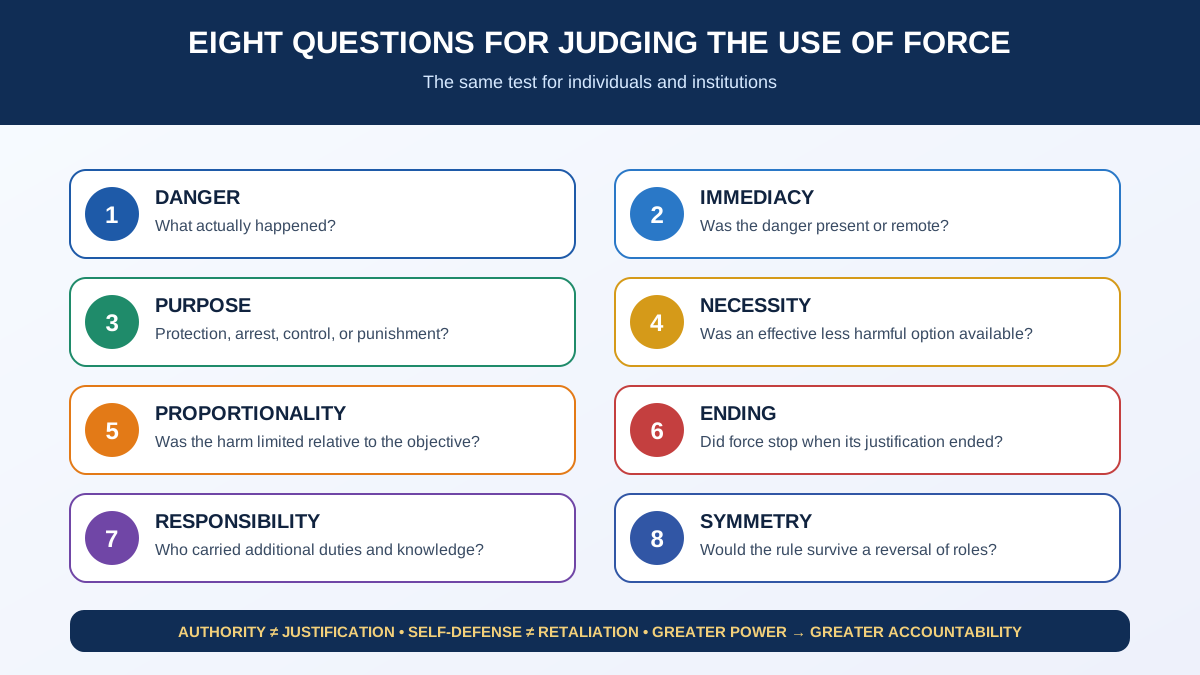
Eight questions for judging self-defense and institutional force
- What danger actually existed? Separate established facts from assumptions about intention or future behavior.
- How immediate was the danger? A present attack is not the same as a general belief that someone may become dangerous someday.
- What was the purpose of using force? Stopping danger, making an arrest, controlling movement, punishment, retaliation, or obtaining some other benefit?
- Was force necessary? Was a less harmful, sufficiently effective, and realistically available method available?
- Was it proportionate? Did the harm imposed exceed what the danger or legitimate objective could reasonably justify?
- When did the justification for force end? Did force continue after the immediate reason for using it had disappeared?
- Who carried additional responsibilities? Official authority can bring additional duties, training, knowledge, procedural requirements, and accountability.
- Would we apply the same standard if the roles were reversed? Would we defend the same action if it were carried out by a private person, institution, political authority, or group we did not personally trust?
These questions do not replace legal analysis and do not determine whether a particular act was lawful in a specific jurisdiction. Their purpose is different: they help prevent moral reasoning from collapsing into an automatic appeal to the identity of the actor.
There are alternatives between monopoly and vigilantism
No one should possess a monopoly on justification A state can organize police, courts, prisons, and a legal order. It can establish legal conditions for the use of force and impose consequences when those conditions are violated. In the Weberian sociological sense, its successful claim to the monopoly of legitimate physical force can be one of the defining features of modern statehood.
But it does not follow that the state possesses a monopoly on moral correctness. Nor can an individual declare themselves sovereign and derive unlimited permission for coercion from that declaration. Both require justification.
Self-defense has its strongest case where there is a sufficiently serious and immediate unjustified threat, where intervention is necessary for protection, where the amount of force is proportionate, and where defensive force ends when the relevant threat ends. Institutional force has its strongest justification when it pursues a lawful objective, is necessary and proportionate, is properly regulated, and remains subject to scrutiny and accountability.
The central Natural Law question is therefore not who possesses a monopoly on force. It is whether we can identify principles governing force that remain valid even when we must apply them to ourselves, our own group, or an authority we trust.
If we can, we have moved closer to a universal principle. If the standard changes as soon as the uniform, flag, institution, or person changes, then we have not discovered a principle. We have discovered a privilege.
State Monopoly and Vigilantism Are Not the Only Options The debate should not be reduced to two choices: a state monopoly or private revenge. There is a broader institutional space between them: arbitration, mediation, customary law, local and community institutions, contractually agreed procedures, and polycentric forms of governance and security.
Elinor Ostrom’s work on polycentric institutions does not prove that the state is unnecessary. It does show that the need for a function does not automatically imply the need for one centralized monopoly provider.
A function requires organization. That does not yet establish the need for a sovereign.
Centralization Reduces One Risk and Concentrates Another Centralization can reduce private warfare, retaliation spirals, and uncontrolled private punishment. At the same time, it concentrates coercive capacity in an institution that must therefore be limited, monitored, and judged by moral standards.
Decentralized systems also have risks: private monopoly, unequal power, local oppression, and weak procedures. The comparison must be symmetrical rather than romantic.
Neither centralization nor decentralization is risk-free. The relevant question is which institutions best limit unjustified force and enable accountability.
Order without a ruler as a research hypothesis
Anarchy in the literal philosophical sense means the absence of a ruler, not the absence of organization, rules, or order. The question of order without rulers is therefore not a claim that all institutions should disappear tomorrow, but an inquiry into whether necessary functions can be performed without a general moral right of some people to rule others.
We can demonstrate the need for functions without yet proving the need for a sovereign.
Sources and further reading
- Stanford Encyclopedia of Philosophy. Self-Defense. Source
- Stanford Encyclopedia of Philosophy. Coercion. Source
- Stanford Encyclopedia of Philosophy. Max Weber. Source
- United Nations Human Rights Office. Use of Force. Source
- OHCHR. United Nations Human Rights Guidance on Less-Lethal Weapons in Law Enforcement. Source
- OHCHR. Basic Principles on the Use of Force and Firearms by Law Enforcement Officials. Source
- European Court of Human Rights. Guide on Article 2 of the European Convention on Human Rights — Right to Life. Source