The Starry Sky as a Symbolic Language
Stars do not draw heroes, animals, or deities by themselves. People connect points, name patterns, and assign meaning, allowing one sky to become calendar, compass, memory, and story.
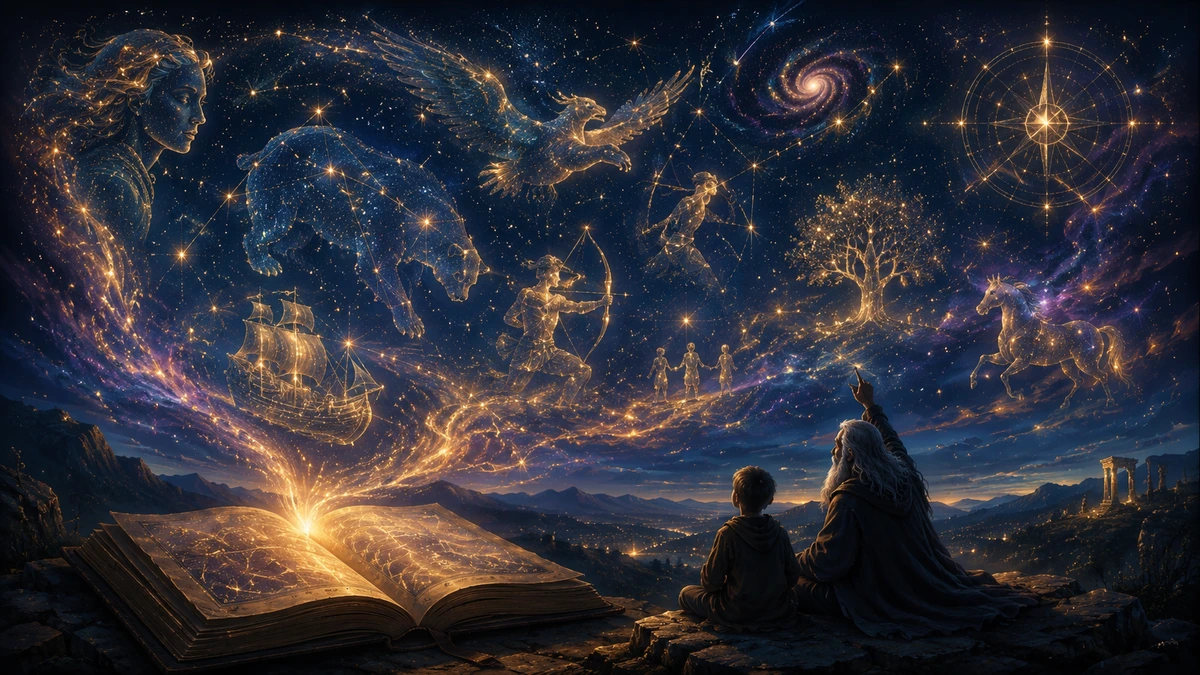
When we look at Orion, the Big Dipper, or Scorpius, it can feel obvious that the stars form a shape. Yet the physical stars are not connected by lines, are not all at the same distance from Earth, and often do not constitute a group in three-dimensional space. The recognizable pattern arises from our viewpoint.
The International Astronomical Union recognizes 88 constellations, and in modern astronomy a constellation is a precisely defined region of the sky rather than merely a traditional stick figure joining bright stars. Stars that appear to belong to one figure can lie at very different distances; from a substantially different viewpoint in the Galaxy, their apparent pattern would change.
The starry sky exists independently of our stories. A constellation as a recognizable figure already includes human interpretation.
Three Layers of the Sky as an Information Space
When we look at the night sky, we can distinguish physical reality, a recognized pattern, and cultural meaning. The physical layer contains stars, planets, the Moon, light, and motion. A second layer appears when observers select groups, directions, cycles, or relationships. A cultural layer then gives a pattern a name, story, symbol, or practical function.
If a star appears in the morning sky before a particular part of the year, that appearance is an astronomical event. If a society uses it as a sign that a seasonal task is approaching, we have a cultural use of astronomical information. If the star is also connected with a story about an ancestor or deity, an additional symbolic layer appears. None of this requires the story to be literally written in the stars; the story arises in the relationship between sky and observer.
Long before modern screens, printed maps, or mechanical clocks, the sky was one of the largest recurring patterns available for human observation. The Sun crossed the daytime sky, the Moon changed phase, and particular stars and star groups appeared during characteristic parts of the year. Because many of these phenomena recur with sufficient regularity, they can be connected with time, seasonal change, and orientation.
Mesopotamian MUL.APIN tablets provide a clear example. They contain star lists, divisions of the sky, information about risings and settings, and star groups along the Moon's path. Here the sky is not only a setting for stories but a structured system for organizing observations.

Egypt: Stars as Clock and Calendar
A similar principle appears in ancient Egypt. The astronomical ceiling associated with Senenmut's tomb depicts star groups, planets, decans, and calendrical elements. Decans were star groups used in schemes for measuring nighttime, while their appearances also belonged to broader calendrical and cosmological systems.
Modern readers may separate astronomy, religion, and calendar into distinct categories. Historical cultures often did not draw such a sharp boundary: the sky could measure time while also locating time within a wider model of the world. The phrase symbolic language is therefore useful as long as it does not imply a hidden universal code. A celestial pattern can measure, indicate, remind, and narrate at the same time.
Different Ways of Drawing the Sky
One of the clearest examples of culturally shaped sky perception comes from Australian Aboriginal traditions. Whereas European traditions commonly join bright stars, several Aboriginal cultures also recognize figures in the dark dust clouds of the Milky Way. The best-known example is the Emu in the Sky, whose outline is formed primarily by dark regions of the Milky Way, with the Coalsack forming part of the figure.
Different Aboriginal groups have different versions and meanings of this pattern; in some contexts it is connected with seasonal, social, or ceremonial activity. The lesson is important: the sky itself does not dictate what must be noticed. One tradition connects bright points, while another also attends to the space between them. Symbolic language therefore concerns not only what is in the sky but what a culture has learned to notice there.
Traditional Chinese systems organized the stars differently from the Greco-European constellation system. They used lunar mansions around the ecliptic and divided the wider sky into different fields and groupings. Well-known structures include directional regions associated with the Azure Dragon, Vermilion Bird, White Tiger, and Black Warrior.
To say only that Chinese observers had different names for our constellations would miss the point. They divided the sky differently. The physical space is the same; the organization of information is not.

When the Sky Becomes a Compass
A symbolic system need not be purely mythological. In traditional Polynesian navigation, the positions of the Sun and stars, together with other environmental cues, form part of navigational knowledge. The Hawaiian star compass organizes rising and setting directions into a system that helps navigators maintain direction on the open ocean.
A star is not a compass because it contains a mysterious power of direction. It becomes useful because its apparent position can be related to direction and because the navigator knows the pattern. Meaning here is a practically learned relationship between the observed sky and one's location on Earth.
From Information to Symbolic Story
Stories, figures, and symbols can combine many separate pieces of information into a memorable whole. Instead of memorizing a list of coordinates, a community can remember a figure, sequence, seasonal relationship, or direction. In some Australian traditions, star patterns and narratives are also connected with learning routes and seasonal information, although researchers caution against automatically treating every such “star map” as direct nighttime navigation; some can function as mnemonic systems for terrestrial routes.
This distinction helps avoid romanticizing the past. Historical knowledge is interesting enough without exaggeration.
When a star or star group becomes important for timing, orientation, or season, it can become part of a story. A narrative can help people remember where a pattern is, when it appears, what it signifies, who is associated with it, and what a community does at a particular time. In an oral culture, narrative can therefore become a way of organizing and transmitting knowledge.
That does not mean every detail of a myth is an astronomical cipher. A mythic layer can matter without every motif encoding a measurable celestial datum.
Symbolic Language Is Not a Universal Secret Code
Calling the sky a symbolic language requires a clear distinction between symbolic meaning and the physical properties of celestial bodies. If a culture associates a planet with war, a star with a ruler, or a constellation with an animal, we have documented a cultural association. We have not thereby shown that the planet causes wars, that the star is physically linked with the ruler's fate, or that the animal figure exists objectively in the stars independently of observers.
A documented historical belief is not the same thing as demonstrated operation in nature.
The IAU uses 88 official constellations as precisely defined regions of the celestial sphere. This provides standardized astronomical orientation regardless of how traditional connecting lines are drawn. The modern system is therefore primarily a standardized scientific map.
This does not make Chinese, Mesopotamian, Polynesian, or Aboriginal skies “wrong” maps. They arose in different historical settings and could serve different purposes.
How to Read a Sky Symbol Without Overinterpreting It
- What is actually in the sky? Identify stars, dark Milky Way regions, planetary motion, the solar cycle, or another observed phenomenon.
- How did the culture organize the phenomenon? Examine which stars were grouped, what pattern was recognized, and how the sky was divided.
- Which meaning is historically documented? Look for texts, artifacts, oral tradition, iconography, or reliable ethnographic documentation.
- What function did the symbol serve? It may relate to calendar, navigation, ritual, political legitimacy, storytelling, or several functions at once.
- What are we adding as modern interpreters? If a connection exists mainly in our comparison, label it as interpretation rather than historical fact.
One Sky Does Not Mean One Language
Physical stars exist independently of us, but people make coordinates, calendars, animals, heroes, deities, directions, narratives, and memory systems from them. We can therefore call the starry sky a symbolic language if we remember who is speaking that language.
The stars do not speak. People observe them, connect them, and use them to understand the world. A star is first a physical object; from our viewpoint it becomes a point, several points can become a pattern, the pattern receives a name, and the name can become connected to a story, season, direction, ritual, or social practice.
The sky is one. The ways humans read it are many.
Sources and further reading
- International Astronomical Union / astroEDU. What is a Constellation? Source
- British Museum. MUL.APIN, tablet 1 Source
- The Metropolitan Museum of Art. Astronomical Ceiling / Telling Time in Ancient Egypt Source
- Xu, J. (2011). Ancient Chinese constellations. Proceedings of the International Astronomical Union, 5, 107–115. DOI: 10.1017/S174392131100319X Source
- Norris, R. P. (2016). Dawes Review 5: Australian Aboriginal Astronomy and Navigation. Publications of the Astronomical Society of Australia, 33, e039 Source
- Forster, P. A. (2021). Review of Aboriginal astronomy and navigation: A Western Australian focus. Publications of the Astronomical Society of Australia, 38, e066. DOI: 10.1017/pasa.2021.51 Source
- Smithsonian Science Education Center. How Can We Use the Sky to Navigate? Source