Does Consent Legitimize Authority?
Consent can change the moral relationship between people. But does living in a country, using public services, voting, or failing to emigrate really amount to consent to political authority?

Consent has extraordinary moral power in everyday life. If I enter your home without permission, my action may constitute an impermissible intrusion. If you invite me, the moral situation changes. If I use your car without permission, I may violate your rights. If you voluntarily lend it to me, the same physical act — driving the car — becomes permissible.
If someone is touched without consent, a boundary may be crossed. If that same person freely agrees to the contact, the moral situation is different. Consent is therefore more than a feeling of approval. In many circumstances it can change our rights and obligations. That is precisely why one of the most attractive explanations of political legitimacy is simple:
perhaps authority has a right to rule because the people have agreed to be governed by it.
At first glance, the solution is elegant. If no one possesses a natural right to command another person, perhaps individuals can voluntarily grant certain limited powers themselves. But political authority quickly presents a difficulty. When exactly did we do that?
Why is consent such a strong candidate for legitimacy?
Why Is Consent Such a Powerful Candidate? Imagine two situations. In the first, someone arbitrarily announces:
“Every month you will pay me one hundred euros and obey my rules.”
In the second, we voluntarily sign an agreement under which we accept a monthly payment and certain rules in exchange for a specified service. Both situations can involve money and obligations. But morally they are not the same. The difference is that in the second case we participated in creating the obligation.
Consent is therefore attractive as an answer to the problem of political subordination. If we are moral equals, another human being does not automatically possess a superior right over our lives. But perhaps we can grant certain powers ourselves. This idea appears very clearly in John Locke. His political philosophy begins with the natural freedom and equality of individuals and places consent near the center of the transition into political society. But already we need to distinguish two claims:
Consent can create certain moral obligations.
and
Existing states actually rest upon the consent of everyone they govern.
The first is quite plausible. The second requires evidence.
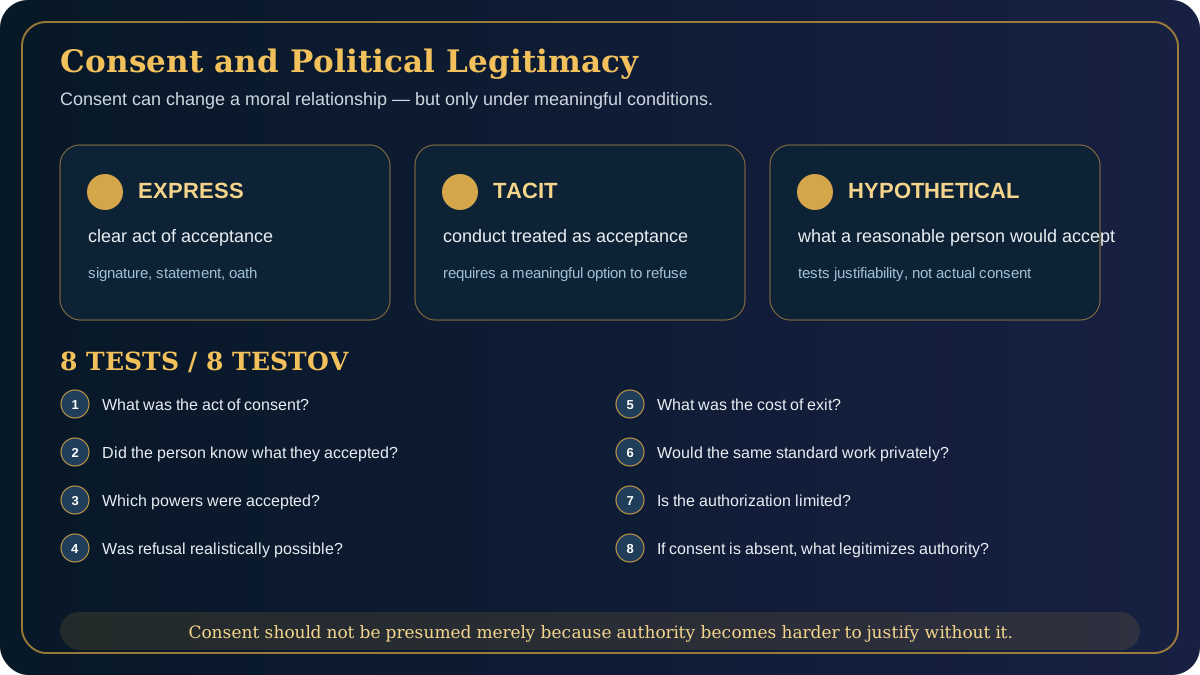
Express Consent Is the Easiest Case The clearest case is express consent. I sign a contract. I say, “I agree.” I voluntarily take an oath connected with a particular office.
I join an association after its rules have been presented to me. In such cases we can identify a concrete act through which certain obligations were accepted. But even express consent is not a magical moral device. I cannot validly consent to absolutely everything.
A contract to carry out an unjustified killing does not become morally right merely because two people signed it. Even if someone voluntarily enters an organization, its leadership does not thereby acquire unlimited rights over that person's body, conscience, or life. Consent can therefore create special powers within defined limits. It does not manufacture moral truth from nothing. That matters for political legitimacy as well. A theory that gives consent great moral importance does not have to conclude that consent legitimizes everything.
But Most Citizens Never Signed a Social Contract This is where the classical problem begins. Most people are born into an already existing state. They do not choose its territory, legal system, tax system, citizenship, constitution, police, courts, or the political history of the community. By the time they are old enough to make meaningful political choices, the institutions are already there.
It is therefore difficult to claim that modern political authority normally rests upon the express consent of every individual. There may be particular cases in which consent is clearer: acquiring a new citizenship, taking an oath of public office, or entering a voluntary contractual relationship with a specific institution. But these special cases do not show that the entire population performed a comparable act. If consent is to remain the basis of general political legitimacy, we need a broader concept. This is where tacit consent enters the debate.
Tacit consent: residence, roads, and voting
Does Living in a Country Mean Consent? One common argument says:
if you remain in a country, you accept its rules.
At first glance this resembles other relationships. If I voluntarily join a private club, understand its rules, and remain free to leave, continued membership may reasonably indicate that I accept its conditions. But the political case is far more difficult. A person may be born in a particular territory. Their family is there. They speak the language. They have a job, a home, friends, property, and cultural ties. They may not possess a realistic right to enter another country. Emigration may be financially, legally, socially, and psychologically extremely costly.
In such circumstances, is it really fair to say:
“If you did not leave, you consented”?
For conduct to count as genuine consent, we would normally expect at least a sufficiently meaningful opportunity to refuse and some understanding that the conduct in question constitutes acceptance. Those conditions are much less obvious in ordinary residence within a state than in signing a contract.
“If You Don't Like It, Leave” Is Not a Self-Evident Argument Imagine a person born in a house. When they reach adulthood, someone tells them:
“Because you still live here, you have agreed that I may determine all the conditions of your life. If you disagree, move to another continent.”
Would their continued presence really amount to freely given contractual consent? Perhaps under some circumstances. But not automatically. The ability to leave matters. Yet the mere existence of a formal exit option does not establish that meaningful consent has occurred.
If the only alternative is extraordinarily expensive, uncertain, or dependent upon permission from another political authority, the relationship differs from a voluntary exchange among several realistic alternatives. This does not yet prove that the state is illegitimate. It shows only that the argument “you remain, therefore you consent” requires much stronger justification than is often assumed.
Does Using Roads Mean Consent? Another version says:
citizens use public roads, schools, police, infrastructure, and other services, therefore they have consented to the system.
But again we must distinguish two things. Receiving a benefit. and voluntarily accepting a contractual obligation. If my neighbor mows my lawn every week without my asking and then demands payment, it is not obvious that the benefit alone created a contract.
If a service is unavoidably built into the environment in which I live, it becomes even harder to infer that using it constitutes voluntary acceptance of every political power possessed by its provider. This does not mean benefits are morally irrelevant. Perhaps fairness or reciprocity can generate an obligation to contribute to a just system from which we benefit. But that would already be an argument from fairness, not a pure argument from consent. The distinction matters. If consent theory cannot do the work by itself, we should not rescue it by simply renaming another moral principle as consent.
Does Voting Mean Consenting to the Government? What about elections? If I vote, do I thereby accept the winner's right to rule me? Perhaps I accept the procedure. But even that is not straightforward.
Imagine three people. The first votes for the winner. The second votes against the winner. The third does not vote. If we say the first person consented, that is understandable.
But did the second person consent to the government merely because they participated in the procedure and lost? And if the third person abstained, did they reject consent, or did their nonparticipation somehow count as “accepting the result”? If both voting and not voting are interpreted as consent, the theory becomes unfalsifiable. Whatever a person does counts as “yes.” That is no longer consent in any ordinary meaning of the word.
Democratic participation may have very important legitimating value for other reasons — political equality, procedural fairness, public justification, or reciprocal respect. But those reasons should not automatically be confused with actual individual consent.
Consent to a Procedure Is Not Consent to Every Decision Even when someone voluntarily accepts a procedure, limits remain. Imagine a club in which every issue is decided by majority vote. A person joins voluntarily. They may reasonably commit themselves to accepting many decisions with which they personally disagree. But have they also consented to being physically assaulted by the majority? To having all their property confiscated? To being forbidden from leaving the club? To having their conscience dictated?
Not necessarily. Consent to decision-making through a particular procedure can have a subject matter and a boundary. Political consent, if it exists, therefore does not automatically mean:
“I agreed to democracy, so whatever a democratic majority does is morally justified.”
Consent does not erase the question of fundamental rights.
Hypothetical consent, Hume, and future generations
Hypothetical Consent Is Something Different When actual consent becomes difficult to establish, another kind of argument often appears:
A reasonable person would agree to this system.
This is no longer a claim about something I actually did. It is a claim about what it would be reasonable to accept under certain fair conditions. We can ask: would free and equal people accept these rules? Could all reasonable citizens accept them? Would the system be acceptable to people who did not know in advance which social position they would occupy?
Such thought experiments can be highly useful for examining the fairness and public justifiability of political institutions. But hypothetical consent is not actual consent. The fact that, upon reasonable reflection, I ought to accept an offer does not mean that I actually accepted it.
“A Rational Person Would Agree” Contains a Dangerous Trap The idea of hypothetical consent is useful. But it can also become a way of replacing an individual's actual voice with the philosopher's voice. Someone says:
“You are saying no, but if you were sufficiently rational, you would say yes.”
Sometimes this may contain a good argument. A person can reject something because of false information or an obviously irrational fear. But where authority is concerned, caution is essential. If an institution can always classify a person's actual refusal as “unreasonable” and then decide for itself what the individual should have wanted, the concept of consent may lose the very function that made it morally attractive:
protecting the person from someone else speaking on their behalf without permission.
It is therefore better to say: hypothetical consent may help show that an arrangement is justifiable. But without a further argument, it should not be presented as a personal fact: “you consented.”
Hume: The Political World Cannot Simply Be Explained as a Contract David Hume sharply criticized the idea that the political obligations of ordinary people arise from an original contract or their tacit consent. His objection was not that consent and promises have no moral importance. The problem was that actual political history is generally not a history of voluntary contracts made by every inhabitant. States emerge through war, conquest, inherited authority, revolution, union, dissolution, and gradual institutional change.
Later generations did not participate in the founding act. Hume therefore preferred to connect political obligation with social usefulness, order, and stability rather than with supposed consent that people had never actually expressed. We do not have to agree with Hume. But his objection reveals something important:
If legitimacy is grounded in consent, we should be able to identify the consent rather than merely assume that it must have occurred somewhere.
Can Parents Consent on Behalf of Future Generations? Imagine that a group of people genuinely agrees voluntarily to establish a political community. The first generation really did consent. What about their children? Does the parents' agreement automatically bind a person born fifty years later?
With ordinary contracts, the answer is often no. Parents can create certain legal and practical circumstances for their children, but they cannot simply sign every possible personal obligation on behalf of their future adult descendants. If political legitimacy depends entirely upon voluntary consent, this creates a problem of intergenerational transmission. An institution may exist for centuries. But the original consent cannot automatically remain an act performed by people who never performed it.
We therefore need some mechanism by which later individuals also become morally bound. Tacit consent? Active citizenship? Participation? Fairness? Membership? Natural duty?
Each answer may be possible. But each introduces a new theory that requires separate examination.
Consent and Contract Are Not the Same as Mere Presence For something to count as a genuinely voluntary agreement, we usually expect at least some of the following conditions: the person knows what they are agreeing to; understands the important consequences; has not been deceived about essential facts;
has the capacity to make the decision; is not subjected to an unjustified threat; performs a sufficiently clear act of acceptance; and does not have the scope of their consent infinitely expanded beyond the subject of the agreement.
We should be cautious before lowering this standard for political authority. If consent is supposed to legitimize powerful political powers, we might expect at least as serious a standard of consent as we demand in important private relationships. Not a weaker one.
Must authority rest on consent at all?
But Must Authority Rest on Consent at All? Here we should avoid the opposite dogma. Perhaps the mistake lies in assuming:
“If there is no consent, political authority must necessarily be illegitimate.”
There are other theories. Some appeal to fairness. If people participate in a fair system that provides important benefits, perhaps they have an obligation to carry a fair share of its burdens. Others appeal to a natural duty to support just institutions.
Some ground political obligations in membership and special relationships among citizens. Others emphasize democratic equality. Still others argue that authority may be justified when it helps people better act upon reasons that already morally apply to them. The failure of a pure consent theory therefore does not automatically establish political anarchism. It means only:
if authority claims consent as the basis of its legitimacy, the consent theory must actually work.
Benefits May Create Obligations — But Which Ones? Imagine a fair protective system in which everyone contributes and everyone benefits. If one person knowingly enjoys the benefits while systematically refusing any fair share of the costs, it may seem that they are taking advantage of others. That is a powerful argument. But such an obligation may be different from:
“You are morally required to obey every law because the state provides benefits.”
Perhaps there is an obligation to contribute to a fair system. That does not establish the content of every possible political obligation. If a community builds a road, the benefit of the road does not necessarily give the institution authority over our religion. If an organization provides protection from violence, that benefit does not automatically give it a right to control our political opinions. The same principle appears again:
A justified function creates an argument for powers connected to that function — not automatically for unlimited authority beyond it.
What About Necessary Common Functions? There may be tasks for which waiting for the complete consent of every individual is simply unworkable. Defense against attack. Controlling an epidemic. Managing dangerous pollution. Basic traffic rules. Resolving disputes in which one party refuses to participate voluntarily.
If no collective decision could be made without unanimous consent, one person might be able to block an action required to protect the rights of everyone else. This is a serious problem for strict consent theory. But the answer cannot simply be: “Therefore consent does not matter.” A better conclusion is: perhaps political legitimacy does not come from a single moral source.
A particular authority may require some combination of protection of equal rights, necessity, fair procedure, limited powers, public justification, mechanisms of oversight, democratic participation, and, where possible, actual consent. That is a more complicated theory. But reality is often more complicated than a single slogan.
Consent May Be Necessary for One Thing but Not Another Even within the same institution, there may not be one universal answer. Marriage requires explicit personal consent. Medical treatment generally does as well. Contracts require acceptance.
Immediate self-defense against an attacker does not require the attacker's consent. Punishment following a fair process does not normally require the offender's agreement. The moral structure depends upon the kind of intervention involved. Perhaps political authority should be analyzed in the same way.
The question “Does the state rest on consent?” may be too broad. More precise questions are: which political powers require consent? Which may instead rest upon protecting the rights of others? Which upon necessary coordination? Which upon fair common procedures? Which lack sufficient justification altogether?
Once the problem is divided into parts, there is less room for a one-line ideological answer.
Consent, obedience, and revocability
Does Consent Create a Duty to Obey? Assume that we really have given valid consent to a political institution. Does that mean we have a moral obligation to obey every command it issues? Not necessarily. If we authorize a contractual partner to perform a particular act, the authority applies within a particular scope. If the person exceeds that agreement, they cannot simply appeal to the original consent.
Political authority should be examined similarly. If consent is the source of political authorization, we must ask: what did the person consent to? For how long? Under which conditions? With what limits? Can the authorization be withdrawn? What happens when the institution violates the purpose for which the authorization was granted?
This also matters because we must distinguish among several claims: that a particular use of political coercion is justified, that an institution possesses certain normative powers, and the stronger claim that it possesses a general right to rule to which subjects have a corresponding duty to obey. These are not necessarily the same thing.
Can Consent Be Withdrawn? In many voluntary relationships, the possibility of exit is an important part of their legitimacy. We can cancel a subscription. Leave an association. Terminate a contract under agreed conditions. Change providers.
Political relationships are different. A person may sometimes renounce citizenship, but this does not necessarily mean they can remain in their home and simply choose another political provider. This raises the question:
is consent genuinely voluntary if it cannot effectively be refused or withdrawn without losing the entire place in which a person lives?
This question does not by itself settle the issue. Territorial legal systems may have good reasons for applying rules to people within a particular area. But if the justification rests on territoriality, protection of rights, or coordination, we should call it that. We should not automatically call it consent.
Eight tests of political consent
When someone claims that an individual has consented to authority, we can ask: What exactly was the act of consent? Did the person know that their action would count as political consent? Which powers did they actually consent to?
Was there a realistic possibility of refusal? What was the cost of refusal or exit? Would we regard the same standard as valid consent in an important private relationship? Does the consent justify only a particular power, or is it being stretched into unlimited authority? If consent is absent, what other moral reason is supposed to justify the authority? This test does not assume that political consent is impossible. It prevents us from discovering consent everywhere merely because we need it for a conclusion.
The key asymmetry and the limit of consent theory
The Most Important Asymmetry In a private relationship, we do not normally say:
“Prove that you did not consent.”
If we want to show that someone assumed an important obligation, we usually look for reasons why their conduct should count as acceptance. Political authority often reverses this logic:
“Because you live here, prove that you did not consent.”
But if consent is doing the moral work — if it is supposed to transform a free person into someone possessing a special obligation toward a particular authority — then the burden of proof should remain with the claim that consent was actually given.
Consent should not be presumed merely because authority becomes harder to justify without it.
Consent Matters, but It May Not Be the Whole Theory After examination, much remains intact. Actually free consent can create important moral obligations. Express consent is much stronger than presumed consent. Tacit consent is possible but requires clear conditions.
Mere residence on territory is not obviously equivalent to a contract. Using unavoidable public goods is not automatically consent to every power possessed by their provider. Voting is an important form of political participation, but it is not obviously a personal contract promising obedience to every future decision. Hypothetical consent can test the public justifiability of institutions, but it is not the same as an actual voluntary act. And even valid consent has content, scope, and limits. This leads to a more precise conclusion:
Consent can legitimize a particular authority over an individual when it is genuine, sufficiently free, informed, and limited to powers that were actually accepted. But it is not self-evident that modern political authority as a whole satisfies these conditions for every person subject to it.
What if consent is not enough?
This does not give us the conclusion:
“Therefore no political authority is legitimate.”
It gives us the next question. If actual consent cannot by itself explain general political legitimacy, we need to examine other candidates. Perhaps political obligations arise from fairness. Perhaps from reciprocity. Perhaps democratic procedure is a sufficiently equal way for people who disagree to make common decisions.
Perhaps we have a moral duty to support just institutions, even when we did not personally choose them. Perhaps legitimate political authority arises from a combination of several reasons. Or perhaps political institutions can often justifiably perform particular functions without this implying a general moral duty for citizens to obey every law merely because it is law. That is the next problem we need to examine.
Sources and further reading
- Stanford Encyclopedia of Philosophy — Political Legitimacy. Source
- Stanford Encyclopedia of Philosophy — Authority. Source
- Stanford Encyclopedia of Philosophy — Locke’s Political Philosophy. Source
- Stanford Encyclopedia of Philosophy — Democracy. Source
- John Locke — Two Treatises of Government, Second Treatise. Source
- David Hume — Of the Original Contract. Source
- A. John Simmons — Moral Principles and Political Obligations. Source
- A. John Simmons — Justification and Legitimacy. Source
- Robert Nozick — Anarchy, State, and Utopia. Source
- John Rawls — Political Liberalism. Source