Does Fairness Create a Duty to Obey?
Benefiting from a common system may create a moral obligation not to live at the expense of others. But does that also create a general duty to obey authority?

Imagine a group of ten people who jointly maintain a water source. Nine of them regularly contribute time and money to cleaning, repairing, and protecting the system. The tenth uses the same water but refuses to contribute anything. When the others ask why, he answers:
“I never asked you to maintain the water source.”
The reply is not completely without force. Perhaps he really did not sign a contract. Perhaps he never expressly consented. Yet something about the situation still seems wrong. He enjoys the benefit of a system that exists because others carry its burdens. This gives rise to one of the most important alternatives to consent theory:
Perhaps political obligation does not arise because we chose authority, but because fairness requires us to contribute fairly to a system of cooperation from which we benefit.
This is the idea of fair play. It is stronger than it may initially appear. But it also has limits.
Free riders, contribution, and fair play
The Free-Rider Problem The issue is easiest to see with common goods. Imagine a village whose residents jointly finance flood protection. The barrier protects every house. Once built, individual houses cannot simply be excluded from its protection. If one resident says:
“I will contribute nothing, but I will continue enjoying the protection you finance,”
it seems that this person is acting unfairly. Such a person is a free rider. They do not want to bear the costs of the system but still want its benefits. Similar problems arise with public safety, infrastructure, clean air, epidemic protection, legal order, and other goods where it may be difficult to provide the benefit only to those who directly paid for it. Here the argument is powerful:
if others carry a fair share of a common burden while I knowingly enjoy the fruits of their cooperation, perhaps I have a moral duty to contribute as well.
But this does not yet establish everything that political authority might want to derive from it. Contribution Is Not the Same as Obedience Suppose fair play establishes:
I owe a fair contribution to flood protection.
Does it follow that:
I must obey every command issued by the organization maintaining the barrier?
No. If the organization establishes technical standards for the barrier, there is an obvious connection. If it determines how the costs are divided, that division must be fair. But if it then announces:
“Because we protect you from floods, we will also decide which books you may read,”
the benefit of flood protection does not explain this new power. That gives us a crucial distinction:
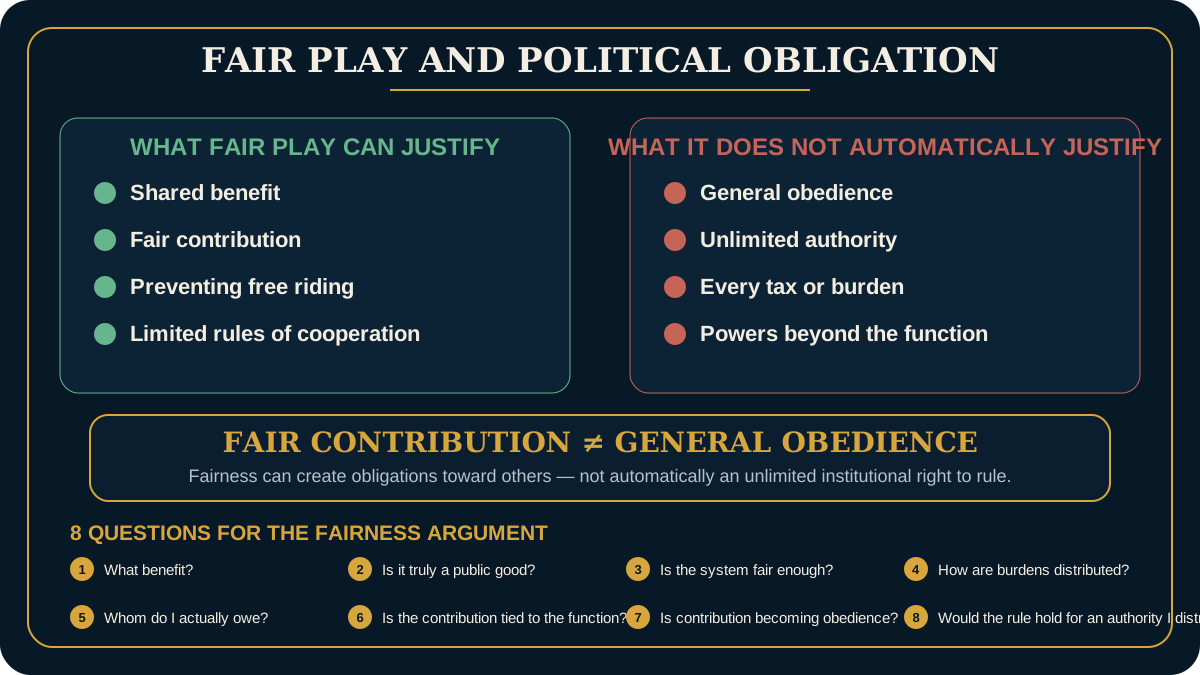
A moral duty to contribute to a particular fair function is not automatically a duty of general obedience to the institution performing that function.
This boundary matters throughout the entire discussion. Why Is Fair Play More Attractive Than Tacit Consent? Consent theory faced a clear problem. Many people never explicitly said:
“I agree that this institution may rule me.”
Fair play does not need them to have done so. It can say:
“The important fact is not whether you signed something. The important fact is that you participate in a cooperative system in which others accept restrictions and bear costs that also benefit you.”
Morally, this is much more realistic. In everyday life, we do recognize obligations that do not always arise through formal contracts. If a group performs a necessary common task while one member systematically exploits their work, the problem of fairness may exist even without a signature. But precisely because of this, we must ask:
When is a cooperative system fair enough to generate such an obligation?
Accepted benefits and the question of a fair share
Not Every Benefit Is a Voluntarily Accepted Benefit Imagine that your neighbor installs a gold roof on your house without asking. Then he sends you a bill for one hundred thousand euros. You answer:
“I never ordered this.”
He replies:
“But you benefited. The roof is better.”
Does the mere fact that someone created a benefit for you mean that you owe payment? Clearly not always. If unilateral provision of a benefit were enough to create an obligation, we would get a dangerous principle. Anyone could impose a service upon others and then say:
“Now you owe me.”
Fair play therefore requires more than: a benefit exists. We need an explanation of why the cooperative system is structured in such a way that it is fair to demand our contribution. What Makes a Cooperative System Fair? Several conditions naturally appear. The system should actually produce an important benefit. Its burdens should not be distributed arbitrarily. The rules should apply with sufficient symmetry.
Those who demand contributions from others should also carry their own fair share. Benefits and costs should at least roughly relate to the purpose of the system. There should be some reasonable way to evaluate whether the demand itself is legitimate. If ten people maintain a shared well and nine contribute fairly, the demand placed on the tenth is intuitively strong. But if nine people demand half of the tenth person's income for a project that primarily benefits themselves, the situation is different.
Fair play does not mean that whenever a collective exists, the individual must contribute whatever the collective demands.
It means that fair cooperation can create certain reciprocal obligations. But Who Determines the “Fair Share”? The problem quickly becomes more difficult. How much should each person contribute? The same amount? The same percentage of income? According to benefit? According to ability? According to risk? According to use? According to past advantages? Even among ten people there can be several reasonable theories of fair distribution. With millions of people the difficulty becomes much greater. This does not destroy the fair-play argument. It shows that the word fairness does not solve the problem by itself. When an institution says:
“This is your fair share,”
we still need to ask:
according to which principle?
Fairness needs content.
Public goods and the limits of the benefit argument
Public Goods Are a Special Case Public goods have an important characteristic: it is often difficult to exclude individuals from benefiting from them. If a military system deters an external attack, protection generally cannot be provided only to those who voluntarily paid. If air pollution is reduced, cleaner air is not inhaled only by contributors. If basic legal order is maintained, even people who criticize particular institutions can benefit from overall stability. This creates a real problem. If everyone can say:
“I will contribute nothing, but I still want the benefits,”
the system may collapse. That is why some form of compulsory burden-sharing can have serious moral justification. But we must continue carefully. Justifying a contribution toward a public good is not necessarily the same as justifying general political subordination. A Road Does Not Legitimize Everything Take a very simple example. The state builds a road. We use it. If its financing is fair and the infrastructure genuinely serves a shared purpose, there may be a good argument for contributing toward its maintenance. But does the road give the state a right to determine: our religious beliefs?
whom we may love? which political ideas we may defend? what we may say in private correspondence? No. A specific benefit may support a specific obligation. It cannot, without further argument, justify the leap to:
“Because you use the road, the institution possesses a general right to rule.”
That would be too much. Fair Play Is Primarily an Argument Against Exploitation Its moral force is clearest where:
others cooperate fairly while I knowingly enjoy the benefits and deliberately shift my share of the burden onto them.
This is the problem of parasitizing cooperation. If the conditions are fair, we may have a duty to participate. But that is a much more precise claim than:
“a citizen has a general duty to obey the state.”
In political philosophy, this transition is one of the central difficulties for fair-play theories. Even if we accept a duty to bear a fair share of a common project, we must still explain why that duty creates an obligation toward all laws or toward political authority as such. What If We Did Not Want the Benefit? Imagine a person who rejects a particular common service. The institution provides it anyway. Then it says:
“Because you received the benefit, you must participate.”
Is that fair? It depends. If the service can easily be refused, compulsory inclusion is harder to justify. But if the good is inherently indivisible — such as epidemic control or flood protection — individual refusal becomes more complicated because the person's choices can also affect others. We therefore need to distinguish: a benefit imposed upon me merely for my own good from a common system without which the rights and interests of others are also threatened. At this point fair play begins to overlap with other moral principles: rights protection, harm prevention, and necessary coordination.
The duty to support just institutions and the demand for reciprocity
Do We Have a Duty to Support Just Institutions? John Rawls defended the idea of a natural duty of justice. The basic thought differs from consent. I do not need to have promised. I do not need to have contracted into the system. If just institutions exist and make fair social cooperation possible, I may have a moral duty to support them and not undermine them. This idea is powerful because it does not make political obligation depend upon historically difficult-to-prove consent. But the central question immediately returns:
What counts as a just institution?
A duty to support just institutions does not mean a duty to support every existing institution. If an institution systematically violates rights, discriminates, uses arbitrary coercion, or serves the privileges of some at the expense of others, the argument from the natural duty of justice may turn against it. Thus even a theory intended to justify political obligation places authority beneath a moral standard.
Legality Is Not Enough for Fairness Suppose a contribution is perfectly legal. That tells us the legal system requires it. It does not yet tell us that it is fair. If a law required one social group to bear every cost while another received every benefit, legal validity would be a weak answer to the question of justice. Fair play therefore requires more than:
“It is the law.”
We need to ask: Are burdens distributed according to a defensible principle? Do people possess sufficiently equal status? Does the system actually serve a common purpose? Are there privileged exemptions? Can political authority itself violate rules that it imposes upon everyone else? This is another case where the moral criterion stands above the institutional fact. Reciprocity Must Be Reciprocal The word reciprocity sounds almost automatically fair. If others do something for me, I do something for them. But reciprocity can be distorted. Imagine the relationship:
“We will provide you with something you did not request, and you will therefore owe us obedience.”
That is not obviously reciprocity. It may be dependency. Perhaps paternalism. Perhaps domination. Genuine reciprocity requires both sides to remain morally relevant. If an institution demands duties from citizens, the institution must also have duties toward citizens. If individuals may not arbitrarily violate agreed rules, authority may not arbitrarily change those rules for its own benefit. If individuals remain responsible for their use of power, institutions must remain responsible as well.
Reciprocity cannot be one-directional.
Rejecting benefits, necessity, taxation, and majority power
What If Someone Rejects Every Benefit? This is an interesting test. Imagine someone saying:
“I do not want your services, therefore I owe you nothing.”
In some cases the answer may be straightforward. If it is a service from which they can genuinely opt out, perhaps they should be allowed to do so. But public goods are more difficult. A person cannot simply opt out of cleaner air. From the absence of war. From epidemic protection. From the general stability of a legal environment. Complete individual exclusion may not be feasible. In such cases the question becomes:
Is the system sufficiently necessary, fair, and limited that it may legitimately demand a contribution even from someone who rejects some of its benefits?
That is a stronger and probably more realistic question than:
“Did they consent?”
But “Necessity” Is a Dangerous Word Institutions often describe their own functions as necessary. But necessary cannot be the end of the argument. We need to ask: Necessary for what? Are alternatives available? Must this particular institution perform the function? Must it possess a monopoly? Is the scope of its authority really proportionate to the problem? Is temporary necessity becoming permanent power? Something can be necessary without needing to be provided in only one possible way. The same principle returns:
The need for a function is not by itself proof of the need for a monopolistic provider of that function.
Taxation Is a Good Test of Fair Play Discussions about taxation quickly become ideological. One side may say:
“Taxation is theft.”
The other:
“Taxation cannot by definition be theft because it is imposed by the state.”
Both formulations move too quickly. Fair play gives us a better way to frame the problem. If there is a fair system of common functions from which a person benefits, and if refusing to contribute would unfairly shift the burden onto others, there may be a moral argument for compulsory contribution. But this still leaves unanswered: How much? For which functions? According to which principle of distribution? With what transparency? Under which limitations? And is every actual expenditure justified?
The possible legitimacy of some compulsory contributions does not establish the legitimacy of every tax. Likewise, the injustice of a particular tax does not prove that every form of compulsory common financing is necessarily wrong. Can the Majority Decide What Counts as a Fair Share? Democracy offers a practical answer. When people disagree, common rules can be decided through a politically equal procedure. That matters. But majority vote alone does not transform an unfair distribution into a fair one. If 60 percent of people vote that the remaining 40 percent should pay the entire cost of their standard of living, the democratic procedure explains how the rule was adopted.
It does not yet explain why the rule is fair. On the other hand, an individual veto held by every person could make every common decision impossible. We therefore again find ourselves between two dangers: tyranny of the majority and an individual's veto over the legitimate rights of others. Fair play by itself does not solve that problem. It requires a broader theory of political justice. If the System Is Unfair, What Remains of Fair Play? Imagine a system in which some people bear large burdens while a privileged group receives disproportionate benefits. Can the privileged group say:
“You must cooperate because fair play makes free riding unjust”?
That would be strange. Fair play has moral force precisely because it presupposes a fair system of cooperation. If the system is seriously unjust, the obligation may change. Individuals may still owe duties to other people. They may still have reasons to support functions that genuinely protect rights. But it is no longer obvious that they have a duty to support the unjust structure as a whole. That is an important limitation.
A theory of fairness cannot derive the legitimacy of authority from fairness without first showing that the system is actually fair enough.
To whom do we owe — people or the institution?
Does the Benefit Create a Debt to the Institution or to Other People? This may be the most interesting question. If nine neighbors finance a flood barrier while I enjoy its protection, whom do I owe something to? The institution? Or the other people who carried the burden? The distinction matters. Perhaps the primary moral obligation is not:
“obey the organization.”
Perhaps it is:
“do not shift your fair share of the burden onto others.”
The institution may simply be the mechanism through which that obligation is coordinated. If so, political authority does not create the moral obligation from nothing. It helps organize moral claims that already exist among people. That would give political institutions an important but more limited role. This Also Changes the Question of Obedience Instead of asking:
“Why must I obey the state?”
we can ask:
“Which moral obligations do I have toward other people, and when is a political institution a legitimate tool for coordinating them?”
That is a different perspective. If a law corresponds to a genuine moral obligation — for example, preventing unjustified violence — we may have a good reason to comply not merely because the law exists, but because an independent moral reason already exists. If a law establishes a fair way of financing a necessary common function, the reason may be similar. But if a law demands something for which no adequate moral justification exists, fair play may not be enough. The distinction returns: acting in accordance with law is not always the same as having a duty to obey because the command came from authority.
Does Fair Play Create a Right to Rule? Now we can sharpen the question. Suppose fair play succeeds. It establishes that we have a duty to bear a fair share of the burdens of a just cooperative system. Does this give the institution a general right to rule? Not automatically. It may give the institution legitimate powers to: establish certain rules of cooperation, collect a fair contribution, resolve certain disputes, prevent free riding. But every expansion of those powers still requires justification. Fair play may be a theory of some political obligations. It is not obviously a theory of unlimited political sovereignty.
Eight questions for the fairness argument
Whenever someone says:
“Because you benefit from the system, you owe it something,”
we can ask:
- What specific benefit am I receiving?
- Is it genuinely a common or public good?
- Is the system providing it sufficiently fair?
- Are burdens distributed according to a defensible principle?
- Do I owe the institution itself, or primarily the other people participating in the system?
- Does the demanded contribution remain connected to the actual common function?
- Is a duty to contribute being improperly transformed into a general duty to obey?
- Would we accept the same standard of fairness if the institution were controlled by a political group we deeply distrust?
Without answers, the word fairness is not yet an argument.
What remains of political obligation after testing?
What Remains After the Test? A fairly strong conclusion remains. A person cannot always demand the benefits of cooperation while refusing every fair share of the burden. Free riding can be a genuine moral wrong. Public goods create problems that purely individual contracting may struggle to solve. Just institutions can possess moral importance even without the express consent of every individual. There are circumstances in which compulsory contribution can be easier to justify than purely voluntary individual payment. But a boundary remains.
A duty to cooperate fairly with others is not automatically a general duty to obey an institution in everything it demands.
That is the core point. Perhaps Political Obligation Is Not a Single Obligation Perhaps we are looking for the wrong thing when we ask:
“Am I obligated to obey the state?”
As though one answer had to apply to every law, every function, and every circumstance. Perhaps we have different moral reasons: sometimes consent, sometimes fairness, sometimes protection of rights, sometimes necessity, sometimes voluntary promise, sometimes a special social role, and sometimes no sufficiently good reason at all. If so, political obligation may be plural rather than unitary. There may be no single magical property of the state that makes all of its commands morally binding. Perhaps each important class of political demand must be justified in relation to its function, rights, fairness, and actual circumstances. That is a more demanding model. But morally it is also more precise.
The Next Question
Does Consent Legitimize Authority? examined:
Can consent create legitimacy?
This article examined:
Can fairness and fair play create political obligation?
Both arguments have real moral force. Neither one by itself establishes an unlimited right to rule. The next important candidate is even stronger:
perhaps we must obey just political institutions because we have a natural moral duty to support justice — even if we never consented and even if the benefits cannot be precisely measured.
If that is true, political obligation may not rest on contract. It may rest on justice itself. But then we must ask a question no authority can bypass:
How do we determine that an institution is sufficiently just to derive our duty toward it from justice itself?
That is the next step.
Sources and further reading
- John Rawls — A Theory of Justice. Source
- John Rawls — Legal Obligation and the Duty of Fair Play. Source
- H. L. A. Hart — Are There Any Natural Rights? Source
- A. John Simmons — Moral Principles and Political Obligations. Source
- George Klosko — The Principle of Fairness and Political Obligation. Source
- Stanford Encyclopedia of Philosophy — Political Obligation. Source
- Stanford Encyclopedia of Philosophy — Political Legitimacy. Source
- Stanford Encyclopedia of Philosophy — Justice. Source