Between East and West: How Yugoslavia Became Non-Aligned
From the break with Stalin to Belgrade 1961: how Yugoslavia turned its position between the blocs into an independent foreign-policy strategy.
A country between two worlds
After the Second World War, Europe was increasingly divided into two political, economic, and military spaces. On one side stood the United States and its Western allies. On the other stood the Soviet Union and the countries under its influence. Yugoslavia was a communist state and in the first postwar years stood very close to Moscow. Then came the split of 1948. The Tito–Stalin conflict suddenly placed Yugoslavia in an exceptionally dangerous position: it remained a socialist country, but outside the Soviet bloc; ideologically it did not belong to the West, yet politically it could no longer rely on Moscow.
From this position gradually emerged one of the great peculiarities of Yugoslav history. Yugoslavia did not decide to become a Western state. Nor did it return under Soviet political leadership. It tried to live between the two. But the word neutrality does not describe this very well. Yugoslavia was not a passive observer of the Cold War. It accepted aid. It purchased and received weapons. It concluded military agreements. It traded with both sides. It intervened politically in debates on colonialism, disarmament, Palestine, Suez, Africa, and Asia. Its companies built projects in the Middle East and Africa. Its citizens went to work in Western Europe. Its engineers went to projects across the non-aligned world. This was not a policy of withdrawal. It was a policy of room for maneuver.
1948: when independence became a question of survival
After the war, the Yugoslav leadership was ideologically and politically closely linked to the Soviet Union. The conflict with Stalin broke that relationship. The socialist countries of Eastern Europe cut much of their economic relations with Yugoslavia. The World Bank later noted that trade with the Eastern bloc virtually collapsed after 1948.[1] For a country in the middle of industrial reconstruction, this was a serious shock. And this is where one of the most unusual turns of the Cold War began: the West came to the aid of communist Yugoslavia.
This assistance did not come without political interests. Internal American documents were quite explicit about this. The U.S. National Security Council described the split between Tito and the Kremlin as an event that served American interests because it deprived the Soviet Union of strategically important space and shattered the image of a monolithic communist bloc.[2] The United States therefore began providing Yugoslavia with economic and military aid.
A U.S. document from 1958 recorded approximately 783 million dollars in programmed economic assistance between the split with Stalin and fiscal year 1958, together with several hundred million dollars in military aid.[2] A later American assessment from 1978 placed total U.S. economic and military assistance to Yugoslavia between 1949 and 1965 at approximately 2.9 billion dollars.[3] This matters for two reasons. First, the aid helped Yugoslavia survive a period of Soviet pressure. Second, American documents themselves show that Washington did not understand this aid as charity. The aim was to keep Yugoslavia outside the Soviet bloc and, as far as possible, draw it toward political, economic, and military cooperation with the West.[2][4] Yugoslavia accepted the assistance. But it did not accept the final step that some in the West wanted. It did not join NATO.
How close to the West did Yugoslavia actually come?
At the beginning of the 1950s, the danger of Soviet pressure was great enough for Yugoslavia to move militarily closer to the West than is often remembered today. In 1953 it signed the Ankara Agreement with Greece and Turkey. Greece and Turkey were already NATO members. In 1954, this cooperation developed into the Bled Agreement, or Balkan Pact, which included provisions for military cooperation.[5] American documents openly understood this as a way to bring Yugoslavia indirectly into the Western defense space, even though there was no formal connection to NATO.[6] At the same time, Yugoslavia received Western military equipment, including aircraft, vehicles, artillery, and other matériel.
But Tito did not want complete alignment with the West. American diplomatic documents from the 1950s already noted that he was trying to preserve as much political independence as possible and that, despite military cooperation, he did not want simply to become part of the Western bloc.[7] This is the essence of Yugoslav foreign policy: aid, yes; subordination, no. Yugoslavia would later try to apply the same logic in its relationship with the Soviet Union.
When Moscow returned
After Stalin's death in 1953, relations between Yugoslavia and the Soviet Union began to improve. In 1955, Soviet leaders came to Belgrade. Trade, which had almost disappeared after the split, was restored. The Soviet Union and other Eastern European states again became important economic partners for Yugoslavia.[4] But normalization did not mean a return to the Soviet bloc. Yugoslavia did not join the Warsaw Pact. Nor did it become a member of the Council for Mutual Economic Assistance, Comecon; it maintained only a special or observer-type relationship with it.[1]
This allowed it to do something remarkable. It could purchase technology, machinery, and equipment from the West. It could sell industrial products on Eastern markets. It could receive loans from one side. It could conclude trade agreements with the other. And when pressure from one side became too strong, it could improve relations with the other. This did not mean complete freedom. But it did mean that neither superpower could simply treat Yugoslavia as its satellite.
An economy between two blocs
Yugoslav foreign trade shows very clearly how practical this policy was. After the Eastern bloc's economic boycott at the end of the 1940s, almost 90 percent of Yugoslav commodity trade was oriented toward the West in the early 1950s.[1] When relations with Moscow normalized, trade with the East quickly returned. According to World Bank data, the share of trade with Comecon countries reached around 28 percent in 1958, roughly 36 percent in 1965, and around 25 percent of total Yugoslav trade in 1970.[1]
The West nevertheless remained crucial. During the 1960s, around half of Yugoslav exports went to OECD markets, while more than 60 percent of imports came from them.[1] This brought advantages. Yugoslavia was not trapped inside one economic space. Its companies had to compete on more demanding Western markets as well. They gained access to Western technology. At the same time, they had large markets for industrial products in the East. But there was also a weakness.
Yugoslavia imported more from the West than it exported there. This created a chronic trade deficit with Western countries. For many years it was partly offset by tourism, remittances from workers abroad, and later by foreign borrowing as well.[1][8] Thus openness created opportunities, but also dependencies. This would become important in the economic crisis of the 1980s.
Non-alignment did not mean being alone
If Yugoslavia had remained merely a country between Washington and Moscow, its policy would have been mainly a European peculiarity. Tito wanted more. During the 1950s, new states were emerging in Asia, Africa, and the Middle East as colonial empires receded. Many of these states did not want independence from London, Paris, or another colonial power simply to become dependence on Washington or Moscow. The Bandung Conference of 1955 established important principles of peaceful coexistence, sovereignty, and anti-colonialism.[9] As a European country, Yugoslavia was not among the Asian-African participants at Bandung, but the ideas were politically close to the direction in which it was already moving.
The following year, Josip Broz Tito, Indian Prime Minister Jawaharlal Nehru, and Egyptian President Gamal Abdel Nasser met on the Brioni islands. The meeting of July 1956 is considered one of the key steps in the formation of the later policy of non-alignment.[10] This was the moment when Yugoslav policy was no longer merely an attempt to ensure its own survival. It was becoming part of a wider question: Can small and medium-sized states conduct an independent foreign policy without having to belong to one of the great military blocs?
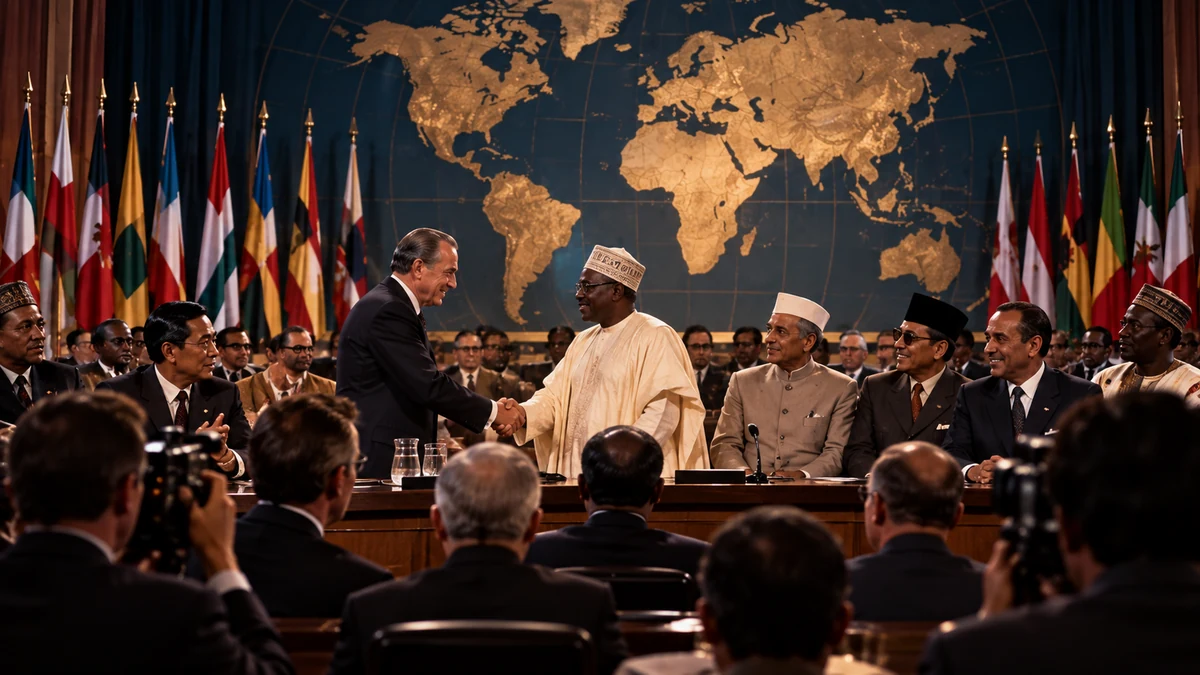
Belgrade 1961: a small country becomes a global diplomatic center
From 1 to 6 September 1961, Belgrade hosted the first conference of leaders of non-aligned countries. Twenty-five states participated, with another three represented as observers.[11] For Yugoslavia, this was an extraordinary diplomatic achievement. A country with a little over 18 million inhabitants became host to a meeting of leaders from Europe, Asia, Africa, and Latin America. Among the key personalities of the early movement were Tito, Nehru, Nasser, Indonesian President Sukarno, and Ghanaian President Kwame Nkrumah.[12] But the purpose of the conference was not to establish a third military bloc.
The Belgrade Declaration explicitly rejected that idea. The non-aligned states emphasized peaceful coexistence, disarmament, the elimination of colonialism, state sovereignty, economic development, and the reduction of the danger of war between the superpowers.[11][13] This matters. Non-alignment did not mean that all member states had identical political systems or interests. They did not. It meant an attempt to create a space in which states were not automatically political extensions of Washington or Moscow. For Yugoslavia, however, it meant something more. It gave the country an international weight far greater than its size.
Tito did not become important only because of his country. Yugoslavia occupied an important geographical position. But its role in the non-aligned world was also strongly connected with Josip Broz Tito's personal diplomacy. Tito traveled extensively. He met leaders from Africa, Asia, the Middle East, the West, and the Soviet Union. Yugoslavia supported numerous decolonization processes and established diplomatic relations with newly independent states. This gave Yugoslavia access to political spaces that countries of its economic scale would otherwise have found difficult to enter.
But here too, we must distinguish two things. Non-alignment was a genuine foreign-policy doctrine. At the same time, it was also an instrument of Yugoslav state interests. It increased Yugoslavia's security. It gave the country new markets. It increased its bargaining power toward both blocs. And it gave Tito direct access to world leaders. That is not criticism. It is how foreign policy works. Principles and interests are not necessarily opposites. They often operate together.

Africa, Asia, and Yugoslav companies
Non-alignment did not remain confined to conferences and political declarations. Yugoslav enterprises became increasingly active in Africa, Asia, and the Middle East. They built industrial plants. Power stations. Roads. Ports. Housing complexes. Infrastructure. They exported machinery, engineering knowledge, and project services. Companies such as Sarajevo's Energoinvest became global economic actors, linking Yugoslavia's self-managed economy with non-aligned and other markets.[14] According to World Bank data, trade with developing countries accounted for approximately 13 percent of Yugoslavia's foreign trade between 1965 and 1971. It was not the largest share of Yugoslav trade, but it mattered as an additional market for Yugoslav industrial products.[1] Yugoslavia occupied an interesting position.
Compared with the wealthiest Western states, it was itself semi-peripheral and technologically weaker. In relation to many newly independent states, however, it could act as a more industrially developed partner offering engineering, equipment, and expertise without the formal colonial background of the former European empires.[14][15] This opened an economic space that cannot be understood through Cold War ideology alone.
The Yugoslav passport as an everyday expression of geopolitics
High politics also had a very concrete consequence for ordinary people. Yugoslav borders gradually opened during the 1960s. Citizens could travel both to the West and to socialist countries. Historical research describes the Yugoslav passport as a document that gave citizens a level of mobility unavailable to most people in socialist Eastern Europe.[16] By the early 1970s, Yugoslav citizens no longer needed visas for travel to most European countries.[17] This was something very unusual.
A person from Ljubljana or Zagreb could shop in Trieste or Graz. A worker from Bosnia, Serbia, Croatia, or another part of the country could go to West Germany or Austria for work. An engineer from a Yugoslav company could travel to a construction project in Iraq, Libya, Zambia, or another non-aligned state. This mobility was directly connected with the country's special foreign-policy position. But here too, the picture is not purely positive. Mass labor migration to Western Europe also reflected the fact that the Yugoslav economy could not provide enough jobs and comparable incomes at home.
The World Bank estimated that between 1965 and 1973 approximately 900,000 Yugoslavs went to Western Europe in search of temporary employment.[8] Their remittances became one of the country's most important sources of foreign currency.[8] Thus the same open system meant both freedom of movement and a safety valve for domestic economic problems.
Non-alignment gave Yugoslavia bargaining power
Perhaps the greatest value of non-alignment for Yugoslavia was not that it stood on neither side. It was that it could negotiate with several sides at once. When it faced Soviet pressure, it obtained aid from the West. When Washington tried to connect assistance with political alignment, Yugoslavia could emphasize its independence and rebuild relations with Moscow. When the two European blocs were too narrow, it built a political and economic network across the non-aligned world. American documents from the 1950s show this tension very clearly.
Washington wanted economic and military aid to preserve Yugoslavia's independence from the Soviet Union, while at the same time encouraging closer cooperation with the West.[2][4] Yugoslavia accepted the assistance but insisted on an independent foreign policy. This was a successful strategy as long as the world was divided into two large blocs and an independent Yugoslavia was useful to multiple sides.
But independence did not mean economic self-sufficiency
Here we reach an important limit of the Yugoslav story. Politically, the country could emphasize independence. Economically, however, it was becoming increasingly connected to the world. It needed Western technology. It needed energy and raw materials. It needed export markets. It needed foreign currency. It needed credit. It needed tourism revenues and remittances from workers abroad. This created a contradiction. The more the Yugoslav economy modernized and integrated into the international market, the more sensitive it became to events outside its own borders. Oil shocks.
Recession in Western Europe. Interest rates. The terms of foreign loans. Exchange rates. External debt. During the 1970s, the very openness that had previously helped growth became one of the channels through which global economic problems began to place pressure on Yugoslavia.[8] This does not mean non-alignment was a failure. It means that foreign-policy independence does not automatically guarantee economic independence.
What did Yugoslavia gain?
If we draw a line under the experience, the policy between the blocs gave Yugoslavia several important advantages. It gave the country security after the break with Stalin. It opened access to Western economic and military assistance. It allowed Yugoslavia to restore trade with the Eastern bloc without returning under its political authority. It opened markets in newly independent states. It raised the country's international standing. It enabled Yugoslav companies to operate in very different parts of the world. And it gave Yugoslav citizens a degree of international mobility exceptional for socialist Europe.
Above all, it gave the country bargaining power. Yugoslavia was not large enough to dictate terms to the superpowers. But it was important enough that neither side wanted simply to surrender it to the other. And what was the hidden risk?
The very success of this strategy may have concealed a question that later became extremely important. How much of the Yugoslav economic model was able to function because the Cold War world existed? A world in which the West benefited from a socialist country that was independent of Moscow. A world in which the Soviet Union benefited from Yugoslavia not becoming a fully Western state. A world in which a large group of newly independent countries needed political and economic partners outside former colonial structures. A world in which Yugoslavia could sit at several tables.
This question does not mean Yugoslavia was artificial. But it does mean that part of its strength depended on a very specific international balance. By the end of the 1980s, that balance would begin to collapse. As the Soviet Union lost power and the Cold War approached its end, Yugoslavia would live in a world in which its strategic particularity was worth less than before. But before we reach that point, we need to look inside the country. How did a state that had spent decades building housing, industry, self-management, and international prestige begin accumulating economic problems in the 1970s that would become a crisis in the 1980s?
The next part therefore opens a subject without which Yugoslavia's breakup cannot be understood: debt, inflation, oil, credit, and the beginning of the end of the feeling that tomorrow would always be better.
Sources and further reading
- World Bank. The Economic Development of Yugoslavia / historical overview of foreign trade and development, especially the section on the regional structure of trade. Documents the collapse of trade with the Eastern bloc after 1948, the almost 90-percent Western orientation of trade in the early 1950s, and later diversification. Additional summary: Source 1 Source 2
- U.S. Department of State, Office of the Historian. NSC 5805: Draft Statement of U.S. Policy Toward Yugoslavia, 28 February 1958. The document explicitly defines the Tito–Kremlin split as a U.S. strategic interest and explains the purpose of economic and military aid. Source
- U.S. Department of State, Office of the Historian. Assessment of U.S. policy toward Yugoslavia, 1978. Gives a figure of approximately $2.9 billion in U.S. economic and military assistance during 1949–1965. Source
- U.S. Department of State, Office of the Historian. Documents on U.S. policy toward Yugoslavia, 1954–1957. Include the intention to influence Yugoslav orientation, aid, Western credits, and the restoration of Yugoslav-Soviet trade. Source 1 Source 2
- U.S. Department of State, Office of the Historian. Documentation on the Balkan Pact: Ankara, 28 February 1953; Bled military alliance, 9 August 1954. Source 1 Source 2
- U.S. Department of State, Office of the Historian. U.S. assessment of the Balkan alliance as an indirect integration of Yugoslavia into the broader Western defense system, without formal NATO membership. Source
- U.S. Department of State, Office of the Historian. NSC assessment of Yugoslav policy: after 1948 Tito sought Western security support while trying to preserve the greatest possible independence. Source
- World Bank. Historical economic review of Yugoslavia: foreign trade, the oil shock, labor migration, and remittances. Estimates approximately 900,000 departures for temporary work in Western Europe between 1965 and 1973. Source
- Ministry of Foreign Affairs / historical overview of the Non-Aligned Movement. Bandung 1955 and the first Non-Aligned Conference in Belgrade in 1961. Source
- Alvin Z. Rubinstein. Yugoslavia and the Nonaligned World. Princeton University Press. Brioni meeting of Tito, Nehru, and Nasser, 18–19 July 1956. Source
- United Nations Digital Library. Historical overview of the Non-Aligned Movement: first conference in Belgrade in 1961, 25 states and 3 observers. Source
- United Nations Digital Library. General Assembly discussion of the historical background to the Belgrade conference and the roles of Tito, Nehru, Nasser, Sukarno, and Nkrumah. Source
- United Nations Digital Library. Belgrade Declaration, 6 September 1961. Includes peaceful coexistence, disarmament, decolonization, sovereignty, and the explicit rejection of forming a new bloc. More complete historical transcription: Source 1 Source 2
- Nationalities Papers. “A Nonaligned Business World: The Global Socialist Enterprise between Self-Management and Transnational Capitalism.” Examples of global operations by Yugoslav companies, especially Energoinvest. Source
- Bernard, Sara. “Global Imaginaries of Work and Workplaces: Yugoslavs Employed Abroad and the Conceptualisation of Yugoslav Identity.” 2026. Discusses Yugoslavia's dual position: peripheral in relation to the capitalist West and a more developed industrial partner in parts of the non-aligned world. Source
- Tchoukarine, Igor. “Yugoslavia’s Open-Door Policy and Global Tourism in the 1950s and 1960s.” East European Politics and Societies. Development of Yugoslavia's open-border policy and mobility during the 1960s. Source
- Bracewell et al. / UCL. Study of Yugoslav shopping and tourist routes finding that by the early 1970s Yugoslavs could travel without visas to most European countries. Source