Yugoslavia Without Myth: Repression, Goli Otok, the Party, and Structural Weaknesses
Repression, Goli Otok, Party rule and structural weaknesses — the other side of a country many people also remember with affection.
A country that does not need to be beautified
In the first three parts of this series, we looked at some of the reasons why Yugoslavia still holds a special place in the memory of a large number of people. Mass employment. Housing construction. The expansion of education and healthcare. Workers’ self-management. Open borders. Non-alignment. The feeling that an ordinary person could build a life through work, and that his or her children had a chance to live better.
If we stopped here, we would create a myth. Yugoslavia was not only a social state, a self-managed economy, and an unusually open socialist state between East and West. It was also a one-party state. After the Second World War, the communist authorities established their monopoly partly through violence. There were extrajudicial killings. Political prisoners. A secret police. Goli Otok. Censorship. Criminal prosecution for political speech. Party purges. Privileges for political and managerial elites. And an economic system that, alongside real social achievements, also produced inefficiencies, bad investments, and unclear responsibility for losses. If we want to be fair to people who remember Yugoslavia as a good period of their lives, we must not hide these things. Quite the opposite. A good memory of youth does not need false history.
The first important distinction: Yugoslavia was not the same throughout its existence
One of the biggest mistakes in talking about socialist Yugoslavia is to treat the period from 1945 to 1991 as if it were one single political moment. It was not. The Yugoslavia of the late 1940s and early 1950s was a much more repressive state than the Yugoslavia of the 1970s or the second half of the 1980s. After the war, the new authorities were consolidating their monopoly.
Nationalizations took place, political purges were carried out, and the regime settled accounts with real and alleged opponents of the new system. After the split with Stalin in 1948, the state security apparatus also turned against people who were often themselves communists, partisans, or officials of the new state, but who were suspected of supporting the Cominform. In the following decades, the system changed considerably. Borders opened. Censorship became less total than in the first postwar years. The economy was decentralized. The cultural sphere became far more diverse than in most Soviet-bloc countries. People traveled to the West, watched Western films, listened to foreign music, and bought products in Italy or Austria. But the political monopoly of the League of Communists did not disappear. That is why one rule is needed for this whole chapter: let us not use the worst events of 1949 as a description of everyday life in 1979 — and let us not use the relative openness of 1979 to deny what happened in 1949. Both were Yugoslavia.
1945: the end of the war did not mean the end of violence
The Second World War in Yugoslavia was extraordinarily violent. Occupation, civil war, revolution, collaboration, genocide, ethnic violence, and partisan resistance overlapped in a conflict that cannot honestly be reduced to a single story. But the end of the war in May 1945 did not mean the immediate end of violence. The victorious communist regime carried out mass reprisals against parts of the defeated armed formations, collaborators, political opponents, and civilians.
A large share of these executions took place without ordinary judicial procedure. For Slovenia, the documentation is now extensive enough that the existence of mass postwar extrajudicial killings cannot be treated as a matter of political opinion. In 2025, when presenting prison ledgers of the OZNA, the Archives of the Republic of Slovenia described the postwar killings as extrajudicial executions that were both a final reckoning with military and ideological opponents and one of the first steps in establishing the monopolistic position of the Communist Party. Referring to the research of the Institute of Contemporary History, it cited nearly 15,000 postwar victims in Slovenia.[1] This does not mean that every victim was politically innocent.
Among the defeated formations were people who had collaborated with occupiers or participated in wartime violence. But the rule of law exists precisely so that personal guilt may be established through procedure. Collective revenge and extrajudicial execution are not the same thing as a trial. This is the first great dark side of postwar Yugoslavia. The revolution did not permit normal political competition.
The new Yugoslavia emerged as a socialist federation under the leadership of the Communist Party of Yugoslavia. The form of the political system changed over the decades, but one basic fact remained: power was not the object of competition among several independent political parties. The 1974 Constitution of the SFRY still explicitly defined the League of Communists of Yugoslavia as the leading organized ideological and political force of the working class and all working people.[2] This means that Yugoslav self-management must not be equated with multi-party democracy. A person could vote within self-management structures. He or she could participate in a workers’ council. He or she could be active in a local community.
He or she could take part in local decision-making through the delegate system. But he or she could not establish an independent political party that would try to take federal power away from the League of Communists through elections. The system allowed participation. It did not allow normal political competition for power. Those are two different things.
Goli Otok: repression directed also against the regime’s own revolutionaries
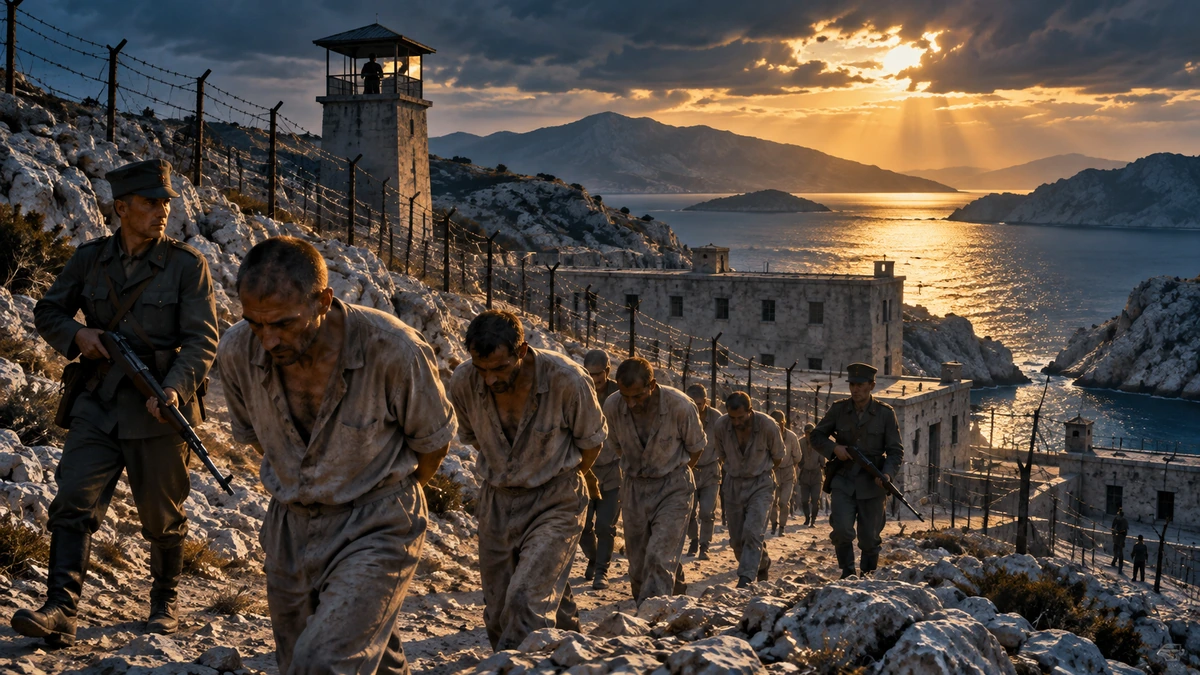
After the split with Stalin in 1948, the Yugoslav leadership lived in genuine fear of Soviet intervention and of an internal pro-Soviet coup. But the way the authorities responded to this fear created one of the best-known symbols of Yugoslav repression. Goli Otok. Those sent there were not primarily prewar conservatives or former collaborators.
A large share of the prisoners came from the communist and partisan milieu itself. They were people whom the authorities labeled Cominformists — real or alleged supporters of Stalin’s position in the conflict with Yugoslavia. Historian Martin Previšić, on the basis of UDBA documentation, reconstructed approximately 15,700 people who were punished and interned within the camp-and-prison system during the Informbiro conflict; Goli Otok was the largest camp, but not the only one.[3] Recent research describes a system of forced labor, political “re-education,” physical violence, mutual punishment among prisoners, humiliation, surveillance, and pressure to denounce others.[3][4]
Goli Otok is important for another reason as well. It shows that repression was not simply a story of “communists against anti-communists.” The system was capable of turning very violently even against people from its own ranks. A partisan past did not necessarily protect someone. Nor did a communist identity. In the period of the harshest conflict, even the suspicion of political disloyalty could push a person into the machinery of repression.
The secret police was not an abstract institution
The OZNA and later the UDBA, or State Security Service, did not exist only for ordinary crime. Part of their task was also the protection of the political system. The surveillance of political opponents, émigrés, alleged nationalists, Stalinists, and other groups was part of the functioning of the state. The scale and brutality of that surveillance changed over time.
Especially after the fall of Aleksandar Ranković in 1966, there were changes and a decentralization of the security apparatus.[5] But the secret services did not disappear. Nor did the principle disappear that the state had the right to monitor political activity that it considered a threat to the socialist constitutional order. That is why Yugoslavia could have relatively open Western borders and a political police at the same time. A citizen could go to Trieste to buy jeans. That did not mean he or she could organize a movement to replace the political system without consequences.
Censorship was not Soviet-style — but it existed
Yugoslavia had a vastly more open cultural sphere than the Soviet Union and most Eastern-bloc countries. It is important to acknowledge this. Films, literature, music, and newspapers could open themes that in some other socialist countries would have been much harder to publish. This very openness also made possible the Yugoslav Black Wave — a film production of the 1960s and early 1970s sharply critical of politics and society.
But the existence of critical culture does not mean the absence of censorship. Individual films were banned or withdrawn from distribution. Academic studies of the history of Yugoslav cinema document restrictions on authors and works in the 1970s; among the well-known cases are films by Želimir Žilnik, Dušan Makavejev, Lazar Stojanović, and Bato Čengić.[6][7] The boundary was not always perfectly clear. That could only increase the power of self-censorship. If an author does not know exactly which political formulation will be treated as permissible criticism and which as an attack on the system, he or she often begins to search for the boundary internally. Yugoslavia, then, was not a culturally closed country. But neither was freedom of expression without political limits.
Article 133: when speech could become a criminal offense. The clearest proof of those limits was the criminal code. The Criminal Code of the SFRY of 1977, in Article 133, defined the criminal offense of “hostile propaganda.” Among other things, it was possible to punish calls for changing the socialist self-managing system or “malicious and untrue” depictions of the sociopolitical situation in the country. The prescribed penalty could range from one to ten years of imprisonment, and in certain forms even more.[8] Those provisions did not remain only on paper.
Amnesty International issued special reports in 1981 and again in 1985 on prisoners of conscience in Yugoslavia, documenting cases of people imprisoned for nonviolent political expression, association, and publication.[9][10] Amnesty drew attention, among other things, precisely to the use of Article 133. Among the better-known cases of the 1980s were people convicted for interviews with foreign journalists, for signing or collecting political petitions, and for other forms of nonviolent political activity.[11] This tells us something important. The Yugoslavia of the 1980s was not Goli Otok in 1950. But neither were the 1980s a system of complete political freedom. The state still had criminal-law tools for punishing certain forms of political speech.

The Croatian Spring: the limits of reform were shown in 1971
The end of the 1960s and the beginning of the 1970s brought a period of political and economic liberalization. In Croatia, out of this emerged the movement now known as the Croatian Spring. Different currents overlapped within it: demands for greater economic autonomy for the republic, questions of language and national identity, criticism of the distribution of foreign-currency revenues, student demands, reform communism, and also stronger forms of nationalism. In December 1971, Tito moved against the reformist leadership. The leaders of the Croatian party were forced to resign, and there followed expulsions from the party, dismissals, and prison sentences for some activists.[12] This matters because it shows the limits of Yugoslav decentralization.
The republics could receive ever wider constitutional powers. But a political movement that began to threaten the Party’s monopoly or was understood as a nationalist threat to the federation could be stopped from above. Tito did not remove only nationalists.
If the story ended with the Croatian Spring, it might be explained only as a reckoning with nationalism. But the following year Tito also removed part of the liberal leadership of the League of Communists of Serbia. This reveals a broader pattern. The problem was not only which national current had become too strong. The problem was also political pluralism inside the communist system itself. In 1971–1972, the reform space was significantly narrowed both in Croatia and in Serbia. Historiography often treats this moment as the end of an important more liberal period and the beginning of cadre consolidation before the 1974 constitution.[13] This is one of the ironies of Yugoslav history. The state was becoming institutionally decentralized. At the same time, Party discipline could be tightened.
The national question was not solved — it was managed
Yugoslavia was built on the principle of “brotherhood and unity.” After the experience of the Second World War, it was clear why. The state was trying to prevent the return of the national conflicts that had led to mass violence during the war. This had a positive side. The formal equality of nations and republics was the foundation of the federation. The 1974 Constitution deepened decentralization further and granted the republics and autonomous provinces very broad powers. But the system had a problem as well. If the national question is treated as a potential danger to the state, then a legitimate discussion of national interests can quickly come to be labeled nationalism.
After the reckonings of 1971–1972, public nationalist writing was heavily restricted. Studies of late socialism find that many national polemics were pushed into a controlled space of intellectual opposition rather than truly resolved.[14] This created an appearance of stability. A conflict that is not openly discussed is not necessarily a conflict that has disappeared. It may simply be a conflict without a legal political space in which it can be openly negotiated. Kosovo 1981: when repression again became mass-based.
The year after Tito’s death, student protests broke out in Kosovo. They began with demands related to university conditions and student standards, then developed into mass political demonstrations in which the demand that Kosovo become a republic also appeared.[15] The Yugoslav leadership treated the protests as a serious nationalist and anti-state threat. It introduced extraordinary measures and used security forces. In the following years, extensive political and security proceedings were launched against parts of the Albanian population, students, and political activists.[15][16] Two facts need to be held together. Part of the protest movement did indeed demand a major change in Kosovo’s constitutional position, and some currents also advocated separatist goals. But the response of the authorities went beyond the prosecution of violent acts alone.
Broader political “differentiation,” arrests, and prosecution affected a large part of the Albanian political and intellectual sphere and further deepened distrust toward the federation.[16] This is one of the examples where an attempt to suppress a national conflict helped, in the long run, to create an even deeper national conflict.
What did a person have reason to fear — and what not?
With this subject there is a danger of the opposite extreme. If we list Goli Otok, the UDBA, Article 133, and Party purges, we can create the impression that the average Yugoslav lived every day in fear of arrest. That too is not a good description of most of the later period. Millions of people were not political prisoners. They went to work. They traveled. They built houses. They studied.
They watched American films. They listened to rock music. They vacationed abroad. They joked about the authorities. In the later decades, everyday social freedom was significantly broader than in the most closed socialist systems. But a political boundary existed. If a person remained within it, he or she could have a great deal of personal freedom. If he or she crossed it — through organized opposition, separatist activity, an attack on the constitutional system, or in certain periods simply through public political speech — the state had the means to punish. This is probably a more accurate description of late Yugoslavia than either extreme: not total everyday fear, but a system with clear political red lines.
Privileges in a society that spoke of equality
Socialist Yugoslavia also built its legitimacy on the idea of social equality. But the political and managerial elite did not live exactly like the ordinary worker. Higher functionaries had better access to housing, official cars, representative facilities, travel, healthcare, and other advantages. Yugoslavia did not develop the same fully closed nomenklatura caste as in some Soviet systems, and the system was far more plural because of decentralization and self-management.
Even so, political connections, Party position, and cadre policy could determine career advancement and access to important functions. Historiography of Yugoslav opposition notes that the system of social privileges helped the regime incorporate important social groups and maintain political stability.[17] Here an obvious contradiction appears. A society can seriously reduce some material inequalities between people and at the same time create a new elite whose privilege comes not from private capital, but from political position. Equality is not automatic simply because there is no classical capitalist.
Self-management did not abolish bureaucracy. The Yugoslav model wanted to reduce state-bureaucratic control. But over time it created its own administrative structures. Workers’ councils. Management boards. TOZDs. Self-managing interest communities. Municipalities. Republics. Federal organs. Party committees. Banks. Self-management agreements. Social compacts. In theory, this was a network of decentralized decision-making. In practice, the system could become very complex. Each new level of self-management created new meetings, new organs, new coordination procedures, and new ways for responsibility to disappear among institutions.
Already in the 1970s and early 1980s, the World Bank warned that the Yugoslav system suffered from problems of macroeconomic coordination and that complex self-managing planning could function effectively only in a relatively stable economic environment.[18] This was not repression. But it was a structural weakness. A state that wanted to disperse power among as many people as possible could end up creating a structure in which it became very difficult to determine who was responsible for what. Who pays the loss if nobody is a classical owner?
Social ownership had a noble idea: capital should not belong to a private individual who can decide solely on the basis of personal interest. But as we saw in the previous article, the question of responsibility appeared immediately. If an enterprise had no classical owner, it was politically and socially difficult to allow it simply to collapse. The collapse of a large factory meant the loss of thousands of jobs, housing funds, and local revenues. For that reason, banks, local communities, republics, or other parts of the system often supported companies that were performing poorly. Economic literature later described this as a soft budget constraint. A World Bank study of Yugoslav firms found extensive redistribution driven by the protection of jobs and incomes, and pointed out that closing down unsuccessful enterprises was rare.[19]
This had a human advantage. A person did not quickly lose a job simply because the company had a bad year. But it also had an economic price. If a company knows that in difficulty it will most likely be rescued, the pressure for timely reorganization, for closing an unsuccessful project, or for using capital more efficiently is weaker. Social security and economic discipline could come into conflict. Investments could be political.
Yugoslavia invested massively in industrialization. Without those investments, the economic transformation described in the first article would not have been possible. But not every factory was a good investment. Development policy also had political goals: reducing differences between republics, creating jobs, industrializing less developed areas, and maintaining regional balance.
These are legitimate social goals. But a project that makes political sense is not always economically efficient. If a bank grants credit because a project is politically important rather than because it will be able to repay invested capital in the long run, the problem may only be postponed into the future. Research on the Yugoslav self-managed economy repeatedly pointed to inefficient allocation of capital, weaker investment discipline, and the expectation that in major difficulty help would eventually come from the wider system.[19][20] As long as the economy grows quickly, such a system can function for a long time. When growth stalls, hidden losses begin to accumulate.
“Brotherhood and unity” was both an ideal and a limitation
Many people experienced brotherhood and unity sincerely. Mixed marriages, the shared army, workplaces, sport, music, studies, and movement between republics created real Yugoslav identities and friendships. There is no reason to declare that a lie today. But the state also used the same idea as a political norm. National belonging was recognized. National conflict, however, was something the system tried to control. The difficulty arose because it was sometimes hard to distinguish between a legitimate national interest and a nationalism that threatened others. This question is not specific only to Yugoslavia.
But in a one-party system, there was an additional problem: there was no independent political arena in which different national interests could organize, compete for voters’ support, and then form new coalitions. These interests were negotiated mainly inside the Party, the republics, and state institutions. When, by the end of the 1980s, the Party lost its ability to make common decisions, the main mechanism through which these conflicts had been managed for decades also began to disintegrate. This helps explain why this article is not an argument against remembering Yugoslavia fondly.
If our parents or grandparents had a beautiful youth in Yugoslavia, the existence of Goli Otok does not erase that. If they received housing, work, education, and social security, Article 133 does not make those things untrue. If they felt safe, their experience is not wrong because someone else was imprisoned for political speech. But the reverse is also true. A good standard of living for a large part of the population does not erase political prisoners. An apartment block does not erase an extrajudicial mass grave. Free education does not erase censorship. A workers’ council does not turn a one-party system into a multi-party democracy.
A holiday on the Adriatic does not turn Goli Otok into a fabrication. We do not have to choose only one of these Yugoslavias. They existed at the same time. This can be accepted without hatred toward the country and without idealizing the system.
Why it matters to admit the failures before we reach the breakup
This article has a special role in the series. If we spoke only about Yugoslavia’s social achievements and then moved directly to the economic crisis, the West, nationalism, and war, a reader could justifiably feel that we were trying to prove a prefabricated story of a perfect country destroyed only by others. That is not our aim. Yugoslavia had its own internal problems. The political monopoly limited the ability to resolve conflicts openly. National questions were often managed from above and sometimes repressively. The economic system produced unclear responsibility. Party and expert elites could gain disproportionate influence.
Enterprises that in a different system might have collapsed or been forced to reorganize quickly could pass their losses forward. The republics were receiving more and more economic and political autonomy without the federation always developing equally effective mechanisms of joint decision-making. All of this matters. But “Yugoslavia had internal weaknesses” and “the breakup was simply the inevitable consequence of those weaknesses” are not the same claim. The first is demonstrable. The second requires much more evidence. That is precisely why the following parts will examine separately domestic mistakes, the international economic environment, debt, the IMF, political elites, nationalism, and outside interests. Only then will we be able to ask how the state actually reached disintegration.
Before nationalism comes insecurity. By the end of the 1970s, Yugoslavia carried two very different legacies. The first was the legacy of extraordinary postwar modernization. The second was the legacy of a political system that knew how to create stability, but did not always know how to permit open political conflict. As long as wages, production, employment, and expectations were rising, it was easier to preserve the balance. When the economic direction changed, political tensions that had previously been more manageable also began to come to the surface. The continuation therefore does not begin with nationalists or with war. It begins with the state’s balance sheet. Debt.
Oil. Interest rates. Inflation. Shortages. Falling real incomes. And with a generation that for the first time in decades began to realize that next year might not be better than the last. After Tito: Debt, Inflation, and a Decade of Insecurity
Sources and further reading
- Archives of the Republic of Slovenia. “Rare written traces of postwar extrajudicial killings,” 1 July 2025. Archival source and summary of the research of the Institute of Contemporary History on postwar victims in Slovenia. See also: Mitja Ferenc, “Absent from Public Memory: Hidden Grave Sites in Slovenia 60 Years After the End of World War Two,” Institute of Contemporary History. Source 1 Source 2
- Constitution of the Socialist Federal Republic of Yugoslavia (1974), Fundamental Principle VIII. Defines the League of Communists as the leading organized ideological and political force. Source
- Previšić, Martin. “Broj kažnjenika na Golom otoku i drugim logorima za informbirovce u vrijeme sukoba sa SSSR-om (1948.–1956.).” Historijski zbornik 66(1), 2013, 173–193. Research based on UDBA documents, literature, and testimonies. Source
- Marko, McKenna. “Remembering Gendered Histories of the Holocaust in Yugoslavia and Goli otok in Eva Grlić's Memories and Ženi Lebl's White Violets.” Slavic Review, 2025. Discusses state violence, forced labor, surveillance, and the system of “re-education” on Goli Otok and Sveti Grgur. Source
- Government and Opposition. “Yugoslavia: The Eleventh Congress, the Constitution and the Succession.” Historical overview of the role of Aleksandar Ranković, head of the political police, and his fall in 1966. Source
- Beard, Danijela Š. “Soft Socialism, Hard Realism: Partisan Song, Parody, and Intertextual Listening in Yugoslav Black Wave Film (1968–1972).” Twentieth-Century Music, 2019. Source
- Slavic Review. “Yugoslav Film in Black and White.” Also documents censorship and restrictions on film production in the 1970s. Source
- Criminal Code of the Socialist Federal Republic of Yugoslavia (1977), Article 133 — Hostile Propaganda. Legal text in Refworld. Source
- Amnesty International. Yugoslavia: Prisoners of Conscience, 1981. Source
- Amnesty International. Yugoslavia: Prisoners of Conscience, 1985. Source
- Amnesty International Newsletter, June 1985. Examples of the use of “hostile propaganda,” including Dobroslav Paraga and Vlado Gotovac. Source
- Irvine, Jill. “The Croatian Spring and the Dissolution of Yugoslavia.” In: State Collapse in South-Eastern Europe: New Perspectives on Yugoslavia's Disintegration. Documents the removal of the reformist Croatian leadership in December 1971 and the later expulsions, dismissals, and prison sentences. Source
- Pavković, Aleksandar. “Anticipating the Disintegration: Nationalisms in Former Yugoslavia, 1980–1990.” Nationalities Papers, 2018. Discusses the suppression of the Croatian movement and of the Serbian liberal communist elite in 1971–1972, as well as later restrictions on nationalist discourse. Source
- Ibid. On the restriction of nationalist publications and the pushing of national polemics into dissident space in the 1970s. Source
- Hetemi, Atdhe. “Student movements in Kosova (1981): academic or nationalist?” Nationalities Papers 46(4), 2018, 685–703. Source
- Nationalities Papers. “Ethnopolitics in a Mining Enterprise in Crisis: Revisiting the Albanian Miners’ Protests in Late Socialist Kosovo.” Discusses the 1981 protests, later political “differentiation,” and the consequences of repression for relations between Albanians and the state. Source
- Spehnjak, Katarina & Cipek, Tihomir. “Dissidents, opposition and resistance — Croatia and Yugoslavia, 1945–1990.” Časopis za suvremenu povijest. Discusses Party purges, opposition, and the system of social privileges. Source
- World Bank. Historical analyses of Yugoslav self-management and planning. Points to the problem of macroeconomic coordination and the strong dependence of self-managing planning on a stable economic environment. Source
- Kraft, Evan & Vodopivec, Milan. “How Soft Is the Budget Constraint for Yugoslav Firms?” World Bank Policy Research Working Paper 937, 1992. Finds extensive redistribution in favor of the security of jobs and incomes and identifies characteristics of the soft budget constraint. Source
- World Bank. The Self-Managed Firm in Yugoslavia / economic analyses of the effects of investment, inflation, and the soft budget constraint. Source